
A French Word to Live By
How to Conjugate Incarcérer in French
/ɛ̃.kaʁ.se.ʁe/
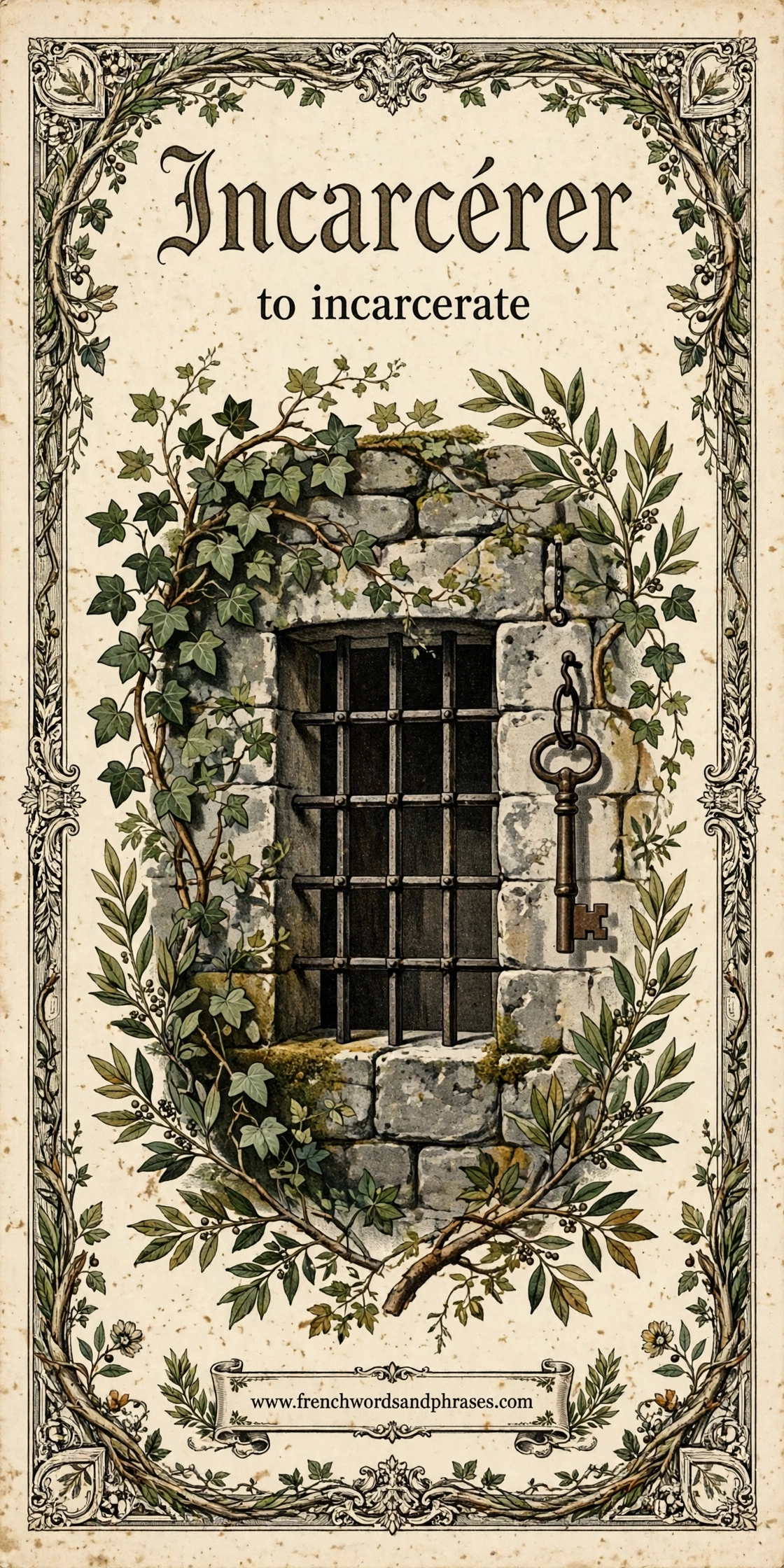
Incarcérer means to incarcerate — to put someone in prison and keep them there, by the authority of a court.
A cell door closing in a courthouse basement, a judge signing the order that takes a man’s freedom for ten years — incarcérer is the formal verb of imprisonment: the word of warrants, verdicts and prison registers.
In this guide, you’ll learn how to conjugate incarcérer in all the major French tenses and moods. Explore complete conjugation tables, French examples, English translations, and practice quizzes.
Understanding the French Verb Incarcérer
Incarcérer is a regular French verb belonging to the first group of verbs, those ending in-er.
It means to incarcerate. Incarcérer belongs to the language of courts, police reports and newspapers: le juge incarcère le suspect, le condamné est incarcéré pour cinq ans. Its noun, l’incarcération, is the standard term for imprisonment in law and statistics — le taux d’incarcération, the imprisonment rate. In conversation, people simply say mettre en prison.
Verb classification: First group (-er)
Auxiliary verb: Avoir
Past participle: incarcéré
Present participle: incarcérant
English equivalents: To incarcerate, to imprison, to jail; incarcérer un suspect — to jail a suspect; incarcérer pour vol — to imprison for theft; être incarcéré à la prison de… — to be held in … prison; l’incarcération — imprisonment.
One important spelling detail: incarcérer belongs to the espérer family — the é of the stem becomes è wherever the ending is mute: j’incarcère, tu incarcères, il incarcère, ils incarcèrent, subjunctive qu’il incarcère, imperative incarcère ! — but the future and conditional keep é: j’incarcérerai, j’incarcérerais, and nous/vous keep é too: nous incarcérons. It is the formal, legal word for putting someone in prison: everyday French says mettre en prison or emprisonner. Past participle incarcéré.
Experience the Word
Incarcérer is imprisonment with its paperwork in order — the verb a register uses when a door closes on a name.
Imagine the basement of a courthouse at midnight. The hearing has lasted nine hours; the judge reads the verdict, signs one last document, and two officers lead the accused down the stairs. In the register, a clerk writes the word that ends the day: incarcéré. A cell door closes, and the formal verb has done its quiet, terrible work.
No shouting, no drama. A signature, a register, a key — and a man is incarcerated, incarcéré.
How to Conjugate Incarcérer: Complete French Conjugation Guide
Let’s explore every major conjugation of incarcérer, beginning with the indicative mood.
How to Conjugate Incarcérer in the Indicative Mood
The indicative mood is used to express facts, observations, actions, and events.
How to Conjugate Incarcérer in the Present Tense (Présent)
Used for actions happening now, habitual actions, and general truths.
| Subject | Conjugation |
|---|---|
| je | incarcère |
| tu | incarcères |
| il / elle | incarcère |
| nous | incarcérons |
| vous | incarcérez |
| ils / elles | incarcèrent |
Example
Le juge incarcère le suspect en attendant le procès.
The judge jails the suspect while awaiting the trial.
Quick Quiz 1
Complete the sentence:
Nous ______ les suspects en attendant le procès.
Reveal the answer
incarcérons
Nous incarcérons les suspects en attendant le procès.
We are jailing the suspects while awaiting the trial.
How to Conjugate Incarcérer in the Passé Composé
Used for completed actions in the past. Incarcérer takes the auxiliary verb avoir.
| Subject | Conjugation |
|---|---|
| j’ | ai incarcéré |
| tu | as incarcéré |
| il / elle | a incarcéré |
| nous | avons incarcéré |
| vous | avez incarcéré |
| ils / elles | ont incarcéré |
Example
On a incarcéré le voleur pour la troisième fois.
The thief has been jailed for the third time.
How to Conjugate Incarcérer in the Imparfait (Imperfect Tense)
Used for habitual past actions, descriptions, and ongoing situations in the past.
| Subject | Conjugation |
|---|---|
| je | incarcérais |
| tu | incarcérais |
| il / elle | incarcérait |
| nous | incarcérions |
| vous | incarcériez |
| ils / elles | incarcéraient |
Example
Autrefois, on incarcérait les débiteurs comme des criminels.
In the old days, debtors were imprisoned like criminals.
Quick Quiz 2
Choose the correct form:
The thief has been jailed.
On ______ le voleur. (a incarcéré / est incarcéré)
Reveal the answer
a incarcéré
On a incarcéré le voleur.
Incarcérer takes avoir.
How to Conjugate Incarcérer in the Plus-que-parfait
Used to describe an action that had already been completed before another past event.
| Subject | Conjugation |
|---|---|
| j’ | avais incarcéré |
| tu | avais incarcéré |
| il / elle | avait incarcéré |
| nous | avions incarcéré |
| vous | aviez incarcéré |
| ils / elles | avaient incarcéré |
Example
La police avait incarcéré le mauvais homme par erreur.
The police had jailed the wrong man by mistake.
How to Conjugate Incarcérer in the Passé Simple
Primarily used in formal writing, literature, and historical narratives. It is rarely used in everyday conversation.
| Subject | Conjugation |
|---|---|
| je | incarcérai |
| tu | incarcéras |
| il / elle | incarcéra |
| nous | incarcérâmes |
| vous | incarcérâtes |
| ils / elles | incarcérèrent |
Example
Le tribunal incarcéra le coupable le soir même.
The court imprisoned the culprit that very evening.
How to Conjugate Incarcérer in the Passé Antérieur
A literary tense used to express an action completed immediately before another past action, generally in the passé simple.
| Subject | Conjugation |
|---|---|
| j’ | eus incarcéré |
| tu | eus incarcéré |
| il / elle | eut incarcéré |
| nous | eûmes incarcéré |
| vous | eûtes incarcéré |
| ils / elles | eurent incarcéré |
Example
Quand le juge eut incarcéré l’accusé, la salle se vida.
When the judge had jailed the accused, the courtroom emptied.
How to Conjugate Incarcérer in the Future Tense (Futur Simple)
Used to describe actions that will take place in the future.
| Subject | Conjugation |
|---|---|
| je | incarcérerai |
| tu | incarcéreras |
| il / elle | incarcérera |
| nous | incarcérerons |
| vous | incarcérerez |
| ils / elles | incarcéreront |
Example
Demain, on incarcérera les membres du gang.
Tomorrow, the members of the gang will be jailed.
How to Conjugate Incarcérer in the Futur Antérieur (Future Perfect)
Used for an action that will have been completed before a particular point in the future.
| Subject | Conjugation |
|---|---|
| j’ | aurai incarcéré |
| tu | auras incarcéré |
| il / elle | aura incarcéré |
| nous | aurons incarcéré |
| vous | aurez incarcéré |
| ils / elles | auront incarcéré |
Example
À la fin du procès, le juge aura incarcéré trois hommes.
By the end of the trial, the judge will have jailed three men.
How to Conjugate Incarcérer in the Near Future (Futur Proche)
Used to describe something that is going to happen soon. Formed with aller + infinitive.
| Subject | Conjugation |
|---|---|
| je | vais incarcérer |
| tu | vas incarcérer |
| il / elle | va incarcérer |
| nous | allons incarcérer |
| vous | allez incarcérer |
| ils / elles | vont incarcérer |
Example
La police va incarcérer le suspect ce soir.
The police are going to jail the suspect this evening.
How to Conjugate Incarcérer in the Conditional Mood
The conditional mood expresses what would happen under certain circumstances. It is also frequently used to make polite requests or express wishes.
How to Conjugate Incarcérer in the Present Conditional
| Subject | Conjugation |
|---|---|
| je | incarcérerais |
| tu | incarcérerais |
| il / elle | incarcérerait |
| nous | incarcérerions |
| vous | incarcéreriez |
| ils / elles | incarcéreraient |
Example
Sans preuves solides, aucun juge ne l’incarcérerait.
Without solid proof, no judge would jail him.
How to Conjugate Incarcérer in the Past Conditional
| Subject | Conjugation |
|---|---|
| j’ | aurais incarcéré |
| tu | aurais incarcéré |
| il / elle | aurait incarcéré |
| nous | aurions incarcéré |
| vous | auriez incarcéré |
| ils / elles | auraient incarcéré |
Example
Il aurait incarcéré le suspect si le mandat avait été signé.
He would have jailed the suspect if the warrant had been signed.
Incarcérer in the Literary Past Conditional Form
This less common literary form uses the imperfect subjunctive of avoir.
| Subject | Conjugation |
|---|---|
| j’ | eusse incarcéré |
| tu | eusses incarcéré |
| il / elle | eût incarcéré |
| nous | eussions incarcéré |
| vous | eussiez incarcéré |
| ils / elles | eussent incarcéré |
Example
Le tribunal eût incarcéré le coupable sans l’aveu tardif.
The court would have imprisoned the culprit without the late confession.
How to Conjugate Incarcérer in the Subjunctive Mood
The subjunctive is used to express wishes, emotions, doubts, necessity, and uncertainty. It frequently follows expressions such as il faut que (it is necessary that) or bien que (although).
How to Conjugate Incarcérer in the Present Subjunctive
| Subject | Conjugation |
|---|---|
| que je | incarcère |
| que tu | incarcères |
| qu’il / qu’elle | incarcère |
| que nous | incarcérions |
| que vous | incarcériez |
| qu’ils / qu’elles | incarcèrent |
Example
Il faut que le juge incarcère le suspect avant sa fuite.
The judge must jail the suspect before he flees.
Quick Quiz 3
Complete the sentence using the subjunctive:
Il faut que vous ______ le suspect avant sa fuite.
Reveal the answer
incarcériez
Il faut que vous incarcériez le suspect avant sa fuite.
You must jail the suspect before he flees.
How to Conjugate Incarcérer in the Imperfect Subjunctive
A literary tense, rarely encountered in modern spoken French.
| Subject | Conjugation |
|---|---|
| que je | incarcérasse |
| que tu | incarcérasses |
| qu’il / qu’elle | incarcérât |
| que nous | incarcérassions |
| que vous | incarcérassiez |
| qu’ils / qu’elles | incarcérassent |
Example
On craignait que le tribunal incarcérât un innocent.
People feared the court might imprison an innocent man.
How to Conjugate Incarcérer in the Pluperfect Subjunctive
A literary construction used to express an action completed before another past action.
| Subject | Conjugation |
|---|---|
| que j’ | eusse incarcéré |
| que tu | eusses incarcéré |
| qu’il / qu’elle | eût incarcéré |
| que nous | eussions incarcéré |
| que vous | eussiez incarcéré |
| qu’ils / qu’elles | eussent incarcéré |
Example
On racontait que le juge eût incarcéré le suspect sans procès.
People said the judge had jailed the suspect without a trial.
How to Conjugate Incarcérer in the Past Subjunctive
| Subject | Conjugation |
|---|---|
| que j’ | aie incarcéré |
| que tu | aies incarcéré |
| qu’il / qu’elle | ait incarcéré |
| que nous | ayons incarcéré |
| que vous | ayez incarcéré |
| qu’ils / qu’elles | aient incarcéré |
Example
Je regrette que l’on ait incarcéré cet homme par erreur.
I regret that this man was jailed by mistake.
How to Conjugate Incarcérer in the Imperative
The imperative is used to give commands, instructions, invitations, or suggestions. Subject pronouns are omitted.
How to Conjugate Incarcérer in the Present Imperative
| Person | Conjugation |
|---|---|
| (tu) | incarcère |
| (nous) | incarcérons |
| (vous) | incarcérez |
Example
Incarcère-le immédiatement, il risque de fuir !
Jail him immediately, he might run away!
Quick Quiz 4
How would you say Jail him immediately (tu form)?
Reveal the answer
Incarcère-le immédiatement !
French Participles of Incarcérer
Participles are verb forms that can be used in compound tenses and other grammatical constructions.
Present Participle of Incarcérer
incarcérant
En incarcérant le suspect, la police a fermé le quartier.
By jailing the suspect, the police closed off the neighbourhood.
Past Participle of Incarcérer
incarcéré
Incarcéré depuis dix ans, il a enfin retrouvé la liberté.
Imprisoned for ten years, he has finally regained his freedom.
Incarcérer in Everyday French: Real-Life Examples
Now that you know the conjugations, let’s see how incarcérer appears in everyday French.
Example 1 — Present
Le juge incarcère le suspect.
The judge jails the suspect.
Example 2 — Passé composé
On a incarcéré le voleur.
The thief has been jailed.
Example 3 — Imparfait
On incarcérait les débiteurs autrefois.
Debtors were imprisoned in the old days.
Example 4 — Future
On incarcérera les membres du gang demain.
The gang members will be jailed tomorrow.
Example 5 — Conditional
Aucun juge ne l’incarcérerait sans preuves.
No judge would jail him without proof.
Example 6 — Imperative
Incarcère-le avant qu’il fuie !
Jail him before he runs away!
Beyond Translation: The Meaning of Incarcérer
English incarcerate is the same formal word — and French incarcérer keeps the cell inside it: Latin carcer is the prison itself.
It is the verb of the register, not of the street.
A mother says mettre en prison; the newspaper writes incarcérer; the statistician counts les incarcérations. Learn it for reading the news and the law — and hear, behind its formality, the oldest sound in justice: a key turning in a lock.
How to Remember the French Verb Incarcérer
Remember it this way: Incarcérer is about the clerk’s register at midnight — a name, a signature, a key.
- Espérer-type spelling: j’incarcère with è in the present, but j’incarcérerai with é in the future.
- The formal word for putting someone in prison — everyday French says mettre en prison or emprisonner.
- Past participle incarcéré: il est incarcéré depuis dix ans; the noun is l’incarcération.
The key idea is the clerk’s register at midnight — a name, a signature, a key.
Test Your Knowledge of Incarcérer
Let’s see how much you’ve learned. Try answering these questions before revealing the answers.
Question 1
Why does je incarcère have a grave accent but je incarcérerai an acute one?
Reveal the answer
The espérer-type rule — é becomes è in the present and subjunctive stems, but the future and conditional keep é: j’incarcérerai.
Question 2
How do you say The judge jails the suspect in French?
Reveal the answer
Le juge incarcère le suspect.
Question 3
Translate: The thief has been jailed for the third time.
Reveal the answer
On a incarcéré le voleur pour la troisième fois.
Question 4
What is the past participle of incarcérer?
Reveal the answer
Incarcéré.
Question 5
Complete the sentence:
Il faut que le juge ______ le suspect avant sa fuite.
Reveal the answer
incarcère
Il faut que le juge incarcère le suspect avant sa fuite.
The judge must jail the suspect before he flees.
Your Final Challenge
Can You Use It?
How would you say this in French?
The judge imprisons the culprit, closes the file, and the courtroom finds its silence again.
Reveal the answer
Le juge incarcère le coupable, referme le dossier, et la salle d’audience retrouve son silence.
The judge imprisons the culprit, closes the file, and the courtroom finds its silence again.
A little French. A little curiosity. A richer everyday life.
LEARN FRENCH ONE WORD AT A TIME




