A French Word to Live By
Translate Île to English
/il/
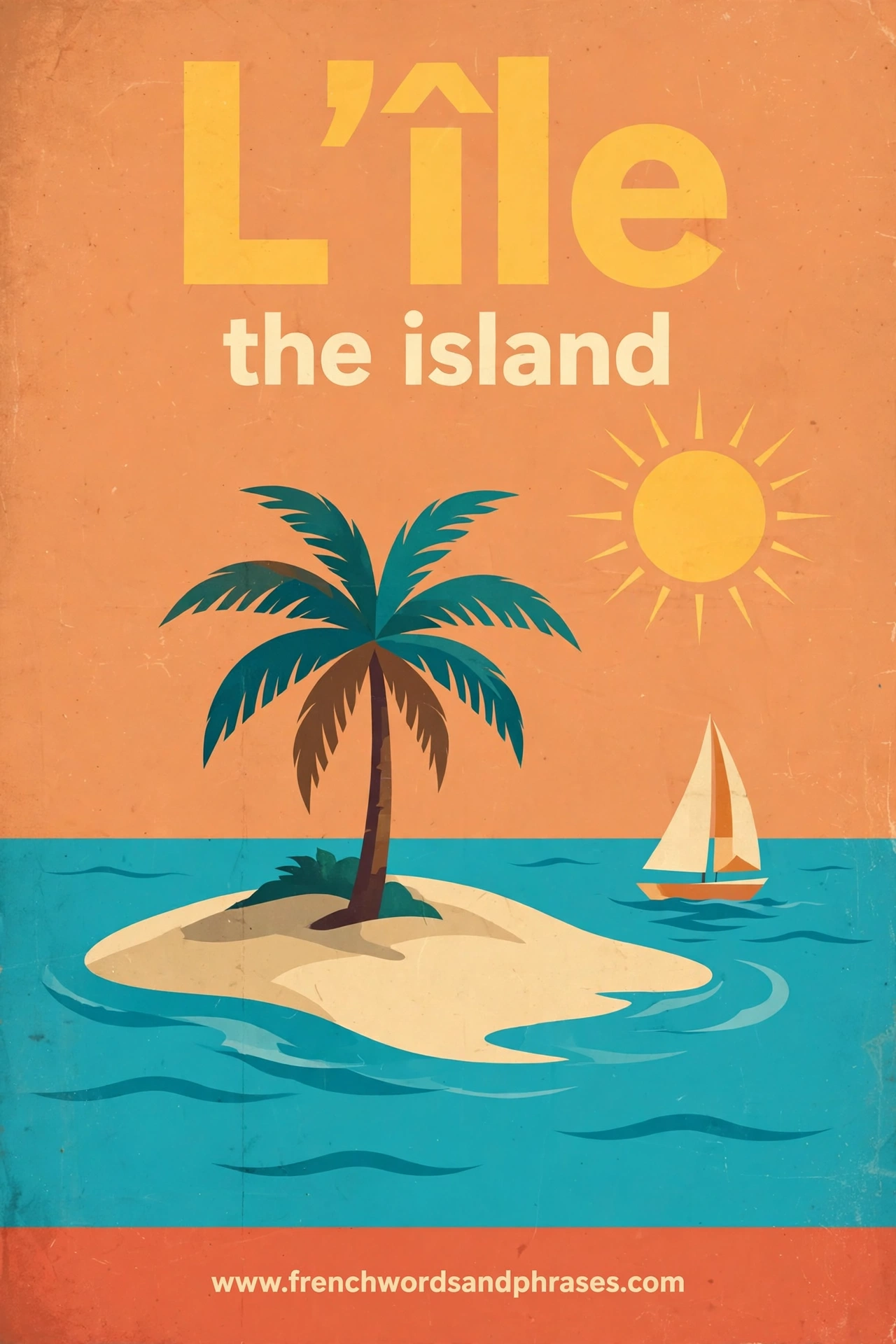
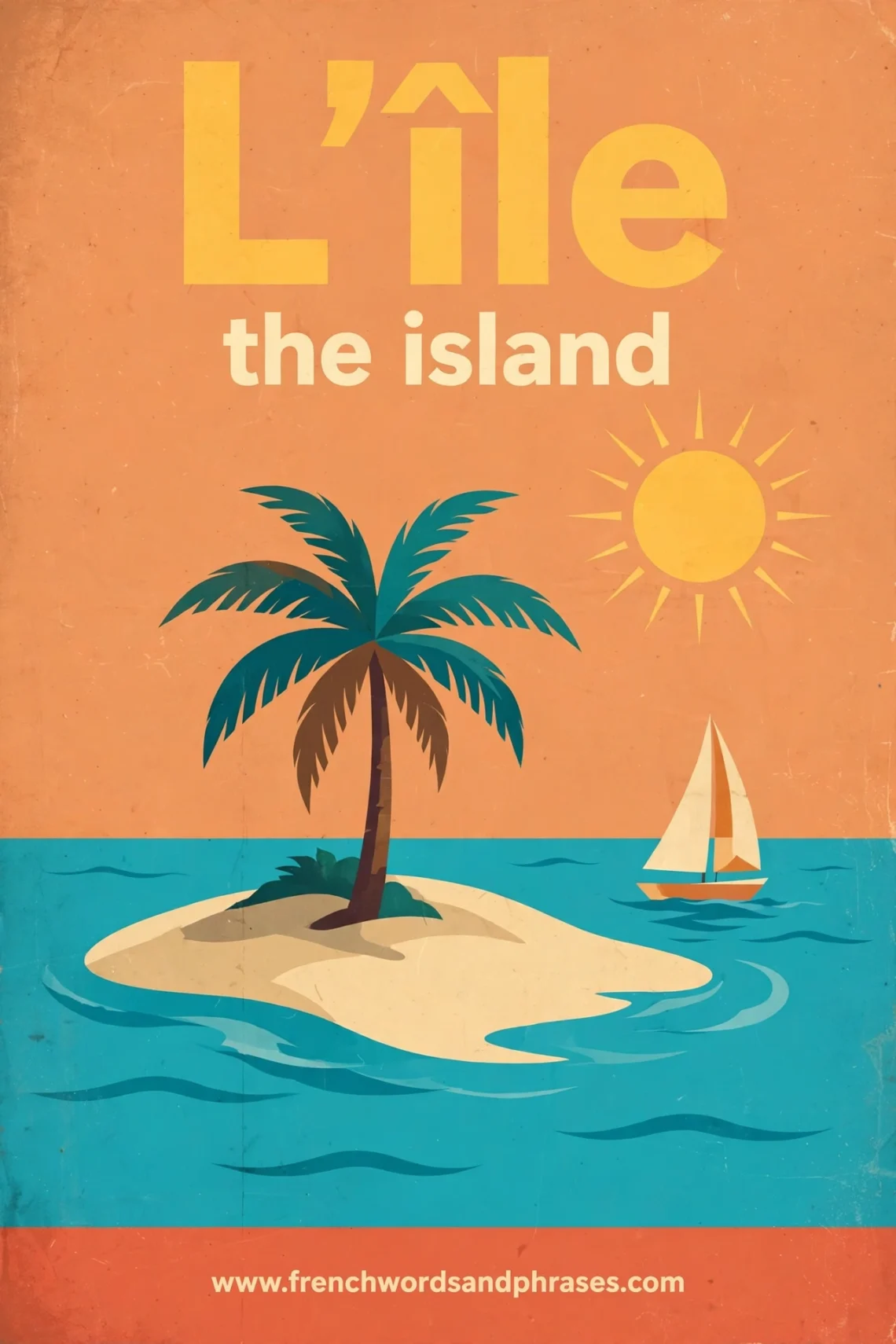
L’île means the island.
The ferry leaves the harbour, the mainland shrinks, and ahead a green shape grows out of the sea, ringed in gold sand — l’île, the island, the land that water keeps for itself.
In this guide, you’ll learn what île means in English, how to use it with its articles, how to form its plural, and how it appears in everyday French. Explore French examples, English translations, and practice quizzes.
Understanding the French Noun Île
Île is a feminine French noun, learned with its article: l’île, une île. It begins with a vowel wearing a circumflex — î, another fossil hat over a lost s (the Latin insula) — so the article melts into it: l’île, never la île in speech.
It means the island — land entirely surrounded by water, in the sea, a lake or a river. Paris itself began on one: l’île de la Cité, the island in the Seine where Notre-Dame stands. An island nobody lives on is une île déserte, a desert island, and the region around Paris is still named for the oldest one: l’Île-de-France.
Gender: Feminine — l’île
Definite article: l’ — l’île (the island), melted before the vowel
Indefinite article: une — une île (an island)
Plural: les îles
Spelling note: the circumflex on î replaces an old s: insula → île
Famous islands: l’île de la Cité (Paris), l’île de Ré, la Corse
English equivalents: The island.
Because île is feminine but begins with a vowel, the possessives cheat politely: mon île, ton île, son île — the masculine forms, used so the words flow without a clash of vowels. The same trick works for école and histoire: son histoire, her story.
Experience the Word
Île is the word of crossings: every island begins with a boat, a bridge or a causeway that the tide covers twice a day.
Imagine the Île de Ré at low tide: bicycles on white lanes, salt marshes glittering, donkeys in striped trousers in the postcards — an island close enough to visit, far enough to feel like another world.
You have not just named land in water. You have promised an escape — l’île, the place the sea keeps separate.
How to Use Île in French: Complete Guide
Let’s explore how île works in French, beginning with its articles — l’île, une île, des îles.
Île with the Definite Article (L’, Les)
Used for a specific island — the one on the horizon. The vowel opening makes la melt into l’.
| Form | French |
|---|---|
| Feminine singular | l’île |
| Plural | les îles |
Example
L’île apparaît lentement dans la brume.
The island appears slowly in the mist.
Île with the Indefinite Article (Une, Des)
Used for an island in general — any land the sea has kept.
| Form | French |
|---|---|
| Feminine singular | une île |
| Plural | des îles |
Example
Une île minuscule se dresse au milieu du lac.
A tiny island rises in the middle of the lake.
Île with the Partitive and Quantities (Sur une île…)
Islands are reached, circled and inhabited — the quantities of the crossing.
| Quantity | French |
|---|---|
| on an island | sur une île |
| a desert island | une île déserte |
| the tour of the island | le tour de l’île |
| a corner of the island | un coin de l’île |
| the islands of the archipelago | les îles de l’archipel |
Example
Ils passent l’été sur une île de Bretagne.
They spend the summer on an island in Brittany.
Quick Quiz 1
Complete the sentence:
______ est entourée par la mer. (the island)
Reveal the answer
L’île
L’île est entourée par la mer.
The island is surrounded by the sea — la melts into l’ before the vowel.
The Plural of Île
Île adds an -s in the plural — les îles, whole archipelagos of them.
| Number | French |
|---|---|
| Singular | l’île |
| Plural | les îles |
Example
Les îles de la Méditerranée attirent les voyageurs.
The islands of the Mediterranean attract travellers.
Île with Possessive Adjectives (Mon, Ton, Son…)
Île is feminine, but it begins with a vowel, so the singular possessives borrow the masculine forms: mon, ton, son — the words must flow.
| Owner | French |
|---|---|
| my | mon île |
| your (tu) | ton île |
| his / her | son île |
| our | notre île |
| your (vous) | votre île |
| their | leur île |
Example
Mon île préférée est l’île de Ré.
My favourite island is the Île de Ré.
Quick Quiz 2
Complete the sentence:
Elle retourne chaque été sur ______ île natale. (her)
Reveal the answer
son
Elle retourne chaque été sur son île natale.
She returns every summer to her native island — son, not sa, before the vowel.
Île with Demonstrative Adjectives (Cette, Ces)
Used to point: cette île, this island.
| Form | French |
|---|---|
| Feminine singular | cette île |
| Plural | ces îles |
Example
Cette île possède un phare célèbre.
This island has a famous lighthouse.
Île with Adjectives
Adjectives agree with île — feminine singular: une île déserte, une petite île.
| Adjective | With Île |
|---|---|
| petite (small) | une petite île |
| déserte (deserted) | une île déserte |
| lointaine (faraway) | une île lointaine |
| verte (green) | une île verte |
| habitée (inhabited) | une île habitée |
Example
Le naufragé attend les secours sur une île déserte.
The castaway waits for rescue on a desert island.
Quick Quiz 3
Complete the sentence:
Ils rêvent d’une île ______. (deserted)
Reveal the answer
déserte
Ils rêvent d’une île déserte.
They dream of a desert island — déserte, feminine, to agree with île.
Everyday Expressions with Île
Desert islands, the island of Paris and the region around it — the île phrases of daily life.
| Expression | In English |
|---|---|
| une île déserte | a desert island |
| l’île de la Cité | the island in the Seine where Paris began |
| l’Île-de-France | the region around Paris |
| vivre sur une île | to live on an island |
| le tour de l’île | the trip around the island |
| une île paradisiaque | a paradise island |
Example
Notre-Dame se dresse sur l’île de la Cité.
Notre-Dame stands on the Île de la Cité.
Words from the Same Family as Île
Ferries, lighthouses and beaches — the words that travel with île.
| French | In English |
|---|---|
| la mer | the sea |
| la plage | the beach |
| le phare | the lighthouse |
| le bateau | the boat |
| un insulaire | an islander |
Example
Le phare de l’île guide les bateaux la nuit.
The island’s lighthouse guides the boats at night.
Quick Quiz 4
What is une île déserte?
Reveal the answer
A desert island — an island where nobody lives.
Le héros du roman survit seul sur une île déserte.
The hero of the novel survives alone on a desert island.
Île in Everyday French: Real-Life Examples
Now that you know the word, let’s see how île appears in everyday French.
Example 1 — The crossing
Le bateau arrive à l’île dans une heure.
The boat reaches the island in one hour.
Example 2 — Paris
L’île de la Cité est le cœur historique de Paris.
The Île de la Cité is the historic heart of Paris.
Example 3 — Holidays
Ils louent une maison sur une île grecque.
They are renting a house on a Greek island.
Example 4 — A dream
Je rêve d’une île déserte avec des cocotiers.
I dream of a desert island with coconut palms.
Example 5 — The lighthouse
Le phare signale l’île aux marins.
The lighthouse signals the island to sailors.
Example 6 — Around it
Faisons le tour de l’île à vélo.
Let’s cycle around the island.
Beyond Translation: The Meaning of Île
Paris, the city of light, began as a village on an island — the île de la Cité, still wearing Notre-Dame like a crown. France keeps islands the way other countries keep treasures: Ré, Oléron, Noirmoutier with its tide-covered road, Corsica the île de Beauté. And the circumflex of île is another fossil: Latin insula lost its s, and the little hat marks the grave.
To say île is to draw a circle of water around a world and call it separate.
It evokes the ferry horn and the lighthouse beam, the desert island of every childhood daydream.
How to Remember the French Noun Île
Remember it this way: Île is the island — feminine, opening with a vowel, so its article melts: l’île, and its possessives borrow mon, ton, son.
- The melted article — l’île, une île, les îles.
- The borrowed possessives — mon île, ton île, son île, because île starts with a vowel.
- The daydream — une île déserte, a desert island.
The key idea is l’île — the island, feminine; possessives mon/ton/son before the vowel.
Test Your Knowledge of Île
Let’s see how much you’ve learned. Try answering these questions before revealing the answers.
Question 1
Is île masculine or feminine?
Reveal the answer
Feminine — l’île, une île (the article melts before the vowel).
Question 2
Why do we say mon île and not ma île?
Reveal the answer
Because île begins with a vowel — the possessive borrows the masculine form so the words flow.
Question 3
Translate: They live on an island.
Reveal the answer
Ils vivent sur une île.
Question 4
What is l’île de la Cité?
Reveal the answer
The island in the Seine where Paris began — Notre-Dame stands on it.
Question 5
Complete the sentence:
Cette ______ possède un beau phare. (island)
Reveal the answer
île
Cette île possède un beau phare.
This island has a beautiful lighthouse.
Your Final Challenge
Can You Use It?
How would you say this in French?
“The island is surrounded by the sea.”
Reveal the answer
L’île est entourée par la mer.
The island is surrounded by the sea.
A little French. A little curiosity. A richer everyday life.
LEARN FRENCH ONE WORD AT A TIME