A French Word to Live By
Translate Histoire to English
/is.twaʁ/
L’histoire means the story; history.
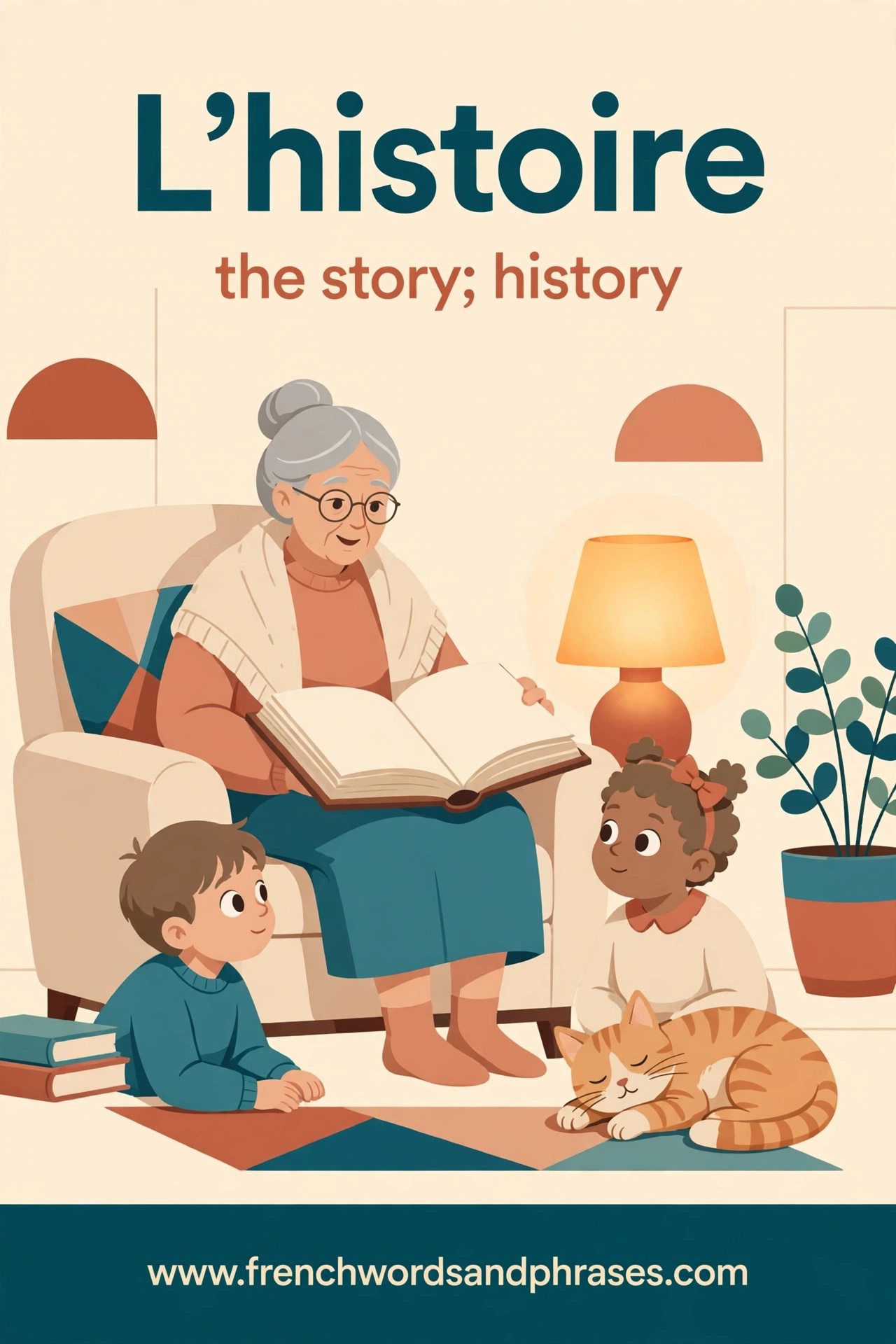
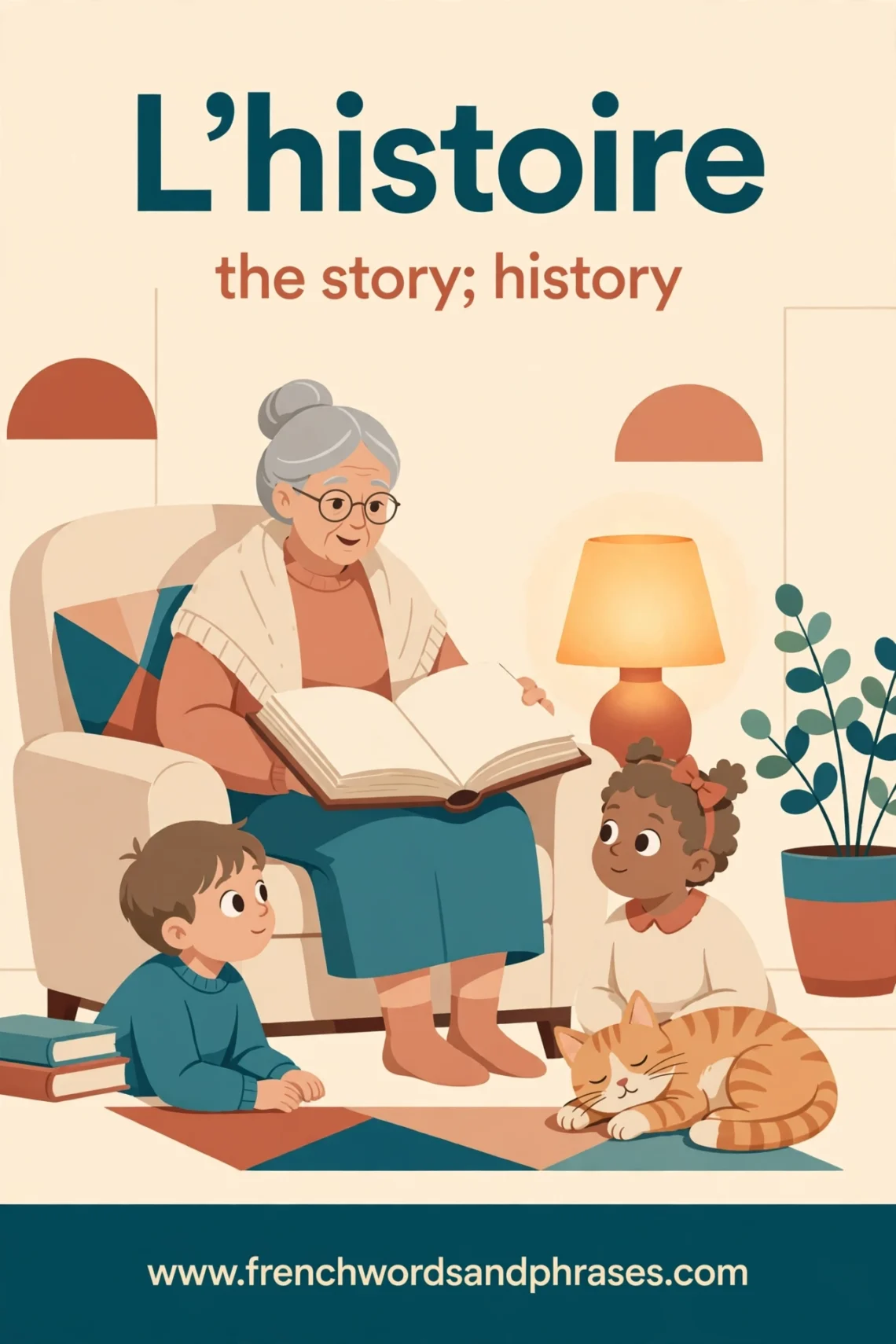
The grandmother settles into her chair, the children settle onto the rug, and the same words open the evening as they have for a thousand years: « Je vais vous raconter une histoire. » — I am going to tell you a story. Histoire is the noun of everything recounted: the tale at bedtime, and History itself with its dates and empires.
In this guide, you’ll learn what histoire means in English, how to use it with its articles, how to form its plural, and how it appears in everyday French. Explore French examples, English translations, and practice quizzes.
Understanding the French Noun Histoire
Histoire is a feminine French noun, learned with its article: l’histoire, une histoire — it begins with a silent h, so the article melts into l’. It comes from the Greek historia, an inquiry, a narrative. One word covers the bedtime tale, the school subject, and the long story of nations — French never separated the telling from the told.
It means the story and history at once: raconter une histoire, to tell a story; l’histoire de France, the history of France; un professeur d’histoire, a history teacher. And everyday French gives it a third, mischievous life: une histoire can be a fuss, an affair — quelle histoire ! what a fuss!; des histoires, in the plural, are tall tales and trouble: ne fais pas d’histoires, do not make a fuss.
Gender: Feminine — l’histoire
Definite article: l’ — l’histoire (the story, history), melted before the silent h
Indefinite article: une — une histoire (a story)
Plural: les histoires — stories; also fuss, tall tales
Key phrase: raconter une histoire — to tell a story
Close neighbour: un conte — a tale, a fairy tale; historique — historic, historical
English equivalents: The story; history.
Watch the possessives: histoire is feminine but begins with a silent h, so the singular possessives borrow the masculine forms — mon histoire, ton histoire, son histoire — never ma histoire. And mind the plural’s second life: des histoires can mean stories, but in a quarrel it means fibs and fuss — il raconte des histoires, he is making things up.
Experience the Word
Histoire is the noun of the human voice at nightfall — everything we know that we did not see, we know by histoire.
Imagine the classroom at nine in the morning: thirty children, one map, and the teacher beginning, « L’histoire de Rome commence par un loup… » — the history of Rome begins with a wolf. Even empires, in French, are first of all a story someone tells.
You have not just named a school subject. You have named the thread that ties the bedtime tale to the fate of nations — l’histoire, the story.
How to Use Histoire in French: Complete Guide
Let’s explore how histoire works in French, beginning with its articles — l’histoire, une histoire, raconter une histoire.
Histoire with the Definite Article (L’, Les)
Used for the specific story, or for History itself — the one being told, the one being studied.
| Form | French |
|---|---|
| Feminine singular | l’histoire |
| Plural | les histoires |
Example
L’histoire de ce château commence en 1200.
The history of this castle begins in 1200.
Histoire with the Indefinite Article (Une, Des)
Used for a story in general — one tale among the thousand of the world.
| Form | French |
|---|---|
| Feminine singular | une histoire |
| Plural | des histoires |
Example
Raconte-moi une histoire avant de dormir.
Tell me a story before sleep.
Histoire in Its Three Lives: Tale, History, Fuss
One word, three doors — the bedtime tale, the school subject, and the everyday commotion.
| Sense | French |
|---|---|
| a story, a tale | une histoire pour enfants — a children’s story |
| history, the subject | l’histoire de France — the history of France |
| a fuss, an affair | quelle histoire ! — what a fuss! |
| tall tales (plural) | raconter des histoires — to make things up |
| a love story | une histoire d’amour — a love story |
Example
Toute cette histoire pour un simple retard !
All this fuss over a simple delay!
Quick Quiz 1
Complete the sentence:
______ histoire de Rome est fascinante. (the)
Reveal the answer
L’
L’histoire de Rome est fascinante.
The history of Rome is fascinating — la melts into l’ before the silent h.
The Plural of Histoire
Histoire takes a regular plural in -s — and the plural loves mischief: stories, but also fibs and fuss.
| Number | French |
|---|---|
| Singular | l’histoire |
| Plural | les histoires |
Example
Les histoires de mon grand-père font rire tout le monde.
My grandfather’s stories make everyone laugh.
Histoire with Possessive Adjectives (Mon, Ton, Son…)
Histoire is feminine, but it begins with a silent h, so the singular possessives borrow the masculine forms: mon, ton, son — the words must flow.
| Owner | French |
|---|---|
| my | mon histoire |
| your (tu) | ton histoire |
| his / her | son histoire |
| our | notre histoire |
| your (vous) | votre histoire |
| their | leur histoire |
Example
Son histoire a ému toute la salle.
Her story moved the whole room.
Quick Quiz 2
Complete the sentence:
Elle raconte ______ histoire à ses enfants. (her)
Reveal the answer
son
Elle raconte son histoire à ses enfants.
She tells her story to her children — son, because histoire begins with a silent h.
Histoire with Demonstrative Adjectives (Cette, Ces)
Used to point: cette histoire, this story — the one on everyone’s lips.
| Form | French |
|---|---|
| Feminine singular | cette histoire |
| Plural | ces histoires |
Example
Cette histoire est vraie, je le jure.
This story is true, I swear it.
Histoire with Adjectives
Adjectives agree with histoire — feminine singular: une histoire vraie, une longue histoire.
| Adjective | With Histoire |
|---|---|
| vraie (true) | une histoire vraie |
| longue (long) | une longue histoire |
| belle (beautiful) | une belle histoire |
| drôle (funny) | une histoire drôle |
| ancienne (ancient, old) | une histoire ancienne |
Example
C’est une belle histoire d’amitié.
It is a beautiful story of friendship.
Quick Quiz 3
Complete the sentence:
C’est une histoire très ______. (funny)
Reveal the answer
drôle
C’est une histoire très drôle.
It is a very funny story — drôle has the same form for masculine and feminine.
Everyday Expressions with Histoire
Bedtime, classrooms and quarrels — the histoire phrases of daily life.
| Expression | In English |
|---|---|
| raconter une histoire | to tell a story |
| l’histoire de France | the history of France |
| ne fais pas d’histoires | do not make a fuss |
| c’est une autre histoire | that is another story, a different matter |
| l’histoire se répète | history repeats itself |
Example
Ne fais pas d’histoires, mange ta soupe.
Do not make a fuss, eat your soup.
Words from the Same Family as Histoire
Tales and tellers — the words that travel with histoire.
| French | In English |
|---|---|
| un conte | a tale, a fairy tale |
| raconter | to tell, to recount (the verb) |
| un historien | a historian |
| historique | historic, historical |
| un récit | an account, a narrative |
Example
L’historien raconte l’histoire de la ville.
The historian recounts the history of the town.
Quick Quiz 4
What does ne fais pas d’histoires mean?
Reveal the answer
Do not make a fuss — in everyday speech, des histoires are trouble and fibs, not tales.
Ne fais pas d’histoires pour un petit retard.
Do not make a fuss over a little delay.
Histoire in Everyday French: Real-Life Examples
Now that you know the word, let’s see how histoire appears in everyday French.
Example 1 — Bedtime
Papa, raconte-moi une histoire.
Daddy, tell me a story.
Example 2 — School
Le professeur d’histoire parle de la Révolution.
The history teacher is talking about the Revolution.
Example 3 — A true tale
Cette histoire est vraie, elle est arrivée à mon voisin.
This story is true, it happened to my neighbour.
Example 4 — A fuss
Quelle histoire pour une assiette cassée !
What a fuss over a broken plate!
Example 5 — Love
Leur histoire d’amour a commencé dans un train.
Their love story began on a train.
Example 6 — Fibs
Ne raconte pas des histoires, dis la vérité.
Do not make things up, tell the truth.
Beyond Translation: The Meaning of Histoire
Histoire is the Greek historia — an inquiry: the word first meant asking, finding out, and only then the tale told afterwards. French never split the word the way English did, where story shrank to fiction and history kept the facts. In French, the tale and the truth still share one name, and every speaker feels the thread between them.
To say histoire is to admit that the past, too, must be told — and telling is an art.
It evokes the grandmother’s chair, the schoolroom map and the family quarrel — quelle histoire ! — the whole human comedy in a single word.
How to Remember the French Noun Histoire
Remember it this way: Histoire is the story and history in one — feminine with a melted article, l’histoire, and a plural that loves mischief.
- Always feminine, silent h first — l’histoire, une histoire, cette histoire.
- The possessive borrows — mon histoire, son histoire, never ma histoire, because of the silent h.
- The double life — raconter une histoire is a tale; des histoires can be fibs and fuss.
The key idea is l’histoire — the story; history, feminine; raconter une histoire; des histoires = fibs, fuss.
Test Your Knowledge of Histoire
Let’s see how much you’ve learned. Try answering these questions before revealing the answers.
Question 1
Is histoire masculine or feminine?
Reveal the answer
Feminine — l’histoire, une histoire (the article melts before the silent h).
Question 2
How do you say « to tell a story »?
Reveal the answer
Raconter une histoire.
Question 3
Translate: The history of France is long.
Reveal the answer
L’histoire de France est longue.
Question 4
What can des histoires mean in a quarrel?
Reveal the answer
Fibs and fuss — il raconte des histoires, he is making things up.
Question 5
Complete the sentence:
______ histoires de grand-mère sont célèbres. (the)
Reveal the answer
Les
Les histoires de grand-mère sont célèbres.
Grandmother’s stories are famous.
Your Final Challenge
Can You Use It?
How would you say this in French?
“Tell me a story before sleep.”
Reveal the answer
Raconte-moi une histoire avant de dormir.
Tell me a story before sleep.
A little French. A little curiosity. A richer everyday life.
LEARN FRENCH ONE WORD AT A TIME