A French Word to Live By
Translate Gendre to English
/ʒɑ̃dʁ/
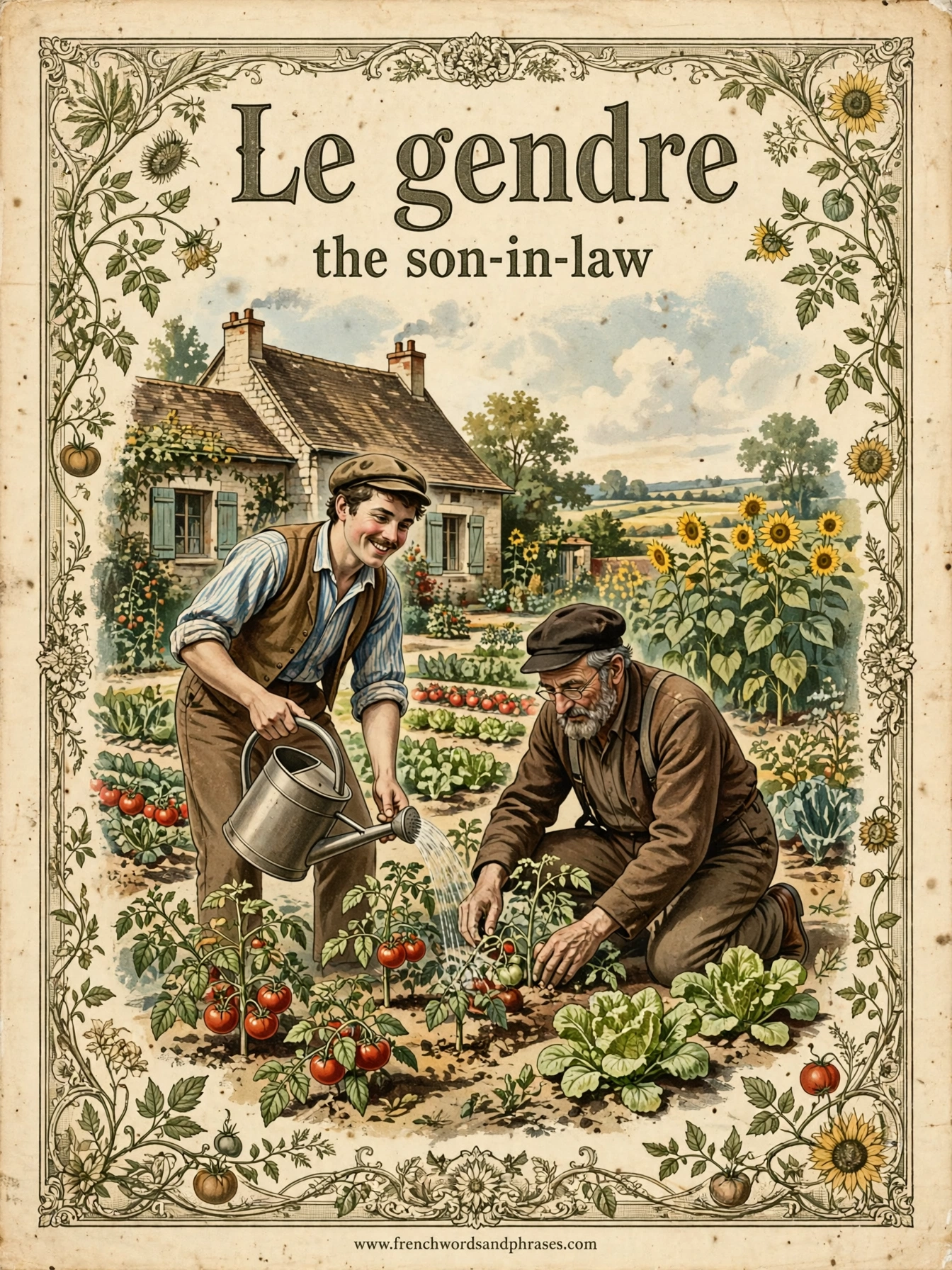
Le gendre means the son-in-law.
He arrives at his in-laws’ house carrying the wine, compliments the roast before tasting it, and laughs at the old stories as if they were new: le gendre, the son-in-law — the son a family gains when a daughter marries. French comedy adores him: le gendre idéal, the perfect son-in-law, is a national character.
In this guide, you’ll learn what gendre means in English, how to use it with its articles, how to form its plural, and how it appears in everyday French. Explore French examples, English translations, and practice quizzes.
Understanding the French Noun Gendre
Gendre is a masculine French noun, learned with its article: le gendre, un gendre. It descends from the Latin gener, son-in-law — the same root as generation and genre. Unlike most in-law words it carries no beau-: gendre is the old, direct word, and its feminine counterpart is la belle-fille (or the literary la bru). The plural is regular: les gendres.
It means a son-in-law — your daughter’s husband: ma fille et mon gendre, my daughter and my son-in-law; présenter son gendre, to introduce one’s son-in-law. It does not mean stepson: that is le beau-fils. French culture wraps the word in an ideal: le gendre idéal is the polite, helpful, successful husband every parent dreams of for a daughter — a compliment and, between friends, a gentle tease.
Gender: Masculine — le gendre
Definite article: le — le gendre (the son-in-law)
Indefinite article: un — un gendre (a son-in-law)
Plural: les gendres — regular, with a simple -s
Feminine counterpart: la belle-fille — the daughter-in-law
Not to confuse: le beau-fils — the stepson (or son-in-law, in loose speech)
English equivalents: The son-in-law.
Gendre is used from the parents-in-law’s side: you ARE someone’s gendre, and you speak of mon gendre with the same possessive warmth as mon fils. The famous phrase is le gendre idéal — say it of a real son-in-law and it is praise; say it with a smile of a boyfriend and it is a hint. A rarer, old-fashioned synonym is le beau-fils used for son-in-law, but beau-fils today mostly means stepson.
Experience the Word
Gendre is the son chosen by the daughter and adopted by the family — judged at the first lunch, teased forever after, and counted on for every heavy suitcase and broken shutter.
Imagine the first Sunday: he brings flowers for the mother, wine for the father, and asks for the recipe of a sauce he cannot pronounce. By the third Sunday he has a seat, a nickname and strong opinions about the family card game. Le gendre est de la famille.
You have not just named a relative. You have named the family’s gained son — le gendre.
How to Use Gendre in French: Complete Guide
Let’s explore how gendre works in French, beginning with its articles — le gendre, un gendre, mon gendre.
Gendre with the Definite Article (Le, Les)
Used for the specific gendre — the one married to your daughter.
| Form | French |
|---|---|
| Masculine singular | le gendre |
| Plural | les gendres |
Example
Le gendre de Monsieur Blanc est avocat.
Mr Blanc’s son-in-law is a lawyer.
Gendre with the Indefinite Article (Un, Des)
Used for a gendre in general — one being described or dreamed of.
| Form | French |
|---|---|
| Masculine singular | un gendre |
| Plural | des gendres |
Example
C’est un gendre attentionné, toujours prêt à aider.
He is a thoughtful son-in-law, always ready to help.
Gendre with Quantities (Un, Deux, Assez de…)
Gendres multiply as daughters marry — one per wedding.
| Quantity | French |
|---|---|
| one son-in-law | un gendre |
| two sons-in-law | deux gendres |
| both sons-in-law | les deux gendres |
| several sons-in-law | plusieurs gendres |
| every son-in-law | chaque gendre |
Example
Elle a deux gendres, les maris de ses deux filles.
She has two sons-in-law, her two daughters’ husbands.
Quick Quiz 1
Complete the sentence:
______ gendre arrive ce soir avec ma fille. (the)
Reveal the answer
Le
Le gendre arrive ce soir avec ma fille.
The son-in-law arrives this evening with my daughter — gendre is masculine, so le.
The Plural of Gendre
Gendre takes a regular plural in -s — no surprises in the spelling.
| Number | French |
|---|---|
| Singular | le gendre |
| Plural | les gendres |
Example
Les gendres organisent le barbecue de famille.
The sons-in-law organise the family barbecue.
Gendre with Possessive Adjectives (Mon, Ton, Son…)
Possessives agree with the noun: gendre is masculine, so mon, ton, son in the singular.
| Owner | French |
|---|---|
| my | mon gendre |
| your (tu) | ton gendre |
| his / her | son gendre |
| our | notre gendre |
| your (vous) | votre gendre |
| their | leur gendre |
Example
Mon gendre répare tout dans la maison.
My son-in-law fixes everything in the house.
Quick Quiz 2
Complete the sentence:
Elle présente ______ gendre à ses collègues. (her)
Reveal the answer
son
Elle présente son gendre à ses collègues.
She introduces her son-in-law to her colleagues — son, because gendre is masculine.
Gendre with Demonstrative Adjectives (Ce, Ces)
Used to point: ce gendre, this son-in-law — praise or teasing, according to the smile.
| Form | French |
|---|---|
| Masculine singular | ce gendre |
| Plural | ces gendres |
Example
Ce gendre-là, c’est le gendre idéal.
That son-in-law is the ideal son-in-law.
Gendre with Adjectives
Adjectives agree with gendre — masculine singular, masculine plural for several.
| Adjective | With Gendre |
|---|---|
| idéal (ideal) | le gendre idéal |
| attentionné (thoughtful) | un gendre attentionné |
| jeune (young) | un jeune gendre |
| nouveau (new) | son nouveau gendre |
| proches (close, plural) | des gendres proches |
Example
Son nouveau gendre est pâtissier, quelle chance !
Her new son-in-law is a pastry chef, how lucky!
Quick Quiz 3
What does le gendre idéal mean?
Reveal the answer
The ideal son-in-law — the polite, helpful husband of French family dreams, half compliment, half joke.
Il aide, il écoute, il rit aux histoires : le gendre idéal. — He helps, he listens, he laughs at the stories: the ideal son-in-law.
Everyday Expressions with Gendre
Weddings, family lunches and gentle teasing — the gendre phrases of daily life.
| Expression | In English |
|---|---|
| mon gendre et ma fille | my son-in-law and my daughter |
| le gendre idéal | the ideal son-in-law |
| devenir le gendre de quelqu’un | to become someone’s son-in-law |
| présenter son gendre | to introduce one’s son-in-law |
| s’entendre avec son gendre | to get on with one’s son-in-law |
Example
Elle s’entend très bien avec son gendre.
She gets on very well with her son-in-law.
Words from the Same Family as Gendre
The by-marriage family — gendre’s shelf of French kinship.
| French | In English |
|---|---|
| la belle-fille | the daughter-in-law, stepdaughter |
| le beau-père | the father-in-law, stepfather |
| la belle-mère | the mother-in-law, stepmother |
| le beau-frère | the brother-in-law |
| les beaux-parents | the in-laws |
Example
Le gendre aide ses beaux-parents au jardin.
The son-in-law helps his in-laws in the garden.
Quick Quiz 4
What is the difference between le gendre and le beau-fils?
Reveal the answer
Le gendre is your daughter’s husband; le beau-fils is usually your stepson.
Mon gendre est le mari de ma fille ; mon beau-fils est le fils de ma femme. — My son-in-law is my daughter’s husband; my stepson is my wife’s son.
Gendre in Everyday French: Real-Life Examples
Now that you know the word, let’s see how gendre appears in everyday French.
Example 1 — Family lunch
Mon gendre apporte le vin dimanche.
My son-in-law is bringing the wine on Sunday.
Example 2 — Introductions
Je vous présente mon gendre, Karim.
Let me introduce my son-in-law, Karim.
Example 3 — Praise
C’est le gendre idéal, dit-elle en souriant.
He’s the ideal son-in-law, she says, smiling.
Example 4 — Helping out
Mon gendre m’aide à repeindre la cuisine.
My son-in-law is helping me repaint the kitchen.
Example 5 — The wedding
Sa fille et son gendre partent en voyage de noces.
Her daughter and son-in-law are leaving on their honeymoon.
Example 6 — Two of them
Ses deux gendres jouent aux cartes avec lui.
His two sons-in-law play cards with him.
Beyond Translation: The Meaning of Gendre
Gendre is an ancient word — Latin gener, from the root of gignere, to beget: the son-in-law is, in the old Roman picture, the man who continues the line. French kept the word while building its courteous beau-/belle- family around it, which is why gendre stands alone without a beau-: he was family before politeness was invented.
To say gendre is to use the oldest word of the in-law shelf — the gained son, named directly.
And the culture crowned him: le gendre idéal haunts French comedy the way the belle-mère haunts its jokes.
How to Remember the French Noun Gendre
Remember it this way: Gendre is the daughter’s husband — masculine, no beau- attached, and not to be confused with the stepson, le beau-fils.
- Always masculine — le gendre, un gendre, mon gendre.
- The daughter’s husband — le mari de ma fille, c’est mon gendre.
- Not the stepson — le fils de mon conjoint, c’est mon beau-fils.
The key idea is le gendre — the son-in-law (daughter’s husband); le gendre idéal = the ideal son-in-law.
Test Your Knowledge of Gendre
Let’s see how much you’ve learned. Try answering these questions before revealing the answers.
Question 1
Is gendre masculine or feminine?
Reveal the answer
Masculine — le gendre, un gendre.
Question 2
How do you say my son-in-law?
Reveal the answer
Mon gendre.
Question 3
Translate: Her son-in-law is a pastry chef.
Reveal the answer
Son gendre est pâtissier.
Question 4
What is the feminine counterpart of gendre?
Reveal the answer
La belle-fille — the daughter-in-law.
Question 5
Complete the sentence:
______ gendres organisent le barbecue. (the)
Reveal the answer
Les
Les gendres organisent le barbecue.
The sons-in-law organise the barbecue.
Your Final Challenge
Can You Use It?
How would you say this in French?
“My son-in-law is helping me repaint the kitchen.”
Reveal the answer
Mon gendre m’aide à repeindre la cuisine.
My son-in-law is helping me repaint the kitchen.
A little French. A little curiosity. A richer everyday life.
LEARN FRENCH ONE WORD AT A TIME