
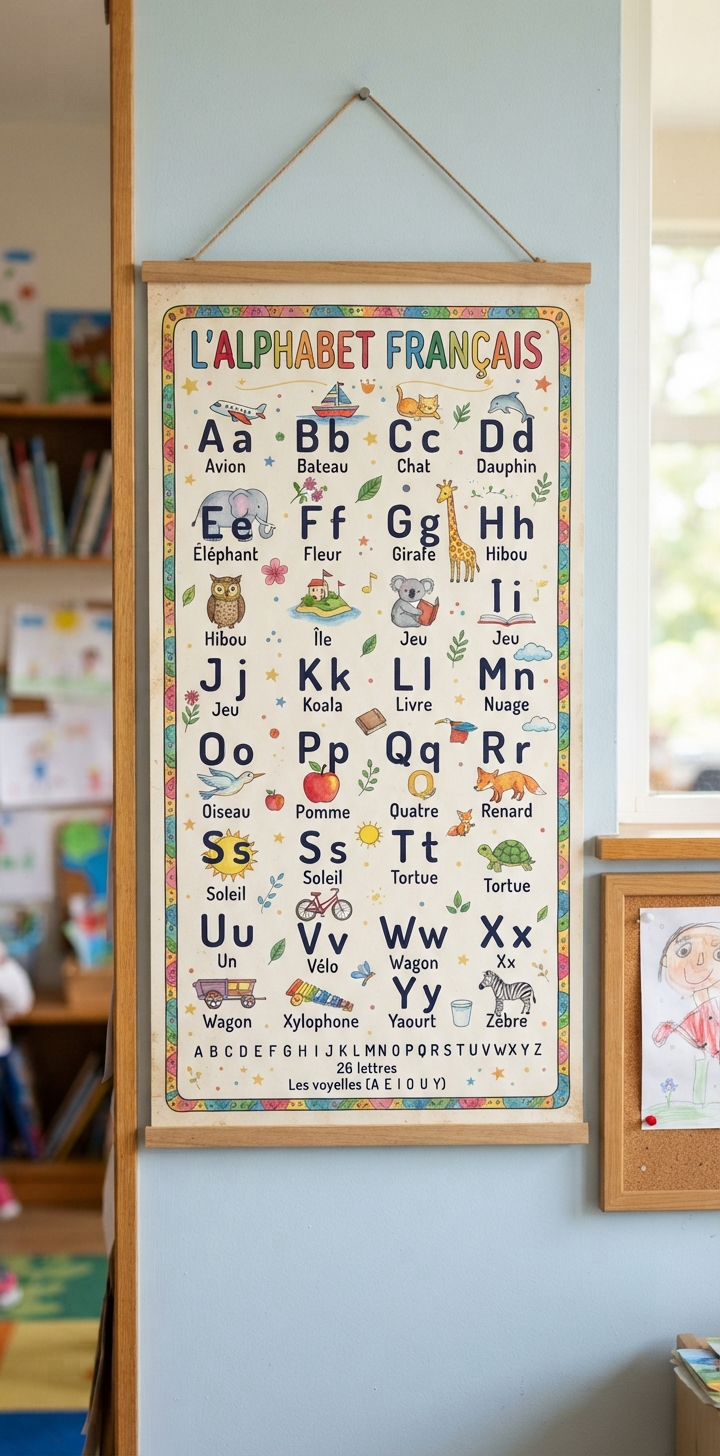
A French Vocabulary Lesson
Welcome to a little French lesson about the alphabet! L’alphabet means the alphabet. French uses the same twenty-six letters as English, so every letter will look familiar — but their names and sounds are quite different. In this lesson, you’ll learn the name of every letter, meet the accented letters that make French spelling special, and discover how to spell your own name the French way.
Learning the alphabet is easier when you see it used in a real situation. So instead of memorising a list, let’s check into a French hotel, where spelling your name is the very first thing you’ll be asked to do.
Our Story: Un Nom à l’Hôtel
Imagine that you have just arrived in Paris. You are tired from the journey, and the receptionist at your hotel is looking for your reservation. Read the story in French first. The English translation follows each passage to help you understand.
Bonjour, monsieur ! Bienvenue à l’hôtel. Vous avez une réservation ?
Good afternoon, sir! Welcome to the hotel. Do you have a reservation?
Oui, j’ai une réservation. Le nom, c’est Mike.
Yes, I have a reservation. The name is Mike.
Vous pouvez épeler votre nom, s’il vous plaît ?
Can you spell your name, please?
Bien sûr ! M — I — K — E. Emme, i, ka, e.
Of course! M — I — K — E. Em, ee, kah, uh.
Ah, merci ! Je vous trouve. Voici votre clé, monsieur. La chambre douze, au premier étage.
Ah, thank you! I have found you. Here is your key, sir. Room twelve, on the first floor.
Merci beaucoup !
Thank you very much!
The Vocabulary: The 26 Letters of the French Alphabet
Here is every letter with its French name, a guide to how that name sounds, and an example word from this site for each letter. Click any example to visit its word page.
| Letter | Its Name in French | Say It Like | Example Word |
|---|---|---|---|
| A | a | “ah” | arbre — tree |
| B | bé | “bay” | boulanger — baker |
| C | cé | “say” | café — coffee |
| D | dé | “day” | dent — tooth |
| E | e | “uh” | école — school |
| F | effe | “ef” | fleur — flower |
| G | gé | “zhay” | garçon — boy |
| H | ache | “ash” | hôtel — hotel |
| I | i | “ee” | île — island |
| J | ji | “zhee” | jardin — garden |
| K | ka | “kah” | kilo — kilo |
| L | elle | “el” | livre — book |
| M | emme | “em” | maison — house |
| N | enne | “en” | nuit — night |
| O | o | “oh” | oiseau — bird |
| P | pé | “pay” | pomme — apple |
| Q | cu | “kew” | question — question |
| R | erre | “air”, with a soft gargle | rouge — red |
| S | esse | “ess” | soleil — sun |
| T | té | “tay” | table — table |
| U | u | “ew”, with tight, rounded lips | univers — universe |
| V | vé | “vay” | voiture — car |
| W | double vé | “doo-bluh vay” | wagon — carriage |
| X | ixe | “eeks” | xylophone — xylophone |
| Y | i grec | “ee grek” | yaourt — yogurt |
| Z | zède | “zed” | zéro — zero |
A small but useful language tip:
Two letters barely belong to French at all. K and W appear almost only in words borrowed from other languages — kilo, week-end, wagon. And watch out for H: its name is ache, but the letter itself is always silent in French. Finally, notice Y: its name, i grec, means “Greek i” — a little souvenir of where the letter came from.
A Little French Grammar: The Accented Letters
French letters often wear little hats and marks. These are not separate letters of the alphabet, but they change how a word sounds — and sometimes what it means.
| Mark | Name in French | What It Does | Example |
|---|---|---|---|
| é | accent aigu | Makes the e sound like “ay” | école — school |
| è | accent grave | Makes the e sound like “eh” | père — father |
| ê | accent circonflexe | Stretches the vowel a little | fête — party |
| ë, ï | tréma | Says “pronounce this vowel separately” | Noël — Christmas; naïf — naive |
| à, ù | accent grave | Changes the meaning, not the sound | là (there) vs la (the); où (where) vs ou (or) |
| â, î, ô, û | accent circonflexe | Often marks an old letter s that disappeared | hôpital (hospital); île (island) |
| ç | cédille | Makes the c soft, like “ss” | garçon — boy; français — French |
French in Everyday Life: Useful Expressions
Comment ça s’écrit ? — How is that written? / How do you spell that?
Épelez, s’il vous plaît. — Please spell it.
Avec deux « l ». — With two l’s.
En un seul mot. — All one word.
Avec une majuscule. — With a capital letter.
Tout en minuscules. — All in lower case.
Test Your Knowledge: The French Alphabet
1. What is the French name of the letter J?
2. Which two letters appear almost only in borrowed words?
3. How do you say the letter Y in French, and what does its name mean?
4. Which letter is always silent in French?
5. How would you spell the word « café » out loud, letter by letter?
Answers: 1. ji (“zhee”). 2. K and W. 3. i grec — “Greek i”. 4. H. 5. cé, a, effe, e accent aigu.
Can You Translate These French Sentences?
Vous pouvez épeler votre nom, s’il vous plaît ?
Can you spell your name, please?
Comment ça s’écrit ?
How is that written?
Ça s’écrit avec deux « n ».
It’s written with two n’s.
Mon nom commence par un « m » majuscule.
My name begins with a capital m.
Discover a Little French Culture
In French schools, spelling is a serious art. Generations of children have practised la dictée — the dictation — where the teacher reads a passage aloud and pupils must write it perfectly, accents and all. A single missing accent can cost a point! French children also learn the alphabet by singing it, to the same tune you know — but listen closely at the end: where English rushes through “l, m, n, o, p”, French gives every letter its full, elegant name.
How to Remember Your New French Letters
Learn the letters in sound families: the “ay” family (bé, cé, dé, gé, pé, té, vé), the “ef” family (effe, elle, emme, enne, erre, esse), and the short sharp ones (a, i, o, ka, cu, u). Practise by spelling things you use every day — your name, your street, your email address — because spelling your name is the alphabet skill you will use most in France. And when a letter name escapes you, picture its example word: the bird for O (oiseau), the sun for S (soleil), the car for V (voiture).
Your Final Challenge
How would you say this in French? Spell your own first name out loud, letter by letter, using the French names — then try your surname, and one word from the table above.
Can You Spell Your Name in French?
Now you know all twenty-six letters, their names, and the little marks that dress them up. The next time a receptionist in France asks « Vous pouvez épeler votre nom ? », you’ll smile — and answer like a local.