A French Word to Live By
Translate Filer à l’anglaise to English
/fi.le a lɑ̃.ɡlɛz/
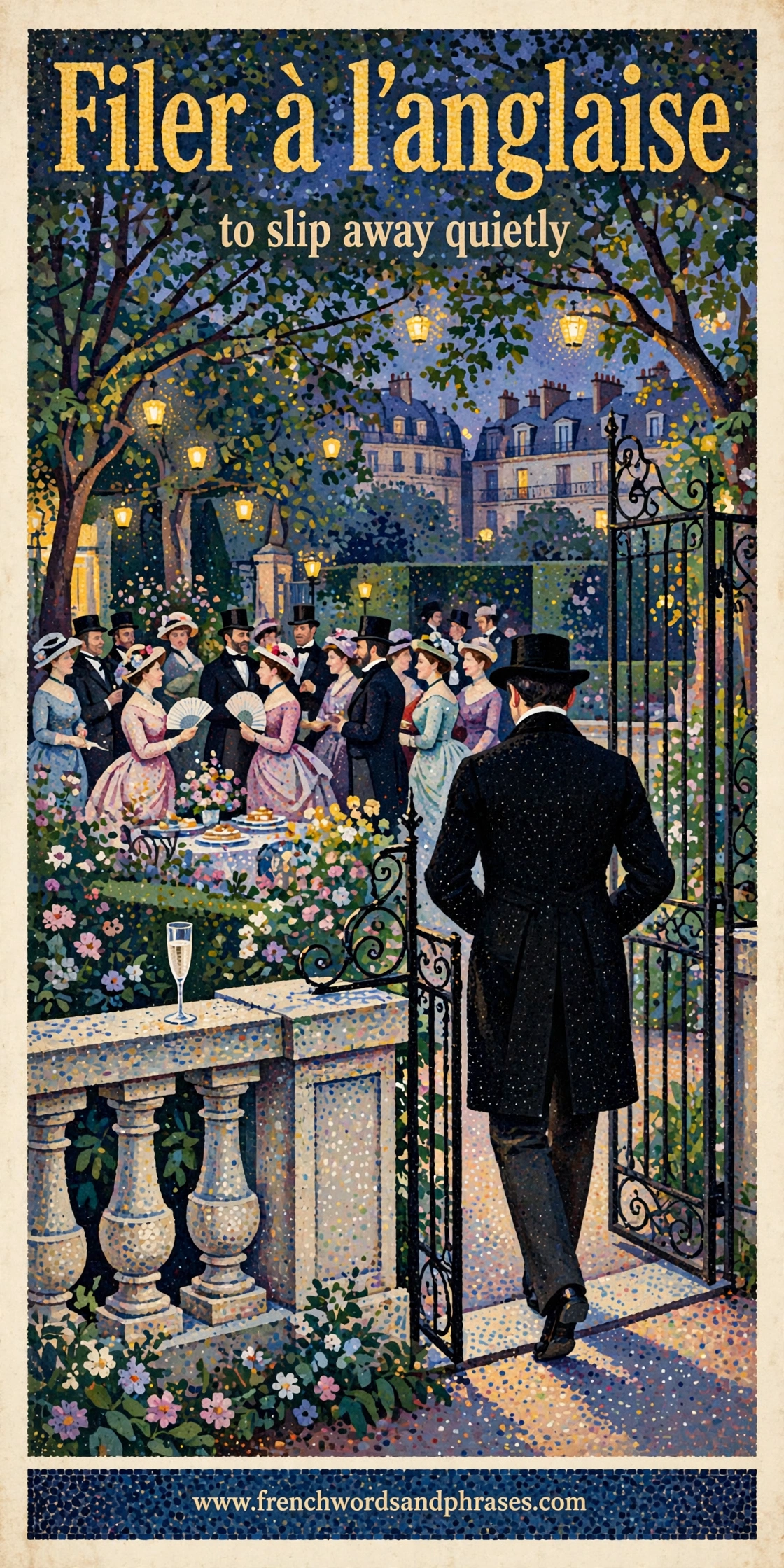
Filer à l’anglaise means to slip away quietly — to leave without saying goodbye to anyone.
The wedding reception is in full swing, the dancing has started, and nobody has noticed the tall man near the door backing slowly towards the coats. Two minutes later his chair is empty, his glass unfinished, and he is halfway home. Nobody heard a single goodbye. In French, he has a name for what he did: « Il a filé à l’anglaise. »
Let’s explore how filer à l’anglaise works in French, beginning with the whole phrase on one card.
Understanding the French Phrase Filer à l’anglaise
Filer à l’anglaise is a French idiomatic expression built from filer (to spin thread; to slip off, to dash away) and à l’anglaise (in the English style, in the English manner). It is the standard French way to say someone left a gathering quietly, without saying goodbye.
It means to slip away unnoticed — to leave a party, a dinner or a meeting without the round of goodbyes. Nobody is spinning thread and nobody is crossing the Channel: the picture is of a guest who simply evaporates. And the compliment is returned across the water, because English calls exactly the same exit ‘taking French leave’.
Type: Idiomatic expression — leaving (verb + à l’anglaise)
Answers the need: Saying someone left without a word of goodbye
Register: Neutral to informal — fine in conversation and most writing
Strength: Mild and amused — a raised eyebrow, sometimes a small reproach
One important usage detail: the feminine anglaise survives from the old full phrase à la manière anglaise, ‘in the English manner’ — manière is feminine, so the adjective stays feminine whoever is leaving. Filer conjugates like any regular -er verb: il file, ils ont filé. The near-twin partir à l’anglaise means exactly the same thing.
Experience the Word
Filer à l’anglaise is the art of the invisible exit — the party keeps dancing, and only the empty chair tells the story.
Imagine the host at midnight, doing the rounds with the last bottle, realising the quiet cousin from Lyon has simply gone. No drama, no long farewell scene at the door, no coats-and-keys performance. Just a text the next morning: merci pour la soirée. That vanishing act is filer à l’anglaise.
Sometimes it is rude and sometimes it is mercy. The phrase keeps both readings alive — that is why French loves it.
How to Use Filer à l’anglaise in French: Complete Guide
Let’s explore how filer à l’anglaise works in French, beginning with the whole phrase on one card.
Filer à l’anglaise at a Glance
The Whole Phrase on One Card
Real meaning, literal picture, English twin and register — filer à l’anglaise in five lines.
| Point | Filer à l’anglaise |
|---|---|
| What it really means | to slip away unnoticed, without saying goodbye |
| Word for word | to spin off in the English style |
| English equivalent | to take French leave / to slip away quietly |
| Register | neutral to informal — safe in speech and writing |
| Use it for | parties, dinners, receptions, any gathering left in silence |
Example
À minuit, il a filé à l’anglaise sans prévenir personne.
At midnight, he slipped away without telling anyone.
Word by Word: Building the Quiet Exit
Three small pieces — take them one by one and the guest is already at the door.
| Word | Literal meaning | Its job in the phrase |
|---|---|---|
| filer | to spin (thread); to slip off, to dash away | the movement itself — quick, smooth, almost invisible |
| à | in, at, in the manner of | the little word that names the style of the exit |
| l’anglaise | the English (way) | short for à la manière anglaise — the English manner; feminine because manière is feminine |
Example
Elle file toujours à l’anglaise avant le dessert.
She always slips away before dessert.
Quick Quiz 1
What does English call the very same exit?
Reveal the answer
Taking French leave — each language blames the other for leaving without goodbye.
Les Anglais disent « French leave », nous disons « filer à l’anglaise ».
The English say ‘French leave’, we say ‘filer à l’anglaise’.
When You Say It: The Vanishing Moments
Filer à l’anglaise fires at moments like these — a gathering, and one guest quietly gone.
| Situation | Example |
|---|---|
| At a wedding | il a filé à l’anglaise avant même le gâteau — he slipped away before even the cake |
| At a work party | elle file à l’anglaise dès que le patron part — she slips away as soon as the boss leaves |
| Noticing the empty chair | tiens, Marc a filé à l’anglaise — look, Marc has slipped away |
| As a habit | moi, je file toujours à l’anglaise — me, I always slip away quietly |
| With mild reproach | tu aurais pu dire au revoir au lieu de filer à l’anglaise — you could have said goodbye instead of slipping away |
Example
Personne ne l’a vu partir : il a filé à l’anglaise.
Nobody saw him leave: he slipped away.
Make It Yours: The Exit for Every Person
Filer is a regular -er verb — only the tense changes, the English style stays.
| Form | French | In English |
|---|---|---|
| I slip away | je file à l’anglaise | I slip away quietly |
| He slipped away | il a filé à l’anglaise | he slipped away |
| She used to slip away | elle filait à l’anglaise | she used to slip away |
| We will slip away | nous filerons à l’anglaise | we will slip away |
| Without saying goodbye | filer à l’anglaise sans dire au revoir | to slip away without saying goodbye |
| Question | il a encore filé à l’anglaise ? | has he slipped away again? |
Example
À dix heures, nous filerons à l’anglaise, promis.
At ten o’clock, we’ll slip away, promise.
Quick Quiz 2
Complete the sentence: « Il a ______ à l’anglaise avant la fin du repas. »
Reveal the answer
filé — the past participle of filer, with avoir.
Il a filé à l’anglaise avant la fin du repas.
He slipped away before the end of the meal.
Everyday Expressions: Building on the Quiet Exit
Filer à l’anglaise slots into these everyday frames — each one ready to use as it stands.
| Frame | In English |
|---|---|
| filer à l’anglaise | to slip away without saying goodbye |
| filer à l’anglaise avant la fin | to slip away before the end |
| encore un qui file à l’anglaise | another one slipping away |
| filer à l’anglaise sans prévenir | to slip away without warning anyone |
| avoir l’habitude de filer à l’anglaise | to be in the habit of slipping away |
Example
Encore un qui file à l’anglaise, c’est contagieux.
Another one slipping away — it’s catching.
Close Cousins: The Other Ways to Leave
French has a whole shelf of leaving phrases — filer à l’anglaise is the silent one; its cousins are politer, older or more deliberate.
| Expression | The difference |
|---|---|
| filer à l’anglaise | to slip away without goodbye — the classic, mildly amused version |
| partir à l’anglaise | exactly the same exit, built on partir instead of filer |
| s’éclipser | to slip away discreetly — elegant and neutral, no blame attached |
| prendre congé | to take one’s leave — the polite opposite: you formally say goodbye |
| fausser compagnie à quelqu’un | to give someone the slip — a little old-fashioned, and deliberate |
| prendre la poudre d’escampette | to make oneself scarce — old, humorous, almost never serious |
Example
Plutôt que de filer à l’anglaise, elle s’est éclipsée après avoir salué la maîtresse de maison.
Rather than slipping away, she quietly left after thanking the hostess.
Quick Quiz 3
Which cousin is the elegant, blame-free way to slip away — s’éclipser or filer à l’anglaise?
Reveal the answer
S’éclipser — it simply notes the discreet exit; filer à l’anglaise keeps a wink and a small reproach.
Le ministre s’est éclipsé avant les questions.
The minister slipped away before the questions.
Filer à l’anglaise and Its Neighbours
The leaving shelf around the phrase — from the goodbye you skip to the door you take.
| French | In English |
|---|---|
| dire au revoir | to say goodbye — the step that gets skipped |
| saluer les invités | to greet (or take leave of) the guests |
| s’éclipser | to slip away discreetly |
| prendre congé | to take one’s leave, politely |
| la sortie | the exit, the way out |
| discrètement | discreetly, quietly |
Example
Il a pris la sortie sans saluer les invités.
He took the exit without saying goodbye to the guests.
Watch Out: The Traps Around Filer à l’anglaise
The traps: a busy verb, a custard that is not an exit, and a compliment that crosses the Channel.
| Trap | The truth |
|---|---|
| filer’s other lives | filer also means to speed along (la voiture file), to shadow someone, and to spin thread — only à l’anglaise makes it the quiet exit |
| the custard trap | une crème anglaise is custard — ‘English-style’ in the kitchen has nothing to do with leaving parties |
| anglaise stays feminine | even for a man: il a filé à l’anglaise — the feminine comes from la manière, understood |
| not always rude | at a huge party, slipping away can be tactful; the phrase judges the exit, not always the person |
Example
La crème anglaise accompagne le gâteau ; elle ne file nulle part.
The custard goes with the cake; it isn’t slipping away anywhere.
Quick Quiz 4
True or false: a man must say il a filé à l’anglais, with a masculine ending.
Reveal the answer
False — it is always à l’anglaise, for everyone, because the understood word is la manière, feminine.
Même le président a filé à l’anglaise ce soir-là.
Even the president slipped away that evening.
Filer à l’anglaise in Everyday French: Real-Life Examples
Now that you know the word, let’s see how filer à l’anglaise appears in everyday French.
Example 1 — At the wedding
Le témoin a filé à l’anglaise avant le bouquet.
The best man slipped away before the bouquet.
Example 2 — Noticing
Tiens, Sophie a filé à l’anglaise, sa chaise est vide.
Look, Sophie has slipped away, her chair is empty.
Example 3 — A habit
Mon oncle file toujours à l’anglaise après le café.
My uncle always slips away after the coffee.
Example 4 — Planning
À onze heures, on file à l’anglaise, d’accord ?
At eleven, we slip away, agreed?
Example 5 — Mild reproach
Tu as filé à l’anglaise sans même me dire au revoir.
You slipped away without even saying goodbye to me.
Example 6 — The next morning
Pardon, j’ai filé à l’anglaise hier soir, j’étais épuisé.
Sorry, I slipped away last night, I was exhausted.
Beyond Translation: The Meaning of Filer à l’anglaise
Two old neighbours stand on either side of the Channel, each pointing at the other. The Frenchman vanishes from the party: the English call it French leave. The Englishman vanishes: the French call it filer à l’anglaise. The rudeness is identical; only the passport changes.
To filer à l’anglaise is to leave the way a rumour leaves a room — everywhere denied, nowhere seen going.
Perhaps that is the real lesson of the phrase: every nation believes good manners are its own invention, and bad manners an import.
How to Remember the French Phrase Filer à l’anglaise
Remember it this way: Filer à l’anglaise is the guest who vanishes like thread off a spool — quick, smooth, and gone before the goodbyes begin.
- You picture the thread — filer is to spin thread, and the guest unwinds himself from the party just as smoothly.
- You remember the mirror — English blames the French (‘French leave’), French blames the English; same exit, two flags.
- You keep anglaise feminine for everyone — it belongs to la manière, the manner, not to the guest.
The key idea is filer à l’anglaise means to slip away without saying goodbye — ‘to take French leave’.
Test Your Knowledge of Filer à l’anglaise
Let’s see how much you’ve learned. Try answering these questions before revealing the answers.
Question 1
What does filer à l’anglaise mean?
Reveal the answer
To slip away quietly without saying goodbye — to leave a gathering unnoticed.
Question 2
What does English call the same behaviour?
Reveal the answer
Taking French leave — each language names the exit after the other country.
Question 3
How do you say ‘she slipped away before dessert’?
Reveal the answer
Elle a filé à l’anglaise avant le dessert — filer is a regular -er verb, with avoir in the past.
Question 4
Why does anglaise stay feminine even for a man?
Reveal the answer
Because the full phrase is à la manière anglaise — ‘in the English manner’, and manière is feminine.
Question 5
Complete the sentence:
À minuit, ils ont ______ à l’anglaise. (At midnight, they slipped away.)
Reveal the answer
filé
À minuit, ils ont filé à l’anglaise.
At midnight, they slipped away.
Your Final Challenge
Can You Use It?
How would you say this in French?
“He slipped away without saying goodbye.”
Reveal the answer
Il a filé à l’anglaise sans dire au revoir.
He slipped away without saying goodbye.
A little French. A little curiosity. A richer everyday life.
LEARN FRENCH ONE WORD AT A TIME