A French Word to Live By
Translate Faire la tête to English
/fɛʁ la tɛt/
Faire la tête means to sulk.
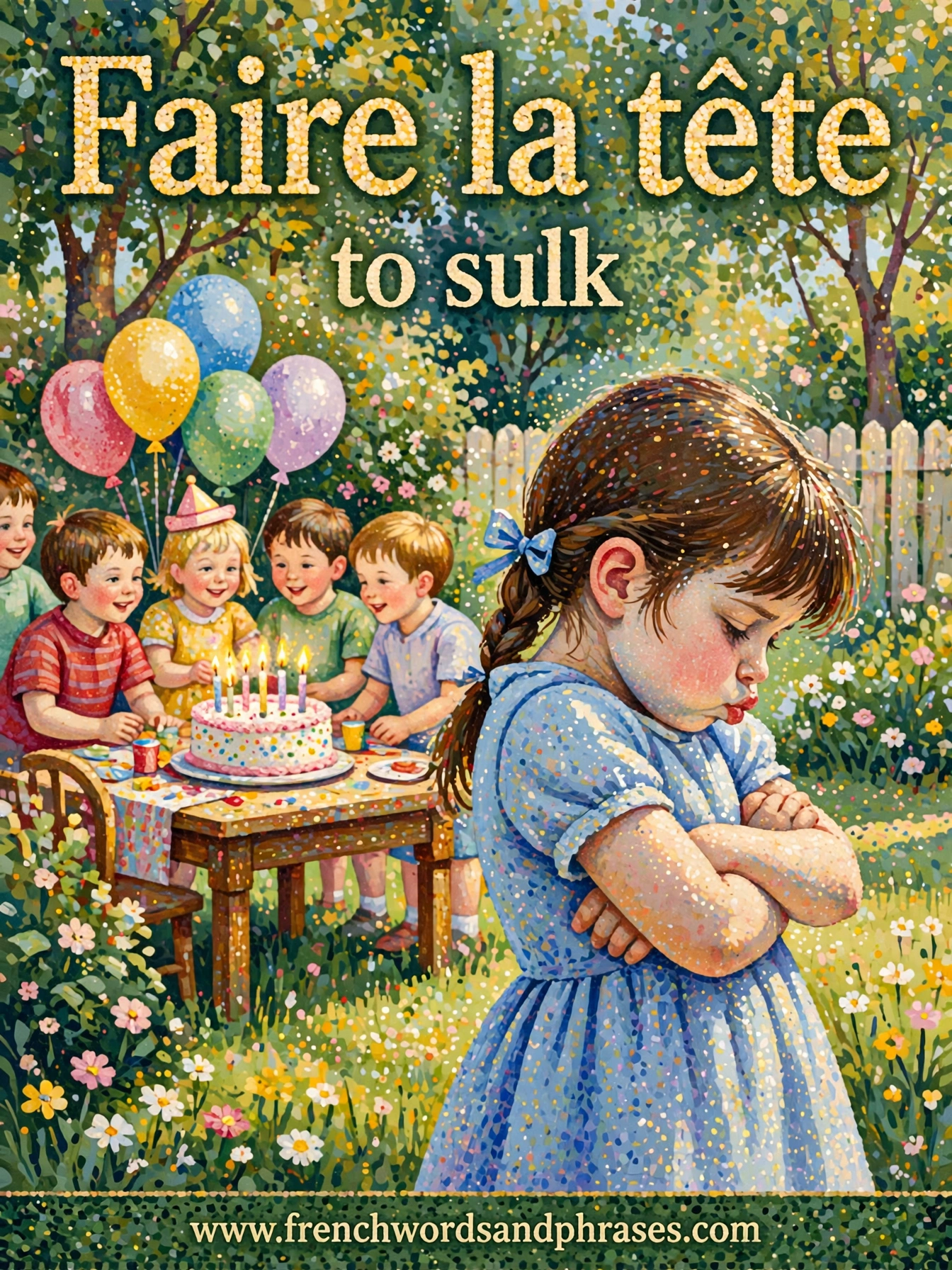
At a birthday lunch in Lyon, little Chloé has just been refused a second slice of cake. The room goes quiet in one corner: arms crossed, chin down, lips pushed forward, she stares at her empty plate like it personally betrayed her. Her grandfather leans over and whispers to the table: « Ça y est, elle fait la tête. »
Let’s explore how faire la tête works in French, beginning with the whole phrase on one card.
Understanding the French Phrase Faire la tête
Faire la tête is a French idiom — a verb phrase built on faire (to make, to do) with la tête (the head). The ‘head’ here is the face and the expression worn on it: the long, downturned face of someone who is sulking. It is the everyday French way to say that someone is in a visible, silent bad mood.
It means to sulk — to show your displeasure with a long face and a heavy silence. English pictures the mood; French pictures the face that announces it. The phrase is mild and often affectionate: it is what you say about a child refused a biscuit, a teenager sent to bed early, or a partner nursing a small grievance.
Type: Idiom — a verb phrase built on faire (to make)
Answers the need: Describing someone sulking — in a bad mood and showing it on their face
Register: Informal, everyday — family and familiar settings
Strength: Mild — it describes a mood, often with a smile; it is not an accusation
Two details. First, the sound-alike trap: faire la tête (to sulk) and faire la fête (to party) differ by one small sound — one letter ruins, or makes, the evening. Second, you can aim the sulk at someone: faire la tête à quelqu’un means to sulk at them, to give them the cold shoulder. And a headache is something else entirely: avoir mal à la tête.
Experience the Word
Faire la tête is the phrase for the face everyone at the table has already read.
Every family knows the choreography: the crossed arms, the plate pushed away, the answers of one syllable. The sulk is a small theatre performed in silence, and faire la tête is the review it gets — amused, unsurprised, and usually right.
French chooses the face because the face is the message. The mood is private; the tête makes it public.
How to Use Faire la tête in French: Complete Guide
Let’s explore how faire la tête works in French, beginning with the whole phrase on one card.
Faire la tête at a Glance
The Whole Phrase on One Card
Real meaning, literal building blocks, English twin and register — faire la tête in five lines.
| Point | Faire la tête |
|---|---|
| What it really means | to sulk — to be in a bad mood and show it with a long face |
| Word for word | to make the head (faire = to make/do, la tête = the head, the face) |
| English equivalent | to sulk / to pull a long face |
| Register | informal and everyday — mild, often affectionate |
| Use it for | children refused a treat, teenagers, partners, players left on the bench |
Example
Il fait la tête parce qu’il a perdu au jeu.
He’s sulking because he lost the game.
Word by Word: Building the Long Face
Two pieces — take them one by one and the picture builds itself.
| Word | Literal meaning | Its job in the phrase |
|---|---|---|
| faire | to make, to do | the verb — the face is ‘made’, performed, like a small piece of theatre |
| la tête | the head | here it means the face and its expression — the downturned mouth, the silence, the sighs |
Example
Elle fait la tête depuis ce matin.
She’s been sulking since this morning.
Quick Quiz 1
Faire la tête, faire la fête — which one is the party?
Reveal the answer
Faire la fête is to party. Faire la tête is to sulk — one small sound apart, and a whole evening apart.
Samedi, on fait la fête ; ce matin, il fait la tête.
On Saturday we party; this morning, he’s sulking.
When You Say It: Long Faces Everywhere
Faire la tête appears wherever a small refusal meets a big expression — the scene chooses the words.
| Situation | Example |
|---|---|
| A refused ice cream | le petit fait la tête parce qu’il n’a pas eu de deuxième glace — the little boy is sulking because he didn’t get a second ice cream |
| A teenager’s phone | elle fait la tête depuis qu’on lui a pris son téléphone — she’s been sulking since her phone was taken away |
| A small argument | il fait la tête à sa femme depuis leur dispute — he’s been giving his wife the cold shoulder since their argument |
| A player on the bench | le joueur fait la tête parce qu’il n’a pas joué — the player is sulking because he didn’t play |
| The last croissant | tu fais la tête pour un croissant ? — you’re sulking over a croissant? |
Example
Ne fais pas la tête, ce n’est pas grave.
Don’t sulk, it’s not serious.
Make It Yours: Sulking in Every Person
Faire conjugates through every person — and the phrase can take a target with à.
| Form | French | In English |
|---|---|---|
| About me | je fais la tête | I’m sulking |
| The question | tu fais la tête ? | are you sulking? |
| About him (all evening) | il a fait la tête toute la soirée | he sulked all evening |
| Aimed at someone | elle fait la tête à son frère | she’s giving her brother the cold shoulder |
| The gentle order | arrête de faire la tête ! | stop sulking! |
| Duration | nous faisons la tête depuis une heure | we’ve been sulking for an hour |
Example
Arrête de faire la tête et viens manger !
Stop sulking and come and eat!
Quick Quiz 2
How do you say someone is sulking at a particular person?
Reveal the answer
Add à + the person: faire la tête à quelqu’un — to give them the cold shoulder.
Elle fait la tête à son frère depuis hier.
She’s been giving her brother the cold shoulder since yesterday.
Everyday Expressions: Frames Around the Sulk
Faire la tête slots into these everyday frames — each one ready to use as it stands.
| Frame | In English |
|---|---|
| faire la tête | to sulk |
| faire la tête à quelqu’un | to sulk at someone, to give them the cold shoulder |
| il fait la tête pour un rien | he sulks over nothing |
| ne fais pas la tête, allez ! | don’t sulk, come on! |
| elle fait la tête depuis ce matin | she’s been sulking since this morning |
Example
Il fait la tête pour un rien, comme toujours.
He sulks over nothing, as always.
Close Cousins: Other Ways to Show a Mood
French shows a bad mood at several volumes — faire la tête is the facial one; its cousins name the mood or raise the volume.
| Expression | The difference |
|---|---|
| faire la tête | to sulk — the long face, mild and everyday |
| bouder | to sulk — the standard single verb, neutral, works anywhere |
| faire la gueule | to sulk — slang and stronger; gueule is the coarse word for a face |
| être de mauvaise humeur | to be in a bad mood — the neutral description, no face required |
| faire semblant d’ignorer quelqu’un | to pretend to ignore someone — the silent treatment, described plainly |
Example
Il boude dans son coin, il fait la tête depuis le déjeuner.
He’s sulking in his corner, he’s had a long face since lunch.
Quick Quiz 3
Which cousin is the plain, standard verb for ‘to sulk’?
Reveal the answer
Bouder — one word, neutral, usable anywhere.
Elle boude parce qu’elle a perdu.
She’s sulking because she lost.
Faire la tête and Its Neighbours
The mood shelf — phrases for sulking, smiling, and making up again.
| French | In English |
|---|---|
| se réconcilier | to make up again — the happy ending of every sulk |
| sourire | to smile — the opposite face |
| de bonne humeur | in a good mood — the opposite weather |
| faire la fête | to party — the sound-alike neighbour, one sound away |
| bouder | to sulk — the one-word twin |
| un caprice | a tantrum, a whim — the child’s version, louder |
Example
Après la fête, ils se sont réconciliés et elle a retrouvé le sourire.
After the party, they made up and she found her smile again.
Watch Out: The Traps Around the Tête
The traps: one sound that turns a sulk into a party, a headache that is a different phrase, and a face that is not a head.
| Trap | The truth |
|---|---|
| saying fête for tête | faire la fête is to party — the classic sound trap; tête = head/face, fête = party |
| meaning a headache | a headache is avoir mal à la tête — faire la tête is always the sulk |
| picturing the skull | tête here is the face and its expression — the long face, not the bone |
| forgetting the target | faire la tête à quelqu’un aims the sulk at a person — without à, it floats in the room |
Example
Elle fait la tête, elle ne fait pas la fête.
She’s sulking, she’s not partying.
Quick Quiz 4
Your daughter has crossed her arms and stopped speaking since the refused biscuit. What is she doing?
Reveal the answer
Elle fait la tête — she’s sulking, wearing the long face for the whole table to read.
Elle fait la tête depuis le goûter.
She’s been sulking since snack time.
Faire la tête in Everyday French: Real-Life Examples
Now that you know the word, let’s see how faire la tête appears in everyday French.
Example 1 — The refused ice cream
Le petit fait la tête parce qu’il voulait une deuxième glace.
The little boy is sulking because he wanted a second ice cream.
Example 2 — The confiscated phone
Elle fait la tête depuis qu’on lui a confisqué son téléphone.
She’s been sulking since her phone was confiscated.
Example 3 — The forgotten anniversary
Il fait la tête à sa femme parce qu’elle a oublié leur anniversaire.
He’s giving his wife the cold shoulder because she forgot their anniversary.
Example 4 — The bench at the match
Le remplaçant fait la tête parce qu’il n’est pas entré en jeu.
The substitute is sulking because he didn’t get on the pitch.
Example 5 — The lost board game
Ma petite sœur fait la tête chaque fois qu’elle perd aux cartes.
My little sister sulks every time she loses at cards.
Example 6 — The last croissant
Tu fais la tête pour le dernier croissant ? Il y en a d’autres demain.
You’re sulking over the last croissant? There will be more tomorrow.
Beyond Translation: The Meaning of Faire la tête
French is a language that watches faces. Avoir une bonne tête is to look likeable, une tête de mule is a stubborn person, and faire la tête turns the face itself into a verb — a mood you perform with your features. The sulk, in French, is not hidden inside; it is worn, deliberately, where everyone can read it.
Faire la tête is communication, not withdrawal — the face is sending a message the mouth refuses to say.
That is why the phrase so often ends the sulk it names. Once the table has said « elle fait la tête », the theatre has been reviewed — and the actor, usually, starts to laugh.
How to Remember the French Phrase Faire la tête
Remember it this way: See the face: chin down, lips forward, arms crossed — a head ‘made’ into a mask of displeasure. Faire la tête is wearing that mask. And keep one ear open: change one sound and the sulk becomes a party — la fête.
- You hear tête and think face — the expression, not the skull.
- You fear the twin — faire la fête is to party; one sound swaps the evening.
- You aim it with à — faire la tête à quelqu’un is the cold shoulder, addressed.
The key idea is faire la tête means to sulk — the long face; not faire la fête, which is to party.
Test Your Knowledge of Faire la tête
Let’s see how much you’ve learned. Try answering these questions before revealing the answers.
Question 1
What does faire la tête mean?
Reveal the answer
To sulk — to be in a bad mood and show it with a long face.
Question 2
What is the dangerous sound-alike, and what does it mean?
Reveal the answer
Faire la fête — to party. Tête (head/face) and fête (party) differ by one small sound.
Question 3
Say it: He’s been sulking since this morning.
Reveal the answer
Il fait la tête depuis ce matin.
Question 4
How do you aim the sulk at a person?
Reveal the answer
Faire la tête à quelqu’un — to give that person the cold shoulder.
Question 5
Complete the sentence:
Arrête de faire la ______, ce n’est pas grave. (Stop sulking, it’s not serious.)
Reveal the answer
tête
Arrête de faire la tête, ce n’est pas grave.
Stop sulking, it’s not serious.
Your Final Challenge
Can You Use It?
How would you say this in French?
“He’s been sulking since this morning.”
Reveal the answer
Il fait la tête depuis ce matin.
He’s been sulking since this morning.
A little French. A little curiosity. A richer everyday life.
LEARN FRENCH ONE WORD AT A TIME