A French Word to Live By
Translate Expérience to English
/ɛks.pe.ʁjɑ̃s/
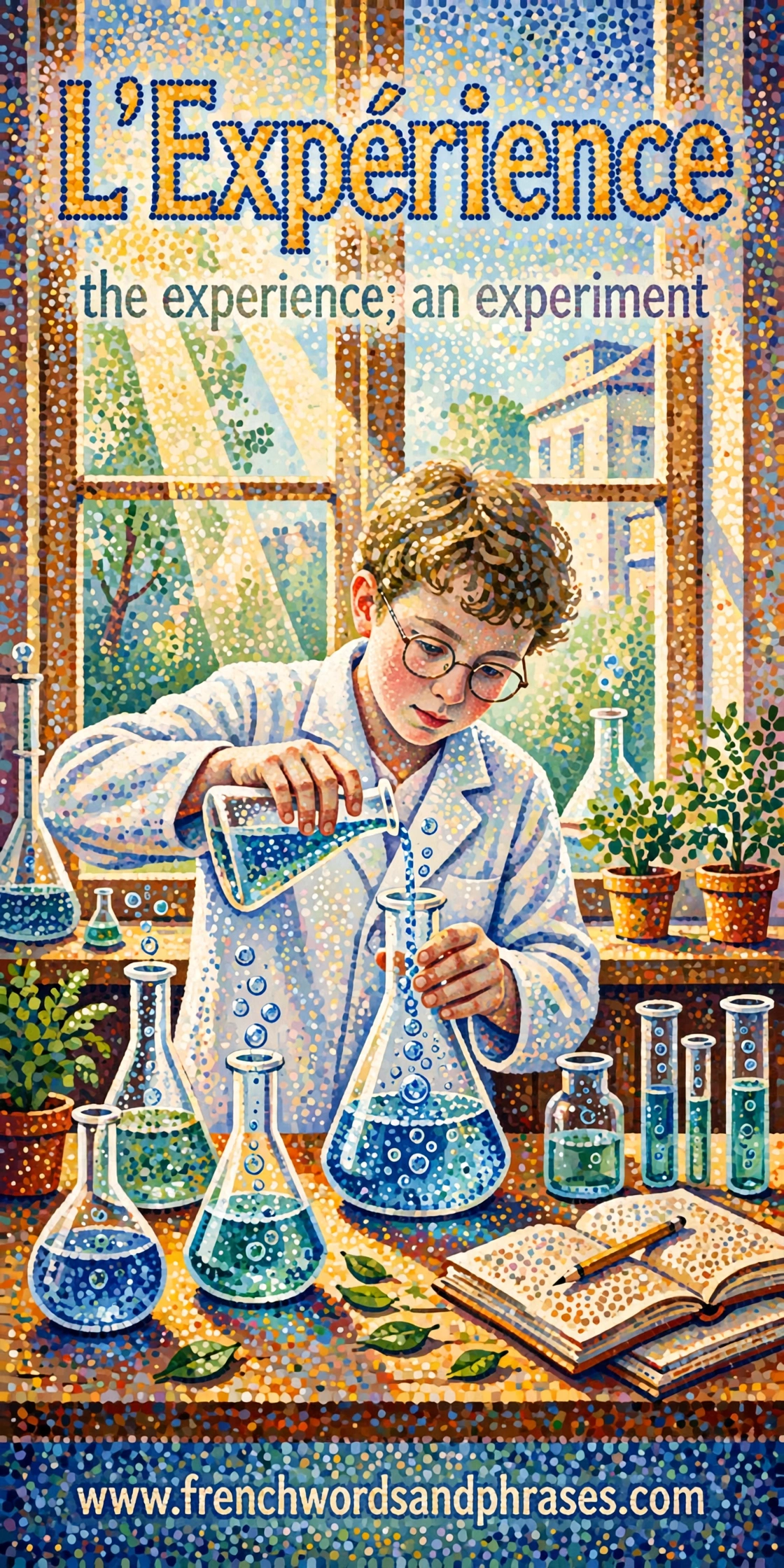
L’Expérience means the experience; an experiment.
In the laboratory, the mixture turns blue exactly as predicted; in the job interview, twenty years of work are summed up in one word: l’expérience — the experience, and the experiment: what life teaches you, and what the scientist tests.
In this guide, you’ll learn what expérience means in English, how to use it with its articles, how to form its plural, and how it appears in everyday French. Explore French examples, English translations, and practice quizzes.
Understanding the French Noun Expérience
Expérience is a feminine French noun, learned with its article: l’expérience, une expérience. It begins with a vowel, so the article melts into it: l’expérience, never la expérience. It comes from the Latin experientia, knowledge gained by trying — and French, unlike English, keeps one word for both the trying (the experiment) and the knowledge (the experience).
It means experience — the knowledge life gives: avoir de l’expérience, to have experience, une expérience professionnelle, professional experience, l’expérience montre que…, experience shows that… It also means an experiment: faire une expérience, to do an experiment, une expérience de chimie, a chemistry experiment. And it names the lived events themselves: une expérience inoubliable, an unforgettable experience, une première expérience, a first experience.
Gender: Feminine — l’expérience
Definite article: l’ — l’expérience (the experience), melted before the vowel
Indefinite article: une — une expérience (an experience, an experiment)
Plural: les expériences — regular, with a simple -s
Spelling note: from Latin experientia, knowledge gained by trying — one word for experiment and experience
Watch the possessives: expérience is feminine but vowel-initial: mon expérience, ton expérience, son expérience
English equivalents: The experience; an experiment.
The double life is the whole lesson: faire une expérience in a laboratory is to do an experiment, but avoir de l’expérience in a job is to be experienced. On a CV, the section is headed expérience professionnelle. And to learn from life, French says apprendre par l’expérience — the school nobody graduates from.
Experience the Word
Expérience is knowledge with scars and diplomas both — what the laboratory proves and what the years teach, in a single word.
Imagine the old chemist and the young graduate side by side at the bench: she has the fresh theory, he has forty years of explosions remembered. Between them, l’expérience does its double work — the experiment on the bench, and the experience behind the eyes.
You have not just named a test. You have named learning itself — l’expérience, the experience, tried and known.
How to Use Expérience in French: Complete Guide
Let’s explore how expérience works in French, beginning with its articles — l’expérience, une expérience, faire une expérience.
Expérience with the Definite Article (L’, Les)
Used for experience in general, or a specific experiment. The vowel opening makes la melt into l’.
| Form | French |
|---|---|
| Feminine singular | l’expérience |
| Plural | les expériences |
Example
L’expérience montre que la patience paie.
Experience shows that patience pays.
Expérience with the Indefinite Article (Une, Des)
Used for one experience or one experiment — in life or in the laboratory.
| Form | French |
|---|---|
| Feminine singular | une expérience |
| Plural | des expériences |
Example
Les élèves font une expérience de chimie.
The pupils are doing a chemistry experiment.
Expérience with the Partitive (De l’expérience…)
Experience as a quality takes the partitive: some experience, a lot of experience, no experience.
| Quantity | French |
|---|---|
| some experience | de l’expérience |
| a lot of experience | beaucoup d’expérience |
| ten years of experience | dix ans d’expérience |
| professional experience | une expérience professionnelle |
| no experience (after negation) | pas d’expérience |
Example
Ce poste demande beaucoup d’expérience.
This job requires a lot of experience.
Quick Quiz 1
Complete the sentence:
______ expérience de chimie commence dans cinq minutes. (the)
Reveal the answer
L’
L’expérience de chimie commence dans cinq minutes.
The chemistry experiment starts in five minutes — la melts into l’ before the vowel.
The Plural of Expérience
Expérience takes a regular plural in -s — experiments in the lab, experiences in a life.
| Number | French |
|---|---|
| Singular | l’expérience |
| Plural | les expériences |
Example
Les expériences ont confirmé la théorie.
The experiments confirmed the theory.
Expérience with Possessive Adjectives (Mon, Ton, Son…)
Expérience is feminine but begins with a vowel, so the singular possessives borrow the masculine forms: mon, ton, son — the words must flow.
| Owner | French |
|---|---|
| my | mon expérience |
| your (tu) | ton expérience |
| his / her | son expérience |
| our | notre expérience |
| your (vous) | votre expérience |
| their | leur expérience |
Example
Son expérience de pilote impressionne tout le monde.
His experience as a pilot impresses everyone.
Quick Quiz 2
Complete the sentence:
Elle raconte ______ expérience de voyage aux enfants. (her)
Reveal the answer
son
Elle raconte son expérience de voyage aux enfants.
She tells the children about her travel experience — son, because expérience begins with a vowel.
Expérience with Demonstrative Adjectives (Cette, Ces)
Used to point: cette expérience, this experience — the one being discussed.
| Form | French |
|---|---|
| Feminine singular | cette expérience |
| Plural | ces expériences |
Example
Cette expérience a changé sa vie.
This experience changed her life.
Expérience with Adjectives
Adjectives agree with expérience — feminine singular: une expérience inoubliable, une expérience réussie.
| Adjective | With Expérience |
|---|---|
| inoubliable (unforgettable) | une expérience inoubliable |
| professionnelle (professional) | une expérience professionnelle |
| réussie (successful) | une expérience réussie |
| première (first) | une première expérience |
| scientifique (scientific) | une expérience scientifique |
Example
Ce voyage a été une expérience inoubliable.
That trip was an unforgettable experience.
Quick Quiz 3
Complete the sentence:
C’était une expérience vraiment ______. (unforgettable)
Reveal the answer
inoubliable
C’était une expérience vraiment inoubliable.
It was a truly unforgettable experience — inoubliable has the same form for masculine and feminine.
Everyday Expressions with Expérience
Laboratories, careers and journeys — the expérience phrases of daily life.
| Expression | In English |
|---|---|
| faire une expérience | to do an experiment |
| avoir de l’expérience | to have experience, to be experienced |
| l’expérience professionnelle | professional experience (on a CV) |
| apprendre par l’expérience | to learn by experience |
| une expérience inoubliable | an unforgettable experience |
Example
On apprend souvent par l’expérience, pas par les livres.
We often learn by experience, not from books.
Words from the Same Family as Expérience
Trying and knowing — the words that travel with expérience.
| French | In English |
|---|---|
| expérimenter | to experiment, to test (the verb) |
| expérimental | experimental (the adjective) |
| un essai | a test, a try, an essay |
| éprouver | to feel, to experience (an emotion) |
| le vécu | lived experience |
Example
La méthode expérimentale repose sur des expériences répétées.
The experimental method rests on repeated experiments.
Quick Quiz 4
Faire une expérience — experiment or experience?
Reveal the answer
An experiment — faire une expérience is to carry out a test; to be experienced is avoir de l’expérience.
Les élèves font une expérience dans le laboratoire.
The pupils are doing an experiment in the laboratory.
Expérience in Everyday French: Real-Life Examples
Now that you know the word, let’s see how expérience appears in everyday French.
Example 1 — In the lab
L’expérience montre que le métal rouille.
The experiment shows that the metal rusts.
Example 2 — At work
Elle a dix ans d’expérience dans la vente.
She has ten years of experience in sales.
Example 3 — Travel
Ce voyage a été une expérience inoubliable.
That trip was an unforgettable experience.
Example 4 — A job advert
Expérience exigée pour ce poste : cinq ans.
Experience required for this post: five years.
Example 5 — Learning
Les enfants apprennent par l’expérience.
Children learn by experience.
Example 6 — Science class
Demain, nous faisons une expérience sur les plantes.
Tomorrow we are doing an experiment on plants.
Beyond Translation: The Meaning of Expérience
English split the Latin inheritance in two — experiment for the laboratory, experience for life — but French kept the original unity, and the unity is a philosophy: all knowledge comes from trying. The scientist’s expérience and the grandmother’s expérience are the same word because, to the French ear, they are the same thing at different speeds: life is the long experiment, and the laboratory is life with the variables controlled.
To say expérience is to say: I tried, therefore I know.
It evokes the blue flame in the school lab, the CV’s proudest section, and the traveller’s story that begins « quelle expérience ! »
How to Remember the French Noun Expérience
Remember it this way: Expérience is both the experience and the experiment — feminine, vowel first: l’expérience, and the possessives are mon, ton, son.
- Feminine, vowel first — l’expérience, une expérience, cette expérience.
- The double life — faire une expérience, to do an experiment; avoir de l’expérience, to be experienced.
- The borrowed possessives — mon expérience, never ma expérience.
The key idea is l’expérience — the experience and the experiment, feminine; one word for both.
Test Your Knowledge of Expérience
Let’s see how much you’ve learned. Try answering these questions before revealing the answers.
Question 1
Is expérience masculine or feminine?
Reveal the answer
Feminine — l’expérience, une expérience.
Question 2
How do you say to do an experiment?
Reveal the answer
Faire une expérience.
Question 3
Translate: She has ten years of experience in sales.
Reveal the answer
Elle a dix ans d’expérience dans la vente.
Question 4
Why do we say mon expérience and not ma expérience?
Reveal the answer
Because expérience begins with a vowel — the feminine possessive borrows the masculine form so the words flow.
Question 5
Complete the sentence:
______ expériences ont confirmé la théorie. (the)
Reveal the answer
Les
Les expériences ont confirmé la théorie.
The experiments confirmed the theory.
Your Final Challenge
Can You Use It?
How would you say this in French?
“Children learn by experience.”
Reveal the answer
Les enfants apprennent par l’expérience.
Children learn by experience.
A little French. A little curiosity. A richer everyday life.
LEARN FRENCH ONE WORD AT A TIME