A French Word to Live By
Translate Évier to English
/e.vje/
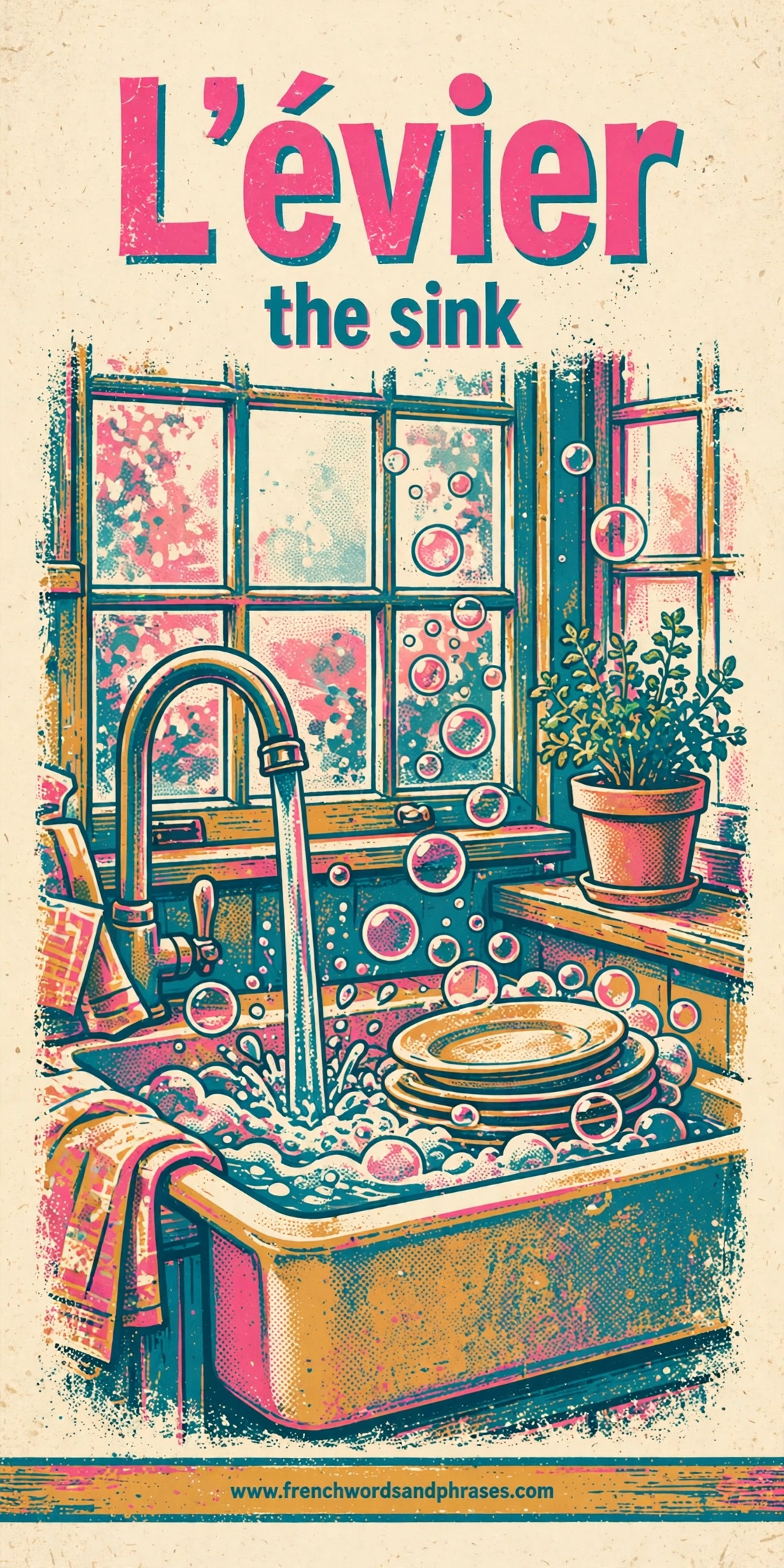
L’évier means the sink.
Dinner is over, the plates are stacked high, the tap is running, and someone has to roll up their sleeves. Everything in that moment gathers around one word — l’évier.
In this guide, you’ll learn what évier means in English, how to use it with its articles, how to form its plural, and how it appears in everyday French. Explore French examples, English translations, and practice quizzes.
Understanding the French Noun Évier
Évier is a masculine French noun that begins with a vowel, so the article melts into it: l’évier, never « le évier ». Learn it with its article, as one block: l’évier, un évier, les éviers.
It means the sink — the kitchen sink, with its tap, its basin and its pile of waiting dishes. Careful: French keeps a second word for the bathroom, le lavabo, the washbasin where you brush your teeth. The évier belongs to the kitchen: it is where the vaisselle (the washing-up) happens.
Gender: Masculine — l’évier
Definite article: l’ — l’évier (the sink), because évier starts with a vowel
Indefinite article: un — un évier (a sink)
Plural: les éviers
Not to confuse: le lavabo — the bathroom sink, the washbasin
Typical partner: le robinet — the tap that stands over it
English equivalents: The sink (the kitchen sink).
Two traps in one small word. First, the elision: évier starts with a vowel, so le becomes l’ — l’évier — and the demonstrative becomes cet évier. Second, the room: washing dishes happens in l’évier, washing your face happens in le lavabo. English uses « sink » for both; French does not.
Experience the Word
Évier is the true centre of the French kitchen. The stove gets the glory, but the évier gets the work — every meal begins and ends in front of it.
Imagine the farmhouse évier of old: a great slab of stone under a small window, cold water, a pump handle, and three generations of hands washed in the same place.
You have not just done the dishes. You have kept the kitchen’s heart beating — un évier à la fois.
How to Use Évier in French: Complete Guide
Let’s explore how évier works in French, beginning with its articles — l’évier, un évier, des éviers — and remember: it is masculine, even behind its l’.
Évier with the Definite Article (L’, Les)
Because évier starts with a vowel, le shrinks to l’ — the sink you are looking at.
| Form | French |
|---|---|
| Masculine singular (before a vowel) | l’évier |
| Plural | les éviers |
Example
L’évier est plein de vaisselle sale.
The sink is full of dirty dishes.
Évier with the Indefinite Article (Un, Des)
Un évier for one sink in general — the one in the catalogue, the one in your dream kitchen.
| Form | French |
|---|---|
| Masculine singular | un évier |
| Plural | des éviers |
Example
La nouvelle cuisine a un évier en inox immense.
The new kitchen has a huge stainless-steel sink.
Évier with the Partitive and Quantities (Un évier plein de…)
Sinks are measured by what fills them — here is the évier in portions and quantities.
| Quantity | French |
|---|---|
| a sink full of dishes | un évier plein de vaisselle |
| a sink of hot water | un évier d’eau chaude |
| half of the sink | la moitié de l’évier |
| the whole sink | tout l’évier |
| under the sink | sous l’évier |
Example
Elle remplit un évier d’eau chaude pour faire la vaisselle.
She fills a sink with hot water to do the washing-up.
Quick Quiz 1
Complete the sentence:
L’évier est ______ : il faut appeler le plombier. (blocked)
Reveal the answer
bouché
L’évier est bouché : il faut appeler le plombier.
The sink is blocked: we need to call the plumber.
The Plural of Évier
Évier adds a simple -s in the plural — les éviers, in showrooms and big restaurant kitchens.
| Number | French |
|---|---|
| Singular | l’évier |
| Plural | les éviers |
Example
Les éviers en inox sont faciles à nettoyer.
Stainless-steel sinks are easy to clean.
Évier with Possessive Adjectives (Mon, Ton, Son…)
Évier is masculine, so the possessives are mon, ton, son — even before its vowel.
| Owner | French |
|---|---|
| my | mon évier |
| your (tu) | ton évier |
| his / her | son évier |
| our | notre évier |
| your (vous) | votre évier |
| their | leur évier |
Example
Ton évier brille, on dirait un neuf !
Your sink is sparkling, it looks brand new!
Quick Quiz 2
Complete the sentence:
Mets les assiettes dans ______ évier. (the)
Reveal the answer
l’
Mets les assiettes dans l’évier.
Put the plates in the sink — before a vowel, le becomes l’.
Évier with Demonstrative Adjectives (Cet, Ces)
Used to point: cet évier — ce becomes cet before a vowel.
| Form | French |
|---|---|
| Masculine singular (before a vowel) | cet évier |
| Plural | ces éviers |
Example
Cet évier est trop petit pour les grandes casseroles.
This sink is too small for the big saucepans.
Évier with Adjectives
Adjectives agree with évier — masculine singular: un évier plein, un évier bouché.
| Adjective | With Évier |
|---|---|
| plein (full) | un évier plein |
| bouché (blocked) | un évier bouché |
| propre (clean) | un évier propre |
| profond (deep) | un évier profond |
| en inox (stainless steel) | un évier en inox |
Example
Après le dîner, il y a toujours un évier plein à vider.
After dinner, there is always a full sink to empty.
Quick Quiz 3
Complete the sentence:
On lave la vaisselle dans ______. (the sink)
Reveal the answer
l’évier
On lave la vaisselle dans l’évier.
We wash the dishes in the sink — the kitchen sink, not the lavabo.
Everyday Expressions with Évier
Blockages, rinsing and the cupboard underneath — the évier phrases of daily life.
| Expression | In English |
|---|---|
| faire la vaisselle dans l’évier | to do the washing-up in the sink |
| l’évier est bouché | the sink is blocked |
| sous l’évier | under the sink |
| rincer les verres dans l’évier | to rinse the glasses in the sink |
| vider l’évier | to empty the sink |
| le bord de l’évier | the edge of the sink |
Example
L’évier est bouché, l’eau ne part plus !
The sink is blocked, the water won’t drain away!
Words from the Same Family as Évier
Taps, dishes and draining racks — the words that live around the évier.
| French | In English |
|---|---|
| le lavabo | the bathroom sink, the washbasin |
| le robinet | the tap |
| la vaisselle | the dishes, the washing-up |
| l’égouttoir | the draining rack |
| le plombier | the plumber |
| égoutter | to drain, to drip-dry |
Example
Le robinet de l’évier goutte toute la nuit.
The sink tap drips all night.
Quick Quiz 4
What is the difference between l’évier and le lavabo?
Reveal the answer
L’évier is the kitchen sink; le lavabo is the bathroom washbasin.
On fait la vaisselle dans l’évier et on se brosse les dents au-dessus du lavabo.
We do the washing-up in the sink and brush our teeth over the washbasin.
Évier in Everyday French: Real-Life Examples
Now that you know the word, let’s see how évier appears in everyday French.
Example 1 — After dinner
L’évier est plein, je fais la vaisselle.
The sink is full, I’ll do the washing-up.
Example 2 — A blockage
L’évier est bouché, appelle le plombier !
The sink is blocked, call the plumber!
Example 3 — Under the sink
Les produits de nettoyage sont sous l’évier.
The cleaning products are under the sink.
Example 4 — A new kitchen
Je rêve d’un grand évier en inox.
I dream of a big stainless-steel sink.
Example 5 — Rinsing
Rince les verres dans l’évier, s’il te plaît.
Rinse the glasses in the sink, please.
Example 6 — Overflowing
Attention, l’évier déborde !
Careful, the sink is overflowing!
Beyond Translation: The Meaning of Évier
The évier carries centuries of kitchen history: in old French farmhouses it was a slab of hollowed stone set under the window, sometimes with nothing more than a bucket beneath it, and the whole household’s water life turned around it. The modern évier en inox, double-bowled and gleaming, is its direct heir.
To say l’évier is to stand where every French meal truly begins and ends.
It evokes rolled-up sleeves, steaming water, the clink of plates — and the quiet satisfaction of an évier vide at the end of the evening.
How to Remember the French Noun Évier
Remember it this way: Évier starts with a vowel, so the article melts into it: l’évier — and behind that l’, the word is firmly masculine: un évier, mon évier.
- The kitchen sink — l’évier, masculine despite the l’.
- The tap above it — le robinet de l’évier.
- The bathroom? That is le lavabo, not l’évier.
The key idea is l’évier — the kitchen sink (masculine).
Test Your Knowledge of Évier
Let’s see how much you’ve learned. Try answering these questions before revealing the answers.
Question 1
How do you say « the sink » (in the kitchen) in French?
Reveal the answer
L’évier. — masculine, with l’ because it starts with a vowel.
Question 2
What is le lavabo?
Reveal the answer
The bathroom sink, the washbasin — not the kitchen sink, which is l’évier.
Question 3
Translate: The sink is blocked.
Reveal the answer
L’évier est bouché.
Question 4
Complete the sentence:
Mets les assiettes dans ______ évier.
Reveal the answer
l’
Mets les assiettes dans l’évier.
Put the plates in the sink.
Question 5
What is le robinet?
Reveal the answer
The tap — the tap that stands over the évier.
Your Final Challenge
Can You Use It?
How would you say this in French?
“The sink is full of dirty dishes.”
Reveal the answer
L’évier est plein de vaisselle sale.
The sink is full of dirty dishes.
A little French. A little curiosity. A richer everyday life.
LEARN FRENCH ONE WORD AT A TIME