A French Word to Live By
Translate Être bourré to English
/ɛtʁ bu.ʁe/
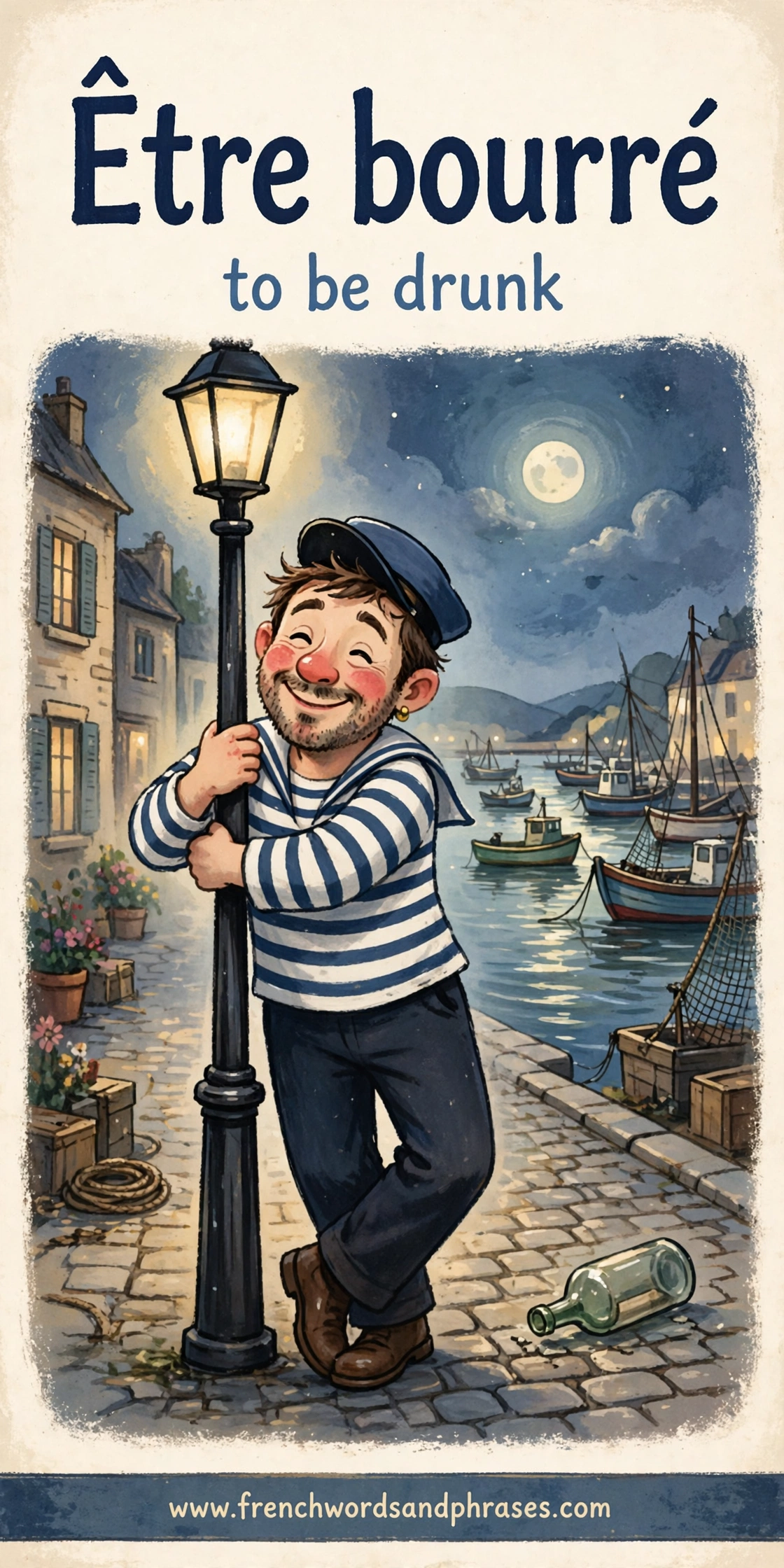
Être bourré means to be drunk — to be completely plastered after drinking far too much.
The wedding has reached the stage where the dancing is enthusiastic and the speeches have stopped making sense. The best man attempts to stand on a chair to toast the couple, misses the chair twice, and sits down hard on the floor, delighted with himself. His sister leans over and gives the official diagnosis: « Laisse-le, il est complètement bourré. »
Let’s explore how être bourré works in French, beginning with the whole phrase on one card.
Understanding the French Phrase Être bourré
Être bourré is a French idiomatic expression built from être (to be) and bourré (stuffed, crammed full — the past participle of bourrer, to stuff). The picture is of a person filled up to the brim, like a suitcase sat on and zipped by force — except what he has been stuffed with is wine. It is the everyday slang word for drunk in French.
It means to be drunk — properly, thoroughly drunk, not merely merry. Nobody is packing luggage: bourré describes anything crammed beyond its reasonable capacity, and the drinker has reached exactly that state. French has a whole cellar of words for drunkenness, graded from tipsy to unconscious; bourré sits near the strong end, and it is the word friends actually use.
Type: Idiomatic expression — state (être + past participle)
Answers the need: Saying someone is thoroughly drunk, in everyday slang
Register: Familiar slang — the standard spoken word for drunk among friends; neutral writing prefers ivre
Strength: Strong — not tipsy, but properly plastered
One important usage detail: bourré agrees like an ordinary adjective — elle est bourrée, ils sont bourrés. And keep the family apart: bourré de means stuffed full of something else entirely, as in un texte bourré de fautes, a text riddled with mistakes. For the state of drunkenness, bourré stands alone after être.
Experience the Word
Être bourré is drunkenness described as overpacking — the man has been filled past his capacity, and the zip has been forced.
Imagine the village fête at midnight: the mayor’s deputy is dancing with great commitment and no rhythm, singing a song whose words left him an hour ago. Nobody reaches for the formal word ivre. The verdict travels round the square in the slang the occasion deserves: il est bourré, and everybody, including the deputy, agrees.
French grades its drunkenness like its cheeses. Bourré is the ripe end of the scale — soft at the edges, unmistakable, and best handled sitting down.
How to Use Être bourré in French: Complete Guide
Let’s explore how être bourré works in French, beginning with the whole phrase on one card.
Être bourré at a Glance
The Whole Phrase on One Card
Real meaning, literal picture, English twin and register — être bourré in five lines.
| Point | Être bourré |
|---|---|
| What it really means | to be drunk — thoroughly, properly drunk |
| Word for word | to be stuffed, crammed full — filled to the brim with drink |
| English equivalent | to be plastered / to be wasted / to be drunk |
| Register | familiar slang — the everyday spoken word; ivre for neutral writing |
| Use it for | weddings, parties, fêtes — drunkenness observed among friends |
Example
Après la fête, il était complètement bourré.
After the party, he was completely plastered.
Word by Word: Building the Stuffed Drinker
Two small pieces — take them one by one and the suitcase is already bursting.
| Word | Literal meaning | Its job in the phrase |
|---|---|---|
| être | to be | the state verb — drunkenness as a condition, not an action |
| bourré | stuffed, crammed full | the past participle of bourrer, to stuff — filled past capacity; it agrees: bourrée, bourrés |
Example
Elle était bourrée et chantait faux avec bonheur.
She was plastered and singing happily out of tune.
Quick Quiz 1
What is the literal picture inside bourré?
Reveal the answer
Something stuffed full — bourrer is to cram and stuff; the drinker is filled to the brim.
Une valise bourrée ne ferme plus ; un homme bourré non plus, en un sens.
An overstuffed suitcase won’t close; nor, in a sense, will a plastered man.
When You Say It: The Drunken Moments
Être bourré fires at moments like these — the party is advanced, and somebody has gone well past merry.
| Situation | Example |
|---|---|
| The wedding guest | le témoin est bourré, il danse sur la table — the best man is plastered, he’s dancing on the table |
| The diagnosis | ne le laisse pas conduire, il est bourré — don’t let him drive, he’s drunk |
| The confession | j’étais bourré, je ne me souviens de rien — I was wasted, I remember nothing |
| The group verdict | à minuit, ils étaient tous bourrés — by midnight, they were all plastered |
| The morning after | il était tellement bourré qu’il a dormi dans le jardin — he was so drunk he slept in the garden |
Example
Il est bourré, appelle-lui un taxi.
He’s drunk, call him a taxi.
Make It Yours: The State for Every Drinker
Être conjugates and bourré agrees — bourrée for her, bourrés for them.
| Form | French | In English |
|---|---|---|
| He is drunk | il est bourré | he is plastered |
| She is drunk | elle est bourrée | she is plastered |
| They were drunk | ils étaient bourrés | they were plastered |
| Completely drunk | complètement bourré | completely wasted |
| Drunk as anything | bourré comme un coing | stuffed like a quince — very drunk (humorous) |
| Question | tu es bourré ? | are you drunk? |
Example
Bourré comme un coing, il a chanté tout le trajet.
Drunk as anything, he sang the whole way home.
Quick Quiz 2
How does bourré change for a woman — elle est bourré or elle est bourrée?
Reveal the answer
Elle est bourrée — bourré agrees like an ordinary adjective, with -e for feminine and -s for plural.
Elles étaient bourrées avant même le dessert.
They were plastered before even the dessert.
Everyday Expressions: Building on the Stuffing
Être bourré slots into these everyday frames — each one ready to use as it stands.
| Frame | In English |
|---|---|
| être bourré | to be plastered |
| être complètement bourré | to be completely wasted |
| être bourré comme un coing | to be drunk as a lord (humorous) |
| rentrer bourré | to come home drunk |
| bourré dès le premier verre | drunk from the first glass — no resistance at all |
Example
Il rentre bourré à chaque fête de village, c’est une tradition.
He comes home drunk from every village fête, it’s a tradition.
Close Cousins: The Cellar of Drunkenness
French grades its drunkenness with care — bourré is near the strong end; its cousins run from the first glow to the formal report.
| Expression | The difference |
|---|---|
| être bourré | to be plastered — familiar slang, the everyday strong word |
| être ivre | to be drunk — the neutral, formal word of reports and literature |
| être soûl | to be drunk — very common, a small notch softer than bourré |
| être pompette | to be tipsy — the gentle first stage, merry and light |
| être rond comme une queue de pelle | to be roaring drunk — old, humorous slang, round as a spade handle |
| avoir un coup dans l’aile | to be a bit drunk — dated and joking, ‘a shot in the wing’ |
Example
Pompette à neuf heures, bourrée à minuit : la soirée a suivi le programme.
Tipsy at nine, plastered by midnight: the evening followed the programme.
Quick Quiz 3
A police report describes the driver. Which word does it use — bourré or ivre?
Reveal the answer
Ivre — the neutral, official word. Bourré is the slang of friends and parties.
Le conducteur était ivre, dit le rapport ; « bourré », disent ses amis.
The driver was drunk, says the report; ‘plastered’, say his friends.
Être bourré and Its Neighbours
The cellar shelf around the phrase — the drinking, the state, and the morning that follows.
| French | In English |
|---|---|
| boire | to drink |
| ivre | drunk — the formal word |
| une cuite | a drinking bout — prendre une cuite, to get drunk |
| la gueule de bois | the hangover — literally ‘the wooden face’ |
| dessoûler | to sober up |
| un verre de trop | one glass too many |
Example
Après la cuite, la gueule de bois ; il faudra dessoûler avant midi.
After the drinking bout, the hangover; he’ll have to sober up before noon.
Watch Out: The Traps Around Être bourré
The traps: a participle with a second career, a near-twin who executes people, and agreement that cannot be skipped.
| Trap | The truth |
|---|---|
| bourré de is different | un texte bourré de fautes is a text stuffed with mistakes — bourré de + noun means crammed with that thing, not drunk |
| bourré is not bourreau | un bourreau is an executioner or a tormentor — one letter’s difference, a whole gallows apart |
| agreement is compulsory | elle est bourrée, ils sont bourrés — bourré behaves like any adjective after être |
| stronger than tipsy | for the first merry stage, French says pompette or éméché; bourré announces the advanced state |
Example
Son discours était bourré de chiffres, et lui, un peu bourré aussi.
His speech was stuffed with figures, and he was a little plastered too.
Quick Quiz 4
True or false: un rapport bourré de fautes means the report was drunk.
Reveal the answer
False — bourré de fautes means stuffed with mistakes. Drunkenness is être bourré, standing alone.
Le rapport n’est pas ivre, il est bourré de fautes.
The report isn’t drunk, it’s riddled with mistakes.
Être bourré in Everyday French: Real-Life Examples
Now that you know the word, let’s see how être bourré appears in everyday French.
Example 1 — The wedding
Le témoin était bourré avant même le dessert.
The best man was plastered before even the dessert.
Example 2 — The warning
Ne le laisse pas conduire, il est complètement bourré.
Don’t let him drive, he’s completely drunk.
Example 3 — The confession
J’étais bourré, je ne me rappelle plus la fin de la soirée.
I was wasted, I don’t remember the end of the evening.
Example 4 — The group
À la fin de la fête, tout le monde était un peu bourré.
By the end of the party, everyone was a bit plastered.
Example 5 — The quince
Bourré comme un coing, il a dormi sur le canapé.
Drunk as anything, he slept on the sofa.
Example 6 — The morning after
Il était tellement bourré qu’il a chanté dans le taxi.
He was so drunk that he sang in the taxi.
Beyond Translation: The Meaning of Être bourré
Every language keeps an honest cellar of words for this state, and the French one is unusually well stocked — because the state is observed closely, graded carefully, and judged with humour rather than horror. Bourré earns its place by the picture: not poisoned, not fallen, but stuffed — a man filled the way a suitcase is filled the night before a long journey, by sitting on it.
Être bourré is drunkenness as a packing problem — the contents exceeded the container, and everyone can see the seams strain.
That is why the word belongs to friends. It diagnoses without condemning, and it quietly includes the remedy: what has been stuffed can, by morning, be unpacked.
How to Remember the French Phrase Être bourré
Remember it this way: Être bourré is the drinker as an overpacked suitcase — stuffed past capacity, zipped by force, and unsteady on his feet.
- You picture the suitcase — bourrer is to stuff and cram; the drinker is filled to the brim.
- You agree the adjective — elle est bourrée, ils sont bourrés: bourré dresses for its subject.
- You guard the border — bourré de fautes is stuffed with mistakes, and a bourreau is an executioner. Neither is drunk.
The key idea is être bourré means to be drunk — stuffed to the brim with drink.
Test Your Knowledge of Être bourré
Let’s see how much you’ve learned. Try answering these questions before revealing the answers.
Question 1
What does être bourré mean?
Reveal the answer
To be drunk — thoroughly plastered, in familiar slang.
Question 2
What is the literal picture?
Reveal the answer
To be stuffed full — bourrer means to cram; the drinker is filled past capacity.
Question 3
How do you say ‘she was plastered’?
Reveal the answer
Elle était bourrée — bourré agrees with the feminine: bourrée.
Question 4
What is the formal word a report would use instead?
Reveal the answer
Ivre — the neutral, official word for drunk; bourré is the slang of friends.
Question 5
Complete the sentence:
Après la fête, ils étaient complètement ______. (After the party, they were completely plastered.)
Reveal the answer
bourrés
Après la fête, ils étaient complètement bourrés.
After the party, they were completely plastered.
Your Final Challenge
Can You Use It?
How would you say this in French?
“He was completely drunk.”
Reveal the answer
Il était complètement bourré.
He was completely drunk.
A little French. A little curiosity. A richer everyday life.
LEARN FRENCH ONE WORD AT A TIME