A French Word to Live By
Translate Être to English
/ɛtʁ/
L’être means a being, a creature; being (philosophy).
A child kneels in the grass, nose to nose with a ladybird, and whispers: « Tu es un petit être vivant. » You are a little living being. In that one word — être — the ladybird, the child and the whole of philosophy suddenly share a page.
In this guide, you’ll learn what être means in English, how to use it with its articles, how to form its plural, and how it appears in everyday French. Explore French examples, English translations, and practice quizzes.
Understanding the French Noun Être
Être is a masculine French noun. It is learned together with its article: l’être, un être — the article shrinks to l’ because the word begins with a vowel sound. It is built from the infinitive of the verb être, to be — but as a noun it names a being: a living creature, or, in philosophy, existence itself.
It means a being, a creature: un être humain (a human being), un être vivant (a living being), un être cher (a loved one). Raised to the capital of philosophy, it becomes Being itself: l’être suprême (the Supreme Being), and Sartre’s famous title L’Être et le Néant — Being and Nothingness. One small word stretches from a ladybird to the universe.
Gender: Masculine
Definite article: l’ — l’être (the being)
Indefinite article: un — un être (a being)
Plural: les êtres
English equivalents: A being, a creature; in philosophy, Being, existence.
One important usage detail: être is also the most essential verb in French — être, to be (je suis, I am). On this page, être is the NOUN: it takes an article — un être, l’être — and names a creature or existence itself. And because it starts with a vowel sound, the articles melt in front of it: l’être, never « le être », and les êtres with a liaison — les-z-êtres.
Experience the Word
Être is more than a creature. It is the word French philosophy reaches for when it asks the biggest question there is: why is there something rather than nothing?
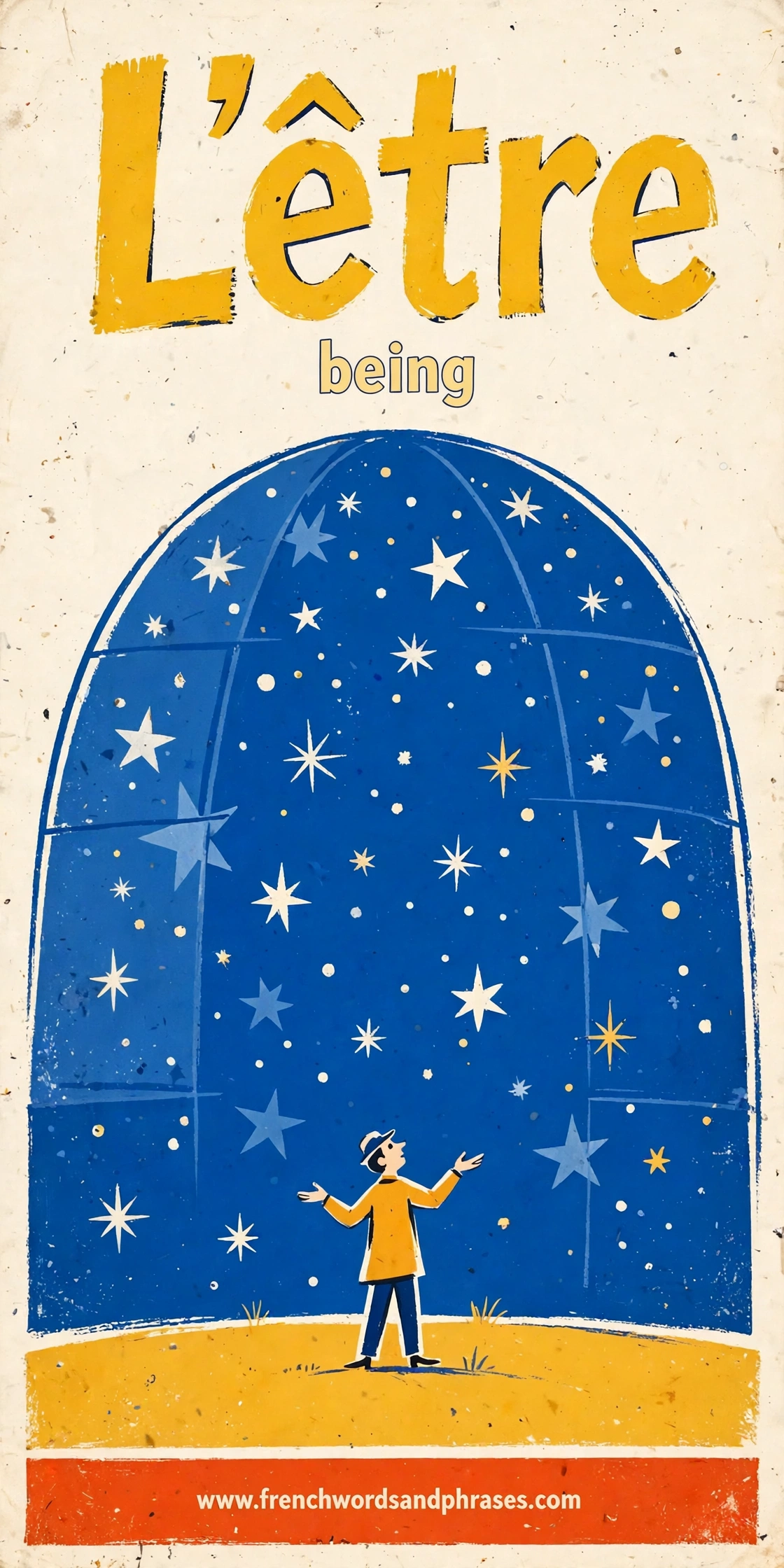
Imagine the night sky over a quiet field: a child, a dog, an owl in the oak, and ten thousand stars. Every one of them, in French, is un être — a being among beings, sharing the same astonishment of existing.
You have not just pointed at a creature. You have named l’être — existence itself, wearing a face.
How to Use Être in French: Complete Guide
Let’s explore how être works in French, beginning with its articles.
Être with the Definite Article (L’, Les)
Used for the being everyone means — and note the article: l’ before the vowel sound.
| Number | French |
|---|---|
| Singular | l’être |
| Plural | les êtres |
Example
L’être humain est un être social.
The human being is a social being.
Être with the Indefinite Article (Un, Des)
Used for a being in general — the creature in the garden, the stranger at the door.
| Number | French |
|---|---|
| Singular | un être |
| Plural | des êtres |
Example
Un être mystérieux vit dans cette forêt.
A mysterious being lives in this forest.
Kinds of Êtres
Human, living, beloved — the beings that fill French sentences.
| French | In English |
|---|---|
| un être humain | a human being |
| un être vivant | a living being |
| un être cher | a loved one, a dear being |
| l’être suprême | the Supreme Being |
| un être sensible | a sensitive being |
| des êtres imaginaires | imaginary beings |
Example
Chaque être vivant mérite le respect.
Every living being deserves respect.
Quick Quiz 1
What is un être humain?
Reveal the answer
A human being — the everyday star of this noun.
Un être humain a besoin d’amour et de respect.
A human being needs love and respect.
The Plural of Être
Être adds an -s in the plural — les êtres, with the liaison sounding the s: les-z-êtres.
| Number | French |
|---|---|
| Singular | l’être |
| Plural | les êtres |
Example
Les êtres vivants partagent la même planète.
Living beings share the same planet.
Être with Possessive Adjectives (Mon, Ton, Son…)
Possessives agree with the noun — and before a vowel sound, even the feminine-looking forms use mon, ton, son: mon être, never « ma être ».
| Owner | French |
|---|---|
| my | mon être |
| your (tu) | ton être |
| his / her | son être |
| our | notre être |
| your (vous) | votre être |
| their | leur être |
Example
Tout son être tremblait d’émotion.
His whole being trembled with emotion.
Quick Quiz 2
Complete the sentence:
______ être tout entier écoutait la musique. (His)
Reveal the answer
Son
Son être tout entier écoutait la musique.
His whole being was listening to the music — son, because être is masculine and begins with a vowel sound.
Être with Demonstrative Adjectives (Cet, Ces)
Used to point: this being here, those beings there — cet, the special form before a vowel sound.
| Number | French |
|---|---|
| Singular | cet être |
| Plural | ces êtres |
Example
Cet être minuscule est une fourmi.
This tiny being is an ant.
Être with Adjectives
Adjectives agree with être, masculine — humain, vivant, suprême.
| Adjective | With Être |
|---|---|
| humain (human) | un être humain |
| vivant (living) | un être vivant |
| suprême (supreme) | l’être suprême |
| étrange (strange) | un être étrange |
| raisonnable (rational) | un être raisonnable |
Example
L’homme est un être raisonnable.
Man is a rational being.
Quick Quiz 3
Complete the sentence:
C’est un être ______. (strange)
Reveal the answer
étrange
C’est un être étrange.
It is a strange being.
Everyday Expressions with Être
Loved ones, depths and philosophy titles — the être phrases of daily life.
| Expression | In English |
|---|---|
| un être cher | a loved one |
| au plus profond de son être | in the depths of one’s being |
| un être humain | a human being |
| les êtres vivants | living beings, living creatures |
| l’être et le néant | being and nothingness (Sartre’s title) |
| un être de lumière | a being of light |
Example
Elle pleure un être cher disparu l’an dernier.
She is mourning a loved one who passed away last year.
Words from the Same Family as Être
Existence, souls and creatures — the words that travel with être. Watch the first one: it is the verb twin.
| French | In English |
|---|---|
| être (verb) | to be — the verb namesake of this noun |
| l’existence | existence |
| exister | to exist |
| la créature | the creature |
| l’âme | the soul |
| le néant | nothingness |
Example
L’existence de ces êtres minuscules fascine les scientifiques.
The existence of these tiny beings fascinates scientists.
Quick Quiz 4
In « un être étrange est entré », why is être a noun here and not the verb?
Reveal the answer
Because it carries the article un and the adjective étrange — the verb être never takes an article.
Un être étrange est entré dans la pièce.
A strange being came into the room.
Être in Everyday French: Real-Life Examples
Now that you know the word, let’s see how être appears in everyday French.
Example 1 — In the garden
La coccinelle est un être vivant comme nous.
The ladybird is a living being like us.
Example 2 — A definition
L’être humain est le seul être qui rit.
The human being is the only being that laughs.
Example 3 — Mourning
Il a perdu un être cher au printemps.
He lost a loved one in the spring.
Example 4 — Deep feeling
Au plus profond de son être, elle le savait.
In the depths of her being, she knew it.
Example 5 — In the forest
Des êtres minuscules vivent sous les feuilles.
Tiny beings live under the leaves.
Example 6 — Philosophy class
Le professeur parle de l’être et du néant.
The teacher is talking about being and nothingness.
Beyond Translation: The Meaning of Être
No French noun carries more philosophy per letter. When Sartre published L’Être et le Néant in 1943, he put this small word on the cover of the century’s most famous French book — and every lycée student in France still meets it in philosophy class. Yet the same word kneels in the grass beside a child and a ladybird: un être vivant.
To say être is to hold the creature and the cosmos in one syllable.
It evokes hospital corridors and philosophy seminars, a loved one’s empty chair and the first page of Genesis — everything that exists, and the mystery that it exists at all.
How to Remember the French Noun Être
Remember it this way: Être the noun is a being — masculine, l’être with the melted article, from the ladybird to Being itself.
- You melt the article — l’être, never le être.
- You meet it daily — un être humain, un être cher.
- You separate the twins — être le nom, a being; être le verbe, to be.
The key idea is un être is a creature — l’être is Being itself.
Test Your Knowledge of Être
Let’s see how much you’ve learned. Try answering these questions before revealing the answers.
Question 1
Is être (the noun) masculine or feminine?
Reveal the answer
Masculine — un être, l’être.
Question 2
How do you say a human being in French?
Reveal the answer
Un être humain — the noun’s most everyday phrase.
Question 3
Translate: Every living being deserves respect.
Reveal the answer
Chaque être vivant mérite le respect.
Question 4
What does un être cher mean?
Reveal the answer
A loved one — a being who is dear to you.
Question 5
Complete the sentence:
______ êtres vivants partagent notre planète. (The)
Reveal the answer
Les
Les êtres vivants partagent notre planète.
Living beings share our planet.
Your Final Challenge
Can You Use It?
How would you say this in French?
“Every living being deserves respect.”
Reveal the answer
Chaque être vivant mérite le respect.
Every living being deserves respect.
A little French. A little curiosity. A richer everyday life.
LEARN FRENCH ONE WORD AT A TIME