A French Word to Live By
Translate Étrange to English
/e.tʁɑ̃ʒ/
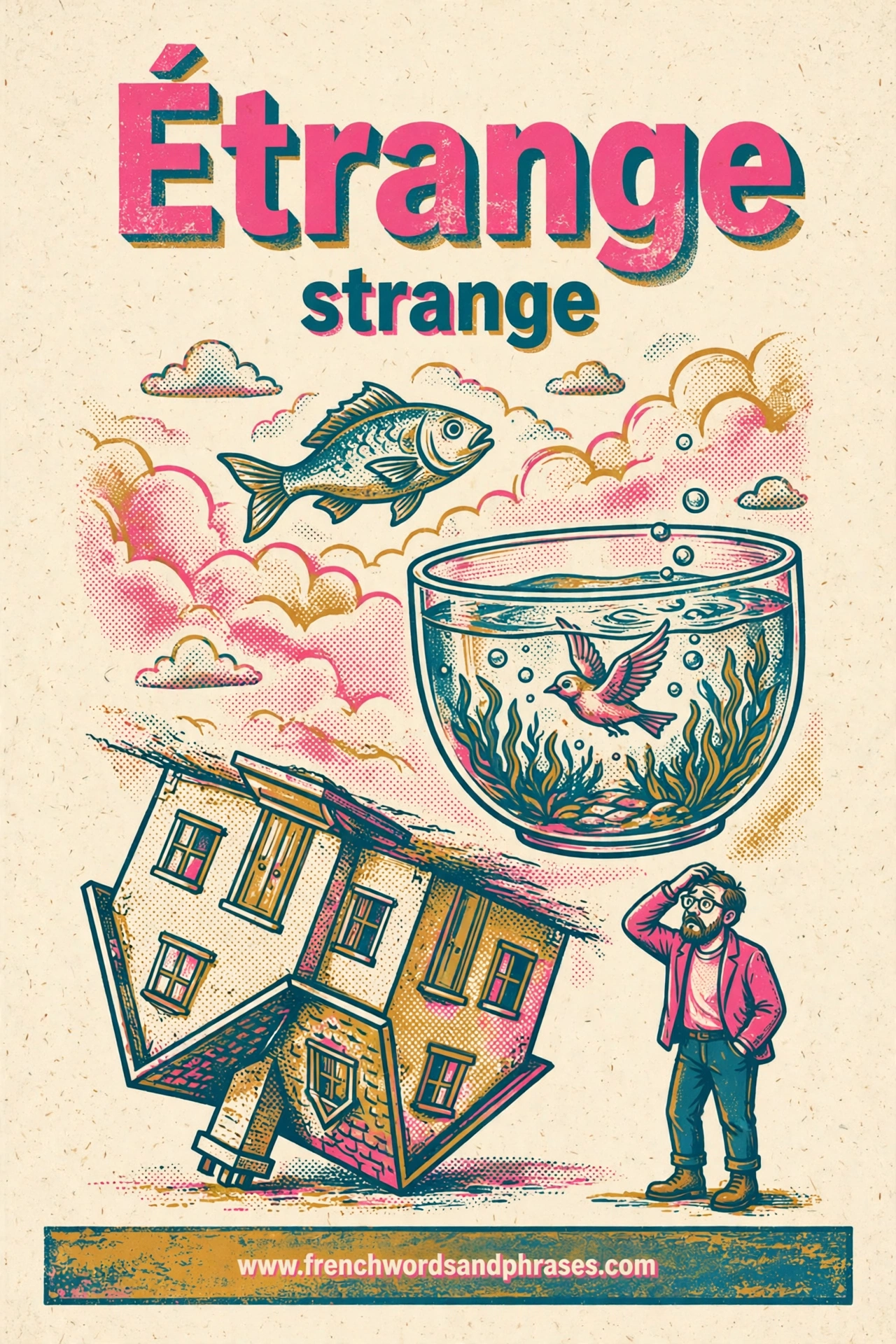
Étrange means strange.
A door in your own house that you have never noticed, a familiar street in fog, a silence where a noise should be: étrange, strange — the feeling that the world is the same and yet not the same at all.
In this guide, you’ll learn what étrange means in English, why its feminine is exactly the same word, where it stands in the sentence, and how it differs from its cousin étranger. Explore French examples, English translations, and practice quizzes.
Understanding the French Adjective Étrange
Étrange is a French adjective of feeling and judgement. It is the close cousin of étranger — foreign, a stranger — and the two share an old idea: what is étrange comes from outside the familiar, even when it was there all along.
It means strange, odd, uncanny: un bruit étrange, a strange noise; une étrange histoire, a strange story; c’est étrange, that’s odd. It judges anything that does not fit — behaviour, coincidences, feelings: un étrange sentiment, a strange feeling, half-recognised and wholly unexplained.
Type: Adjective of feeling and judgement — the uncanny
Answers the question: What is it like? — strange, odd, not as it should be
Changes form: Invariable in gender — étrange for him and for her; plural étranges
English equivalents: Strange; odd; uncanny; peculiar.
One important usage detail: étrange very often begins the sentence of judgement — c’est étrange que… takes the subjunctive: c’est étrange qu’il ne réponde pas, it’s strange that he doesn’t answer. And do not confuse it with étranger: une langue étrangère is a foreign language, not a strange one.
Experience the Word
Étrange is the shiver of the almost-familiar: the house in fog, the face in the photograph you cannot quite name.
Imagine coming home at night and hearing, from your own empty kitchen, un bruit étrange — one small sound, and the whole house becomes a foreign country.
You have not just named oddity. You have named the uncanny itself — étrange, strange, the familiar turned foreign.
How to Use Étrange in French: Complete Guide
Let’s explore how étrange works in French, beginning with its forms — étrange for both genders, étranges in the plural.
Étrange at a Glance
Before the details, here is the whole word on one card.
The Whole Word on One Card
Étrange in four lines — meaning, type, position, form.
| Point | Étrange |
|---|---|
| Meaning | strange, odd — what does not fit the familiar |
| Type | adjective of feeling and judgement |
| Usual position | after the noun — un bruit étrange; often in c’est étrange |
| Form | étrange for both genders — étranges in the plural |
Example
C’est étrange, cette porte était fermée.
That’s strange, that door was closed.
The Four Forms of Étrange
Étrange ends in -e, so the feminine is the same word; only the plural adds an s.
| Form | Étrange | Example |
|---|---|---|
| Masculine singular | étrange | un bruit étrange — a strange noise |
| Feminine singular | étrange | une histoire étrange — a strange story |
| Masculine plural | étranges | des bruits étranges — strange noises |
| Feminine plural | étranges | des histoires étranges — strange stories |
Example
Des bruits étranges venaient du grenier.
Strange noises were coming from the attic.
Quick Quiz 1
Complete the sentence:
C’est une histoire ______ . (strange)
Reveal the answer
étrange
C’est une histoire étrange.
It is a strange story — étrange does not change for the feminine.
The Feminine of Étrange: The Same Word
Adjectives ending in -e keep one form for both genders.
| Situation | Example |
|---|---|
| Masculine | un sentiment étrange — a strange feeling |
| Feminine | une impression étrange — identical: the -e is already there |
| Why | adjectives ending in -e do not change for the feminine |
| The plural | add s — des impressions étranges, strange impressions |
Example
Elle avait une étrange impression de déjà-vu.
She had a strange feeling of déjà vu.
Where Étrange Goes: After the Noun, and in C’est étrange
Étrange follows its noun, and stars in the judgement formula c’est étrange.
| Pattern | Example |
|---|---|
| After the noun | un bruit étrange — a strange noise |
| Judgement | c’est étrange — that’s strange |
| With que + subjunctive | c’est étrange qu’il soit parti — it’s strange that he left |
| Before the noun | une étrange histoire — common in stories and headlines |
Example
C’est étrange qu’elle ne dise rien.
It’s strange that she says nothing.
Quick Quiz 2
Choose the correct sentence:
(a) C’est étrange qu’il ne répond pas. (b) C’est étrange qu’il ne réponde pas.
Reveal the answer
(b) C’est étrange qu’il ne réponde pas.
After c’est étrange que, French uses the subjunctive: réponde, not répond.
More Étrange: Comparing with Étrange
Comparisons work as usual — plus, moins, aussi before the adjective.
| Degree | Example |
|---|---|
| As strange as | aussi étrange que — as strange as |
| Stranger | plus étrange — stranger, odder |
| Less strange | moins étrange — less strange |
| The strangest (masc.) | le plus étrange — le plus étrange des rêves |
| The strangest (fem.) | la plus étrange — la plus étrange des histoires |
Example
Ce rêve est plus étrange que l’autre.
This dream is stranger than the other.
Everyday Expressions with Étrange
Noises, stories and silences — where étrange lives in daily French.
| Expression | In English |
|---|---|
| un bruit étrange | a strange noise |
| c’est étrange | that’s strange, that’s odd |
| un étrange sentiment | a strange feeling |
| une étrange coïncidence | a strange coincidence |
| étrange, non ? | strange, isn’t it? |
| un silence étrange | a strange silence |
Example
Un silence étrange a suivi l’annonce.
A strange silence followed the announcement.
Quick Quiz 3
What does c’est étrange mean?
Reveal the answer
That’s strange / that’s odd.
C’est étrange, je l’ai vu hier.
That’s strange, I saw him yesterday.
Étrange and Its Neighbours
Near words, from odd to foreign.
| French | In English |
|---|---|
| bizarre | bizarre, weird — the stronger, more colourful cousin |
| curieux | curious; odd (c’est curieux = that’s odd) |
| singulier | singular, peculiar — literary |
| anormal | abnormal |
| étranger | foreign; a stranger — the cousin, not the same word |
| ordinaire | ordinary — the opposite |
Example
Cette langue étrangère n’a rien d’étrange pour lui.
This foreign language has nothing strange about it for him.
Watch Out: The Traps Around Étrange
Four things learners get wrong with étrange.
| Trap | The truth |
|---|---|
| Étrange vs étranger | étrange = strange; étranger = foreign or a stranger — une langue étrangère, a foreign language |
| The feminine | une histoire étrange — no new form: invariable in gender |
| The subjunctive | c’est étrange que… takes the subjunctive: qu’il vienne, not qu’il vient |
| Strength | étrange is milder than bizarre: odd and uncanny, not freakish |
Example
C’est étrange qu’il vienne si tard.
It’s strange that he is coming so late.
Quick Quiz 4
Complete the sentence:
Des lumières ______ brillaient dans le ciel. (strange)
Reveal the answer
étranges
Des lumières étranges brillaient dans le ciel.
Strange lights were shining in the sky — plural étranges.
Étrange in Everyday French: Real-Life Examples
Now that you know the word, let’s see how étrange appears in everyday French.
Example 1 — A noise
J’ai entendu un bruit étrange.
I heard a strange noise.
Example 2 — Judgement
C’est étrange, il ne répond pas.
That’s strange, he is not answering.
Example 3 — A story
Elle raconte une étrange histoire.
She is telling a strange story.
Example 4 — A feeling
J’ai un étrange sentiment ce matin.
I have a strange feeling this morning.
Example 5 — Coincidence
Quelle étrange coïncidence !
What a strange coincidence!
Example 6 — Silence
Un silence étrange régnait dans la maison.
A strange silence reigned in the house.
Beyond Translation: The Meaning of Étrange
Étrange and étranger are one family: the stranger at the gate and the strange noise in the attic both come from outside the circle of the known. French philosophy and poetry love the word — l’étrange is where the familiar world shows its seam, the moment a door you pass every day suddenly looks like a door you have never opened.
Étrange is the adjective of the almost-known.
It asks nothing and explains nothing; it simply points and shivers.
How to Remember the French Adjective Étrange
Remember it this way: Étrange is the strange adjective — one form for him and for her, an s in the plural, and c’est étrange que takes the subjunctive.
- One form for both genders — un bruit étrange, une histoire étrange; plural étranges.
- Not its cousin — étranger means foreign, or a stranger.
- The formula — c’est étrange que + subjunctive: c’est étrange qu’il vienne.
The key idea is étrange means strange; invariable in gender, plural étranges.
Test Your Knowledge of Étrange
Let’s see how much you’ve learned. Try answering these questions before revealing the answers.
Question 1
What is the feminine of étrange?
Reveal the answer
Étrange — identical; adjectives ending in -e do not change.
Question 2
How do you say a strange noise in French?
Reveal the answer
Un bruit étrange.
Question 3
Translate: That’s strange, he is not answering.
Reveal the answer
C’est étrange, il ne répond pas.
Question 4
What is the difference between étrange and étranger?
Reveal the answer
Étrange = strange, odd; étranger = foreign, or a stranger — une langue étrangère is a foreign language.
Question 5
Complete the sentence:
C’est étrange qu’elle ______ si tard. (venir)
Reveal the answer
vienne
C’est étrange qu’elle vienne si tard.
It’s strange that she is coming so late — subjunctive after c’est étrange que.
Your Final Challenge
Can You Use It?
How would you say this in French?
“Strange noises were coming from the attic.”
Reveal the answer
Des bruits étranges venaient du grenier.
Strange noises were coming from the attic.
A little French. A little curiosity. A richer everyday life.
LEARN FRENCH ONE WORD AT A TIME