A French Word to Live By
How to Conjugate Étourdir in French
/e.tuʁ.diʁ/
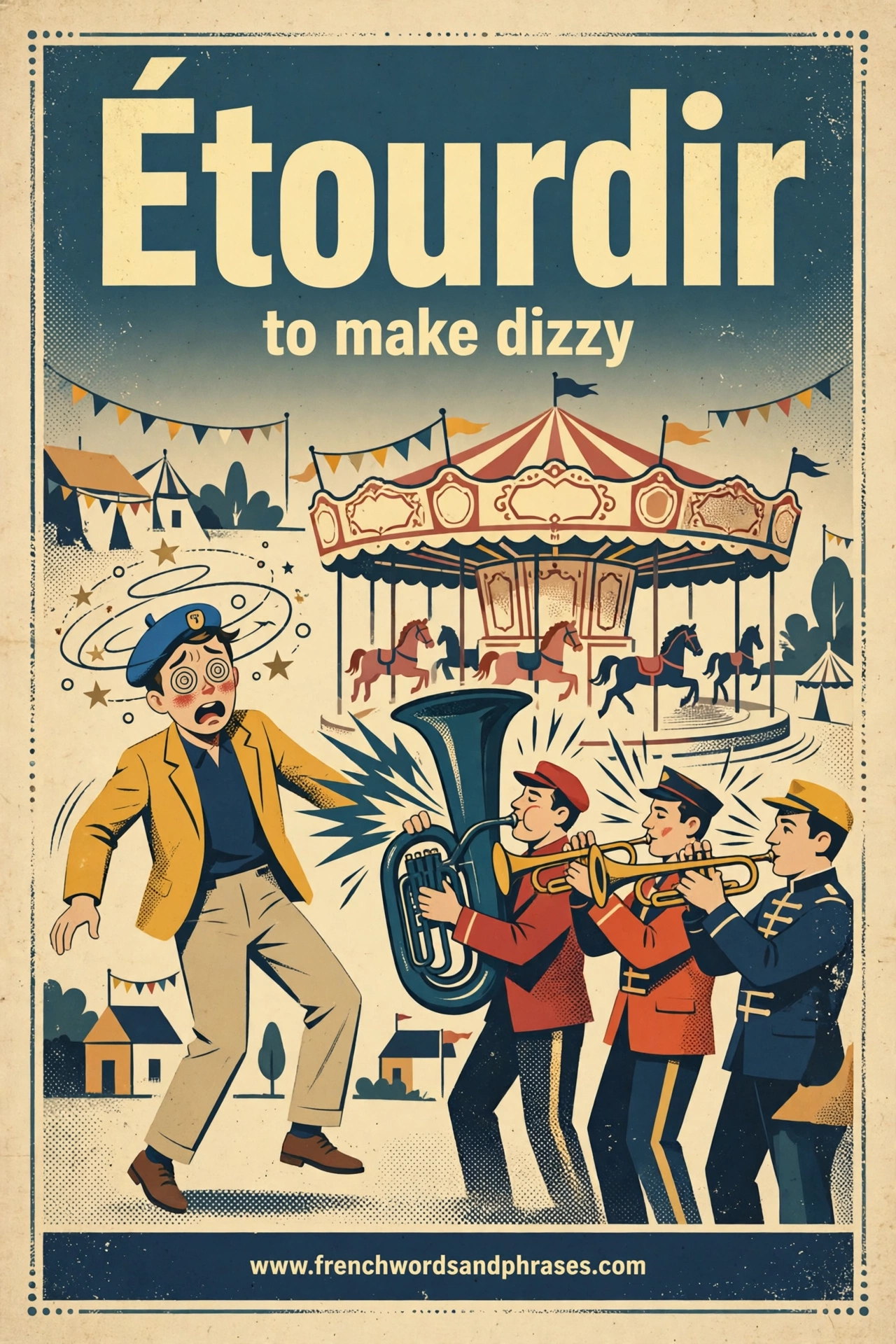
Étourdir means to stun, to deafen, or to make dizzy.
A bell rung too close, a blow on the head, a fairground ride that spins too fast, good news that leaves you reeling — étourdir is the verb of the head that suddenly cannot keep up.
In this guide, you’ll learn how to conjugate étourdir in all the major French tenses and moods. Explore complete conjugation tables, French examples, English translations, and practice quizzes.
Understanding the French Verb Étourdir
Étourdir is a regular French verb belonging to the second group of verbs, those ending in -ir.
It means to stun, to deafen, to make dizzy. It is commonly used for deafening noise, blows that stun, heat and rides that make you dizzy, and figuratively for success or news that goes to your head — le succès l’a étourdi.
Verb classification: Second group (-ir)
Auxiliary verb: Avoir
Past participle: étourdi
Present participle: étourdissant
English equivalents: To stun, to deafen, to make dizzy, to daze.
One important detail: étourdir rarely has a human hand behind it — noises, blows, heat, rides and strong emotions do the stunning: le bruit nous étourdit. Its participle étourdi has wandered off on its own: un étourdi is a scatterbrain, someone whose head is always slightly spinning, and étourdiment means heedlessly, without thinking.
Experience the Word
Étourdir is the verb of the spinning moment — when the world turns a little too fast and you reach for something solid.
Imagine the village fête at midnight. The band is loud, the roundabout is lit like a small sun, and the children stagger off it laughing, holding their heads. Étourdis — happily stunned.
Nothing has hurt you. The world simply spun — and étourdir names the spin.
How to Conjugate Étourdir: Complete French Conjugation Guide
Let’s explore every major conjugation of étourdir, beginning with the indicative mood.
How to Conjugate Étourdir in the Indicative Mood
The indicative mood is used to express facts, observations, actions, and events.
How to Conjugate Étourdir in the Present Tense (Présent)
Used for actions happening now, habitual actions, and general truths.
| Subject | Conjugation |
|---|---|
| je | étourdis |
| tu | étourdis |
| il / elle | étourdit |
| nous | étourdissons |
| vous | étourdissez |
| ils / elles | étourdissent |
Example
Ce bruit constant étourdit tout le monde.
That constant noise deafens everyone.
Quick Quiz 1
Complete the sentence:
Les cloches ______ tout le village.
Reveal the answer
étourdissent
Les cloches étourdissent tout le village.
The bells deafen the whole village.
How to Conjugate Étourdir in the Passé Composé
Used for completed actions in the past. Étourdir takes the auxiliary verb avoir.
| Subject | Conjugation |
|---|---|
| j’ | ai étourdi |
| tu | as étourdi |
| il / elle | a étourdi |
| nous | avons étourdi |
| vous | avez étourdi |
| ils / elles | ont étourdi |
Example
Le coup l’a étourdi un instant.
The blow stunned him for a moment.
How to Conjugate Étourdir in the Imparfait (Imperfect Tense)
Used for habitual past actions, descriptions, and ongoing situations in the past.
| Subject | Conjugation |
|---|---|
| je | étourdissais |
| tu | étourdissais |
| il / elle | étourdissait |
| nous | étourdissions |
| vous | étourdissiez |
| ils / elles | étourdissaient |
Example
La chaleur étourdissait les ouvriers à midi.
The heat used to make the workers dizzy at noon.
Quick Quiz 2
Choose the correct form:
The heat made them dizzy.
La chaleur ______ . (les a étourdis / les est étourdis)
Reveal the answer
les a étourdis
La chaleur les a étourdis.
Étourdir takes avoir, and the participle agrees with the object placed before it.
How to Conjugate Étourdir in the Plus-que-parfait
Used to describe an action that had already been completed before another past event.
| Subject | Conjugation |
|---|---|
| j’ | avais étourdi |
| tu | avais étourdi |
| il / elle | avait étourdi |
| nous | avions étourdi |
| vous | aviez étourdi |
| ils / elles | avaient étourdi |
Example
Le vacarme les avait étourdis dès l’entrée.
The din had deafened them from the moment they entered.
How to Conjugate Étourdir in the Passé Simple
Primarily used in formal writing, literature, and historical narratives. It is rarely used in everyday conversation.
| Subject | Conjugation |
|---|---|
| je | étourdis |
| tu | étourdis |
| il / elle | étourdit |
| nous | étourdîmes |
| vous | étourdîtes |
| ils / elles | étourdirent |
Example
L’explosion étourdit les soldats un long moment.
The explosion stunned the soldiers for a long while.
How to Conjugate Étourdir in the Passé Antérieur
A literary tense used to express an action completed immediately before another past action, generally in the passé simple.
| Subject | Conjugation |
|---|---|
| j’ | eus étourdi |
| tu | eus étourdi |
| il / elle | eut étourdi |
| nous | eûmes étourdi |
| vous | eûtes étourdi |
| ils / elles | eurent étourdi |
Example
Quand le coup l’eut étourdi, il s’assit par terre.
When the blow had stunned him, he sat down on the ground.
How to Conjugate Étourdir in the Future Tense (Futur Simple)
Used to describe actions that will take place in the future.
| Subject | Conjugation |
|---|---|
| je | étourdirai |
| tu | étourdiras |
| il / elle | étourdira |
| nous | étourdirons |
| vous | étourdirez |
| ils / elles | étourdiront |
Example
Ce manège étourdira les enfants.
That ride will make the children dizzy.
How to Conjugate Étourdir in the Futur Antérieur (Future Perfect)
Used for an action that will have been completed before a particular point in the future.
| Subject | Conjugation |
|---|---|
| j’ | aurai étourdi |
| tu | auras étourdi |
| il / elle | aura étourdi |
| nous | aurons étourdi |
| vous | aurez étourdi |
| ils / elles | auront étourdi |
Example
À la fin du concert, le bruit nous aura étourdis.
By the end of the concert, the noise will have deafened us.
How to Conjugate Étourdir in the Near Future (Futur Proche)
Used to describe something that is going to happen soon. Formed with aller + infinitive.
| Subject | Conjugation |
|---|---|
| je | vais étourdir |
| tu | vas étourdir |
| il / elle | va étourdir |
| nous | allons étourdir |
| vous | allez étourdir |
| ils / elles | vont étourdir |
Example
Ferme la fenêtre, ce vacarme va nous étourdir.
Close the window, that racket is going to deafen us.
How to Conjugate Étourdir in the Conditional Mood
The conditional mood expresses what would happen under certain circumstances. It is also frequently used to make polite requests or express wishes.
How to Conjugate Étourdir in the Present Conditional
| Subject | Conjugation |
|---|---|
| je | étourdirais |
| tu | étourdirais |
| il / elle | étourdirait |
| nous | étourdirions |
| vous | étourdiriez |
| ils / elles | étourdiraient |
Example
Sans les casques, le chantier nous étourdirait.
Without the helmets, the building site would deafen us.
How to Conjugate Étourdir in the Past Conditional
| Subject | Conjugation |
|---|---|
| j’ | aurais étourdi |
| tu | aurais étourdi |
| il / elle | aurait étourdi |
| nous | aurions étourdi |
| vous | auriez étourdi |
| ils / elles | auraient étourdi |
Example
La nouvelle l’aurait étourdi de joie.
The news would have made him dizzy with joy.
Étourdir in the Literary Past Conditional Form
This less common literary form uses the imperfect subjunctive of avoir.
| Subject | Conjugation |
|---|---|
| j’ | eusse étourdi |
| tu | eusses étourdi |
| il / elle | eût étourdi |
| nous | eussions étourdi |
| vous | eussiez étourdi |
| ils / elles | eussent étourdi |
Example
Le vin eût étourdi les convives.
The wine would have made the guests’ heads spin.
How to Conjugate Étourdir in the Subjunctive Mood
The subjunctive is used to express wishes, emotions, doubts, necessity, and uncertainty. It frequently follows expressions such as il faut que (it is necessary that) or bien que (although).
How to Conjugate Étourdir in the Present Subjunctive
| Subject | Conjugation |
|---|---|
| que je | étourdisse |
| que tu | étourdisses |
| qu’il / qu’elle | étourdisse |
| que nous | étourdissions |
| que vous | étourdissiez |
| qu’ils / qu’elles | étourdissent |
Example
Il faut que ce bruit ne nous étourdisse plus.
That noise must not deafen us any more.
Quick Quiz 3
Complete the sentence using the subjunctive:
Je crains que le soleil ne vous ______.
Reveal the answer
étourdisse
Je crains que le soleil ne vous étourdisse.
I fear the sun may make you dizzy.
How to Conjugate Étourdir in the Imperfect Subjunctive
A literary tense, rarely encountered in modern spoken French.
| Subject | Conjugation |
|---|---|
| que je | étourdisse |
| que tu | étourdisses |
| qu’il / qu’elle | étourdît |
| que nous | étourdissions |
| que vous | étourdissiez |
| qu’ils / qu’elles | étourdissent |
Example
Je craignais que la chaleur l’étourdît.
I feared the heat might make him dizzy.
How to Conjugate Étourdir in the Pluperfect Subjunctive
A literary construction used to express an action completed before another past action.
| Subject | Conjugation |
|---|---|
| que j’ | eusse étourdi |
| que tu | eusses étourdi |
| qu’il / qu’elle | eût étourdi |
| que nous | eussions étourdi |
| que vous | eussiez étourdi |
| qu’ils / qu’elles | eussent étourdi |
Example
Il semblait que le succès les eût étourdis.
It seemed success had gone to their heads.
How to Conjugate Étourdir in the Past Subjunctive
| Subject | Conjugation |
|---|---|
| que j’ | aie étourdi |
| que tu | aies étourdi |
| qu’il / qu’elle | ait étourdi |
| que nous | ayons étourdi |
| que vous | ayez étourdi |
| qu’ils / qu’elles | aient étourdi |
Example
Je suis étonné que le coup l’ait étourdi.
I am surprised the blow stunned him.
How to Conjugate Étourdir in the Imperative
The imperative is used to give commands, instructions, invitations, or suggestions. Subject pronouns are omitted.
How to Conjugate Étourdir in the Present Imperative
| Person | Conjugation |
|---|---|
| (tu) | étourdis |
| (nous) | étourdissons |
| (vous) | étourdissez |
Example
N’étourdis pas ton frère avec ce sifflet !
Do not deafen your brother with that whistle!
Quick Quiz 4
How would you say Do not deafen me (tu form)?
Reveal the answer
Ne m’étourdis pas !
French Participles of Étourdir
Participles are verb forms that can be used in compound tenses and other grammatical constructions.
Present Participle of Étourdir
étourdissant
La fumée, en étourdissant les abeilles, calme la ruche.
The smoke, by dazing the bees, calms the hive.
Past Participle of Étourdir
étourdi
Étourdi par le soleil, il chercha l’ombre.
Dizzy from the sun, he looked for shade.
Étourdir in Everyday French: Real-Life Examples
Now that you know the conjugations, let’s see how étourdir appears in everyday French.
Example 1 — Present
Ce bruit m’étourdit.
That noise is deafening me.
Example 2 — Passé composé
Le soleil l’a étourdi pendant la randonnée.
The sun made him dizzy during the hike.
Example 3 — Imparfait
Les cloches étourdissaient le village entier.
The bells used to deafen the whole village.
Example 4 — Future
Les feux d’artifice étourdiront les enfants.
The fireworks will dazzle the children.
Example 5 — Conditional
Un tel succès étourdirait n’importe qui.
Such success would go to anyone’s head.
Example 6 — Imperative
N’étourdissons pas les voisins avec cette musique !
Let’s not deafen the neighbours with this music!
Beyond Translation: The Meaning of Étourdir
English splits stun, deafen and make dizzy; French lets étourdir spin them into one — too much noise, too much sun, too much joy, same spinning head.
And the scatterbrain hides inside it.
Un étourdi is the person who forgets his umbrella, his keys and his appointment — head forever slightly spinning. If someone calls you quel étourdi !, smile: in French it is almost a term of endearment.
How to Remember the French Verb Étourdir
Remember it this way: Étourdir is about the spinning head — noise, sun and success.
- Things stun, rarely people — le bruit, le soleil, le succès étourdissent.
- Un étourdi — a scatterbrain; étourdiment — heedlessly, without thinking.
- Regular -ir: j’étourdis, nous étourdissons, past participle étourdi.
The key idea is the spinning head — noise, sun and success.
Test Your Knowledge of Étourdir
Let’s see how much you’ve learned. Try answering these questions before revealing the answers.
Question 1
What is un étourdi?
Reveal the answer
A scatterbrain — someone whose head is always spinning, from étourdi, the participle of étourdir.
Question 2
How do you say That noise is deafening me in French?
Reveal the answer
Ce bruit m’étourdit.
Question 3
Translate: The blow stunned him.
Reveal the answer
Le coup l’a étourdi.
Question 4
What is the past participle of étourdir?
Reveal the answer
Étourdi.
Question 5
Complete the sentence:
Il faut que ce bruit ne nous ______ plus.
Reveal the answer
étourdisse
Il faut que ce bruit ne nous étourdisse plus.
That noise must not deafen us any more.
Your Final Challenge
Can You Use It?
How would you say this in French?
The midday sun makes the walkers dizzy, but the fountain awaits them.
Reveal the answer
Le soleil de midi étourdit les marcheurs, mais la fontaine les attend.
The midday sun makes the walkers dizzy, but the fountain awaits them.
A little French. A little curiosity. A richer everyday life.
LEARN FRENCH ONE WORD AT A TIME