A French Word to Live By
Translate Étape to English
/e.tap/
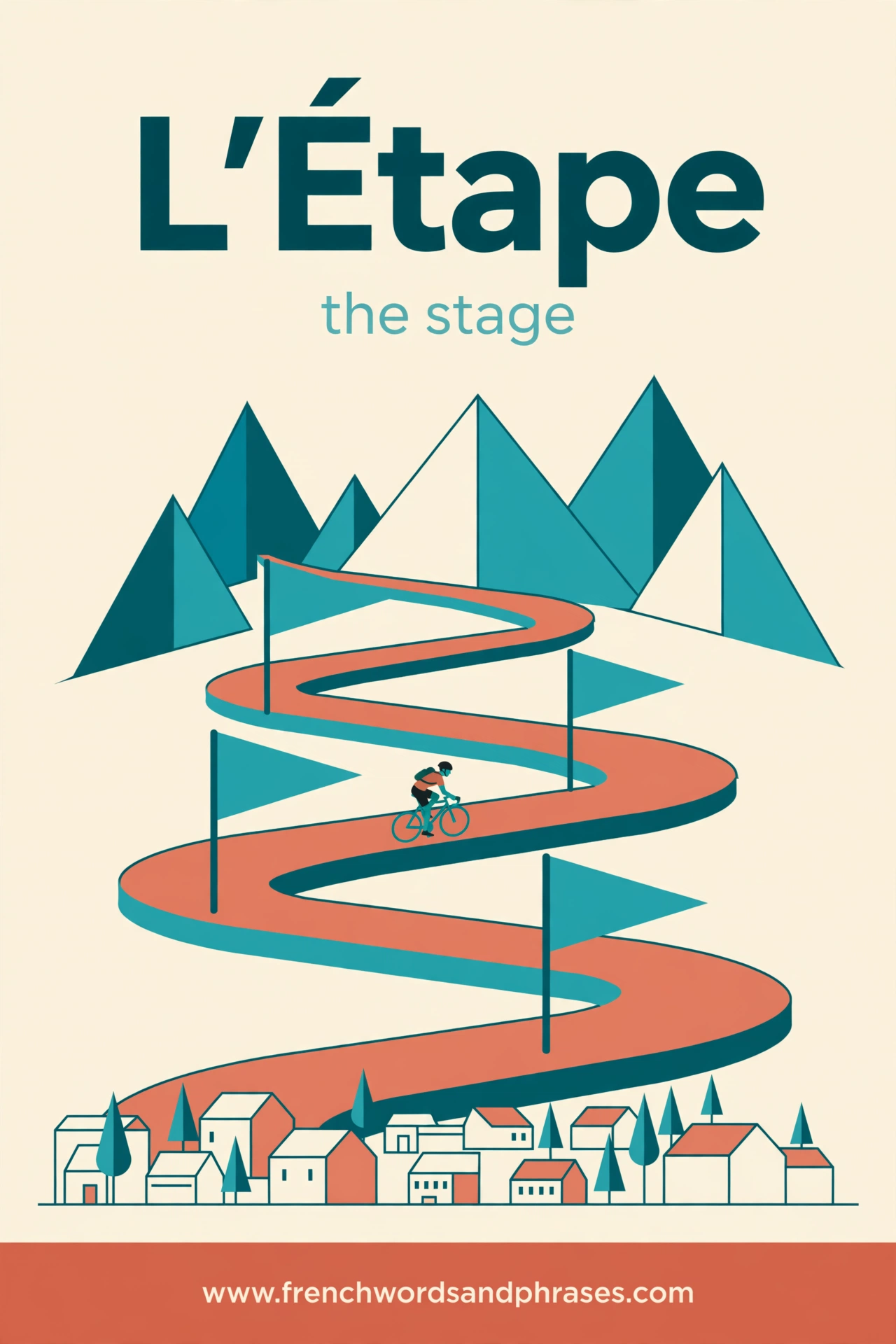
L’Étape means the stage.
The Tour de France caravan rolls into a small town at the foot of the Alps. Banners go up, the square fills with music, and the mayor beams at the cameras: « Notre ville est ville-étape cette année ! » Tonight, this town is a stage town.
In this guide, you’ll learn what étape means in English, how to use it with its articles, how to form its plural, and how it appears in everyday French. Explore French examples, English translations, and practice quizzes.
Understanding the French Noun Étape
Étape is a feminine French noun, learned with its article: l’étape, une étape. It is a stage — one stop on a journey, one phase of a process, one day’s ride in a great race. The idiom brûler les étapes means to skip the stages, to rush ahead without doing things in order.
It means the stage — a stopping place on a route, or one step in a series. Travellers reach une étape for the night; projects advance étape par étape, step by step; cyclists win une étape of the Tour. Wherever something long is broken into manageable pieces, French calls each piece une étape.
Gender: Feminine — l’étape, une étape
Plural: les étapes — a regular -s plural
Definite article: l’ — l’étape (the stage), the article elides before the vowel
Indefinite article: une — une étape (a stage, a stop)
Key idiom: brûler les étapes — to skip stages, to jump ahead too fast
English equivalents: The stage; a stop, a leg (of a journey); a step, a phase
One important usage detail: étape par étape is the French for step by step — the safest way to learn, build or travel. And in cycling, a town that hosts the finish of a day’s racing is proudly une ville-étape. Brûler les étapes is almost always a warning: someone is going too fast and skipping what matters.
Experience the Word
L’étape belongs to the road. It comes from the old staging posts where horses were changed and travellers slept, and the word still carries that rhythm: travel, rest, travel again.
Every July, the word takes over French television: the Tour de France is a necklace of étapes, each with its own winner, its own mountains, its own town celebrating in the square. To win une étape is glory for a day.
For learners, étape is the encouraging word: every long project — even learning French — is just a series of étapes, and you only ever have to finish the one you are on.
How to Use Étape in French: Complete Guide
Let’s explore how étape works in French, beginning with its articles — a feminine noun whose l’ elides before its opening é.
Étape with the Definite Article (L’, Les)
Étape begins with a vowel, so the definite article is l’ in the singular, les in the plural.
| Form | French | English |
|---|---|---|
| Feminine singular | l’étape | the stage |
| Plural | les étapes | the stages |
| In a sentence | L’étape d’aujourd’hui est difficile. | Today’s stage is difficult. |
Example
L’étape se termine au sommet du col.
The stage finishes at the top of the pass.
Étape with the Indefinite Article (Une, Des)
Use une for one stage, des for several.
| Form | French | English |
|---|---|---|
| Feminine singular | une étape | a stage; a stop |
| Plural | des étapes | some stages |
| In a sentence | C’est une étape importante. | It’s an important stage. |
Example
Nous ferons une étape à Lyon pour la nuit.
We’ll make a stop in Lyon for the night.
Étape with Partitives and Quantities
Étape is countable; quantities are built with numbers and de phrases.
| Quantity | French | English |
|---|---|---|
| One more | une étape de plus | one more stage |
| Several | plusieurs étapes | several stages |
| Each | chaque étape | each stage |
| The first | la première étape | the first stage |
Example
Le voyage comprend plusieurs étapes en montagne.
The journey includes several stages in the mountains.
Quick Quiz 1
Complete the sentence:
______ étape de demain sera la plus longue.
Reveal the answer
L’
L’étape de demain sera la plus longue.
Tomorrow’s stage will be the longest — étape is feminine and starts with a vowel, so the article is l’.
The Plural of Étape
Étape adds a regular -s in the plural.
| Number | French | English |
|---|---|---|
| Singular | l’étape | the stage |
| Plural | les étapes | the stages |
| With a number | vingt et une étapes | twenty-one stages |
Example
Le Tour compte vingt et une étapes cette année.
The Tour has twenty-one stages this year.
Étape with Possessive Adjectives (Mon, Ton, Son…)
Before a vowel, the feminine possessives ma, ta, sa become mon, ton, son — listen for the smooth link.
| Owner | French | English |
|---|---|---|
| My | mon étape | my stage; my stop |
| Your | ton étape | your stage |
| His / her | son étape | his / her stage |
| Their (plural) | leurs étapes | their stages |
Example
Grenoble est mon étape préférée du voyage.
Grenoble is my favourite stop on the journey.
Quick Quiz 2
What is the plural of l’étape?
Reveal the answer
Les étapes — a regular -s plural.
Étape with Demonstrative Adjectives (Cette, Ces)
For a feminine noun: cette in the singular, ces in the plural.
| Form | French | English |
|---|---|---|
| Singular | cette étape | this stage |
| Plural | ces étapes | these stages |
| In a sentence | Cette étape est décisive. | This stage is decisive. |
Example
Cette étape de montagne va fatiguer les coureurs.
This mountain stage will tire the riders.
Étape with Adjectives: Agreement
Adjectives agree with étape: feminine singular forms, then -s in the plural.
| Adjective | French | English |
|---|---|---|
| Long | une longue étape | a long stage |
| Difficult | une étape difficile | a difficult stage |
| Plural | des étapes difficiles | difficult stages |
| Next | la prochaine étape | the next stage |
Example
Après cette longue étape, les cyclistes méritent du repos.
After this long stage, the cyclists deserve some rest.
Quick Quiz 3
Translate: the next stage
Reveal the answer
La prochaine étape — prochain agrees with the feminine étape: prochaine.
Everyday Expressions with Étape
Étape organises journeys, races and projects alike.
| Expression | Meaning |
|---|---|
| brûler les étapes | to skip stages, to rush ahead out of order |
| étape par étape | step by step |
| une ville-étape | a stage town (Tour de France) |
| franchir une étape | to get through a stage, to reach a milestone |
Example
Ne brûle pas les étapes : apprends d’abord les bases.
Don’t skip stages: learn the basics first.
Words from the Same Family as Étape
The family of étape is small but full of movement.
| Word | Meaning |
|---|---|
| un étapiste | a stage specialist (cycling) |
| le pas | the step — one single pace |
| le parcours | the route, the course covered in stages |
| l’arrivée | the finish, the arrival at the stage’s end |
Example
Ce coureur est un étapiste redoutable en montagne.
This rider is a formidable stage specialist in the mountains.
Quick Quiz 4
What does « brûler les étapes » mean?
Reveal the answer
To skip stages — to rush ahead and miss out steps that should be done in order, like burning through the stops of a journey.
Étape in Everyday French: Real-Life Examples
Now that you know the word, let’s see how étape appears in everyday French.
Example 1 — On the road
Nous ferons une étape à Dijon avant de continuer.
We’ll make a stop in Dijon before carrying on.
Example 2 — Watching the Tour
L’étape d’aujourd’hui traverse les Pyrénées.
Today’s stage crosses the Pyrenees.
Example 3 — A project
Le projet avance, étape par étape.
The project is moving forward, step by step.
Example 4 — Good advice
Ne brûlez pas les étapes, chaque chose en son temps.
Don’t skip stages, everything in its own time.
Example 5 — A milestone
Elle a franchi une étape importante dans sa carrière.
She has reached an important milestone in her career.
Example 6 — Planning
La dernière étape du voyage sera la plus belle.
The last stage of the journey will be the most beautiful.
Beyond Translation: The Meaning of Étape
Étape is France’s favourite way of cutting a long road into human pieces. The word ruled the age of stagecoaches, when une étape was the distance between two relays of fresh horses — and it rules July today, when the whole country follows the Tour de France from étape to étape. Brûler les étapes, its great idiom, is a warning every French child hears: the stages exist for a reason, and skipping them has a price.
How to Remember the French Noun Étape
Remember it this way: Étape is one day’s piece of a long journey. See the cyclist finishing today’s stage, resting, and riding again tomorrow — never brûler les étapes.
- Feminine — l’étape, une étape; the article elides before the é.
- Regular plural — les étapes, twenty-one of them in the Tour.
- The idiom warns you: brûler les étapes, don’t skip the stages.
The key idea is l’étape — one stage of the journey at a time.
Test Your Knowledge of Étape
Let’s see how much you’ve learned. Try answering these questions before revealing the answers.
Question 1
Is étape masculine or feminine?
Reveal the answer
Feminine — l’étape, une étape.
Question 2
What does étape par étape mean?
Reveal the answer
Step by step — one stage at a time.
Question 3
What does brûler les étapes mean?
Reveal the answer
To skip stages — to rush ahead without doing things in order.
Question 4
How do you say the stages?
Reveal the answer
Les étapes — a regular -s plural.
Question 5
Complete the sentence:
______ étape de demain sera décisive.
Reveal the answer
L’
L’étape de demain sera décisive.
Tomorrow’s stage will be decisive.
Your Final Challenge
Can You Use It?
How would you say this in French?
“The project moves forward step by step.”
Reveal the answer
Le projet avance étape par étape.
The project moves forward step by step.
A little French. A little curiosity. A richer everyday life.
LEARN FRENCH ONE WORD AT A TIME