A French Word to Live By
Translate Estomac to English
/ɛs.tɔ.ma/
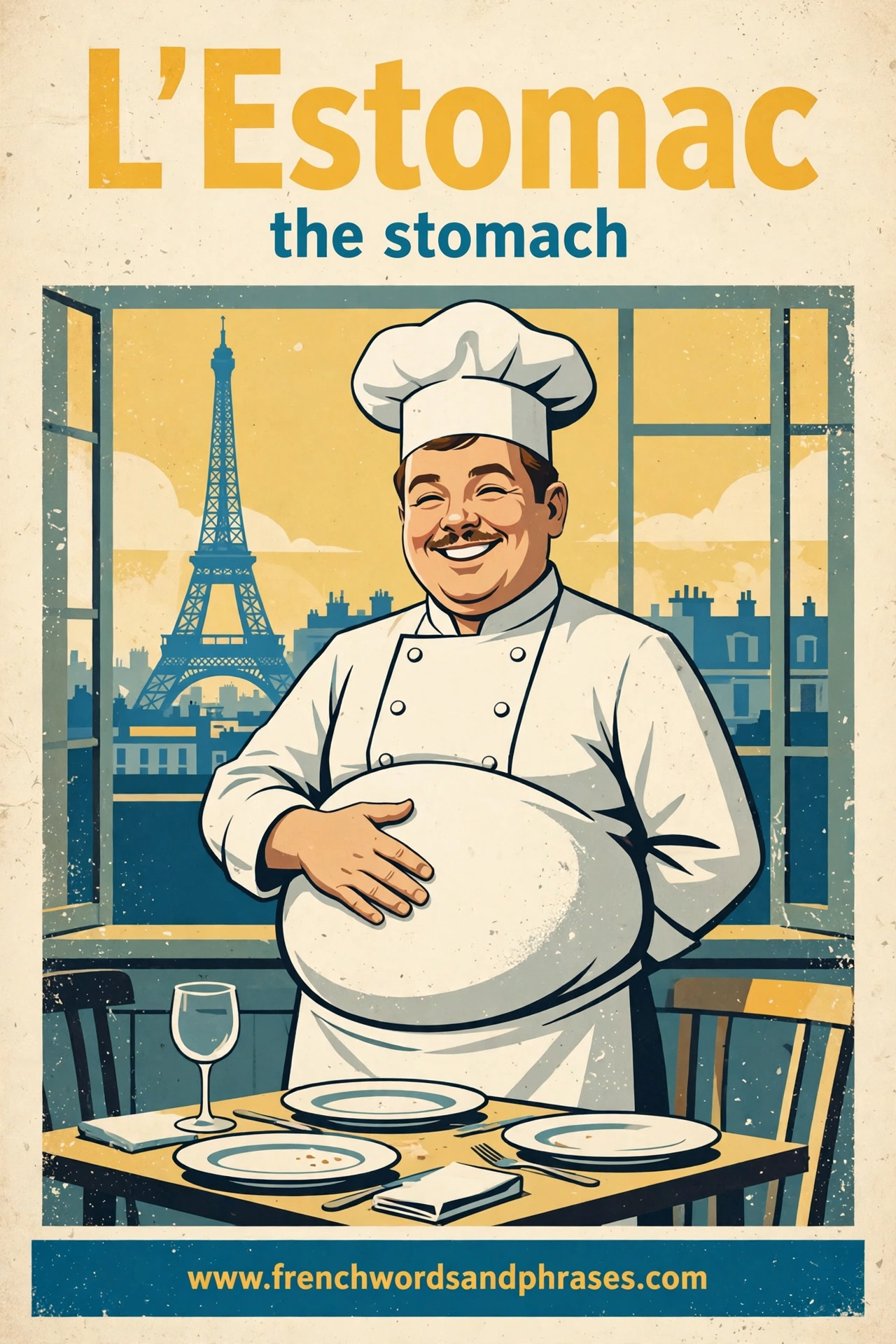
L’estomac means the stomach.
It is barely noon, the smell of roast chicken drifts from the kitchen, and a small boy announces to the whole house what his stomach has been saying for an hour: « J’ai faim ! Mon estomac crie ! »
In this guide, you’ll learn what estomac means in English, how to use it with its articles, how to form its plural, and how it appears in everyday French. Explore French examples, English translations, and practice quizzes.
Understanding the French Noun Estomac
Estomac is a masculine French noun. It begins with a vowel, so the article shrinks: l’estomac, never « le estomac ». The final -c is silent — estomac sounds like « es-to-ma » — and the indefinite article is un estomac.
It means the stomach — the muscular pouch where food arrives after every meal and digestion begins. French listens to it constantly: it growls (l’estomac gargouille), it aches (les brûlures d’estomac, heartburn), and when you are ravenous it drops, in the famous image, dans les talons — down into your heels.
Gender: Masculine
Definite article: l’ — l’estomac (the stomach), because estomac begins with a vowel
Indefinite article: un — un estomac (a stomach)
Plural: les estomacs
Sound note: The final -c is silent — estomac ends with the sound « ma »
English equivalents: The stomach; the tummy (for children).
One important usage detail: avoir de l’estomac has nothing to do with digestion — it means to have nerve, to be bold, to dare. And a queasy stomach is un estomac barbouillé, a lovely word for feeling sick.
Experience the Word
Estomac is the body’s most talkative organ. It growls in quiet rooms, tightens before exams, and celebrates every good meal — the stomach always has an opinion.
Imagine the Sunday lunch at grandmother’s: second helpings, a loosened belt, and an estomac so full it can only ask for a nap.
You have not just eaten. You have fed the furnace — l’estomac, the kitchen inside you.
How to Use Estomac in French: Complete Guide
Let’s explore how estomac works in French, beginning with its articles — and watch le become l’ before its vowel.
Estomac with the Definite Article (L’, Les)
Estomac begins with a vowel, so le shrinks to l’ — l’estomac, the stomach everyone can hear growling.
| Form | French |
|---|---|
| Masculine singular | l’estomac |
| Plural | les estomacs |
L’estomac du garçon gargouille pendant le cours.
The boy’s stomach rumbles during the lesson.
Estomac with the Indefinite Article (Un, Des)
Used for a stomach in general — un estomac, a stomach like any other.
| Form | French |
|---|---|
| Masculine singular | un estomac |
| Plural | des estomacs |
Example
Il faut un estomac solide pour ce métier de cuisinier.
You need a strong stomach for the job of cook.
Estomac with Quantities and States
Stomachs are described by how full they are — the quantities of hunger and lunch.
| Quantity | French |
|---|---|
| one stomach | un estomac |
| an empty stomach | un estomac vide |
| a full stomach | un estomac plein |
| on an empty stomach | à jeun, l’estomac vide |
| a hollow feeling in the stomach | un creux à l’estomac |
Example
Ne prends pas ce médicament l’estomac vide.
Don’t take this medicine on an empty stomach.
Quick Quiz 1
Complete the sentence:
______ estomac gargouille, il est midi passé. (The)
Reveal the answer
L’
L’estomac gargouille, il est midi passé.
My stomach is rumbling, it’s past noon — l’, because estomac begins with a vowel.
The Plural of Estomac
Estomac adds an -s in the plural — les estomacs, spelled with the silent -c kept.
| Number | French |
|---|---|
| Singular | l’estomac |
| Plural | les estomacs |
Example
Les estomacs des invités sont pleins après le festin.
The guests’ stomachs are full after the feast.
Estomac with Possessive Adjectives (Mon, Ton, Son…)
A vowel-start bonus: estomac takes mon, ton, son — the smooth forms, for every owner.
| Owner | French |
|---|---|
| my | mon estomac |
| your (tu) | ton estomac |
| his / her | son estomac |
| our | notre estomac |
| your (vous) | votre estomac |
| their | leur estomac |
Example
Mon estomac crie famine depuis ce matin.
My stomach has been crying out for food since this morning.
Quick Quiz 2
Complete the sentence:
Elle pose la main sur ______ estomac barbouillé. (her)
Reveal the answer
son
Elle pose la main sur son estomac barbouillé.
She puts her hand on her queasy stomach — son, because estomac is masculine and starts with a vowel.
Estomac with Demonstrative Adjectives (Cet, Ces)
Used to point: cet estomac — cet, not ce, because estomac begins with a vowel.
| Form | French |
|---|---|
| Masculine singular | cet estomac |
| Plural | ces estomacs |
Example
Cet estomac fragile ne supporte pas les plats épicés.
This delicate stomach can’t cope with spicy dishes.
Estomac with Adjectives
Adjectives agree with estomac: vide, plein, fragile — masculine forms.
| Adjective | With Estomac |
|---|---|
| vide (empty) | un estomac vide |
| plein (full) | un estomac plein |
| fragile (delicate) | un estomac fragile |
| barbouillé (queasy) | un estomac barbouillé |
| solide (strong) | un estomac solide |
Example
Après le repas, tout le monde a l’estomac plein et le sourire aux lèvres.
After the meal, everyone has a full stomach and a smile.
Quick Quiz 3
How do you say « this stomach » in French?
Reveal the answer
Cet estomac
Cet estomac gargouille depuis une heure.
This stomach has been rumbling for an hour — cet, because estomac starts with a vowel.
Everyday Expressions with Estomac
Hunger, heartburn and sheer nerve — the estomac phrases of daily life.
| Expression | In English |
|---|---|
| avoir l’estomac dans les talons | to be ravenous, famished |
| les brûlures d’estomac | heartburn |
| avoir de l’estomac | to have nerve, to be bold |
| rester sur l’estomac | to lie heavy on the stomach; to be hard to accept |
| avoir l’estomac barbouillé | to feel queasy, sick to one’s stomach |
| l’estomac gargouille | the stomach rumbles |
Example
À sept heures du soir, les enfants ont l’estomac dans les talons.
By seven in the evening, the children are ravenous.
Words from the Same Family as Estomac
Digestion, hunger and doctors — the words that travel with estomac.
| French | In English |
|---|---|
| digérer | to digest |
| la digestion | digestion |
| gastrique | gastric, of the stomach (medical) |
| le ventre | the belly, the abdomen |
| la faim | hunger |
Example
Une petite marche aide la digestion après un gros repas.
A short walk helps digestion after a big meal.
Quick Quiz 4
What does « avoir l’estomac dans les talons » mean?
Reveal the answer
To be ravenous — so hungry your stomach feels as if it had dropped into your heels.
Vite, à table, j’ai l’estomac dans les talons !
Quick, to the table, I’m famished!
Estomac in Everyday French: Real-Life Examples
Now that you know the word, let’s see how estomac appears in everyday French.
Example 1 — Before lunch
Son estomac gargouille pendant la réunion du matin.
His stomach rumbles during the morning meeting.
Example 2 — Heartburn
Après le repas épicé, elle a des brûlures d’estomac.
After the spicy meal, she has heartburn.
Example 3 — Ravenous
Les enfants rentrent de l’école avec l’estomac dans les talons.
The children come home from school ravenous.
Example 4 — Medicine
Prends ce sirop après manger, jamais l’estomac vide.
Take this syrup after eating, never on an empty stomach.
Example 5 — Nerve
Il a de l’estomac : il a demandé une augmentation au directeur.
He has nerve: he asked the director for a raise.
Example 6 — Queasy
Après le bateau, tout le monde avait l’estomac barbouillé.
After the boat trip, everyone felt queasy.
Beyond Translation: The Meaning of Estomac
Estomac comes from the Greek stomakhos, the gullet and stomach — and French has always treated the organ as a seat of courage as much as digestion: avoir de l’estomac is to have guts, in every sense. Its silent final -c is a souvenir of learned spelling, restored by scribes who wanted the Greek ancestry visible on the page even if the ear never hears it.
To say estomac is to name the organ that votes at every meal — and sometimes on your courage.
It evokes the growl in the quiet classroom, the loosened belt after Sunday lunch, and hunger so big it drops into your heels.
How to Remember the French Noun Estomac
Remember it this way: Estomac is the stomach — masculine, starting with a vowel, and its final -c is silent: l’estomac, cet estomac, mon estomac.
- You see the vowel — l’estomac, never « le estomac ».
- You hear the hunger — l’estomac dans les talons, ravenous.
- You find the courage — avoir de l’estomac, to have nerve.
The key idea is l’estomac — silent -c, and hunger that drops to your heels.
Test Your Knowledge of Estomac
Let’s see how much you’ve learned. Try answering these questions before revealing the answers.
Question 1
Is estomac masculine or feminine?
Reveal the answer
Masculine — l’estomac, un estomac.
Question 2
Why do we say l’estomac and not le estomac?
Reveal the answer
Because estomac begins with a vowel — le shrinks to l’ before a vowel sound.
Question 3
Translate: My stomach is rumbling.
Reveal the answer
Mon estomac gargouille.
Question 4
What are les brûlures d’estomac?
Reveal the answer
Heartburn — the burning feeling after a heavy or spicy meal.
Question 5
Complete the sentence:
______ estomac est fragile. (This)
Reveal the answer
Cet
Cet estomac est fragile.
This stomach is delicate — cet, because estomac begins with a vowel.
Your Final Challenge
Can You Use It?
How would you say this in French?
“The children’s stomachs are rumbling before lunch.”
Reveal the answer
L’estomac des enfants gargouille avant le déjeuner.
The children’s stomachs are rumbling before lunch.
A little French. A little curiosity. A richer everyday life.
LEARN FRENCH ONE WORD AT A TIME