A French Word to Live By
Translate Esprit to English
/ɛs.pʁi/
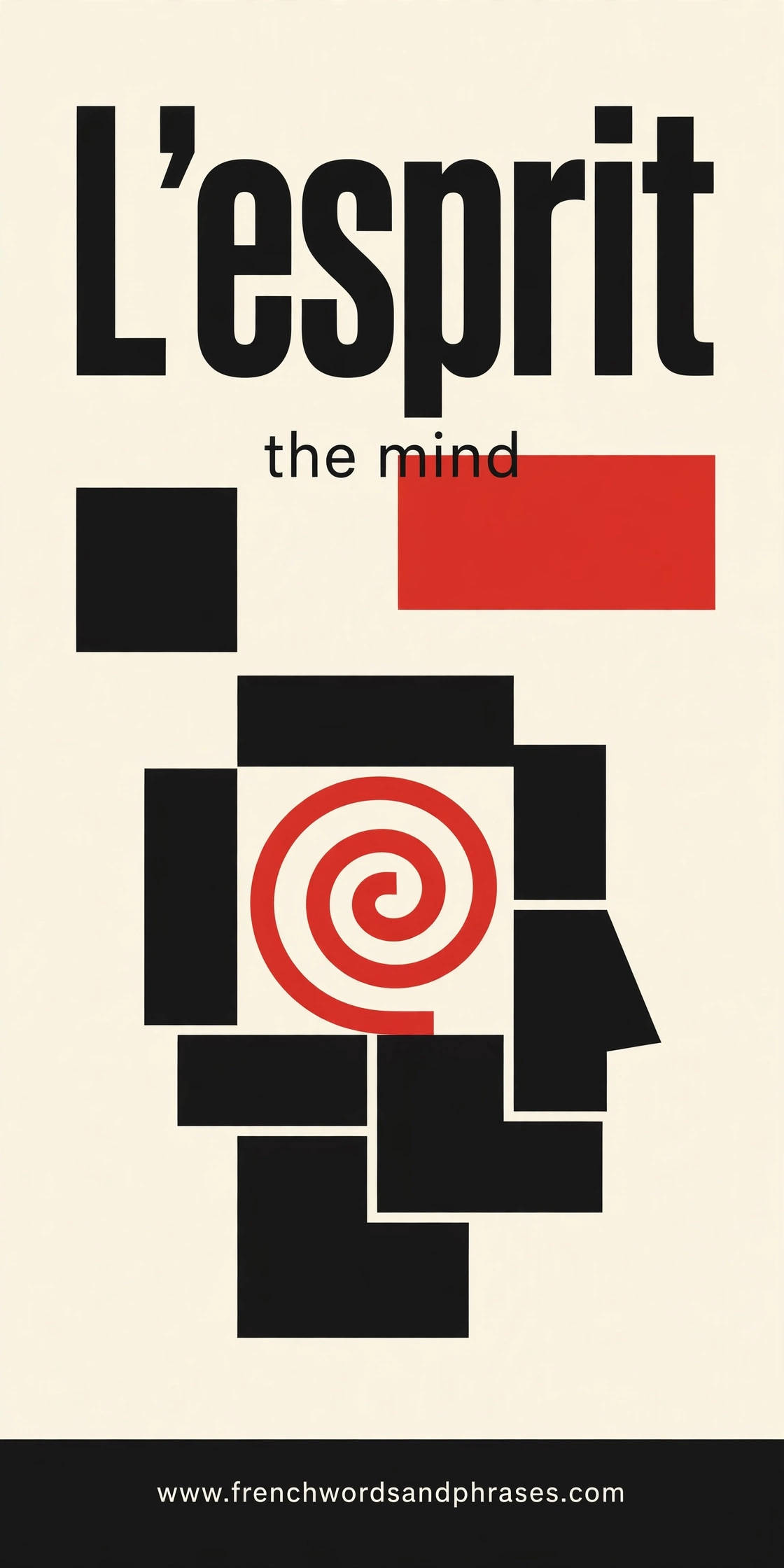
L’esprit means the mind; a spirit.
The chess clock ticks, the café falls quiet, and the old champion stares at the board without touching a single piece. The game is not happening on the table at all — it is happening where all his games happen: in l’esprit, the mind.
In this guide, you’ll learn what esprit means in English, how to use it with its articles, how to form its plural, and how it appears in everyday French. Explore French examples, English translations, and practice quizzes.
Understanding the French Noun Esprit
Esprit is a masculine French noun. It is learned together with its article: l’esprit, un esprit. Few French words carry so many lives: esprit is the mind that thinks, the spirit that haunts, the wit that sparkles in conversation, and the spirit of a team, a place or a season.
It means, first, the mind: avoir l’esprit vif, to have a sharp mind; un état d’esprit, a state of mind. It also means a spirit or ghost: les esprits walk in old houses and at séances. And in the phrase avoir de l’esprit, it means wit — the quick, sparkling intelligence the French admire at every dinner table.
Gender: Masculine
Definite article: l’ — l’esprit (the mind, the spirit)
Indefinite article: un — un esprit (a mind; a spirit, a ghost)
Plural: les esprits
English equivalents: The mind; a spirit, a ghost; wit in avoir de l’esprit; the spirit of a thing.
One important usage detail: avoir de l’esprit does not mean having a ghost — it means being witty. The mind sense builds with adjectives and states: l’esprit ouvert (open-minded), l’esprit critique (critical thinking), l’esprit d’équipe (team spirit). And when French wants the Holy Spirit, it is le Saint-Esprit, with capitals.
Experience the Word
Esprit is more than the brain at work. It is the quickness of a reply, the mood of a room, the ghost in the corridor and the invisible bond of a team — all the things that cannot be weighed but decide everything.
Imagine the dinner table when the conversation suddenly sparkles: a remark lands, everyone laughs, and someone murmurs, « Elle a de l’esprit, celle-là. » She has wit. No diploma measures it; every French guest recognises it in a second.
You have not just thought something. You have shown de l’esprit — the mind, awake and shining.
How to Use Esprit in French: Complete Guide
Let’s explore how esprit works in French, beginning with its articles.
Esprit with the Definite Article (L’, Les)
Used for the mind itself — the one doing the thinking, the one everyone is trying to read.
| Number | French |
|---|---|
| Singular | l’esprit |
| Plural | les esprits |
Example
L’esprit humain adore les histoires.
The human mind loves stories.
Esprit with the Indefinite Article (Un, Des)
Used for a mind or a spirit in particular — a sharp one at the chessboard, a restless one in the attic.
| Number | French |
|---|---|
| Singular | un esprit |
| Plural | des esprits |
Example
C’est un esprit brillant, toujours en avance sur les autres.
He is a brilliant mind, always ahead of the others.
The Many Lives of Esprit
Mind, ghost, wit and team spirit — the one word in all its costumes.
| French | In English |
|---|---|
| l’esprit humain | the human mind |
| un esprit vif | a sharp mind |
| avoir de l’esprit | to be witty |
| l’esprit d’équipe | team spirit |
| un esprit (fantôme) | a spirit, a ghost |
| l’esprit de Noël | the Christmas spirit |
Example
Elle a beaucoup d’esprit : ses réponses font rire toute la table.
She is very witty: her replies make the whole table laugh.
Quick Quiz 1
Your friend says of a dinner guest: « Il a de l’esprit. » What is she praising?
Reveal the answer
His wit — his quick, sparkling intelligence, not a ghost.
Il a de l’esprit et un grand sens de l’humour.
He is witty and has a great sense of humour.
The Plural of Esprit
Esprit adds an -s in the plural — les esprits, the minds of a classroom or the ghosts of a castle.
| Number | French |
|---|---|
| Singular | l’esprit |
| Plural | les esprits |
Example
Les grands esprits se rencontrent, dit le proverbe.
Great minds think alike, says the proverb.
Esprit with Possessive Adjectives (Mon, Ton, Son…)
Possessives agree with the noun, not with the owner — and esprit is masculine, so it takes mon, ton, son.
| Owner | French |
|---|---|
| my | mon esprit |
| your (tu) | ton esprit |
| his / her | son esprit |
| our | notre esprit |
| your (vous) | votre esprit |
| their | leur esprit |
Example
Mon esprit est ailleurs pendant la réunion.
My mind is elsewhere during the meeting.
Quick Quiz 2
Complete the sentence:
______ esprit travaille même pendant son sommeil. (His)
Reveal the answer
Son
Son esprit travaille même pendant son sommeil.
His mind works even during his sleep.
Esprit with Demonstrative Adjectives (Cet, Ces)
Used to point: this mind here, those spirits there — cet before a masculine word beginning with a vowel.
| Number | French |
|---|---|
| Singular | cet esprit |
| Plural | ces esprits |
Example
Cet esprit curieux pose mille questions par jour.
This curious mind asks a thousand questions a day.
Esprit with Adjectives
Adjectives agree with esprit, masculine — vif, ouvert, critique.
| Adjective | With Esprit |
|---|---|
| vif (sharp) | un esprit vif |
| ouvert (open) | un esprit ouvert |
| critique (critical) | un esprit critique |
| libre (free) | un esprit libre |
| sain (healthy) | un esprit sain |
Example
Un esprit sain dans un corps sain, dit la devise.
A healthy mind in a healthy body, says the motto.
Quick Quiz 3
Complete the sentence:
Elle a un esprit très ______, toujours prêt à apprendre. (open)
Reveal the answer
ouvert
Elle a un esprit très ouvert, toujours prêt à apprendre.
She has a very open mind, always ready to learn.
Everyday Expressions with Esprit
Open minds, team spirit and states of mind — the esprit phrases of daily life.
| Expression | In English |
|---|---|
| un état d’esprit | a state of mind, a mindset |
| l’esprit d’équipe | team spirit |
| avoir l’esprit ouvert | to be open-minded |
| en esprit | in spirit (present in thought) |
| perdre l’esprit | to lose one’s mind |
| l’esprit de contradiction | a contrary streak, the spirit of contradiction |
Example
Je ne peux pas venir, mais je serai là en esprit.
I cannot come, but I will be there in spirit.
Words from the Same Family as Esprit
Spirits, inspiration and witty words — the words that travel with esprit.
| French | In English |
|---|---|
| spirituel | spiritual; also witty |
| la spiritualité | spirituality |
| inspirer | to inspire |
| l’inspiration | inspiration |
| le Saint-Esprit | the Holy Spirit |
| spirituellement | spiritually |
Example
Cette musique l’inspire : son esprit s’envole loin du bureau.
This music inspires her: her mind flies far from the office.
Quick Quiz 4
What is l’esprit d’équipe, and why do coaches love it?
Reveal the answer
Team spirit — the willingness to play for the group, not just for oneself.
L’esprit d’équipe compte autant que le talent.
Team spirit counts as much as talent.
Esprit in Everyday French: Real-Life Examples
Now that you know the word, let’s see how esprit appears in everyday French.
Example 1 — At the office
Son état d’esprit le matin décide de toute sa journée.
His state of mind in the morning decides his whole day.
Example 2 — At the match
L’esprit d’équipe de ces joueurs est admirable.
These players’ team spirit is admirable.
Example 3 — At dinner
Elle a de l’esprit : la table rit à chacune de ses phrases.
She is witty: the table laughs at every one of her sentences.
Example 4 — In class
Le professeur développe l’esprit critique des élèves.
The teacher develops the pupils’ critical thinking.
Example 5 — An apology
Je serai absent, mais je penserai à vous : je serai là en esprit.
I will be away, but I will think of you: I will be there in spirit.
Example 6 — A ghost story
Les enfants racontent que des esprits marchent dans le grenier.
The children tell each other that spirits walk in the attic.
Beyond Translation: The Meaning of Esprit
Esprit may be the most French of all French words. It names what the culture prizes most — not raw cleverness, but cleverness with sparkle: the well-turned reply, the mind that plays. Voltaire built an essay on it, salons competed in it, and the language still pays its highest compliment with it: avoir de l’esprit. That the same word also names ghosts and the Holy Spirit only widens its sky.
To say esprit is to praise the mind at its brightest.
It evokes the chess player’s stare, the dinner guest’s perfect reply, the team’s invisible bond — intelligence, in France, is a social art, and esprit is its name.
How to Remember the French Noun Esprit
Remember it this way: Esprit is the mind — masculine, also a spirit and, in the right phrase, wit itself.
- You praise the wit — avoir de l’esprit, briller à table.
- You open the mind — un esprit ouvert, un esprit critique.
- You join the team — l’esprit d’équipe, jouer pour les autres.
The key idea is l’esprit thinks, sparkles — and sometimes haunts.
Test Your Knowledge of Esprit
Let’s see how much you’ve learned. Try answering these questions before revealing the answers.
Question 1
Is esprit masculine or feminine?
Reveal the answer
Masculine — l’esprit, un esprit.
Question 2
What does avoir de l’esprit mean?
Reveal the answer
To be witty — to have a quick, sparkling intelligence.
Question 3
Translate: Team spirit is important.
Reveal the answer
L’esprit d’équipe est important.
Question 4
What is un état d’esprit?
Reveal the answer
A state of mind — a mindset, the way your mind is set at a given time.
Question 5
Complete the sentence:
Elle garde ______ esprit ouvert en toute circonstance. (her)
Reveal the answer
son
Elle garde son esprit ouvert en toute circonstance.
She keeps her mind open in all circumstances.
Your Final Challenge
Can You Use It?
How would you say this in French?
“Team spirit is important.”
Reveal the answer
L’esprit d’équipe est important.
Team spirit is important.
A little French. A little curiosity. A richer everyday life.
LEARN FRENCH ONE WORD AT A TIME