A French Word to Live By
Translate Entorse to English
/ɑ̃.tɔʁs/
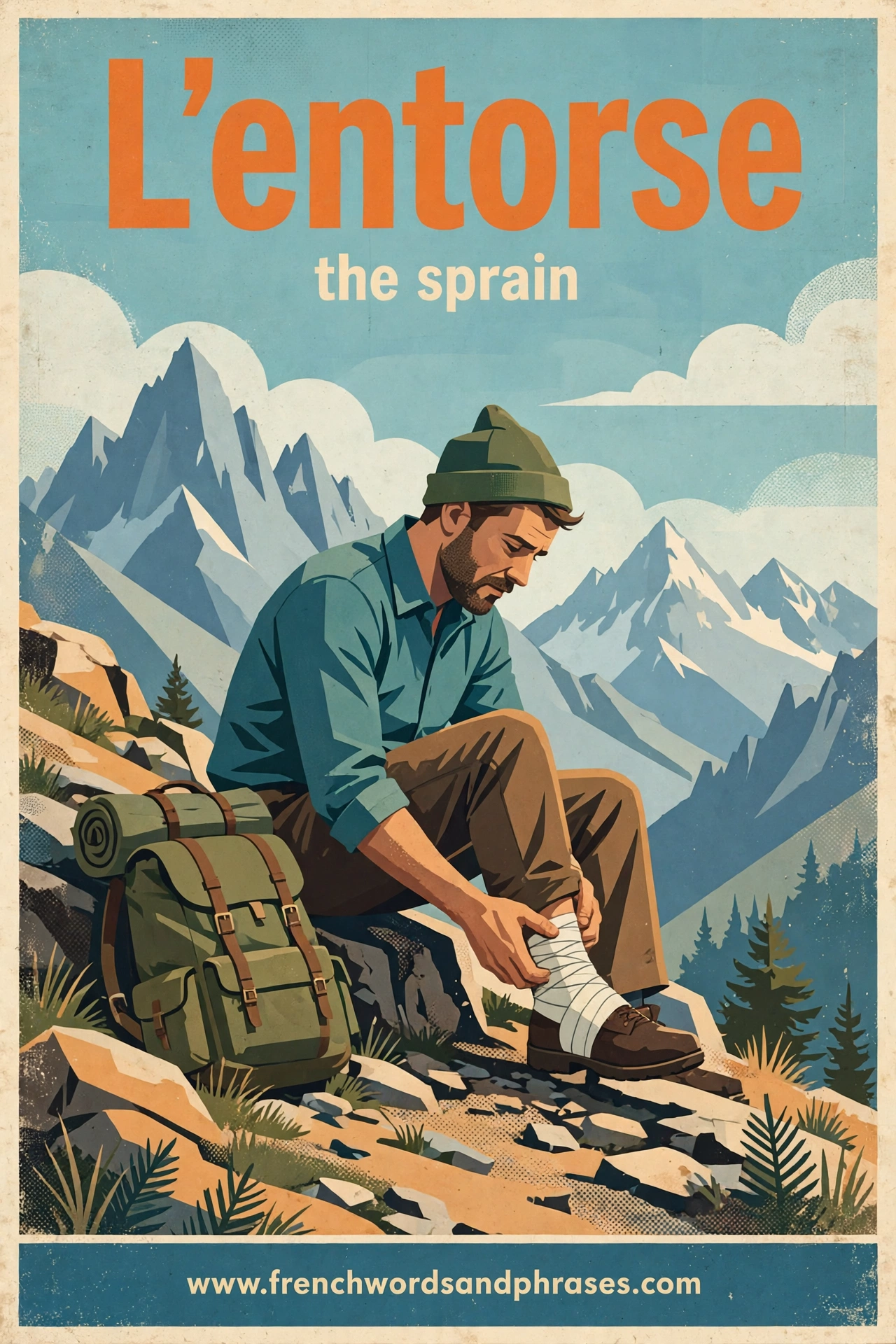
L’entorse means the sprain.
The football rolls away, the ankle turns on the wet grass, and the match stops. He sits down slowly, shoe in hand — everyone on the pitch knows the word: l’entorse.
In this guide, you’ll learn what entorse means in English, how to use it with its articles, how to form its plural, and how it appears in everyday French. Explore French examples, English translations, and practice quizzes.
Understanding the French Noun Entorse
Entorse is a feminine French noun. Because it begins with a vowel, the definite article shrinks: l’entorse, never « la entorse » — but the indefinite article shows the gender clearly: une entorse. Its plural is les entorses.
It means the sprain — the twisted joint that follows a false step: une entorse de la cheville (a sprained ankle) is the classic, followed by le genou (the knee) and le poignet (the wrist). The verb phrase is worth learning with it: se faire une entorse, to sprain something, or se fouler la cheville, to twist your ankle.
Gender: Feminine
Definite article: l’ — l’entorse (the sprain)
Indefinite article: une — une entorse (a sprain)
Plural: les entorses
Classic place: la cheville — the ankle is the sprain’s favourite joint
English equivalents: The sprain; a twisted ankle is une entorse de la cheville.
One important usage detail: the injury is almost always introduced with the verb se faire — je me suis fait une entorse, I sprained something — and the joint follows with à or de: une entorse à la cheville. For the treatment, French first aid spells it out: repos, glace, compression, élévation — rest, ice, compression, elevation.
Experience the Word
Entorse is the injury of the almost: almost reached the ball, almost landed the jump, almost caught the train. It is rarely dramatic and always badly timed.
Imagine the aftermath: the bag of frozen peas on the ankle, the foot up on cushions, the whole weekend reorganised around one small joint that refuses to forgive.
You have not broken anything. You have been benched — arrêtée net, stopped in your tracks, by your own ankle.
How to Use Entorse in French: Complete Guide
Let’s explore how entorse works in French, beginning with its articles — watch the elision: l’entorse, because the word begins with a vowel.
Entorse with the Definite Article (L’, Les)
Entorse begins with a vowel, so the article shrinks to l’ — the sprain everyone is talking about.
| Form | French |
|---|---|
| Feminine singular | l’entorse |
| Plural | les entorses |
Example
L’entorse de Marc l’empêche de jouer dimanche.
Marc’s sprain stops him playing on Sunday.
Entorse with the Indefinite Article (Une, Des)
Used for a sprain in general — une entorse, the kind a false step gives you.
| Form | French |
|---|---|
| Feminine singular | une entorse |
| Plural | des entorses |
Example
Ce joueur a eu des entorses aux deux chevilles.
This player has had sprains in both ankles.
The Joints at Risk: Where Entorses Happen
Ankles, knees and wrists — the sprain’s favourite addresses.
| French | In English |
|---|---|
| la cheville | the ankle |
| le genou | the knee |
| le poignet | the wrist |
| se fouler la cheville | to twist your ankle |
| enfler | to swell |
| boiter | to limp |
Example
Elle s’est foulé la cheville en descendant l’escalier.
She twisted her ankle coming down the stairs.
Quick Quiz 1
Complete the sentence:
Après sa chute, ______ entorse l’oblige à rester au repos.
Reveal the answer
l’
Après sa chute, l’entorse l’oblige à rester au repos.
After his fall, the sprain forces him to rest — l’, because entorse begins with a vowel.
The Plural of Entorse
Entorse adds an -s in the plural — les entorses.
| Number | French |
|---|---|
| Singular | l’entorse |
| Plural | les entorses |
Example
Les entorses répétées fragilisent la cheville.
Repeated sprains weaken the ankle.
Entorse with Possessive Adjectives (Mon, Ton, Son…)
A useful exception: entorse begins with a vowel, so even the feminine takes mon, ton, son — mon entorse, never « ma entorse ».
| Owner | French |
|---|---|
| my | mon entorse |
| your (tu) | ton entorse |
| his / her | son entorse |
| our | notre entorse |
| your (vous) | votre entorse |
| their | leur entorse |
Example
Mon entorse va beaucoup mieux après une semaine de repos.
My sprain is much better after a week of rest.
Quick Quiz 2
Complete the sentence:
______ entorse au genou date du match de samedi. (His)
Reveal the answer
Son
Son entorse au genou date du match de samedi.
His knee sprain dates from Saturday’s match — son, because entorse begins with a vowel.
Entorse with Demonstrative Adjectives (Cette, Ces)
Used to point at the damage: cette entorse, this sprain here.
| Form | French |
|---|---|
| Feminine singular | cette entorse |
| Plural | ces entorses |
Example
Cette entorse vient d’un mauvais appui au basket.
This sprain comes from a bad landing at basketball.
Entorse with Adjectives
Adjectives agree with entorse and take the feminine -e: une entorse grave, une entorse légère.
| Adjective | With Entorse |
|---|---|
| grave (serious) | une entorse grave |
| léger (mild) | une entorse légère |
| premier (first) | une première entorse |
| nouveau (new) | une nouvelle entorse |
| ancien (old, former) | une ancienne entorse |
Example
Ce n’est qu’une entorse légère, elle pourra marcher demain.
It’s only a mild sprain, she’ll be able to walk tomorrow.
Quick Quiz 3
Complete the sentence:
Il s’agit d’une entorse ______ : six semaines sans sport. (serious)
Reveal the answer
grave
Il s’agit d’une entorse grave : six semaines sans sport.
It’s a serious sprain: six weeks without sport.
Everyday Expressions with Entorse
Ice packs and crutches — the entorse phrases of daily life.
| Expression | In English |
|---|---|
| se faire une entorse | to sprain something, to get a sprain |
| mettre de la glace | to put ice on it |
| rester au repos | to stay resting |
| marcher avec des béquilles | to walk on crutches |
| une entorse bénigne | a minor sprain |
| guérir d’une entorse | to recover from a sprain |
Example
Elle s’est fait une entorse et marche avec des béquilles.
She got a sprain and is walking on crutches.
Words from the Same Family as Entorse
Twisting and turning — the entorse family is built on tordre, to twist.
| French | In English |
|---|---|
| tordre | to twist, to wring |
| la foulure | a slight sprain, a twist |
| la cheville | the ankle |
| le ligament | the ligament |
| la béquille | the crutch |
| le bandage | the bandage |
Example
Le médecin met un bandage autour de la cheville foulée.
The doctor puts a bandage around the twisted ankle.
Quick Quiz 4
What is the classic verb phrase for getting a sprain?
Reveal the answer
Se faire une entorse — literally, to make yourself a sprain.
Je me suis fait une entorse au poignet.
I sprained my wrist.
Entorse in Everyday French: Real-Life Examples
Now that you know the word, let’s see how entorse appears in everyday French.
Example 1 — On the pitch
Il se fait une entorse à la cheville pendant le match.
He sprains his ankle during the match.
Example 2 — At the surgery
Le médecin examine l’entorse et demande une radio.
The doctor examines the sprain and orders an X-ray.
Example 3 — At home
Mets de la glace sur ton entorse et lève le pied.
Put ice on your sprain and raise your foot.
Example 4 — Explaining an absence
Elle ne vient pas : elle a une entorse au genou.
She isn’t coming: she has a knee sprain.
Example 5 — Recovery
Après trois semaines, l’entorse est presque guérie.
After three weeks, the sprain is almost healed.
Example 6 — A warning
Attention à la marche, c’est là que je me suis fait mon entorse.
Mind the step, that’s where I got my sprain.
Beyond Translation: The Meaning of Entorse
The entorse is sport’s most democratic injury: it visits the professional in the stadium and the grandfather on the stairs with the same indifference. French even lends the word to the law and to language itself — une entorse au règlement is a breach of the rules, a twisting of what should stay straight, and une entorse à la vérité is a small sprain given to the truth.
To say entorse is to name the twist — of an ankle, of a rule, of a story.
It evokes frozen peas and bandages, the physio’s patience, and the lesson every ankle teaches once: the ground is never quite where you left it.
How to Remember the French Noun Entorse
Remember it this way: Entorse is the sprain — feminine, but it begins with a vowel, so the article shrinks to l’entorse, and the classic phrase is se faire une entorse.
- You twist the ankle — l’entorse de la cheville.
- You tell the story — je me suis fait une entorse.
- You treat it — repos et glace, rest and ice.
The key idea is l’entorse — se faire une entorse, to sprain something.
Test Your Knowledge of Entorse
Let’s see how much you’ve learned. Try answering these questions before revealing the answers.
Question 1
Why do we write l’entorse and not la entorse?
Reveal the answer
Because entorse begins with a vowel — the article elides to l’, though the word is feminine: une entorse.
Question 2
How do you say a sprained ankle in French?
Reveal the answer
Une entorse de la cheville — la cheville is the ankle, the sprain’s favourite joint.
Question 3
Translate: I sprained my wrist.
Reveal the answer
Je me suis fait une entorse au poignet.
Question 4
What are des béquilles, the entorse’s companions?
Reveal the answer
Crutches — what you walk with while the sprain heals.
Question 5
Complete the sentence:
______ entorse est grave, il faut consulter.
Reveal the answer
L’
L’entorse est grave, il faut consulter.
The sprain is serious, you need to see a doctor.
Your Final Challenge
Can You Use It?
How would you say this in French?
“He sprained his ankle during the match.”
Reveal the answer
Il s’est fait une entorse à la cheville pendant le match.
He sprained his ankle during the match.
A little French. A little curiosity. A richer everyday life.
LEARN FRENCH ONE WORD AT A TIME