A French Word to Live By
How to Conjugate Enjôler in French
/ɑ̃.ʒo.le/
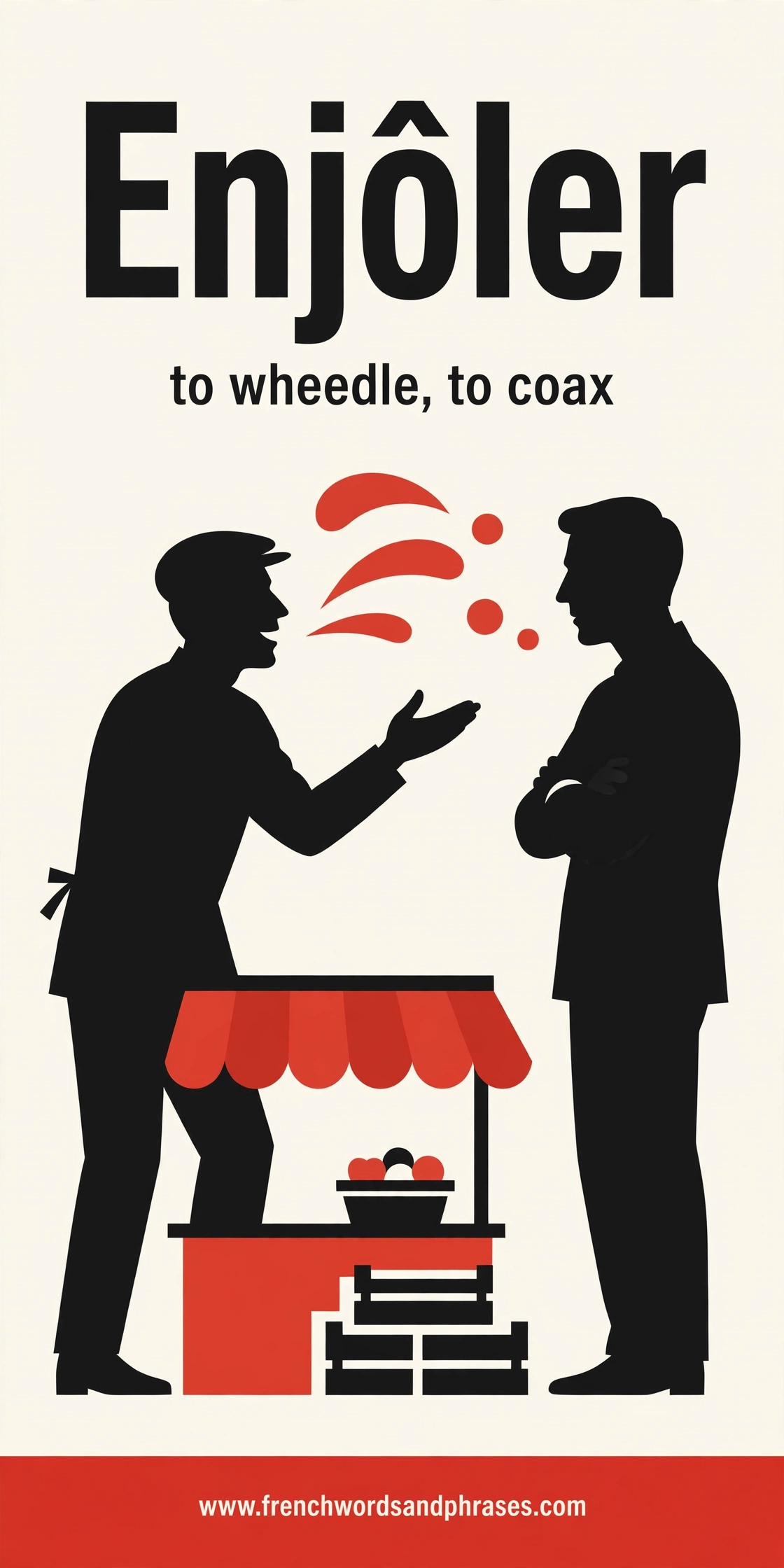
Enjôler means to wheedle, to coax — to win someone over with soft words, flattery and charm until they agree to what they had refused, never quite noticing how it happened.
A market trader talking a hesitant customer into the expensive cheese, a grandchild melting a strict grandmother with one well-timed compliment, a salesman whose voice is made of honey — enjôler is the verb of the soft conquest: no force, no argument, just charm applied patiently until the answer becomes yes.
In this guide, you’ll learn how to conjugate enjôler in all the major French tenses and moods. Explore complete conjugation tables, French examples, English translations, and practice quizzes.
Understanding the French Verb Enjôler
Enjôler is a regular French verb belonging to the first group of verbs, those ending in-er.
It means to wheedle, to coax. Enjôler is never about force or honest persuasion: it is charm used as a tool, by traders, children, lovers and salesmen, and French treats it with amusement rather than anger — un enjôleur is a smooth operator you cannot quite help liking. The victim usually knows, afterwards, exactly what happened: je me suis laissé enjôler.
Verb classification: First group (-er)
Auxiliary verb: Avoir
Past participle: enjôlé
Present participle: enjôlant
English equivalents: To wheedle, to coax, to sweet-talk; enjôler quelqu’un — to wheedle someone; se laisser enjôler — to let oneself be sweet-talked; enjôler un client — to coax a customer; un enjôleur, une enjôleuse — a smooth talker, a charmer.
One important detail: enjôler wears its circumflex proudly on the ô — a fossil of an old s that vanished from the spelling (the word is related to geôle, an old word for a cage or prison cell: to enjôler was once to lure a bird into a cage). The verb itself is a perfectly regular -er: j’enjôle, nous enjôlons, past participle enjôlé. It almost always takes a person as its object, and its partner phrase is se laisser enjôler — to let yourself be wheedled, which is how most of us meet it.
Experience the Word
Enjôler is persuasion with the gloves off and the smile on — you agree first, and understand later.
Imagine a small boy who wants the last slice of tart. He does not beg. He admires his grandmother’s cooking, asks how she makes the pastry so light, wonders aloud if anyone will ever cook like her again. Five minutes later the slice is on his plate and grand-mère is beaming: il l’a enjôlée, completely, and she half knows it.
No demand was made and nothing was refused. She was wheedled — enjôlée — and the tart never stood a chance.
How to Conjugate Enjôler: Complete French Conjugation Guide
Let’s explore every major conjugation of enjôler, beginning with the indicative mood.
How to Conjugate Enjôler in the Indicative Mood
The indicative mood is used to express facts, observations, actions, and events.
How to Conjugate Enjôler in the Present Tense (Présent)
Used for actions happening now, habitual actions, and general truths.
| Subject | Conjugation |
|---|---|
| je | enjôle |
| tu | enjôles |
| il / elle | enjôle |
| nous | enjôlons |
| vous | enjôlez |
| ils / elles | enjôlent |
Example
Le marchand enjôle ses clients avec de belles paroles.
The trader wheedles his customers with fine words.
Quick Quiz 1
Complete the sentence:
Nous ______ les clients avec de belles paroles.
Reveal the answer
enjôlons
Nous enjôlons les clients avec de belles paroles.
We wheedle the customers with fine words.
How to Conjugate Enjôler in the Passé Composé
Used for completed actions in the past. Enjôler takes the auxiliary verb avoir.
| Subject | Conjugation |
|---|---|
| j’ | ai enjôlé |
| tu | as enjôlé |
| il / elle | a enjôlé |
| nous | avons enjôlé |
| vous | avez enjôlé |
| ils / elles | ont enjôlé |
Example
Elle a enjôlé le gardien et est entrée sans billet.
She sweet-talked the caretaker and got in without a ticket.
How to Conjugate Enjôler in the Imparfait (Imperfect Tense)
Used for habitual past actions, descriptions, and ongoing situations in the past.
| Subject | Conjugation |
|---|---|
| je | enjôlais |
| tu | enjôlais |
| il / elle | enjôlait |
| nous | enjôlions |
| vous | enjôliez |
| ils / elles | enjôlaient |
Example
Enfant, il enjôlait sa grand-mère pour avoir des bonbons.
As a child, he used to wheedle his grandmother for sweets.
Quick Quiz 2
Choose the correct form:
He wheedled his grandmother.
Il ______ sa grand-mère. (a enjôlé / est enjôlé)
Reveal the answer
a enjôlé
Il a enjôlé sa grand-mère.
Enjôler takes avoir.
How to Conjugate Enjôler in the Plus-que-parfait
Used to describe an action that had already been completed before another past event.
| Subject | Conjugation |
|---|---|
| j’ | avais enjôlé |
| tu | avais enjôlé |
| il / elle | avait enjôlé |
| nous | avions enjôlé |
| vous | aviez enjôlé |
| ils / elles | avaient enjôlé |
Example
Le vendeur l’avait enjôlée avec un sourire et trois compliments.
The salesman had coaxed her with a smile and three compliments.
How to Conjugate Enjôler in the Passé Simple
Primarily used in formal writing, literature, and historical narratives. It is rarely used in everyday conversation.
| Subject | Conjugation |
|---|---|
| je | enjôlai |
| tu | enjôlas |
| il / elle | enjôla |
| nous | enjôlâmes |
| vous | enjôlâtes |
| ils / elles | enjôlèrent |
Example
Le renard enjôla le corbeau et le fromage tomba.
The fox flattered the crow and the cheese fell.
How to Conjugate Enjôler in the Passé Antérieur
A literary tense used to express an action completed immediately before another past action, generally in the passé simple.
| Subject | Conjugation |
|---|---|
| j’ | eus enjôlé |
| tu | eus enjôlé |
| il / elle | eut enjôlé |
| nous | eûmes enjôlé |
| vous | eûtes enjôlé |
| ils / elles | eurent enjôlé |
Example
Quand elle eut enjôlé le directeur, elle obtint son congé.
When she had sweet-talked the manager, she got her day off.
How to Conjugate Enjôler in the Future Tense (Futur Simple)
Used to describe actions that will take place in the future.
| Subject | Conjugation |
|---|---|
| je | enjôlerai |
| tu | enjôleras |
| il / elle | enjôlera |
| nous | enjôlerons |
| vous | enjôlerez |
| ils / elles | enjôleront |
Example
Il essaiera de t’enjôler, ne l’écoute pas trop.
He will try to wheedle you, do not listen to him too much.
How to Conjugate Enjôler in the Futur Antérieur (Future Perfect)
Used for an action that will have been completed before a particular point in the future.
| Subject | Conjugation |
|---|---|
| j’ | aurai enjôlé |
| tu | auras enjôlé |
| il / elle | aura enjôlé |
| nous | aurons enjôlé |
| vous | aurez enjôlé |
| ils / elles | auront enjôlé |
Example
À la fin de la foire, le marchand aura enjôlé la moitié du village.
By the end of the fair, the trader will have sweet-talked half the village.
How to Conjugate Enjôler in the Near Future (Futur Proche)
Used to describe something that is going to happen soon. Formed with aller + infinitive.
| Subject | Conjugation |
|---|---|
| je | vais enjôler |
| tu | vas enjôler |
| il / elle | va enjôler |
| nous | allons enjôler |
| vous | allez enjôler |
| ils / elles | vont enjôler |
Example
Attention, ce petit va enjôler sa grand-mère, c’est sûr.
Watch out, that little boy is going to wheedle his grandmother, for sure.
How to Conjugate Enjôler in the Conditional Mood
The conditional mood expresses what would happen under certain circumstances. It is also frequently used to make polite requests or express wishes.
How to Conjugate Enjôler in the Present Conditional
| Subject | Conjugation |
|---|---|
| je | enjôlerais |
| tu | enjôlerais |
| il / elle | enjôlerait |
| nous | enjôlerions |
| vous | enjôleriez |
| ils / elles | enjôleraient |
Example
Avec ce sourire, tu enjôlerais n’importe qui.
With that smile, you would coax anyone.
How to Conjugate Enjôler in the Past Conditional
| Subject | Conjugation |
|---|---|
| j’ | aurais enjôlé |
| tu | aurais enjôlé |
| il / elle | aurait enjôlé |
| nous | aurions enjôlé |
| vous | auriez enjôlé |
| ils / elles | auraient enjôlé |
Example
Sans son air innocent, elle n’aurait enjôlé personne.
Without her innocent air, she would not have wheedled anyone.
Enjôler in the Literary Past Conditional Form
This less common literary form uses the imperfect subjunctive of avoir.
| Subject | Conjugation |
|---|---|
| j’ | eusse enjôlé |
| tu | eusses enjôlé |
| il / elle | eût enjôlé |
| nous | eussions enjôlé |
| vous | eussiez enjôlé |
| ils / elles | eussent enjôlé |
Example
Le flatteur eût enjôlé le roi lui-même.
The flatterer would have wheedled the king himself.
How to Conjugate Enjôler in the Subjunctive Mood
The subjunctive is used to express wishes, emotions, doubts, necessity, and uncertainty. It frequently follows expressions such as il faut que (it is necessary that) or bien que (although).
How to Conjugate Enjôler in the Present Subjunctive
| Subject | Conjugation |
|---|---|
| que je | enjôle |
| que tu | enjôles |
| qu’il / qu’elle | enjôle |
| que nous | enjôlions |
| que vous | enjôliez |
| qu’ils / qu’elles | enjôlent |
Example
Il est facile qu’un beau parleur vous enjôle.
It is easy for a smooth talker to wheedle you.
Quick Quiz 3
Complete the sentence using the subjunctive:
Il est facile qu’un beau parleur vous ______.
Reveal the answer
enjôle
Il est facile qu’un beau parleur vous enjôle.
It is easy for a smooth talker to wheedle you.
How to Conjugate Enjôler in the Imperfect Subjunctive
A literary tense, rarely encountered in modern spoken French.
| Subject | Conjugation |
|---|---|
| que je | enjôlasse |
| que tu | enjôlasses |
| qu’il / qu’elle | enjôlât |
| que nous | enjôlassions |
| que vous | enjôlassiez |
| qu’ils / qu’elles | enjôlassent |
Example
Je craignais qu’elle n’enjôlât le vieux monsieur pour son héritage.
I feared she might wheedle the old gentleman out of his inheritance.
How to Conjugate Enjôler in the Pluperfect Subjunctive
A literary construction used to express an action completed before another past action.
| Subject | Conjugation |
|---|---|
| que j’ | eusse enjôlé |
| que tu | eusses enjôlé |
| qu’il / qu’elle | eût enjôlé |
| que nous | eussions enjôlé |
| que vous | eussiez enjôlé |
| qu’ils / qu’elles | eussent enjôlé |
Example
On racontait qu’il eût enjôlé toute la cour en une saison.
People said he had sweet-talked the whole court in one season.
How to Conjugate Enjôler in the Past Subjunctive
| Subject | Conjugation |
|---|---|
| que j’ | aie enjôlé |
| que tu | aies enjôlé |
| qu’il / qu’elle | ait enjôlé |
| que nous | ayons enjôlé |
| que vous | ayez enjôlé |
| qu’ils / qu’elles | aient enjôlé |
Example
Je sais que ce vendeur t’a enjôlé, avoue-le.
I know that salesman sweet-talked you, admit it.
How to Conjugate Enjôler in the Imperative
The imperative is used to give commands, instructions, invitations, or suggestions. Subject pronouns are omitted.
How to Conjugate Enjôler in the Present Imperative
| Person | Conjugation |
|---|---|
| (tu) | enjôle |
| (nous) | enjôlons |
| (vous) | enjôlez |
Example
N’enjôle pas ta grand-mère, demande simplement !
Do not wheedle your grandmother, just ask!
Quick Quiz 4
How would you say Do not wheedle your grandmother (tu form)?
Reveal the answer
N’enjôle pas ta grand-mère !
French Participles of Enjôler
Participles are verb forms that can be used in compound tenses and other grammatical constructions.
Present Participle of Enjôler
enjôlant
En enjôlant les clients, le marchand vendait deux fois plus.
By coaxing the customers, the trader sold twice as much.
Past Participle of Enjôler
enjôlé
Enjôlé par le vendeur, il a acheté la voiture la plus chère.
Sweet-talked by the salesman, he bought the most expensive car.
Enjôler in Everyday French: Real-Life Examples
Now that you know the conjugations, let’s see how enjôler appears in everyday French.
Example 1 — Present
Le marchand enjôle ses clients.
The trader wheedles his customers.
Example 2 — Passé composé
Elle a enjôlé le gardien.
She sweet-talked the caretaker.
Example 3 — Imparfait
Il enjôlait sa grand-mère pour des bonbons.
He used to wheedle his grandmother for sweets.
Example 4 — Future
Il essaiera de t’enjôler.
He will try to wheedle you.
Example 5 — Conditional
Tu enjôlerais n’importe qui avec ce sourire.
You would coax anyone with that smile.
Example 6 — Imperative
N’enjôle pas ta grand-mère !
Do not wheedle your grandmother!
Beyond Translation: The Meaning of Enjôler
La Fontaine built his most famous fable on this verb’s territory: the fox does not steal the crow’s cheese, he flatte and enjôle until the crow drops it himself — apprenez que tout flatteur vit aux dépens de celui qui l’écoute.
The old spelling hides a cage.
Geôle was a cell, and to enjôler was originally to lure a creature into one with soft sounds; the circumflex on the ô is the scar the vanished s left behind — and the wheedled customer, smiling on the way out, is in the cage exactly as planned.
How to Remember the French Verb Enjôler
Remember it this way: Enjôler is about the fox, the crow, and the cheese that flattery dropped.
- Keep the circumflex: enjôler, j’enjôle — the ô is the scar of an old s, from geôle, a cage.
- Regular -er: j’enjôle, nous enjôlons, past participle enjôlé.
- The classic victim’s sentence is je me suis laissé enjôler — I let myself be sweet-talked.
The key idea is the fox, the crow, and the cheese that flattery dropped.
Test Your Knowledge of Enjôler
Let’s see how much you’ve learned. Try answering these questions before revealing the answers.
Question 1
What is a person who enjôle called, and what does the verb really involve?
Reveal the answer
Un enjôleur (une enjôleuse) — a smooth talker; the verb is winning people over by charm and flattery, never by force.
Question 2
How do you say She sweet-talked the caretaker in French?
Reveal the answer
Elle a enjôlé le gardien.
Question 3
Translate: As a child, he used to wheedle his grandmother for sweets.
Reveal the answer
Enfant, il enjôlait sa grand-mère pour avoir des bonbons.
Question 4
What is the past participle of enjôler?
Reveal the answer
Enjôlé.
Question 5
Complete the sentence:
Je craignais qu’elle n’______ le vieux monsieur.
Reveal the answer
enjôlât
Je craignais qu’elle n’enjôlât le vieux monsieur.
I feared she might wheedle the old gentleman.
Your Final Challenge
Can You Use It?
How would you say this in French?
The little boy wheedled his grandmother with a single compliment, and the last slice of tart changed plates, smiling.
Reveal the answer
Le petit garçon enjôla sa grand-mère d’un seul compliment, et la dernière part de tarte changea d’assiette en souriant.
The little boy wheedled his grandmother with a single compliment, and the last slice of tart changed plates, smiling.
A little French. A little curiosity. A richer everyday life.
LEARN FRENCH ONE WORD AT A TIME