A French Word to Live By
How to Conjugate Enguirlander in French
/ɑ̃.ɡiʁ.lɑ̃.de/
Enguirlander means to garland, to scold (fam.) — to drape something with garlands, and, in familiar French, to give someone a right dressing-down, as if wrapping them in something they cannot escape.
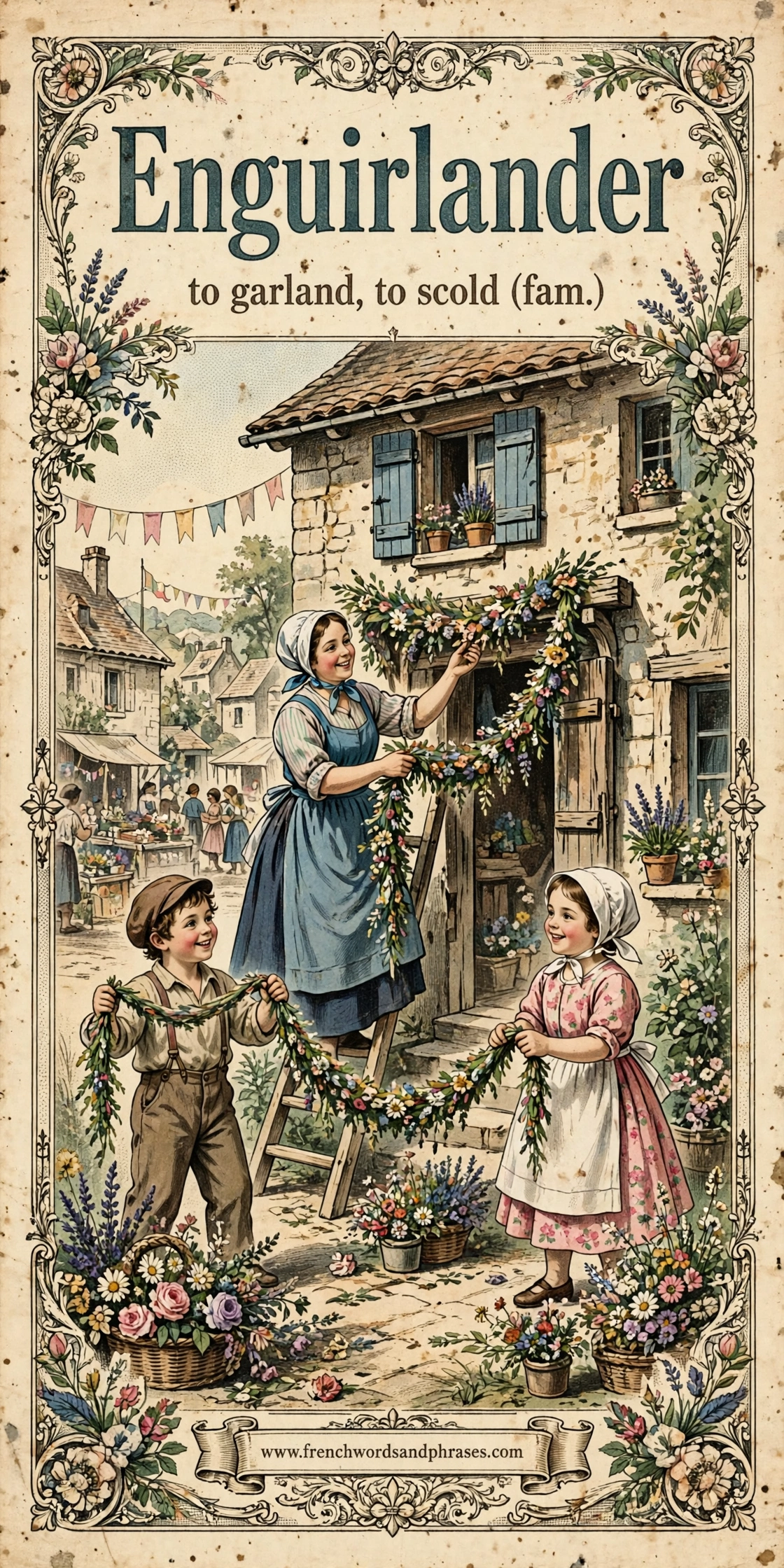
A village square in July, paper garlands strung from lamp post to lamp post — and, across town, a mother tearing a strip off her son for the third broken window this month. Enguirlander lives in both scenes: it decks things with garlands, and in familiar speech it decks people out with a scolding.
In this guide, you’ll learn how to conjugate enguirlander in all the major French tenses and moods. Explore complete conjugation tables, French examples, English translations, and practice quizzes.
Understanding the French Verb Enguirlander
Enguirlander is a regular French verb belonging to the first group of verbs, those ending in-er.
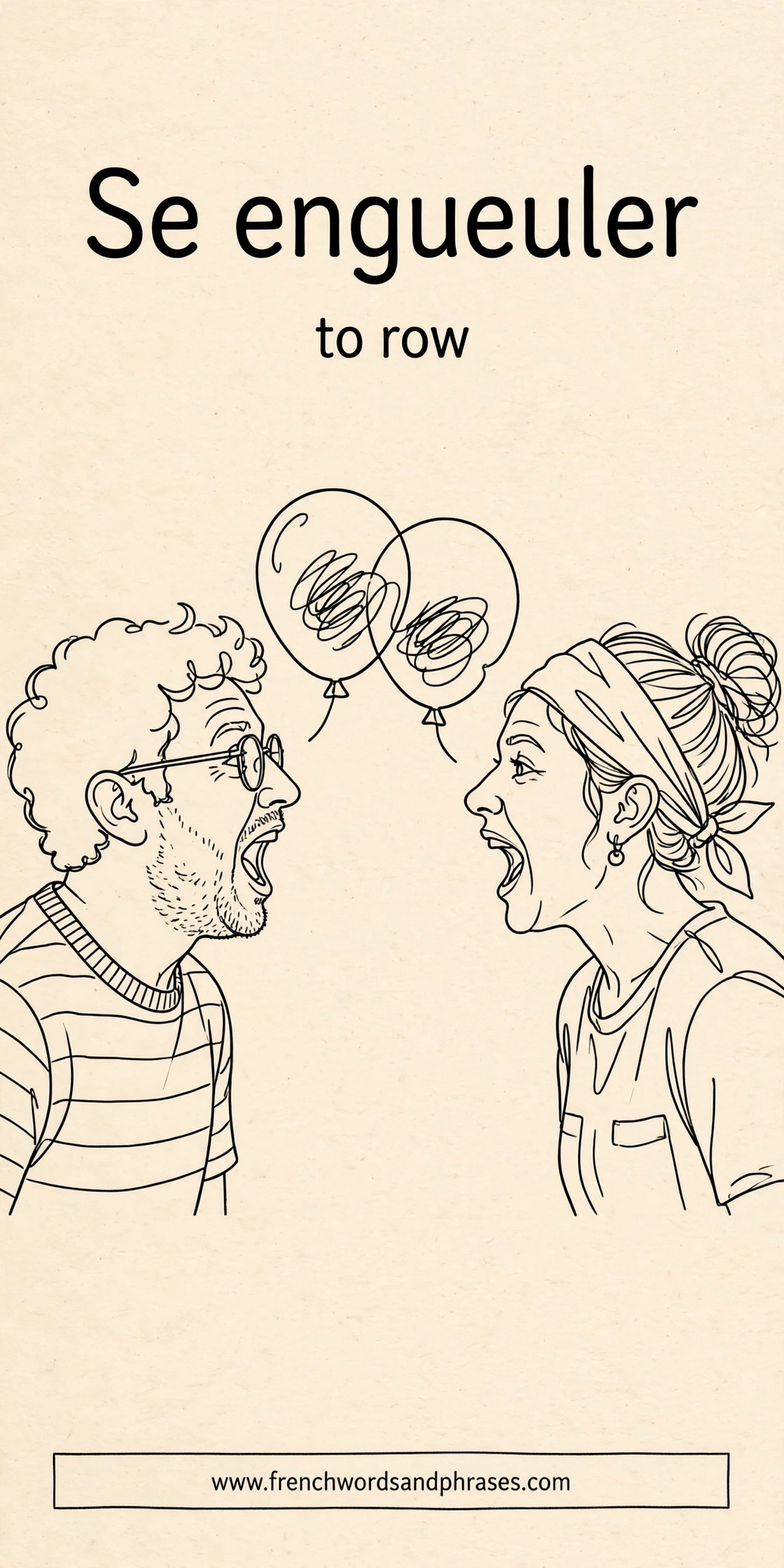
It means to garland, to scold (fam.). The garlanding sense belongs to festivals, weddings and Christmas decorating; the scolding sense is familiar register and very much alive — se faire enguirlander is one of the most colourful French ways to say you got told off, and it always carries a hint of comedy rather than real anger.
Verb classification: First group (-er)
Auxiliary verb: Avoir
Past participle: enguirlandé
Present participle: enguirlandant
English equivalents: To garland, to deck with garlands, to scold (fam.); enguirlander un balcon de fleurs — to garland a balcony with flowers; enguirlander la salle des fêtes — to deck the village hall with garlands; se faire enguirlander — to get a telling-off (fam.); enguirlander quelqu’un de reproches — to shower someone with reproaches.
One important detail: enguirlander is built on une guirlande, a garland, and its two lives grow out of that single image. Literally, you drape garlands over balconies, halls and Christmas trees: enguirlander un sapin. Figuratively — and this is the familiar, everyday sense — to be enguirlandé is to be wrapped, head to toe, in a scolding you cannot wriggle out of: il s’est fait enguirlander par sa mère, he got a proper dressing-down from his mother. The verb itself is perfectly regular: j’enguirlande, nous enguirlandons, past participle enguirlandé. Watch the spelling of the stem: guir- with a u after the g, like guirlande itself.
Experience the Word
Enguirlander is the verb of the garland — decoration when things go well, and a wreath of reproaches when they do not.
Imagine the morning of the village fête. The mayor’s team enguirlande the square: paper chains over the bandstand, flowers round the fountain. By noon the square looks wonderful — and by one o’clock, the lad who unplugged the bandstand lights gets himself thoroughly enguirlandé by the mayor, in front of everyone, garlands swaying overhead.
Decorated or dressed down — either way, you end up covered: enguirlandé.
How to Conjugate Enguirlander: Complete French Conjugation Guide
Let’s explore every major conjugation of enguirlander, beginning with the indicative mood.
How to Conjugate Enguirlander in the Indicative Mood
The indicative mood is used to express facts, observations, actions, and events.
How to Conjugate Enguirlander in the Present Tense (Présent)
Used for actions happening now, habitual actions, and general truths.
| Subject | Conjugation |
|---|---|
| je | enguirlande |
| tu | enguirlandes |
| il / elle | enguirlande |
| nous | enguirlandons |
| vous | enguirlandez |
| ils / elles | enguirlandent |
Example
Les enfants enguirlandent le sapin de guirlandes en papier.
The children garland the Christmas tree with paper chains.
Quick Quiz 1
Complete the sentence:
Nous ______ le balcon de fleurs.
Reveal the answer
enguirlandons
Nous enguirlandons le balcon de fleurs.
We garland the balcony with flowers.
How to Conjugate Enguirlander in the Passé Composé
Used for completed actions in the past. Enguirlander takes the auxiliary verb avoir.
| Subject | Conjugation |
|---|---|
| j’ | ai enguirlandé |
| tu | as enguirlandé |
| il / elle | a enguirlandé |
| nous | avons enguirlandé |
| vous | avez enguirlandé |
| ils / elles | ont enguirlandé |
Example
Il s’est fait enguirlander par sa mère pour son retard.
He got a proper telling-off from his mother for being late.
How to Conjugate Enguirlander in the Imparfait (Imperfect Tense)
Used for habitual past actions, descriptions, and ongoing situations in the past.
| Subject | Conjugation |
|---|---|
| je | enguirlandais |
| tu | enguirlandais |
| il / elle | enguirlandait |
| nous | enguirlandions |
| vous | enguirlandiez |
| ils / elles | enguirlandaient |
Example
Chaque été, on enguirlandait la place du village pour la fête.
Every summer, they used to garland the village square for the festival.
Quick Quiz 2
Choose the correct form:
He got a telling-off from his mother.
Il ______ par sa mère. (s’est fait enguirlander / a enguirlandé le sapin)
Reveal the answer
s’est fait enguirlander
Il s’est fait enguirlander par sa mère.
Se faire enguirlander is the familiar way to say to get told off.
How to Conjugate Enguirlander in the Plus-que-parfait
Used to describe an action that had already been completed before another past event.
| Subject | Conjugation |
|---|---|
| j’ | avais enguirlandé |
| tu | avais enguirlandé |
| il / elle | avait enguirlandé |
| nous | avions enguirlandé |
| vous | aviez enguirlandé |
| ils / elles | avaient enguirlandé |
Example
Elle avait enguirlandé le balcon de roses avant l’arrivée des invités.
She had garlanded the balcony with roses before the guests arrived.
How to Conjugate Enguirlander in the Passé Simple
Primarily used in formal writing, literature, and historical narratives. It is rarely used in everyday conversation.
| Subject | Conjugation |
|---|---|
| je | enguirlandai |
| tu | enguirlandas |
| il / elle | enguirlanda |
| nous | enguirlandâmes |
| vous | enguirlandâtes |
| ils / elles | enguirlandèrent |
Example
La foule enguirlanda le balcon de fleurs aux couleurs du pays.
The crowd garlanded the balcony with flowers in the country’s colours.
How to Conjugate Enguirlander in the Passé Antérieur
A literary tense used to express an action completed immediately before another past action, generally in the passé simple.
| Subject | Conjugation |
|---|---|
| j’ | eus enguirlandé |
| tu | eus enguirlandé |
| il / elle | eut enguirlandé |
| nous | eûmes enguirlandé |
| vous | eûtes enguirlandé |
| ils / elles | eurent enguirlandé |
Example
Dès qu’il eut enguirlandé la salle, la fête commença.
As soon as he had decked the hall with garlands, the party began.
How to Conjugate Enguirlander in the Future Tense (Futur Simple)
Used to describe actions that will take place in the future.
| Subject | Conjugation |
|---|---|
| je | enguirlanderai |
| tu | enguirlanderas |
| il / elle | enguirlandera |
| nous | enguirlanderons |
| vous | enguirlanderez |
| ils / elles | enguirlanderont |
Example
Demain, nous enguirlanderons la terrasse pour l’anniversaire.
Tomorrow, we will garland the terrace for the birthday.
How to Conjugate Enguirlander in the Futur Antérieur (Future Perfect)
Used for an action that will have been completed before a particular point in the future.
| Subject | Conjugation |
|---|---|
| j’ | aurai enguirlandé |
| tu | auras enguirlandé |
| il / elle | aura enguirlandé |
| nous | aurons enguirlandé |
| vous | aurez enguirlandé |
| ils / elles | auront enguirlandé |
Example
À midi, ils auront enguirlandé toute la rue principale.
By noon, they will have garlanded the whole main street.
How to Conjugate Enguirlander in the Near Future (Futur Proche)
Used to describe something that is going to happen soon. Formed with aller + infinitive.
| Subject | Conjugation |
|---|---|
| je | vais enguirlander |
| tu | vas enguirlander |
| il / elle | va enguirlander |
| nous | allons enguirlander |
| vous | allez enguirlander |
| ils / elles | vont enguirlander |
Example
Attention, tu vas te faire enguirlander si tu rentres si tard !
Watch out, you are going to get a telling-off if you come home that late!
How to Conjugate Enguirlander in the Conditional Mood
The conditional mood expresses what would happen under certain circumstances. It is also frequently used to make polite requests or express wishes.
How to Conjugate Enguirlander in the Present Conditional
| Subject | Conjugation |
|---|---|
| je | enguirlanderais |
| tu | enguirlanderais |
| il / elle | enguirlanderait |
| nous | enguirlanderions |
| vous | enguirlanderiez |
| ils / elles | enguirlanderaient |
Example
Sans ces reproches, il ne s’enguirlanderait pas à chaque réunion.
Without those reproaches, he would not get dressed down at every meeting.
How to Conjugate Enguirlander in the Past Conditional
| Subject | Conjugation |
|---|---|
| j’ | aurais enguirlandé |
| tu | aurais enguirlandé |
| il / elle | aurait enguirlandé |
| nous | aurions enguirlandé |
| vous | auriez enguirlandé |
| ils / elles | auraient enguirlandé |
Example
Tu te serais fait enguirlander si le patron avait vu ce désordre.
You would have got a telling-off if the boss had seen this mess.
Enguirlander in the Literary Past Conditional Form
This less common literary form uses the imperfect subjunctive of avoir.
| Subject | Conjugation |
|---|---|
| j’ | eusse enguirlandé |
| tu | eusses enguirlandé |
| il / elle | eût enguirlandé |
| nous | eussions enguirlandé |
| vous | eussiez enguirlandé |
| ils / elles | eussent enguirlandé |
Example
Il se fût enguirlandé par tout le village pour un tel scandale.
He would have been dressed down by the whole village for such a scandal.
How to Conjugate Enguirlander in the Subjunctive Mood
The subjunctive is used to express wishes, emotions, doubts, necessity, and uncertainty. It frequently follows expressions such as il faut que (it is necessary that) or bien que (although).
How to Conjugate Enguirlander in the Present Subjunctive
| Subject | Conjugation |
|---|---|
| que je | enguirlande |
| que tu | enguirlandes |
| qu’il / qu’elle | enguirlande |
| que nous | enguirlandions |
| que vous | enguirlandiez |
| qu’ils / qu’elles | enguirlandent |
Example
Il faut que nous enguirlandions le porche avant la cérémonie.
We must garland the porch before the ceremony.
Quick Quiz 3
Complete the sentence using the subjunctive:
Il faut que vous ______ la salle avant la fête.
Reveal the answer
enguirlandiez
Il faut que vous enguirlandiez la salle avant la fête.
You must garland the hall before the party.
How to Conjugate Enguirlander in the Imperfect Subjunctive
A literary tense, rarely encountered in modern spoken French.
| Subject | Conjugation |
|---|---|
| que je | enguirlandasse |
| que tu | enguirlandasses |
| qu’il / qu’elle | enguirlandât |
| que nous | enguirlandassions |
| que vous | enguirlandassiez |
| qu’ils / qu’elles | enguirlandassent |
Example
Elle craignait qu’il s’enguirlandât devant tout le monde.
She feared he might get a dressing-down in front of everyone.
How to Conjugate Enguirlander in the Pluperfect Subjunctive
A literary construction used to express an action completed before another past action.
| Subject | Conjugation |
|---|---|
| que j’ | eusse enguirlandé |
| que tu | eusses enguirlandé |
| qu’il / qu’elle | eût enguirlandé |
| que nous | eussions enguirlandé |
| que vous | eussiez enguirlandé |
| qu’ils / qu’elles | eussent enguirlandé |
Example
On disait qu’elle eût enguirlandé la façade entière en une matinée.
People said she had garlanded the entire façade in one morning.
How to Conjugate Enguirlander in the Past Subjunctive
| Subject | Conjugation |
|---|---|
| que j’ | aie enguirlandé |
| que tu | aies enguirlandé |
| qu’il / qu’elle | ait enguirlandé |
| que nous | ayons enguirlandé |
| que vous | ayez enguirlandé |
| qu’ils / qu’elles | aient enguirlandé |
Example
Je suis content que vous ayez enguirlandé le jardin pour la fête.
I am glad you garlanded the garden for the party.
How to Conjugate Enguirlander in the Imperative
The imperative is used to give commands, instructions, invitations, or suggestions. Subject pronouns are omitted.
How to Conjugate Enguirlander in the Present Imperative
| Person | Conjugation |
|---|---|
| (tu) | enguirlande |
| (nous) | enguirlandons |
| (vous) | enguirlandez |
Example
Enguirlande le sapin, les enfants adorent ça !
Garland the tree, the children love it!
Quick Quiz 4
How would you say Garland the tree (tu form)?
Reveal the answer
Enguirlande le sapin !
French Participles of Enguirlander
Participles are verb forms that can be used in compound tenses and other grammatical constructions.
Present Participle of Enguirlander
enguirlandant
En enguirlandant la salle, elle fredonnait de vieilles chansons.
While garlanding the hall, she was humming old songs.
Past Participle of Enguirlander
enguirlandé
Enguirlandé de reproches, il a quitté la pièce sans un mot.
Showered with reproaches, he left the room without a word.
Enguirlander in Everyday French: Real-Life Examples
Now that you know the conjugations, let’s see how enguirlander appears in everyday French.
Example 1 — Present
Nous enguirlandons le balcon de fleurs.
We garland the balcony with flowers.
Example 2 — Passé composé
Il s’est fait enguirlander par sa mère.
He got a telling-off from his mother.
Example 3 — Imparfait
On enguirlandait la place pour la fête.
They used to garland the square for the festival.
Example 4 — Future
Tu vas te faire enguirlander !
You are going to get a telling-off!
Example 5 — Conditional
Elle enguirlanderait le jardin de roses.
She would garland the garden with roses.
Example 6 — Imperative
Enguirlandez le porche avant la fête !
Garland the porch before the party!
Beyond Translation: The Meaning of Enguirlander
The noun underneath is une guirlande — a garland, a string of lights, a paper chain — and English garland is the same word wearing different clothes.
Only French, though, turned the garland into a punishment.
To be enguirlandé is to be festooned with blame: the scolding wraps round you like the decoration round a tree, which is why the familiar sense always sounds more theatrical than truly angry.
How to Remember the French Verb Enguirlander
Remember it this way: Enguirlander is about garlands on the tree — and a scolding wrapped round you like one.
- Built on guirlande, a garland: drape the garlands, or drape someone in reproaches.
- The familiar sense lives in se faire enguirlander — to get a telling-off.
- Regular -er throughout: j’enguirlande, nous enguirlandons, past participle enguirlandé.
The key idea is garlands on the tree — and a scolding wrapped round you like one.
Test Your Knowledge of Enguirlander
Let’s see how much you’ve learned. Try answering these questions before revealing the answers.
Question 1
What are the two meanings of enguirlander?
Reveal the answer
To garland (to deck with garlands) and, in familiar French, to scold — se faire enguirlander, to get a telling-off.
Question 2
How do you say He got a telling-off from his mother in French?
Reveal the answer
Il s’est fait enguirlander par sa mère.
Question 3
Translate: The children garland the tree with paper chains.
Reveal the answer
Les enfants enguirlandent le sapin de guirlandes en papier.
Question 4
What is the past participle of enguirlander?
Reveal the answer
Enguirlandé.
Question 5
Complete the sentence:
Il faut que nous ______ le porche avant la cérémonie.
Reveal the answer
enguirlandions
Il faut que nous enguirlandions le porche avant la cérémonie.
We must garland the porch before the ceremony.
Your Final Challenge
Can You Use It?
How would you say this in French?
The garlanded square shone with a thousand colours, and even the boy who had been told off by his mother could not help smiling.
Reveal the answer
La place enguirlandée brillait de mille couleurs, et même le garçon enguirlandé par sa mère ne pouvait s’empêcher de sourire.
The garlanded square shone with a thousand colours, and even the boy who had been told off by his mother could not help smiling.
A little French. A little curiosity. A richer everyday life.
LEARN FRENCH ONE WORD AT A TIME