A French Word to Live By
How to Conjugate Engraisser in French
/ɑ̃.ɡʁɛ.se/
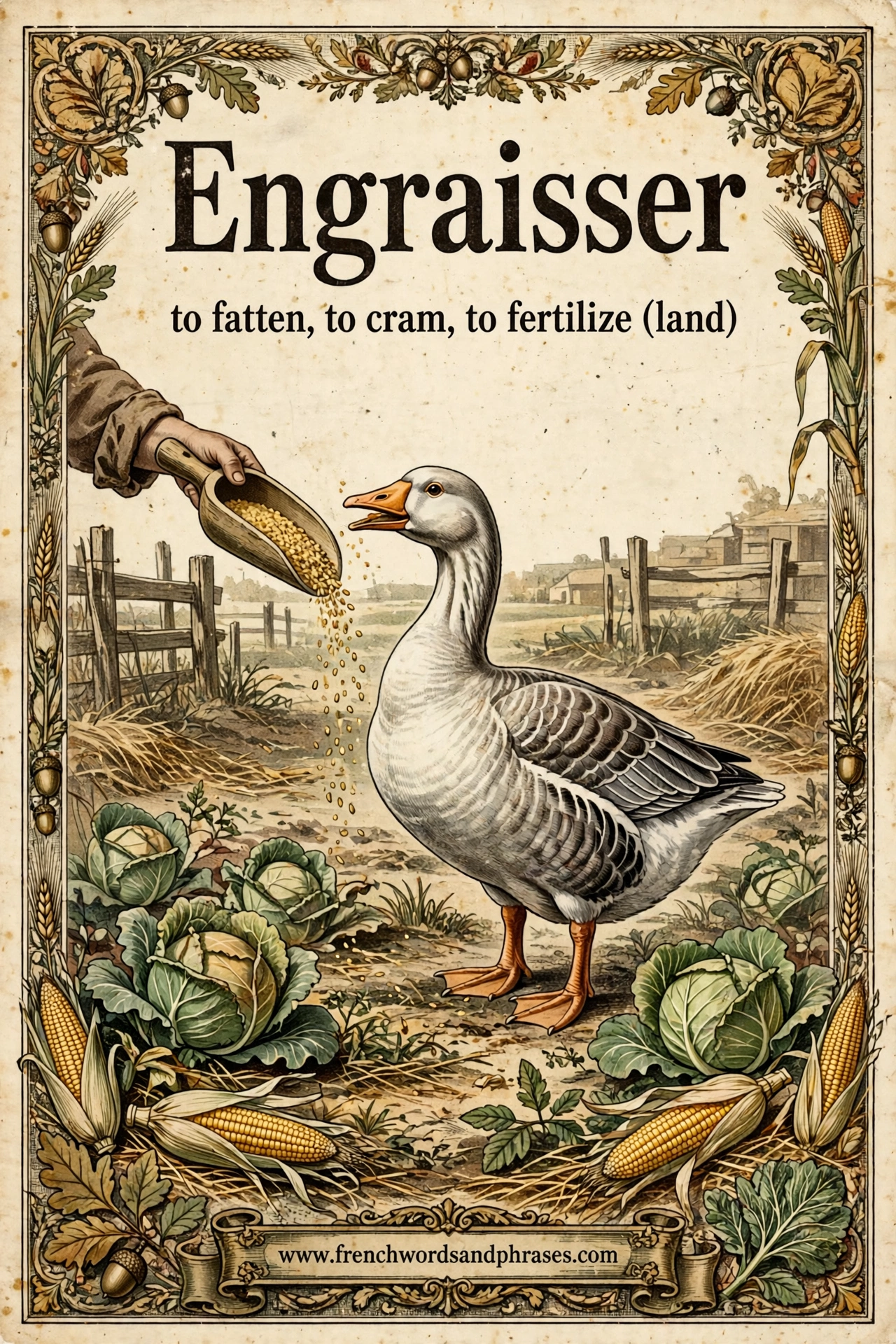
Engraisser means to fatten, to cram, to fertilize (land) — to feed animals until they grow fat, geese until their livers swell, or soil until it grows rich.
Autumn on the farm: pigs on acorns, geese on corn, fields under a good layer of manure. Engraisser is the farmer’s verb of making things fat and fertile — beasts, birds and land all grow richer under its hand.
In this guide, you’ll learn how to conjugate engraisser in all the major French tenses and moods. Explore complete conjugation tables, French examples, English translations, and practice quizzes.
Understanding the French Verb Engraisser
Engraisser is a regular French verb belonging to the first group of verbs, those ending in-er.
It means to fatten, to cram, to fertilize (land). It is commonly used in farming for fattening pigs, cattle and poultry, in the foie gras country of the south-west for the cramming of geese and ducks, and in gardening and agriculture for enriching the soil — engraisser la terre, engraisser un champ.
Verb classification: First group (-er)
Auxiliary verb: Avoir
Past participle: engraissé
Present participle: engraissant
English equivalents: To fatten, to cram, to fertilize; engraisser un porc — to fatten a pig; engraisser des oies — to cram geese; engraisser la terre — to fertilize the soil; un engrais — a fertilizer; la graisse — fat, grease.
One important detail: engraisser is la graisse — fat, grease — turned into a verb: to put fat on. That is why one word covers three farmyard jobs: fattening an animal, cramming a goose for foie gras, and feeding a field, since rich soil is, so to speak, fat soil — and un engrais is the French word for fertilizer. The verb is perfectly regular: j’engraisse, nous engraissons, ils engraissent.
Experience the Word
Engraisser is the verb of deliberate abundance — nothing is left to grow thin or poor if the farmer can feed it.
Imagine a farm in the Périgord in October. Morning and evening the geese come to the cramming pen, the pigs root among the fallen acorns, and the farmer carts manure to the resting field — il engraisse ses bêtes et il engraisse sa terre, and the whole farm swells gently toward winter.
Beasts, birds and soil alike. Everything on the farm is being fattened — engraissé, on purpose, by feeding.
How to Conjugate Engraisser: Complete French Conjugation Guide
Let’s explore every major conjugation of engraisser, beginning with the indicative mood.
How to Conjugate Engraisser in the Indicative Mood
The indicative mood is used to express facts, observations, actions, and events.
How to Conjugate Engraisser in the Present Tense (Présent)
Used for actions happening now, habitual actions, and general truths.
| Subject | Conjugation |
|---|---|
| je | engraisse |
| tu | engraisses |
| il / elle | engraisse |
| nous | engraissons |
| vous | engraissez |
| ils / elles | engraissent |
Example
Le fermier engraisse ses porcs pour l’hiver.
The farmer is fattening his pigs for the winter.
Quick Quiz 1
Complete the sentence:
Nous ______ les oies pour Noël.
Reveal the answer
engraissons
Nous engraissons les oies pour Noël.
We are cramming the geese for Christmas.
How to Conjugate Engraisser in the Passé Composé
Used for completed actions in the past. Engraisser takes the auxiliary verb avoir.
| Subject | Conjugation |
|---|---|
| j’ | ai engraissé |
| tu | as engraissé |
| il / elle | a engraissé |
| nous | avons engraissé |
| vous | avez engraissé |
| ils / elles | ont engraissé |
Example
Elle a engraissé les oies pendant un mois.
She crammed the geese for a month.
How to Conjugate Engraisser in the Imparfait (Imperfect Tense)
Used for habitual past actions, descriptions, and ongoing situations in the past.
| Subject | Conjugation |
|---|---|
| je | engraissais |
| tu | engraissais |
| il / elle | engraissait |
| nous | engraissions |
| vous | engraissiez |
| ils / elles | engraissaient |
Example
On engraissait les chapons dans la basse-cour.
People used to fatten the capons in the farmyard.
Quick Quiz 2
Choose the correct form:
He fertilized the soil.
Il ______ la terre. (a engraissé / est engraissé)
Reveal the answer
a engraissé
Il a engraissé la terre.
Engraisser takes avoir.
How to Conjugate Engraisser in the Plus-que-parfait
Used to describe an action that had already been completed before another past event.
| Subject | Conjugation |
|---|---|
| j’ | avais engraissé |
| tu | avais engraissé |
| il / elle | avait engraissé |
| nous | avions engraissé |
| vous | aviez engraissé |
| ils / elles | avaient engraissé |
Example
Il avait engraissé la terre avant de semer.
He had fertilized the soil before sowing.
How to Conjugate Engraisser in the Passé Simple
Primarily used in formal writing, literature, and historical narratives. It is rarely used in everyday conversation.
| Subject | Conjugation |
|---|---|
| je | engraissai |
| tu | engraissas |
| il / elle | engraissa |
| nous | engraissâmes |
| vous | engraissâtes |
| ils / elles | engraissèrent |
Example
Le paysan engraissa ses bêtes tout l’automne.
The farmer fattened his animals all autumn.
How to Conjugate Engraisser in the Passé Antérieur
A literary tense used to express an action completed immediately before another past action, generally in the passé simple.
| Subject | Conjugation |
|---|---|
| j’ | eus engraissé |
| tu | eus engraissé |
| il / elle | eut engraissé |
| nous | eûmes engraissé |
| vous | eûtes engraissé |
| ils / elles | eurent engraissé |
Example
Quand il eut engraissé les oies, il les mena au marché.
When he had crammed the geese, he took them to market.
How to Conjugate Engraisser in the Future Tense (Futur Simple)
Used to describe actions that will take place in the future.
| Subject | Conjugation |
|---|---|
| je | engraisserai |
| tu | engraisseras |
| il / elle | engraissera |
| nous | engraisserons |
| vous | engraisserez |
| ils / elles | engraisseront |
Example
Cette année, nous engraisserons vingt canards.
This year, we will fatten twenty ducks.
How to Conjugate Engraisser in the Futur Antérieur (Future Perfect)
Used for an action that will have been completed before a particular point in the future.
| Subject | Conjugation |
|---|---|
| j’ | aurai engraissé |
| tu | auras engraissé |
| il / elle | aura engraissé |
| nous | aurons engraissé |
| vous | aurez engraissé |
| ils / elles | auront engraissé |
Example
En décembre, elle aura engraissé toutes les oies de la ferme.
By December, she will have crammed all the geese on the farm.
How to Conjugate Engraisser in the Near Future (Futur Proche)
Used to describe something that is going to happen soon. Formed with aller + infinitive.
| Subject | Conjugation |
|---|---|
| je | vais engraisser |
| tu | vas engraisser |
| il / elle | va engraisser |
| nous | allons engraisser |
| vous | allez engraisser |
| ils / elles | vont engraisser |
Example
Le fermier va engraisser la terre avec du fumier.
The farmer is going to fertilize the soil with manure.
How to Conjugate Engraisser in the Conditional Mood
The conditional mood expresses what would happen under certain circumstances. It is also frequently used to make polite requests or express wishes.
How to Conjugate Engraisser in the Present Conditional
| Subject | Conjugation |
|---|---|
| je | engraisserais |
| tu | engraisserais |
| il / elle | engraisserait |
| nous | engraisserions |
| vous | engraisseriez |
| ils / elles | engraisseraient |
Example
Le fermier engraisserait ses porcs avec du maïs.
The farmer would fatten his pigs with corn.
How to Conjugate Engraisser in the Past Conditional
| Subject | Conjugation |
|---|---|
| j’ | aurais engraissé |
| tu | aurais engraissé |
| il / elle | aurait engraissé |
| nous | aurions engraissé |
| vous | auriez engraissé |
| ils / elles | auraient engraissé |
Example
Il aurait engraissé plus de canards avec un plus grand enclos.
He would have fattened more ducks with a bigger pen.
Engraisser in the Literary Past Conditional Form
This less common literary form uses the imperfect subjunctive of avoir.
| Subject | Conjugation |
|---|---|
| j’ | eusse engraissé |
| tu | eusses engraissé |
| il / elle | eût engraissé |
| nous | eussions engraissé |
| vous | eussiez engraissé |
| ils / elles | eussent engraissé |
Example
Le paysan eût engraissé ses oies sans la sécheresse.
The farmer would have crammed his geese without the drought.
How to Conjugate Engraisser in the Subjunctive Mood
The subjunctive is used to express wishes, emotions, doubts, necessity, and uncertainty. It frequently follows expressions such as il faut que (it is necessary that) or bien que (although).
How to Conjugate Engraisser in the Present Subjunctive
| Subject | Conjugation |
|---|---|
| que je | engraisse |
| que tu | engraisses |
| qu’il / qu’elle | engraisse |
| que nous | engraissions |
| que vous | engraissiez |
| qu’ils / qu’elles | engraissent |
Example
Il faut que tu engraisses la terre avant les semailles.
You must fertilize the soil before sowing time.
Quick Quiz 3
Complete the sentence using the subjunctive:
Il faut que tu ______ la terre avant les semailles.
Reveal the answer
engraisses
Il faut que tu engraisses la terre avant les semailles.
You must fertilize the soil before sowing time.
How to Conjugate Engraisser in the Imperfect Subjunctive
A literary tense, rarely encountered in modern spoken French.
| Subject | Conjugation |
|---|---|
| que je | engraissasse |
| que tu | engraissasses |
| qu’il / qu’elle | engraissât |
| que nous | engraissassions |
| que vous | engraissassiez |
| qu’ils / qu’elles | engraissassent |
Example
Le fermier voulait que l’on engraissât les porcs dès septembre.
The farmer wanted the pigs fattened from September on.
How to Conjugate Engraisser in the Pluperfect Subjunctive
A literary construction used to express an action completed before another past action.
| Subject | Conjugation |
|---|---|
| que j’ | eusse engraissé |
| que tu | eusses engraissé |
| qu’il / qu’elle | eût engraissé |
| que nous | eussions engraissé |
| que vous | eussiez engraissé |
| qu’ils / qu’elles | eussent engraissé |
Example
On disait qu’il eût engraissé ses bêtes avec un fourrage secret.
People said he had fattened his animals on a secret feed.
How to Conjugate Engraisser in the Past Subjunctive
| Subject | Conjugation |
|---|---|
| que j’ | aie engraissé |
| que tu | aies engraissé |
| qu’il / qu’elle | ait engraissé |
| que nous | ayons engraissé |
| que vous | ayez engraissé |
| qu’ils / qu’elles | aient engraissé |
Example
Je suis content qu’elle ait engraissé la terre à temps.
I am glad she fertilized the soil in time.
How to Conjugate Engraisser in the Imperative
The imperative is used to give commands, instructions, invitations, or suggestions. Subject pronouns are omitted.
How to Conjugate Engraisser in the Present Imperative
| Person | Conjugation |
|---|---|
| (tu) | engraisse |
| (nous) | engraissons |
| (vous) | engraissez |
Example
Engraissez les oies matin et soir !
Cram the geese morning and evening!
Quick Quiz 4
How would you say Fatten the geese (tu form)?
Reveal the answer
Engraisse les oies !
French Participles of Engraisser
Participles are verb forms that can be used in compound tenses and other grammatical constructions.
Present Participle of Engraisser
engraissant
En engraissant ses porcs, le fermier prépare l’hiver.
By fattening his pigs, the farmer prepares for winter.
Past Participle of Engraisser
engraissé
Engraissées au maïs, les oies donnent un foie célèbre.
Crammed on corn, the geese produce a famous liver.
Engraisser in Everyday French: Real-Life Examples
Now that you know the conjugations, let’s see how engraisser appears in everyday French.
Example 1 — Present
Le fermier engraisse ses porcs.
The farmer is fattening his pigs.
Example 2 — Passé composé
Elle a engraissé les oies.
She crammed the geese.
Example 3 — Imparfait
On engraissait les chapons pour Noël.
People used to fatten the capons for Christmas.
Example 4 — Future
Nous engraisserons les canards.
We will fatten the ducks.
Example 5 — Conditional
Il engraisserait la terre avec du fumier.
He would fertilize the soil with manure.
Example 6 — Imperative
Engraisse les oies, s’il te plaît !
Cram the geese, please!
Beyond Translation: The Meaning of Engraisser
Few French verbs carry a whole farm economy in one word. Engraisser begins with la graisse, fat, and radiates outward: fat animals, fat livers, fat soil.
Even the fertilizer keeps the name.
Un engrais — chemical or natural — is literally a fattener, something that puts flesh on the land. And the goose on the label of every foie gras tin has met this verb personally.
How to Remember the French Verb Engraisser
Remember it this way: Engraisser is about the farmer fattening his geese for winter.
- From la graisse, fat: engraisser is to put fat on — animals, geese, and even the soil.
- Three jobs, one verb: fatten a pig, cram a goose, fertilize a field.
- Regular -er: j’engraisse, nous engraissons, past participle engraissé.
The key idea is the farmer fattening his geese for winter.
Test Your Knowledge of Engraisser
Let’s see how much you’ve learned. Try answering these questions before revealing the answers.
Question 1
What three farmyard jobs does engraisser cover?
Reveal the answer
Fattening animals, cramming geese, and fertilizing land — all from la graisse, fat.
Question 2
How do you say The farmer is fattening his pigs in French?
Reveal the answer
Le fermier engraisse ses porcs.
Question 3
Translate: She crammed the geese for a month.
Reveal the answer
Elle a engraissé les oies pendant un mois.
Question 4
What is the past participle of engraisser?
Reveal the answer
Engraissé.
Question 5
Complete the sentence:
Il faut que tu ______ la terre avant les semailles.
Reveal the answer
engraisses
Il faut que tu engraisses la terre avant les semailles.
You must fertilize the soil before sowing time.
Your Final Challenge
Can You Use It?
How would you say this in French?
The farmer fattens his geese, fertilizes his soil, and the farm prospers.
Reveal the answer
Le fermier engraisse ses oies, engraisse sa terre, et la ferme prospère.
The farmer fattens his geese, fertilizes his soil, and the farm prospers.
A little French. A little curiosity. A richer everyday life.
LEARN FRENCH ONE WORD AT A TIME