A French Word to Live By
How to Conjugate Engerber in French
/ɑ̃.ʒɛʁ.be/
Engerber means to sheaf, to pile up — to bind cut corn into sheaves and stack them, the central gesture of the old harvest.
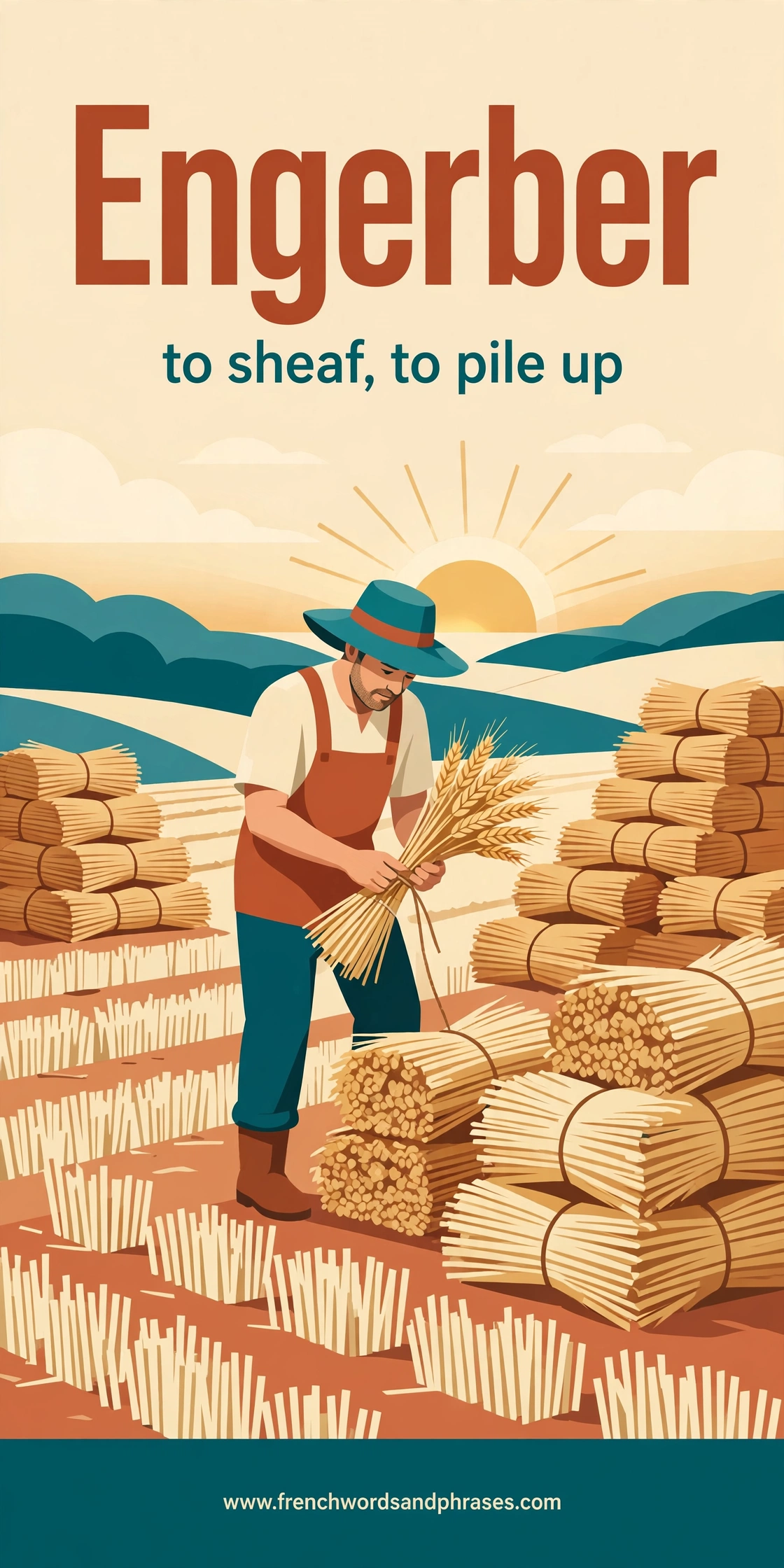
A wheat field in August before the age of combine harvesters: the reapers cut, and behind them the binders gather armfuls of stalks, tie them into sheaves and stand them in piles to dry — engerber is that gesture, binding the harvest into gerbes.
In this guide, you’ll learn how to conjugate engerber in all the major French tenses and moods. Explore complete conjugation tables, French examples, English translations, and practice quizzes.
Understanding the French Verb Engerber
Engerber is a regular French verb belonging to the first group of verbs, those ending in-er.
It means to sheaf, to pile up. It is commonly used of wheat, oats, barley and rye at harvest time, and it survives wherever traditional harvests are still gathered by hand or re-enacted. Figuratively it can pile up anything gathered in armfuls, but its home is the cornfield in high summer.
Verb classification: First group (-er)
Auxiliary verb: Avoir
Past participle: engerbé
Present participle: engerbant
English equivalents: To sheaf, to bind into sheaves, to pile up; engerber le blé — to sheaf the wheat; engerber les gerbes — to pile up the sheaves; une gerbe — a sheaf (also a bouquet, a spray of sparks); la moisson — the harvest.
One important detail: engerber is the verb of une gerbe, a sheaf — an armful of stalks tied together. The harvest sequence matters: faucher or moissonner is to cut the corn, engerber is to bind and pile what has been cut, and battre is to thresh it later. The verb is a regular -er: j’engerbe, nous engerbons, ils engerbent, past participle engerbé. Modern machines have nearly retired it — a moissonneuse-batteuse cuts, threshes and pours in one pass, and nobody engerbe any more except in old farms, festivals and novels.
Experience the Word
Engerber is the verb of arms full of wheat — gather, tie, stand the sheaf upright, and move on to the next armful.
Imagine a harvest in 1900. The reapers swing their scythes in a line, and behind them women and children gather the fallen stalks, twist a band of straw, and engerbent — sheaf after sheaf standing in golden rows across the field, drying in the sun like a small army at rest.
By evening the field is not empty. It is sheaved — engerbé — a thousand bundles waiting for the carts.
How to Conjugate Engerber: Complete French Conjugation Guide
Let’s explore every major conjugation of engerber, beginning with the indicative mood.
How to Conjugate Engerber in the Indicative Mood
The indicative mood is used to express facts, observations, actions, and events.
How to Conjugate Engerber in the Present Tense (Présent)
Used for actions happening now, habitual actions, and general truths.
| Subject | Conjugation |
|---|---|
| je | engerbe |
| tu | engerbes |
| il / elle | engerbe |
| nous | engerbons |
| vous | engerbez |
| ils / elles | engerbent |
Example
Les moissonneurs engerbent le blé sous un soleil de plomb.
The harvesters are sheafing the wheat under a blazing sun.
Quick Quiz 1
Complete the sentence:
Nous ______ le seigle demain matin.
Reveal the answer
engerberons
Nous engerberons le seigle demain matin.
We will sheaf the rye tomorrow morning.
How to Conjugate Engerber in the Passé Composé
Used for completed actions in the past. Engerber takes the auxiliary verb avoir.
| Subject | Conjugation |
|---|---|
| j’ | ai engerbé |
| tu | as engerbé |
| il / elle | a engerbé |
| nous | avons engerbé |
| vous | avez engerbé |
| ils / elles | ont engerbé |
Example
Ils ont engerbé tout le champ avant l’orage.
They sheaved the whole field before the storm.
How to Conjugate Engerber in the Imparfait (Imperfect Tense)
Used for habitual past actions, descriptions, and ongoing situations in the past.
| Subject | Conjugation |
|---|---|
| je | engerbais |
| tu | engerbais |
| il / elle | engerbait |
| nous | engerbions |
| vous | engerbiez |
| ils / elles | engerbaient |
Example
Mon grand-père engerbait l’avoine à la main.
My grandfather used to sheaf the oats by hand.
Quick Quiz 2
Choose the correct form:
They sheaved the whole field.
Ils ______ tout le champ. (ont engerbé / sont engerbés)
Reveal the answer
ont engerbé
Ils ont engerbé tout le champ.
Engerber takes avoir.
How to Conjugate Engerber in the Plus-que-parfait
Used to describe an action that had already been completed before another past event.
| Subject | Conjugation |
|---|---|
| j’ | avais engerbé |
| tu | avais engerbé |
| il / elle | avait engerbé |
| nous | avions engerbé |
| vous | aviez engerbé |
| ils / elles | avaient engerbé |
Example
Elle avait engerbé les gerbes près de la grange.
She had piled up the sheaves near the barn.
How to Conjugate Engerber in the Passé Simple
Primarily used in formal writing, literature, and historical narratives. It is rarely used in everyday conversation.
| Subject | Conjugation |
|---|---|
| je | engerbai |
| tu | engerbas |
| il / elle | engerba |
| nous | engerbâmes |
| vous | engerbâtes |
| ils / elles | engerbèrent |
Example
Les paysans engerbèrent la récolte en trois jours.
The peasants sheaved the harvest in three days.
How to Conjugate Engerber in the Passé Antérieur
A literary tense used to express an action completed immediately before another past action, generally in the passé simple.
| Subject | Conjugation |
|---|---|
| j’ | eus engerbé |
| tu | eus engerbé |
| il / elle | eut engerbé |
| nous | eûmes engerbé |
| vous | eûtes engerbé |
| ils / elles | eurent engerbé |
Example
Quand ils eurent engerbé le dernier champ, la fête commença.
When they had sheaved the last field, the festival began.
How to Conjugate Engerber in the Future Tense (Futur Simple)
Used to describe actions that will take place in the future.
| Subject | Conjugation |
|---|---|
| je | engerberai |
| tu | engerberas |
| il / elle | engerbera |
| nous | engerberons |
| vous | engerberez |
| ils / elles | engerberont |
Example
Demain, nous engerberons le seigle.
Tomorrow, we will sheaf the rye.
How to Conjugate Engerber in the Futur Antérieur (Future Perfect)
Used for an action that will have been completed before a particular point in the future.
| Subject | Conjugation |
|---|---|
| j’ | aurai engerbé |
| tu | auras engerbé |
| il / elle | aura engerbé |
| nous | aurons engerbé |
| vous | aurez engerbé |
| ils / elles | auront engerbé |
Example
À la tombée de la nuit, ils auront engerbé tout le pré.
By nightfall, they will have sheaved the whole meadow.
How to Conjugate Engerber in the Near Future (Futur Proche)
Used to describe something that is going to happen soon. Formed with aller + infinitive.
| Subject | Conjugation |
|---|---|
| je | vais engerber |
| tu | vas engerber |
| il / elle | va engerber |
| nous | allons engerber |
| vous | allez engerber |
| ils / elles | vont engerber |
Example
Regarde, ils vont engerber les gerbes près du chemin.
Look, they are going to pile up the sheaves near the path.
How to Conjugate Engerber in the Conditional Mood
The conditional mood expresses what would happen under certain circumstances. It is also frequently used to make polite requests or express wishes.
How to Conjugate Engerber in the Present Conditional
| Subject | Conjugation |
|---|---|
| je | engerberais |
| tu | engerberais |
| il / elle | engerberait |
| nous | engerberions |
| vous | engerberiez |
| ils / elles | engerberaient |
Example
Avec une lieuse mécanique, on engerberait deux fois plus vite.
With a mechanical binder, we would sheaf twice as fast.
How to Conjugate Engerber in the Past Conditional
| Subject | Conjugation |
|---|---|
| j’ | aurais engerbé |
| tu | aurais engerbé |
| il / elle | aurait engerbé |
| nous | aurions engerbé |
| vous | auriez engerbé |
| ils / elles | auraient engerbé |
Example
Nous aurions engerbé plus tôt sans la panne du tracteur.
We would have sheaved earlier without the tractor breaking down.
Engerber in the Literary Past Conditional Form
This less common literary form uses the imperfect subjunctive of avoir.
| Subject | Conjugation |
|---|---|
| j’ | eusse engerbé |
| tu | eusses engerbé |
| il / elle | eût engerbé |
| nous | eussions engerbé |
| vous | eussiez engerbé |
| ils / elles | eussent engerbé |
Example
Il eût engerbé tout le champ avant la nuit, sans la pluie.
He would have sheaved the whole field before night, if not for the rain.
How to Conjugate Engerber in the Subjunctive Mood
The subjunctive is used to express wishes, emotions, doubts, necessity, and uncertainty. It frequently follows expressions such as il faut que (it is necessary that) or bien que (although).
How to Conjugate Engerber in the Present Subjunctive
| Subject | Conjugation |
|---|---|
| que je | engerbe |
| que tu | engerbes |
| qu’il / qu’elle | engerbe |
| que nous | engerbions |
| que vous | engerbiez |
| qu’ils / qu’elles | engerbent |
Example
Il faut que vous engerbiez ce blé avant la pluie.
You must sheaf this wheat before the rain.
Quick Quiz 3
Complete the sentence using the subjunctive:
Il faut que tu ______ le blé avant la pluie.
Reveal the answer
engerbes
Il faut que tu engerbes le blé avant la pluie.
You must sheaf the wheat before the rain.
How to Conjugate Engerber in the Imperfect Subjunctive
A literary tense, rarely encountered in modern spoken French.
| Subject | Conjugation |
|---|---|
| que je | engerbasse |
| que tu | engerbasses |
| qu’il / qu’elle | engerbât |
| que nous | engerbassions |
| que vous | engerbassiez |
| qu’ils / qu’elles | engerbassent |
Example
Le fermier voulait que l’on engerbât les gerbes le jour même.
The farmer wanted the sheaves piled up that very day.
How to Conjugate Engerber in the Pluperfect Subjunctive
A literary construction used to express an action completed before another past action.
| Subject | Conjugation |
|---|---|
| que j’ | eusse engerbé |
| que tu | eusses engerbé |
| qu’il / qu’elle | eût engerbé |
| que nous | eussions engerbé |
| que vous | eussiez engerbé |
| qu’ils / qu’elles | eussent engerbé |
Example
On doutait qu’ils eussent engerbé toute la récolte à temps.
People doubted they had sheaved the whole harvest in time.
How to Conjugate Engerber in the Past Subjunctive
| Subject | Conjugation |
|---|---|
| que j’ | aie engerbé |
| que tu | aies engerbé |
| qu’il / qu’elle | ait engerbé |
| que nous | ayons engerbé |
| que vous | ayez engerbé |
| qu’ils / qu’elles | aient engerbé |
Example
Je suis ravi qu’ils aient engerbé le champ avant l’orage.
I am delighted they sheaved the field before the storm.
How to Conjugate Engerber in the Imperative
The imperative is used to give commands, instructions, invitations, or suggestions. Subject pronouns are omitted.
How to Conjugate Engerber in the Present Imperative
| Person | Conjugation |
|---|---|
| (tu) | engerbe |
| (nous) | engerbons |
| (vous) | engerbez |
Example
Engerbez ces gerbes près de la grange !
Pile up these sheaves near the barn!
Quick Quiz 4
How would you say Pile up these sheaves (tu form)?
Reveal the answer
Engerbe ces gerbes !
French Participles of Engerber
Participles are verb forms that can be used in compound tenses and other grammatical constructions.
Present Participle of Engerber
engerbant
En engerbant le blé, les enfants apprenaient le métier.
By sheafing the wheat, the children were learning the trade.
Past Participle of Engerber
engerbé
Engerbées en plein soleil, les gerbes attendaient le chariot.
Sheaved in full sun, the bundles waited for the cart.
Engerber in Everyday French: Real-Life Examples
Now that you know the conjugations, let’s see how engerber appears in everyday French.
Example 1 — Present
Les moissonneurs engerbent le blé.
The harvesters are sheafing the wheat.
Example 2 — Passé composé
Ils ont engerbé tout le champ.
They sheaved the whole field.
Example 3 — Imparfait
Mon grand-père engerbait l’avoine à la main.
My grandfather used to sheaf the oats by hand.
Example 4 — Future
Nous engerberons le seigle demain.
We will sheaf the rye tomorrow.
Example 5 — Conditional
On engerberait plus vite avec une lieuse mécanique.
We would sheaf faster with a mechanical binder.
Example 6 — Imperative
Engerbez ces gerbes près de la grange !
Pile up these sheaves near the barn!
Beyond Translation: The Meaning of Engerber
English sheaf is a noun looking for its verb; French engerber does the whole job — en- + gerbe, to put corn into sheaves.
Une gerbe leads a double life in French.
It is a sheaf of wheat, but also a bouquet (une gerbe de fleurs), a spray of sparks (une gerbe d’étincelles) and even a sheaf of papers — anything gathered and bound in one generous armful.
How to Remember the French Verb Engerber
Remember it this way: Engerber is about armfuls of wheat tied into sheaves under the August sun.
- Built on une gerbe, a sheaf: engerber is to put the cut corn into sheaves and pile them up.
- Harvest order: faucher (cut), engerber (bind and pile), battre (thresh).
- Regular -er: j’engerbe, nous engerbons, past participle engerbé.
The key idea is armfuls of wheat tied into sheaves under the August sun.
Test Your Knowledge of Engerber
Let’s see how much you’ve learned. Try answering these questions before revealing the answers.
Question 1
What is une gerbe?
Reveal the answer
A sheaf — an armful of cut stalks tied together; engerber is to bind corn into sheaves.
Question 2
How do you say They sheaved the whole field in French?
Reveal the answer
Ils ont engerbé tout le champ.
Question 3
Translate: Tomorrow, we will sheaf the rye.
Reveal the answer
Demain, nous engerberons le seigle.
Question 4
What is the past participle of engerber?
Reveal the answer
Engerbé.
Question 5
Complete the sentence:
Il faut que vous ______ ce blé avant la pluie.
Reveal the answer
engerbiez
Il faut que vous engerbiez ce blé avant la pluie.
You must sheaf this wheat before the rain.
Your Final Challenge
Can You Use It?
How would you say this in French?
They were sheafing the wheat at sunset, and the whole field was becoming a village of golden sheaves.
Reveal the answer
Ils engerbaient le blé au coucher du soleil, et le champ entier devenait un village de gerbes dorées.
They were sheafing the wheat at sunset, and the whole field was becoming a village of golden sheaves.
A little French. A little curiosity. A richer everyday life.
LEARN FRENCH ONE WORD AT A TIME