A French Word to Live By
How to Conjugate Enfouir in French
/ɑ̃.fwiʁ/
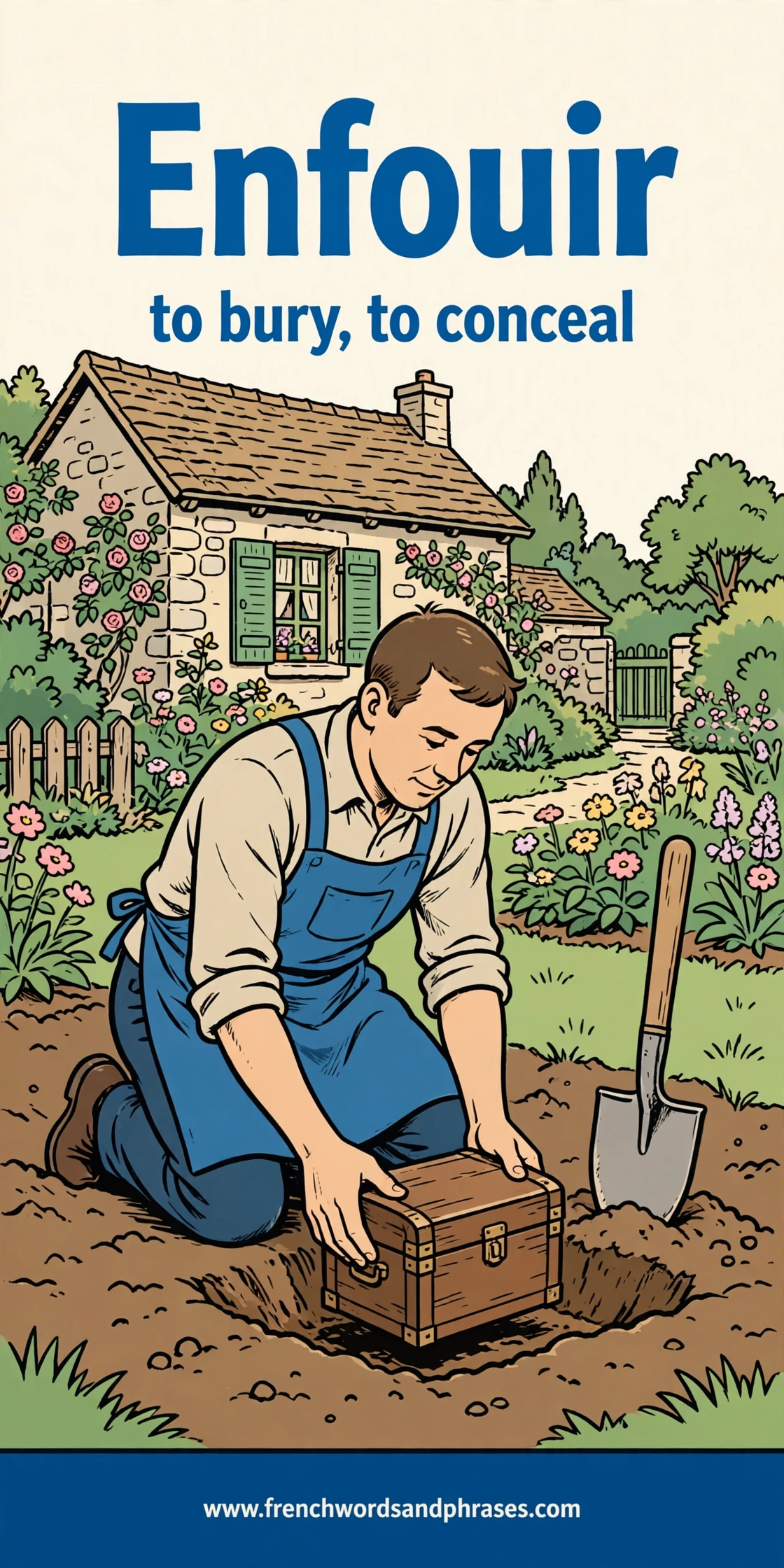
Enfouir means to bury, to conceal — to put something deep under earth, sand or clutter so that it disappears from sight.
A dog digging furiously in the corner of the garden, pirates lowering a chest into the sand at midnight, a letter pushed under the floorboards — enfouir is the verb of hiding things deep: not tidying them away, but burying them out of sight.
In this guide, you’ll learn how to conjugate enfouir in all the major French tenses and moods. Explore complete conjugation tables, French examples, English translations, and practice quizzes.
Understanding the French Verb Enfouir
Enfouir is a regular French verb belonging to the second group of verbs, those ending in -ir.
It means to bury, to conceal. It is used for treasure and secrets, for dogs burying bones and gardeners burying bulbs, for the modern technical job of burying cables and pipes underground, and figuratively for a face buried in hands or a memory buried deep — enfouir un souvenir.
Verb classification: Second group (-ir)
Auxiliary verb: Avoir
Past participle: enfoui
Present participle: enfouissant
English equivalents: To bury, to conceal, to hide away; enfouir un trésor — to bury treasure; enfouir son visage dans ses mains — to bury one’s face in one’s hands; enfouir des déchets — to bury waste (landfill); enfouir des câbles — to lay cables underground; enfoui sous — buried under.
One important detail: enfouir is a regular second-group verb like finir — j’enfouis, nous enfouissons, ils enfouissent, imperfect j’enfouissais, present participle en enfouissant, past participle enfoui. Do not confuse it with enfuir (to flee), which is irregular: enfouir buries something, enfuir runs away. Its favourite companions are depth words: enfouir sous la terre, enfouir au fond du jardin, enfouir sous une pile de linge.
Experience the Word
Enfouir is the verb of the deep hiding place — whatever is enfoui is not stored, it has vanished into the earth.
Imagine a pirate crew at midnight on a small island. The chest goes down into the sand, the hole is filled, palm leaves are scattered over the spot. They have not hidden their gold — ils l’ont enfoui, and only the map knows where.
Nothing shows on the surface. The treasure is buried — enfoui — and the sand keeps the secret.
How to Conjugate Enfouir: Complete French Conjugation Guide
Let’s explore every major conjugation of enfouir, beginning with the indicative mood.
How to Conjugate Enfouir in the Indicative Mood
The indicative mood is used to express facts, observations, actions, and events.
How to Conjugate Enfouir in the Present Tense (Présent)
Used for actions happening now, habitual actions, and general truths.
| Subject | Conjugation |
|---|---|
| je | enfouis |
| tu | enfouis |
| il / elle | enfouit |
| nous | enfouissons |
| vous | enfouissez |
| ils / elles | enfouissent |
Example
Le chien enfouit son os au fond du jardin.
The dog buries its bone at the bottom of the garden.
Quick Quiz 1
Complete the sentence:
Nous ______ les câbles sous la route.
Reveal the answer
enfouirons
Nous enfouirons les câbles sous la route.
>We will bury the cables under the road.
How to Conjugate Enfouir in the Passé Composé
Used for completed actions in the past. Enfouir takes the auxiliary verb avoir.
| Subject | Conjugation |
|---|---|
| j’ | ai enfoui |
| tu | as enfoui |
| il / elle | a enfoui |
| nous | avons enfoui |
| vous | avez enfoui |
| ils / elles | ont enfoui |
Example
Les pirates ont enfoui leur trésor sous le sable.
The pirates buried their treasure under the sand.
How to Conjugate Enfouir in the Imparfait (Imperfect Tense)
Used for habitual past actions, descriptions, and ongoing situations in the past.
| Subject | Conjugation |
|---|---|
| je | enfouissais |
| tu | enfouissais |
| il / elle | enfouissait |
| nous | enfouissions |
| vous | enfouissiez |
| ils / elles | enfouissaient |
Example
Autrefois, on enfouissait les déchets derrière la maison.
In the old days, people buried rubbish behind the house.
Quick Quiz 2
Choose the correct form:
The pirates buried their treasure.
Les pirates ______ leur trésor. (ont enfoui / sont enfouis)
Reveal the answer
ont enfoui
Les pirates ont enfoui leur trésor.
Enfouir takes avoir.
How to Conjugate Enfouir in the Plus-que-parfait
Used to describe an action that had already been completed before another past event.
| Subject | Conjugation |
|---|---|
| j’ | avais enfoui |
| tu | avais enfoui |
| il / elle | avait enfoui |
| nous | avions enfoui |
| vous | aviez enfoui |
| ils / elles | avaient enfoui |
Example
Elle avait enfoui la lettre sous les planches du grenier.
She had hidden the letter under the floorboards of the attic.
How to Conjugate Enfouir in the Passé Simple
Primarily used in formal writing, literature, and historical narratives. It is rarely used in everyday conversation.
| Subject | Conjugation |
|---|---|
| je | enfouis |
| tu | enfouis |
| il / elle | enfouit |
| nous | enfouîmes |
| vous | enfouîtes |
| ils / elles | enfouirent |
Example
Le jardinier enfouit les bulbes avant l’hiver.
The gardener buried the bulbs before winter.
How to Conjugate Enfouir in the Passé Antérieur
A literary tense used to express an action completed immediately before another past action, generally in the passé simple.
| Subject | Conjugation |
|---|---|
| j’ | eus enfoui |
| tu | eus enfoui |
| il / elle | eut enfoui |
| nous | eûmes enfoui |
| vous | eûtes enfoui |
| ils / elles | eurent enfoui |
Example
Quand il eut enfoui le coffret, il recouvrit la terre de feuilles.
When he had buried the little chest, he covered the earth with leaves.
How to Conjugate Enfouir in the Future Tense (Futur Simple)
Used to describe actions that will take place in the future.
| Subject | Conjugation |
|---|---|
| je | enfouirai |
| tu | enfouiras |
| il / elle | enfouira |
| nous | enfouirons |
| vous | enfouirez |
| ils / elles | enfouiront |
Example
Nous enfouirons les câbles sous la route.
We will bury the cables under the road.
How to Conjugate Enfouir in the Futur Antérieur (Future Perfect)
Used for an action that will have been completed before a particular point in the future.
| Subject | Conjugation |
|---|---|
| j’ | aurai enfoui |
| tu | auras enfoui |
| il / elle | aura enfoui |
| nous | aurons enfoui |
| vous | aurez enfoui |
| ils / elles | auront enfoui |
Example
À la fin du chantier, ils auront enfoui toutes les canalisations.
By the end of the works, they will have buried all the pipes.
How to Conjugate Enfouir in the Near Future (Futur Proche)
Used to describe something that is going to happen soon. Formed with aller + infinitive.
| Subject | Conjugation |
|---|---|
| je | vais enfouir |
| tu | vas enfouir |
| il / elle | va enfouir |
| nous | allons enfouir |
| vous | allez enfouir |
| ils / elles | vont enfouir |
Example
Regarde le chien, il va enfouir son os !
Look at the dog, it is going to bury its bone!
How to Conjugate Enfouir in the Conditional Mood
The conditional mood expresses what would happen under certain circumstances. It is also frequently used to make polite requests or express wishes.
How to Conjugate Enfouir in the Present Conditional
| Subject | Conjugation |
|---|---|
| je | enfouirais |
| tu | enfouirais |
| il / elle | enfouirait |
| nous | enfouirions |
| vous | enfouiriez |
| ils / elles | enfouiraient |
Example
Sans pelle, nous enfouirions difficilement ce tuyau.
Without a spade, we would have trouble burying this pipe.
How to Conjugate Enfouir in the Past Conditional
| Subject | Conjugation |
|---|---|
| j’ | aurais enfoui |
| tu | aurais enfoui |
| il / elle | aurait enfoui |
| nous | aurions enfoui |
| vous | auriez enfoui |
| ils / elles | auraient enfoui |
Example
Elle aurait enfoui la lettre si elle avait eu le temps.
She would have buried the letter if she had had the time.
Enfouir in the Literary Past Conditional Form
This less common literary form uses the imperfect subjunctive of avoir.
| Subject | Conjugation |
|---|---|
| j’ | eusse enfoui |
| tu | eusses enfoui |
| il / elle | eût enfoui |
| nous | eussions enfoui |
| vous | eussiez enfoui |
| ils / elles | eussent enfoui |
Example
Il eût enfoui le trésor au pied du chêne.
He would have buried the treasure at the foot of the oak.
How to Conjugate Enfouir in the Subjunctive Mood
The subjunctive is used to express wishes, emotions, doubts, necessity, and uncertainty. It frequently follows expressions such as il faut que (it is necessary that) or bien que (although).
How to Conjugate Enfouir in the Present Subjunctive
| Subject | Conjugation |
|---|---|
| que je | enfouisse |
| que tu | enfouisses |
| qu’il / qu’elle | enfouisse |
| que nous | enfouissions |
| que vous | enfouissiez |
| qu’ils / qu’elles | enfouissent |
Example
Il faut que tu enfouisses les graines plus profondément.
You must bury the seeds deeper.
Quick Quiz 3
Complete the sentence using the subjunctive:
Il faut que vous ______ le coffret ce soir.
Reveal the answer
enfouissiez
Il faut que vous enfouissiez le coffret ce soir.
You must bury the little chest this evening.
How to Conjugate Enfouir in the Imperfect Subjunctive
A literary tense, rarely encountered in modern spoken French.
| Subject | Conjugation |
|---|---|
| que je | enfouisse |
| que tu | enfouisses |
| qu’il / qu’elle | enfouît |
| que nous | enfouissions |
| que vous | enfouissiez |
| qu’ils / qu’elles | enfouissent |
Example
Il voulait qu’elle enfouît le secret au fond de son cœur.
He wanted her to bury the secret deep in her heart.
How to Conjugate Enfouir in the Pluperfect Subjunctive
A literary construction used to express an action completed before another past action.
| Subject | Conjugation |
|---|---|
| que j’ | eusse enfoui |
| que tu | eusses enfoui |
| qu’il / qu’elle | eût enfoui |
| que nous | eussions enfoui |
| que vous | eussiez enfoui |
| qu’ils / qu’elles | eussent enfoui |
Example
On disait qu’il eût enfoui une fortune quelque part dans l’île.
People said he had buried a fortune somewhere on the island.
How to Conjugate Enfouir in the Past Subjunctive
| Subject | Conjugation |
|---|---|
| que j’ | aie enfoui |
| que tu | aies enfoui |
| qu’il / qu’elle | ait enfoui |
| que nous | ayons enfoui |
| que vous | ayez enfoui |
| qu’ils / qu’elles | aient enfoui |
Example
Je doute qu’elle ait enfoui quoi que ce soit dans ce jardin.
I doubt she buried anything at all in this garden.
How to Conjugate Enfouir in the Imperative
The imperative is used to give commands, instructions, invitations, or suggestions. Subject pronouns are omitted.
How to Conjugate Enfouir in the Present Imperative
| (tu) | enfouis |
| (nous) | enfouissons |
| (vous) | enfouissez |
Example
Enfouis ce trésor et n’en parle à personne !
Bury this treasure and tell no one about it!
Quick Quiz 4
How would you say Bury the seeds deeper (tu form)?
Reveal the answer
Enfouis les graines plus profondément !
French Participles of Enfouir
Participles are verb forms that can be used in compound tenses and other grammatical constructions.
Present Participle of Enfouir
enfouissant
En enfouissant l’argent dans le jardin, il espérait le protéger.
By burying the money in the garden, he hoped to keep it safe.
Past Participle of Enfouir
enfoui
Enfoui sous trois mètres de terre, le coffre attendait depuis un siècle.
Buried under three metres of earth, the chest had been waiting for a century.
Enfouir in Everyday French: Real-Life Examples
Now that you know the conjugations, let’s see how enfouir appears in everyday French.
Example 1 — Present
Le chien enfouit son os dans le jardin.
The dog buries its bone in the garden.
Example 2 — Passé composé
Ils ont enfoui le trésor sous le sable.
They buried the treasure under the sand.
Example 3 — Imparfait
On enfouissait les déchets derrière la maison.
People used to bury rubbish behind the house.
Example 4 — Future
Nous enfouirons les câbles sous la route.
We will bury the cables under the road.
Example 5 — Conditional
Elle enfouirait la lettre si elle pouvait.
She would bury the letter if she could.
Example 6 — Imperative
Enfouis les graines plus profondément !
Bury the seeds deeper!
Beyond Translation: The Meaning of Enfouir
English has no exact everyday match — bury is about graves and earth, but French enfouir happily hides letters under floorboards and faces in hands.
It is built on fouir, an old verb meaning to dig.
The same root gives fouiller, to search by digging around — so what you enfouis today, someone may fouiller for tomorrow. Modern French also uses it as an environment word: l’enfouissement des déchets is landfill burial.
How to Remember the French Verb Enfouir
Remember it this way: Enfouir is about the pirates’ chest going down into the sand at midnight.
- Think of the dog and its bone: enfouir is hiding something deep, not just putting it away.
- Regular -ir of the finir family: j’enfouis, nous enfouissons, past participle enfoui.
- Not enfuir: enfouir buries, enfuir flees — one letter changes the whole story.
The key idea is the pirates’ chest going down into the sand at midnight.
Test Your Knowledge of Enfouir
Let’s see how much you’ve learned. Try answering these questions before revealing the answers.
Question 1
What is the difference between enfouir and enfuir?
Reveal the answer
Enfouir means to bury or conceal something; Enfuir (always reflexive, s’enfuir) means to flee.
Question 2
How do you say The dog buries its bone in the garden in French?
Reveal the answer
Le chien enfouit son os dans le jardin.
Question 3
Translate: They buried the treasure under the sand.
Reveal the answer
Ils ont enfoui le trésor sous le sable.
Question 4
What is the past participle of enfouir?
Reveal the answer
Enfoui.
Question 5
Complete the sentence:
Il faut que tu ______ les graines plus profondément.
Reveal the answer
enfouisses
Il faut que tu enfouisses les graines plus profondément.
You must bury the seeds deeper.
Your Final Challenge
Can You Use It?
How would you say this in French?
The dog buries its bone at the bottom of the garden, sure it will find it again one day.
Reveal the answer
Le chien enfouit son os au fond du jardin, certain de le retrouver un jour.
The dog buries its bone at the bottom of the garden, sure it will find it again one day.
A little French. A little curiosity. A richer everyday life.
LEARN FRENCH ONE WORD AT A TIME