A French Word to Live By
How to Conjugate Enfoncer in French
/ɑ̃.fɔ̃.se/
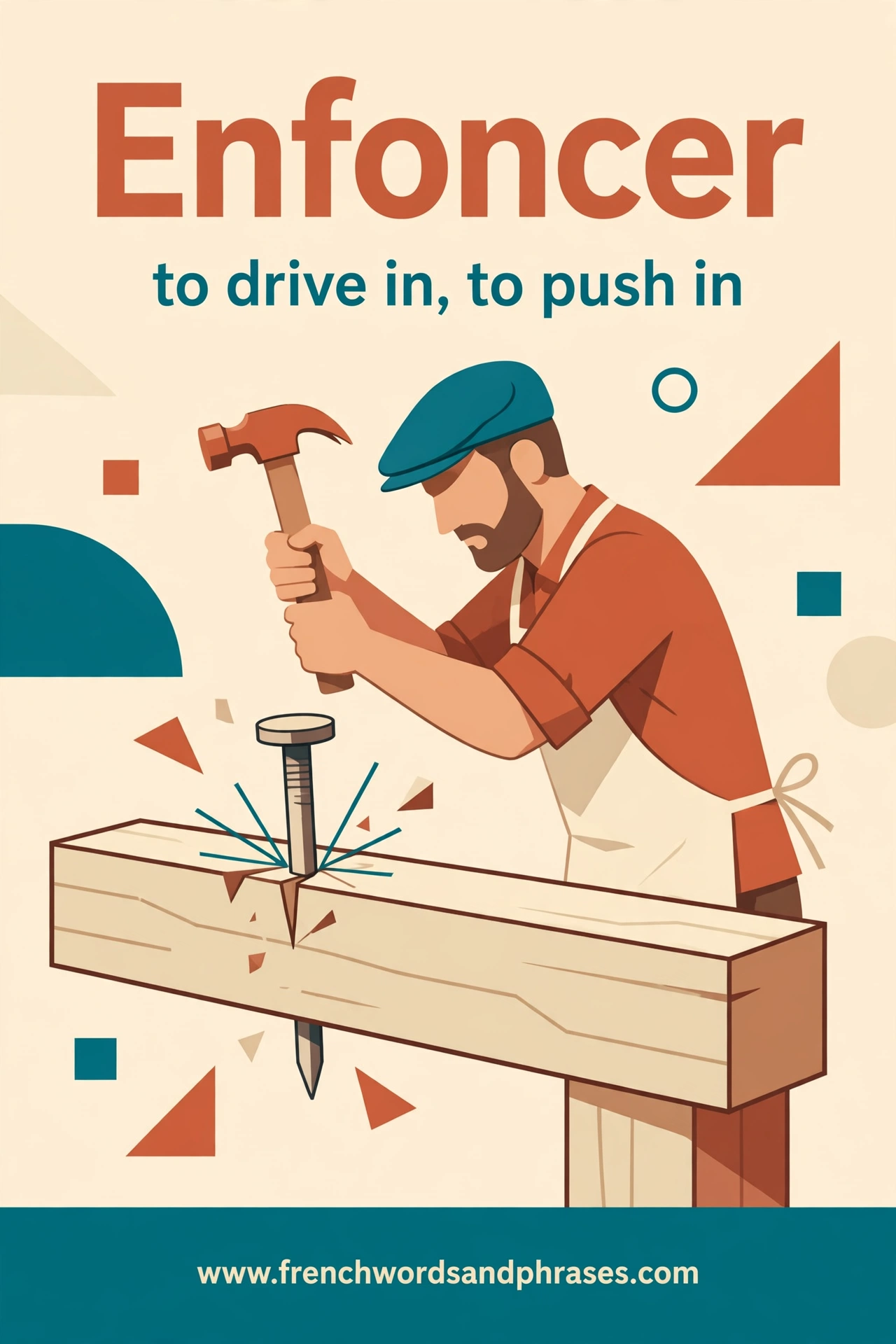
Enfoncer means to drive in, to push in — to force something deep into something else, from a nail into wood to a door bursting under a shoulder.
A hammer driving a nail flush with the plank, a firefighter’s shoulder against a locked door — enfoncer is the verb of force applied inward: whatever resists is pushed, driven or sunk deep.
In this guide, you’ll learn how to conjugate enfoncer in all the major French tenses and moods. Explore complete conjugation tables, French examples, English translations, and practice quizzes.
Understanding the French Verb Enfoncer
Enfoncer is a regular French verb belonging to the first group of verbs, those ending in-er.
It means to drive in, to push in. It covers nails, stakes and posts driven into wood or earth, doors forced open, hats and caps pulled firmly down, and, figuratively, opponents driven deeper into trouble — enfoncer un adversaire. Police and fire reports use it constantly: enfoncer une porte is the standard phrase for breaking a door down.
Verb classification: First group (-er)
Auxiliary verb: Avoir
Past participle: enfoncé
Present participle: enfonçant
English equivalents: To drive in, to push in, to sink; enfoncer un clou — to drive in a nail; enfoncer une porte — to break down a door; enfoncer son chapeau — to pull one’s hat down firmly; enfoncer un pieu dans la terre — to drive a stake into the ground.
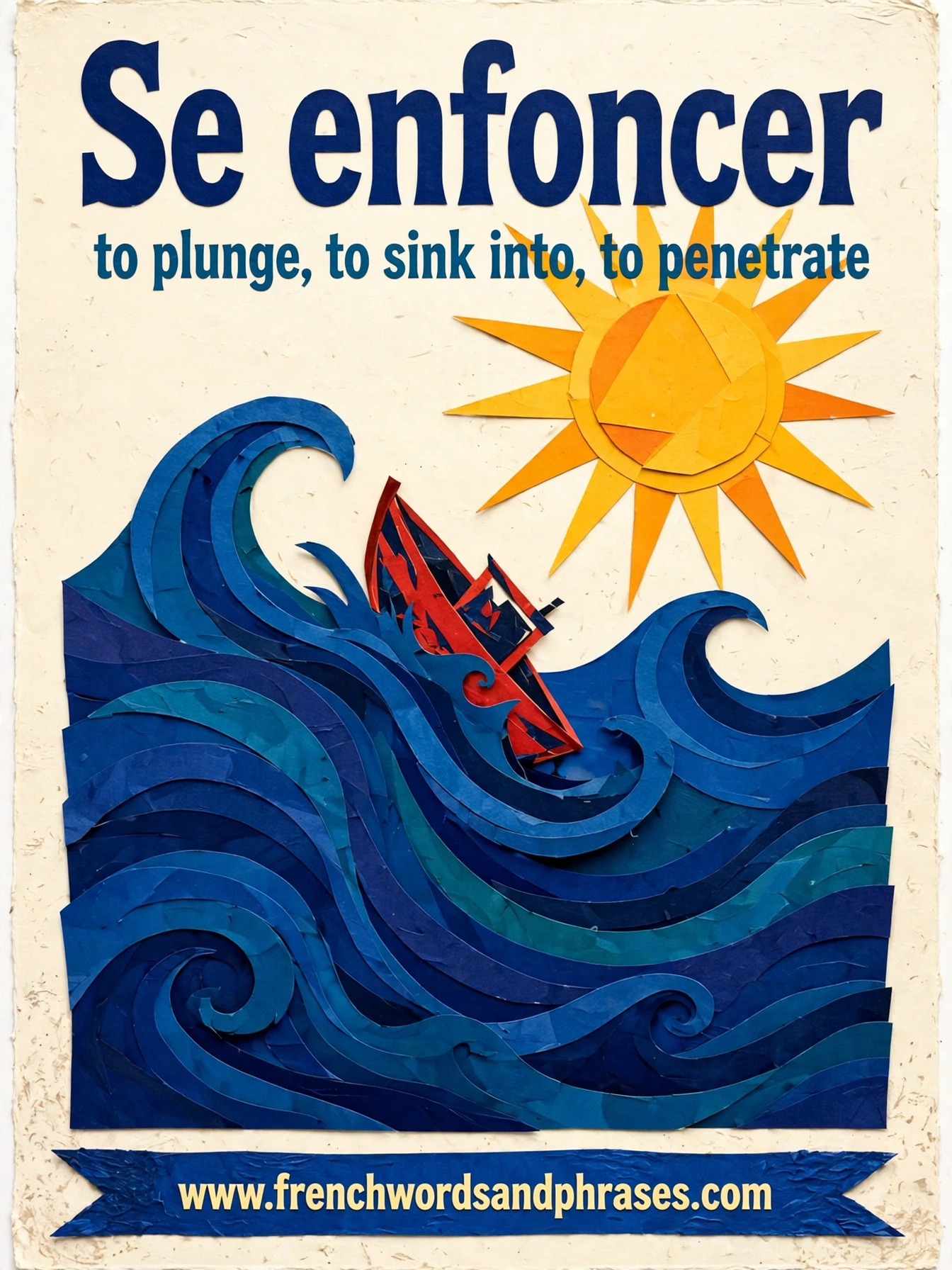
One important detail: enfoncer is a -cer verb, so the c becomes ç before a and o to keep the soft s sound: nous enfonçons, j’enfonçais, enfonçant — but j’enfonce, nous enfonciez keep the plain c before e and i. Built on le fond, the bottom, it means to send something to the bottom of its hole: a nail, a stake, a hat pulled down to the ears. Its reflexive twin s’enfoncer is the thing sinking by itself — into mud, sand or forest.
Experience the Word
Enfoncer is the verb of inward force — one blow, one push, and the thing is deep inside what resisted it.
Imagine a carpenter roofing a barn before the rain. Each nail takes exactly two blows: the first sets it, the second l’enfonce jusqu’au bois, flush and final, while the clouds gather over the valley.
No third blow is needed. The nail is driven home — enfoncé, to the bottom, for good.
How to Conjugate Enfoncer: Complete French Conjugation Guide
Let’s explore every major conjugation of enfoncer, beginning with the indicative mood.
How to Conjugate Enfoncer in the Indicative Mood
The indicative mood is used to express facts, observations, actions, and events.
How to Conjugate Enfoncer in the Present Tense (Présent)
Used for actions happening now, habitual actions, and general truths.
| Subject | Conjugation |
|---|---|
| je | enfonce |
| tu | enfonces |
| il / elle | enfonce |
| nous | enfonçons |
| vous | enfoncez |
| ils / elles | enfoncent |
Example
Il enfonce le clou d’un seul coup de marteau.
He drives the nail in with a single hammer blow.
Quick Quiz 1
Complete the sentence:
Nous ______ les poteaux dans la terre molle.
Reveal the answer
enfonçons
Nous enfonçons les poteaux dans la terre molle.
We are driving the posts into the soft earth — note the cedilla in enfonçons.
How to Conjugate Enfoncer in the Passé Composé
Used for completed actions in the past. Enfoncer takes the auxiliary verb avoir.
| Subject | Conjugation |
|---|---|
| j’ | ai enfoncé |
| tu | as enfoncé |
| il / elle | a enfoncé |
| nous | avons enfoncé |
| vous | avez enfoncé |
| ils / elles | ont enfoncé |
Example
Les pompiers ont enfoncé la porte de l’appartement.
The firefighters broke down the flat’s door.
How to Conjugate Enfoncer in the Imparfait (Imperfect Tense)
Used for habitual past actions, descriptions, and ongoing situations in the past.
| Subject | Conjugation |
|---|---|
| je | enfonçais |
| tu | enfonçais |
| il / elle | enfonçait |
| nous | enfoncions |
| vous | enfonciez |
| ils / elles | enfonçaient |
Example
Le jardinier enfonçait les pieux dans la terre molle.
The gardener used to drive the stakes into the soft earth.
Quick Quiz 2
Choose the correct form:
The firefighters broke down the door.
Les pompiers ______ la porte. (ont enfoncé / sont enfoncés)
Reveal the answer
ont enfoncé
Les pompiers ont enfoncé la porte.
Enfoncer takes avoir.
How to Conjugate Enfoncer in the Plus-que-parfait
Used to describe an action that had already been completed before another past event.
| Subject | Conjugation |
|---|---|
| j’ | avais enfoncé |
| tu | avais enfoncé |
| il / elle | avait enfoncé |
| nous | avions enfoncé |
| vous | aviez enfoncé |
| ils / elles | avaient enfoncé |
Example
Elle avait enfoncé son chapeau avant d’affronter le vent.
She had pulled her hat down firmly before facing the wind.
How to Conjugate Enfoncer in the Passé Simple
Primarily used in formal writing, literature, and historical narratives. It is rarely used in everyday conversation.
| Subject | Conjugation |
|---|---|
| je | enfonçai |
| tu | enfonças |
| il / elle | enfonça |
| nous | enfonçâmes |
| vous | enfonçâtes |
| ils / elles | enfonçèrent |
Example
D’un coup d’épaule, il enfonça la vieille porte.
With one thrust of his shoulder, he burst the old door in.
How to Conjugate Enfoncer in the Passé Antérieur
A literary tense used to express an action completed immediately before another past action, generally in the passé simple.
| Subject | Conjugation |
|---|---|
| j’ | eus enfoncé |
| tu | eus enfoncé |
| il / elle | eut enfoncé |
| nous | eûmes enfoncé |
| vous | eûtes enfoncé |
| ils / elles | eurent enfoncé |
Example
Quand il eut enfoncé le dernier pieu, la clôture tint bon.
When he had driven in the last stake, the fence stood firm.
How to Conjugate Enfoncer in the Future Tense (Futur Simple)
Used to describe actions that will take place in the future.
| Subject | Conjugation |
|---|---|
| je | enfoncerai |
| tu | enfonceras |
| il / elle | enfoncera |
| nous | enfoncerons |
| vous | enfoncerez |
| ils / elles | enfonceront |
Example
Nous enfoncerons les poteaux demain matin.
We will drive in the posts tomorrow morning.
How to Conjugate Enfoncer in the Futur Antérieur (Future Perfect)
Used for an action that will have been completed before a particular point in the future.
| Subject | Conjugation |
|---|---|
| j’ | aurai enfoncé |
| tu | auras enfoncé |
| il / elle | aura enfoncé |
| nous | aurons enfoncé |
| vous | aurez enfoncé |
| ils / elles | auront enfoncé |
Example
À midi, ils auront enfoncé tous les clous de la toiture.
By noon, they will have driven in all the roof nails.
How to Conjugate Enfoncer in the Near Future (Futur Proche)
Used to describe something that is going to happen soon. Formed with aller + infinitive.
| Subject | Conjugation |
|---|---|
| je | vais enfoncer |
| tu | vas enfoncer |
| il / elle | va enfoncer |
| nous | allons enfoncer |
| vous | allez enfoncer |
| ils / elles | vont enfoncer |
Example
Attention, tu vas enfoncer le clou de travers !
Careful, you are going to drive the nail in crooked!
How to Conjugate Enfoncer in the Conditional Mood
The conditional mood expresses what would happen under certain circumstances. It is also frequently used to make polite requests or express wishes.
How to Conjugate Enfoncer in the Present Conditional
| Subject | Conjugation |
|---|---|
| je | enfoncerais |
| tu | enfoncerais |
| il / elle | enfoncerait |
| nous | enfoncerions |
| vous | enfonceriez |
| ils / elles | enfonceraient |
Example
Avec un marteau plus lourd, j’enfoncerais ce pieu sans peine.
With a heavier hammer, I would drive this stake in without trouble.
How to Conjugate Enfoncer in the Past Conditional
| Subject | Conjugation |
|---|---|
| j’ | aurais enfoncé |
| tu | aurais enfoncé |
| il / elle | aurait enfoncé |
| nous | aurions enfoncé |
| vous | auriez enfoncé |
| ils / elles | auraient enfoncé |
Example
Il aurait enfoncé la porte si elle n’avait pas été blindée.
He would have broken the door down if it had not been reinforced.
Enfoncer in the Literary Past Conditional Form
This less common literary form uses the imperfect subjunctive of avoir.
| Subject | Conjugation |
|---|---|
| j’ | eusse enfoncé |
| tu | eusses enfoncé |
| il / elle | eût enfoncé |
| nous | eussions enfoncé |
| vous | eussiez enfoncé |
| ils / elles | eussent enfoncé |
Example
Il eût enfoncé le pieu d’un seul coup, dans sa jeunesse.
He would have driven the stake in with a single blow, in his youth.
How to Conjugate Enfoncer in the Subjunctive Mood
The subjunctive is used to express wishes, emotions, doubts, necessity, and uncertainty. It frequently follows expressions such as il faut que (it is necessary that) or bien que (although).
How to Conjugate Enfoncer in the Present Subjunctive
| Subject | Conjugation |
|---|---|
| que je | enfonce |
| que tu | enfonces |
| qu’il / qu’elle | enfonce |
| que nous | enfoncions |
| que vous | enfonciez |
| qu’ils / qu’elles | enfoncent |
Example
Il faut que tu enfonces le clou jusqu’au bout.
You must drive the nail right in.
Quick Quiz 3
Complete the sentence using the subjunctive:
Il faut que vous ______ les pieux avant ce soir.
Reveal the answer
enfonciez
Il faut que vous enfonciez les pieux avant ce soir.
You must drive the stakes in before this evening.
How to Conjugate Enfoncer in the Imperfect Subjunctive
A literary tense, rarely encountered in modern spoken French.
| Subject | Conjugation |
|---|---|
| que je | enfoncasse |
| que tu | enfoncasses |
| qu’il / qu’elle | enfoncât |
| que nous | enfoncassions |
| que vous | enfoncassiez |
| qu’ils / qu’elles | enfoncassent |
Example
Je doutais qu’il enfonçât la porte à mains nues.
I doubted he would break the door down with his bare hands.
How to Conjugate Enfoncer in the Pluperfect Subjunctive
A literary construction used to express an action completed before another past action.
| Subject | Conjugation |
|---|---|
| que j’ | eusse enfoncé |
| que tu | eusses enfoncé |
| qu’il / qu’elle | eût enfoncé |
| que nous | eussions enfoncé |
| que vous | eussiez enfoncé |
| qu’ils / qu’elles | eussent enfoncé |
Example
On admirait qu’il eût enfoncé tous les pieux en une matinée.
People admired that he had driven in all the stakes in one morning.
How to Conjugate Enfoncer in the Past Subjunctive
| Subject | Conjugation |
|---|---|
| que j’ | aie enfoncé |
| que tu | aies enfoncé |
| qu’il / qu’elle | ait enfoncé |
| que nous | ayons enfoncé |
| que vous | ayez enfoncé |
| qu’ils / qu’elles | aient enfoncé |
Example
Je suis content que vous ayez enfoncé les poteaux avant l’orage.
I am glad you drove the posts in before the storm.
How to Conjugate Enfoncer in the Imperative
The imperative is used to give commands, instructions, invitations, or suggestions. Subject pronouns are omitted.
How to Conjugate Enfoncer in the Present Imperative
| Person | Conjugation |
|---|---|
| (tu) | enfonce |
| (nous) | enfonçons |
| (vous) | enfoncez |
Example
Enfonce ce clou jusqu’au bout !
Drive this nail right in!
Quick Quiz 4
How would you say Drive this nail right in (tu form)?
Reveal the answer
Enfonce ce clou jusqu’au bout !
French Participles of Enfoncer
Participles are verb forms that can be used in compound tenses and other grammatical constructions.
Present Participle of Enfoncer
enfonçant
En enfonçant les pieux, il a fait le tour du jardin.
Driving in the stakes, he worked his way round the garden.
Past Participle of Enfoncer
enfoncé
Enfoncé jusqu’à la tête, le clou ne bougera plus.
Driven in up to its head, the nail will not move again.
Enfoncer in Everyday French: Real-Life Examples
Now that you know the conjugations, let’s see how enfoncer appears in everyday French.
Example 1 — Present
Il enfonce le clou d’un seul coup.
He drives the nail in with one blow.
Example 2 — Passé composé
Les pompiers ont enfoncé la porte.
The firefighters broke down the door.
Example 3 — Imparfait
Le jardinier enfonçait les pieux.
The gardener used to drive in the stakes.
Example 4 — Future
Nous enfoncerons les poteaux demain.
We will drive in the posts tomorrow.
Example 5 — Conditional
J’enfoncerais ce pieu avec un marteau plus lourd.
I would drive this stake in with a heavier hammer.
Example 6 — Imperative
Enfonce ce clou jusqu’au bout !
Drive this nail right in!
Beyond Translation: The Meaning of Enfoncer
English drive in is the plain twin, but French enfoncer keeps the depth in view — le fond is the bottom, and to enfoncer is to send a thing to the bottom of its place.
It is also the verb of no return.
A nail enfoncé cannot be argued with; a door enfoncée cannot be unbroken; and a man enfoncé dans les dettes is in up to his neck — the family picture never changes, only the depth.
How to Remember the French Verb Enfoncer
Remember it this way: Enfoncer is about the nail driven flush — force applied inward, to the bottom.
- -Cer spelling: nous enfonçons and j’enfonçais take ç; j’enfonce keeps the plain c.
- Le fond is the bottom: enfoncer sends the nail to the bottom of the wood.
- Two classic scenes: enfoncer un clou, enfoncer une porte.
The key idea is the nail driven flush — force applied inward, to the bottom.
Test Your Knowledge of Enfoncer
Let’s see how much you’ve learned. Try answering these questions before revealing the answers.
Question 1
Why does nous enfonçons have a cedilla but je enfonce does not?
Reveal the answer
The -cer rule — c becomes ç before a and o to keep the soft sound: nous enfonçons, j’enfonçais; before e it stays c: j’enfonce.
Question 2
How do you say He drives the nail in with one blow in French?
Reveal the answer
Il enfonce le clou d’un seul coup.
Question 3
Translate: The firefighters broke down the door.
Reveal the answer
Les pompiers ont enfoncé la porte.
Question 4
What is the past participle of enfoncer?
Reveal the answer
Enfoncé.
Question 5
Complete the sentence:
Il faut que tu ______ le clou jusqu’au bout.
Reveal the answer
enfonces
Il faut que tu enfonces le clou jusqu’au bout.
You must drive the nail right in.
Your Final Challenge
Can You Use It?
How would you say this in French?
The carpenter drives in the last nail, and the roof already defies the rising rain.
Reveal the answer
Le charpentier enfonce le dernier clou, et le toit défie déjà la pluie qui monte.
The carpenter drives in the last nail, and the roof already defies the rising rain.
A little French. A little curiosity. A richer everyday life.
LEARN FRENCH ONE WORD AT A TIME