A French Word to Live By
Translate Encore que to English
/ɑ̃.kɔʁ kə/
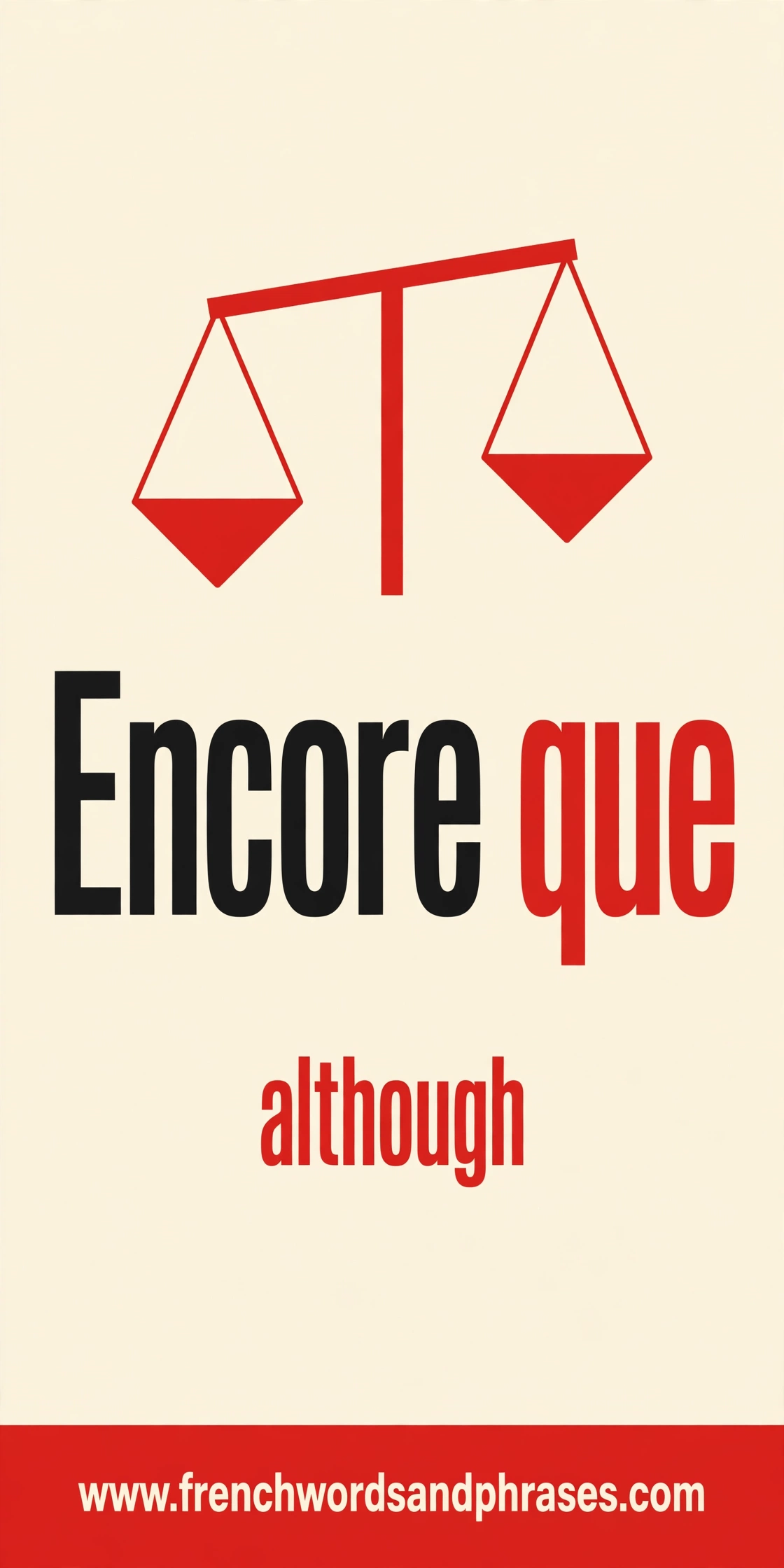
Encore que means although.
« C’est un beau jardin, encore qu’il soit petit. » — It’s a fine garden, although it is small. Encore que is the raised eyebrow of French conjunctions: a compliment is paid, and then, quietly, the reservation arrives. You will meet it in novels and essays far more than in cafés.
In this guide, you’ll learn what encore que means in English, how this literary ‘although’ adds a reservation, why the verb after it stands in the subjunctive, and how it differs from its everyday cousins bien que and quoique. Explore French examples, English translations, and practice quizzes.
Understanding the French Conjunction Encore que
Encore que is a French subordinating conjunction of concession — the literary member of the ‘although’ family. It introduces a fact that stands in the way of the main clause, and concedes it with a certain elegance.
It means although, even though — with a bookish flavour. Il est sorti, encore qu’il soit malade — he went out, although he is ill. The conceded fact is real, but because the conjunction presents it as a reservation weighed in the balance, French still puts the verb in the subjunctive.
Type: Subordinating conjunction — concession
Register: Literary, written French
What follows it: A full clause: subject + verb
Mood after it: Subjunctive — always
One important usage detail: do not confuse encore que with encore meaning ‘still’ or ‘again’ — encore que is a single fixed conjunction, and the encore inside it adds no sense of repetition. In everyday speech, bien que and quoique do this job; encore que belongs to the written page.
Experience the Word
Encore que is the conjunction of the elegant reservation — praise first, doubt second, all in one sentence.
Imagine a critic writing about a young chef: « sa cuisine est brillante, encore qu’elle soit parfois trop sage ». The compliment stands; the little reservation glitters beside it like a raised eyebrow.
You have not just conceded a point. You have conceded it with style.
How to Use Encore que in French: Complete Guide
Let’s explore how encore que works in French, beginning with the whole expression on one card.
Encore que at a Glance
Before the details, here is the whole expression on one card.
The Whole Expression on One Card
Meaning, job, pattern and mood — encore que in four lines.
| Point | Encore que |
|---|---|
| Meaning | although, even though |
| Job | concedes a fact that works against the main clause |
| What follows | a full clause — subject + verb |
| Mood | subjunctive, always |
Example
Elle sourit, encore qu’elle soit fatiguée.
She smiles, although she is tired.
How Encore que Links: The Claim, Then the Reservation
Encore que usually follows the main clause, attaching the concession behind it like a footnote — although the whole sentence can be turned around in formal writing.
| Pattern | Example |
|---|---|
| claim + encore que + reservation | il travaille bien, encore qu’il soit lent — he works well, although he is slow |
| compliment + reservation | c’est un beau livre, encore qu’il soit un peu long — it’s a fine book, although it’s a bit long |
| two different subjects | nous partirons, encore que le ciel soit gris — we’ll leave, although the sky is grey |
| concession first (formal) | encore qu’il soit tôt, la place est déjà pleine — although it’s early, the square is already full |
Example
Le village est charmant, encore qu’il soit loin de tout.
The village is charming, although it’s far from everything.
Quick Quiz 1
Is encore que a word of the café or of the written page?
Reveal the answer
Of the written page — it is literary. In speech, bien que and quoique take its place.
Il est content, encore qu’il soit déçu. (written)
He is happy, although he is disappointed.
The Mood Question: Always the Subjunctive
Like all the ‘although’ conjunctions, encore que takes the subjunctive: the conceded fact is weighed and set aside, not asserted, so its verb leaves the indicative behind.
| Verb | Subjunctive form after encore que |
|---|---|
| être | encore qu’il soit tard — although it’s late |
| avoir | encore qu’elle ait raison — although she is right |
| faire | encore qu’il fasse froid — although it’s cold |
| pouvoir | encore que nous puissions refuser — although we could refuse |
| aller | encore que tout aille bien — although everything is going well |
Example
Il accepte le poste, encore qu’il soit mal payé.
He accepts the job, although it’s badly paid.
Where Encore que Goes: Behind the Main Clause
Encore que’s home is after the main clause, set off by a comma — the reservation trails the claim. Fronting it is possible but sounds distinctly literary.
| Position | Example |
|---|---|
| After the main clause | elle rit, encore qu’elle soit triste — she laughs, although she is sad |
| A comma before it | the comma marks the turn: claim, then reservation |
| Elision before a vowel | encore qu’il pleuve — the -e of que drops before il |
| Register | written French — novels, essays, criticism; rare in speech |
Example
Le film plaît, encore qu’il soit très long.
The film is popular, although it’s very long.
Quick Quiz 2
Complete with the subjunctive: Il sort, encore qu’il ______ (être) malade.
Reveal the answer
soit — the subjunctive of être.
Il sort, encore qu’il soit malade.
He goes out, although he is ill.
Everyday Expressions with Encore que
‘Everyday’ is generous for so literary a word — but these are the shapes it takes when it appears, usually adding a wry afterthought.
| Expression | In English |
|---|---|
| encore qu’il soit tôt | although it’s early |
| encore que ce soit dommage | although it’s a pity |
| c’est bien, encore que… | it’s good, although… (the reservation left hanging) |
| encore qu’à vrai dire… | although, to tell the truth… |
| beau, encore que petit | beautiful, albeit small (compressed literary style) |
Example
C’est bien, encore que ce soit un peu cher.
It’s good, although it’s a little expensive.
Close Cousins: Encore que, Bien que, Quoique
The ‘although’ family has three members sharing one job and one mood. The difference is pure register — where each one feels at home.
| Word | The difference |
|---|---|
| encore que | literary and elegant; loves the afterthought position after a comma |
| bien que | the standard ‘although’; works everywhere, speech and writing |
| quoique | one word (or two: quoi que is different!); common in speech, can soften to ‘mind you’ |
| même si | ‘even if’ — takes the INDICATIVE; the obstacle is hypothetical, not conceded fact |
Example
Bien qu’il pleuve, nous sortons ; le jardin est beau, encore qu’il soit petit.
Although it’s raining, we’re going out; the garden is beautiful, although it’s small.
Quick Quiz 3
Which cousin takes the indicative, not the subjunctive?
Reveal the answer
même si — even if. Its obstacle is imagined, not conceded.
Même s’il pleut, nous sortirons.
Even if it rains, we’ll go out.
Encore que and Its Neighbours
Concession and contrast live side by side in French — here are encore que’s nearest neighbours.
| French | In English |
|---|---|
| bien que | although (standard) |
| quoique | although (everyday) |
| malgré | despite (+ noun) |
| pourtant | yet, however (main-clause word, indicative) |
| tout de même | all the same, nevertheless |
Example
Malgré la pluie, ils sortent ; le temps est doux, encore qu’il soit humide.
Despite the rain, they go out; the weather is mild, although it’s damp.
Watch Out: The Traps Around Encore que
The traps: dragging in the wrong mood, mistaking it for plain encore, and using it in casual speech where it sounds like a quotation from a novel.
| Trap | The truth |
|---|---|
| indicative after it | never: encore qu’il est tard is wrong — say encore qu’il soit tard |
| reading encore as ‘again/still’ | encore que is one fixed conjunction meaning although; no repetition is implied |
| using it in casual conversation | in speech prefer bien que / quoique; encore que marks you as quoting literature |
| confusing quoique and quoi que | quoique = although; quoi que = whatever (quoi que tu fasses — whatever you do) |
Example
Elle chante, encore qu’elle soit enrouée.
She sings, although she is hoarse.
Quick Quiz 4
Which is correct: encore qu’il fait beau or encore qu’il fasse beau?
Reveal the answer
encore qu’il fasse beau — fasse is the subjunctive of faire.
Nous restons dedans, encore qu’il fasse beau.
We’re staying in, although the weather is fine.
Encore que in Everyday French: Real-Life Examples
Now that you know the word, let’s see how encore que appears in everyday French.
Example 1 — A review
Le roman est passionnant, encore qu’il soit difficile par moments.
The novel is gripping, although it’s difficult at times.
Example 2 — A small flat
L’appartement est lumineux, encore qu’il soit au cinquième étage.
The flat is bright, although it’s on the fifth floor.
Example 3 — Honest praise
Tu as bien joué, encore que tu sois resté trop prudent.
You played well, although you stayed too cautious.
Example 4 — Weather
La journée s’annonce belle, encore qu’il fasse frais ce matin.
The day looks promising, although it’s chilly this morning.
Example 5 — A decision
Nous acceptons l’offre, encore qu’elle soit loin de nos espérances.
We accept the offer, although it’s far from what we hoped.
Example 6 — An old house
La maison a du charme, encore qu’elle soit pleine de courants d’air.
The house has charm, although it’s full of draughts.
Beyond Translation: The Meaning of Encore que
English says although for the meaning of encore que — but where English plants its reservation at the front of the sentence, encore que prefers to arrive late, after the claim, like a guest who slips in once the speeches are done.
Encore que is concession with good manners: it never interrupts.
Its literary perfume is part of its meaning. To write encore que is to signal a certain kind of French — considered, written, a little ironic — the French of people who weigh a compliment before paying it.
How to Remember the French Conjunction Encore que
Remember it this way: Encore que is the raised eyebrow — the claim goes first, the elegant reservation follows, and the subjunctive signs it.
- You picture a compliment with a raised eyebrow — c’est beau, encore que… — the doubt comes second.
- You keep it for the written page — in the café, bien que and quoique do the talking.
- You hold the subjunctive firm — qu’il soit, qu’elle ait, qu’il fasse — although means subjunctive, always.
The key idea is encore que is the literary ‘although’: claim first, reservation after, subjunctive throughout.
Test Your Knowledge of Encore que
Let’s see how much you’ve learned. Try answering these questions before revealing the answers.
Question 1
What does encore que mean?
Reveal the answer
Although / even though — in a literary register.
Question 2
Which mood follows encore que?
Reveal the answer
The subjunctive — always, like bien que and quoique.
Question 3
Translate: He works, although he is tired.
Reveal the answer
Il travaille, encore qu’il soit fatigué.
Question 4
How does encore que differ from bien que?
Reveal the answer
Only in register — encore que is literary and written; bien que is the standard all-purpose ‘although’.
Question 5
Complete the sentence:
Elle reste, encore qu’elle ______ (avoir) envie de partir.
Reveal the answer
ait
Elle reste, encore qu’elle ait envie de partir.
She stays, although she wants to leave.
Your Final Challenge
Can You Use It?
How would you say this in French?
“The house is lovely, although it is small.”
Reveal the answer
La maison est ravissante, encore qu’elle soit petite.
The house is lovely, although it is small.
A little French. A little curiosity. A richer everyday life.
LEARN FRENCH ONE WORD AT A TIME