A French Word to Live By
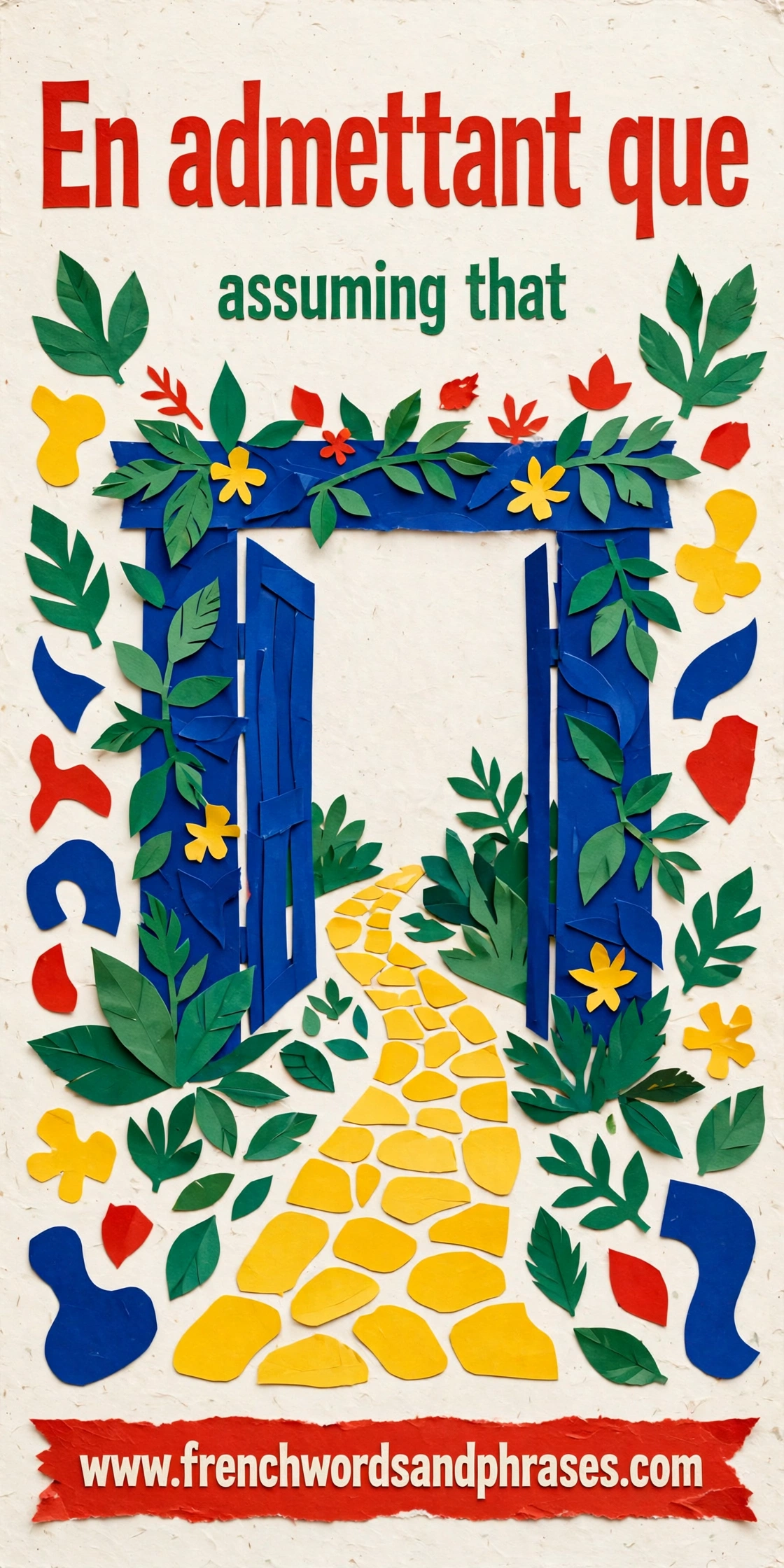
Translate En admettant que to English
/ɑ̃.nad.mɛ.tɑ̃ kə/
En admettant que means assuming that.
« En admettant que tu aies raison… » — Let’s say you’re right… It is the polite doorway into an argument: before anyone objects, the speaker grants the other side its best case, walks through it, and shows where it leads. Debates, negotiations and family dinners all run on this little phrase.
In this guide, you’ll learn what en admettant que means in English, how it grants a point for the sake of argument, why the verb after it stands in the subjunctive, and how it differs from its cousins en supposant que and supposé que. Explore French examples, English translations, and practice quizzes.
Understanding the French Conjunction En admettant que
En admettant que is a French subordinating conjunction of hypothesis — literally ‘admitting that’. Built from the present participle of admettre, to admit, it introduces a clause the speaker accepts for the sake of argument, without necessarily believing it.
It means assuming that, or granting that. The clause after it is treated as a supposition, not a fact: en admettant qu’il fasse beau demain, nous partirons tôt — assuming the weather is fine tomorrow, we’ll leave early. The speaker concedes the point first, then draws the consequence.
Type: Subordinating conjunction — hypothesis / concession
Literal shape: en + admettant (admitting) + que
What follows it: A full clause: subject + verb
Mood after it: Subjunctive — always
One important usage detail: en admettant que belongs to careful, slightly formal French — debates, essays, negotiations. It is the grown-up way of saying ‘okay, let’s grant that…’ before the mais arrives. The main clause often begins with a consequence: en admettant que…, alors…
Experience the Word
En admettant que is the conjunction of the fair opponent — it wins arguments by first giving something away.
Imagine two neighbours disputing a fence. One says, calm as you like: « en admettant que le mur soit sur mon terrain, il faut quand même le réparer ». The point is granted; the sting lands afterwards.
You have not just supposed something. You have conceded it — strategically.
How to Use En admettant que in French: Complete Guide
Let’s explore how en admettant que works in French, beginning with the whole expression on one card.
En admettant que at a Glance
Before the details, here is the whole expression on one card.
The Whole Expression on One Card
Meaning, job, pattern and mood — en admettant que in four lines.
| Point | En admettant que |
|---|---|
| Meaning | assuming that, granting that |
| Job | concedes a point for the sake of argument |
| What follows | a full clause — subject + verb |
| Mood | subjunctive, always |
Example
En admettant que tu aies raison, que proposes-tu ?
Assuming you’re right, what do you suggest?
How En admettant que Links: The Granted Point, Then the Consequence
En admettant que opens the sentence with the point being granted; the main clause then delivers the consequence — what follows if we accept it.
| Pattern | Example |
|---|---|
| granted point + consequence | en admettant qu’elle vienne, nous serons six — assuming she comes, there will be six of us |
| granted point + objection | en admettant que ce soit vrai, cela ne change rien — even granting that’s true, it changes nothing |
| two different subjects | en admettant que le train soit en retard, nous prendrons un taxi — assuming the train is late, we’ll take a taxi |
| granted point mid-sentence | nous acceptons, en admettant que tout soit prêt à temps — we accept, assuming everything is ready in time |
Example
En admettant que le projet réussisse, il faudra embaucher.
Assuming the project succeeds, we’ll need to hire.
Quick Quiz 1
What does en admettant que do with the point it introduces — state it as fact, deny it, or grant it for the sake of argument?
Reveal the answer
It grants it for the sake of argument.
En admettant que tu aies raison…
Assuming you’re right…
The Mood Question: Always the Subjunctive
A granted point is not a fact — it is a hypothesis the speaker is entertaining. French marks that unreality with the subjunctive, in the present or the past subjunctive for something already done.
| Verb | Subjunctive form after en admettant que |
|---|---|
| être | en admettant que ce soit vrai — assuming that’s true |
| avoir | en admettant qu’il ait le temps — assuming he has the time |
| faire | en admettant qu’elle fasse de son mieux — assuming she does her best |
| pouvoir | en admettant que nous puissions partir — assuming we can leave |
| venir | en admettant qu’ils viennent demain — assuming they come tomorrow |
Example
En admettant qu’il ait compris, pourquoi se tait-il ?
Assuming he understood, why is he saying nothing?
Where En admettant que Goes: Front of the Sentence
En admettant que almost always opens the sentence, setting up the hypothesis before the main clause. A comma separates the granted point from its consequence.
| Position | Example |
|---|---|
| Start of the sentence | en admettant que tout aille bien, nous signerons lundi — assuming all goes well, we’ll sign on Monday |
| Comma after the clause | the granted clause is closed by a comma before the consequence |
| Elision before a vowel | en admettant qu’il vienne — the -e of que drops before il |
| Register | careful, formal French — essays, debates, negotiations |
Example
En admettant que les prix baissent, ce sera le moment d’acheter.
Assuming prices drop, it will be the moment to buy.
Quick Quiz 2
Complete with the subjunctive: En admettant qu’il ______ (être) d’accord…
Reveal the answer
soit — the subjunctive of être.
En admettant qu’il soit d’accord…
Assuming he agrees…
Everyday Expressions with En admettant que
En admettant que appears wherever people reason out loud — planning, negotiating, arguing gently.
| Expression | In English |
|---|---|
| en admettant que oui | assuming yes, granting that it’s so |
| en admettant que ce soit vrai | even supposing that’s true |
| en admettant que tout se passe bien | assuming everything goes well |
| en admettant même que… | even assuming that… (a stronger grant) |
| en admettant que j’aie tort | assuming I’m wrong (the debater’s opening) |
Example
En admettant que oui, qui paiera la facture ?
Assuming yes, who will pay the bill?
Close Cousins: En admettant que, En supposant que, Supposé que
Three French phrases grant a hypothesis, and the difference is one of colour: admettant concedes, supposant imagines, supposé que states the supposition flatly.
| Word | The difference |
|---|---|
| en admettant que | ‘admitting that’ — grants the OPPONENT’s point; argumentative, concessive |
| en supposant que | ‘supposing that’ — invents a neutral scenario to explore |
| supposé que | ‘supposed that’ — compact and bookish; states the hypothesis plainly |
| à supposer que | ‘to suppose that’ — another neutral variant, close to en supposant que |
Example
En supposant qu’il pleuve, nous resterons ; mais en admettant que tu aies raison, nous partirons quand même.
Supposing it rains, we’ll stay; but granting you’re right, we’ll leave anyway.
Quick Quiz 3
Which cousin is the debater’s word — the one that grants the other side’s point?
Reveal the answer
en admettant que — admettre means to admit, to concede.
En admettant que tu aies raison, écoute ma réponse.
Granting that you’re right, hear my reply.
En admettant que and Its Neighbours
Hypothesis and concession have a whole neighbourhood in French — here are the closest houses.
| French | In English |
|---|---|
| en supposant que | supposing that |
| supposé que | supposed that |
| à supposer que | to suppose that |
| même si | even if (+ indicative — a real possibility, not a granted point) |
| pourvu que | provided that |
Example
Même s’il pleut, nous partirons ; en admettant que le vent se lève, nous attendrons.
Even if it rains, we’ll leave; assuming the wind picks up, we’ll wait.
Watch Out: The Traps Around En admettant que
The big trap is the mood: after a hypothesis, the indicative sounds wrong to a French ear. Two smaller traps follow it around.
| Trap | The truth |
|---|---|
| indicative after it | never: en admettant qu’il vient is wrong — say en admettant qu’il vienne |
| confusing it with en attendant que | attendant = waiting (time); admettant = admitting (argument) — one letter changes the world |
| using it for a known fact | for facts use puisque or comme; en admettant que is for points granted, not known |
| forgetting the comma | the granted clause closes with a comma before the main clause |
Example
En admettant qu’elle soit prête, nous pouvons commencer.
Assuming she is ready, we can begin.
Quick Quiz 4
Which is correct: en admettant qu’il vient or en admettant qu’il vienne?
Reveal the answer
en admettant qu’il vienne — vienne is the subjunctive of venir.
En admettant qu’il vienne, nous commencerons sans lui s’il tarde.
Assuming he comes, we’ll start without him if he’s late.
En admettant que in Everyday French: Real-Life Examples
Now that you know the word, let’s see how en admettant que appears in everyday French.
Example 1 — A negotiation
En admettant que le prix soit correct, je signe demain.
Assuming the price is right, I’ll sign tomorrow.
Example 2 — Planning a trip
En admettant qu’il fasse beau, nous camperons près du lac.
Assuming the weather is fine, we’ll camp by the lake.
Example 3 — A gentle argument
En admettant que tu aies raison, il reste le problème de l’argent.
Granting that you’re right, there’s still the money problem.
Example 4 — At the office
En admettant que le client accepte, le projet commence en mai.
Assuming the client agrees, the project starts in May.
Example 5 — Family talk
En admettant que grand-mère vienne, il faudra une chambre de plus.
Assuming Grandma comes, we’ll need one more room.
Example 6 — Worst case
En admettant que le pire arrive, nous avons un plan B.
Assuming the worst happens, we have a plan B.
Beyond Translation: The Meaning of En admettant que
English says assuming that for the meaning of en admettant que — but the French keeps the gesture visible: admettre is to admit, to let in. The speaker opens the door of the argument and lets the opposing point walk in, seating it politely before answering it.
To say en admettant que is to argue like a host, not a bouncer.
It is no accident that French debate, from the classroom dissertation to the televised panel, leans on this phrase: first concede, then reason. The hypothesis is admitted — and only then examined.
How to Remember the French Conjunction En admettant que
Remember it this way: En admettant que is the debater’s courtesy — admit the point, then answer it, and let the subjunctive carry the ‘not yet proven’ sign.
- You picture a door opening — admettre is to let in: you let the other point into the argument.
- You keep the point hypothetical — subjunctive every time: qu’il soit, qu’elle ait, qu’ils viennent.
- You follow with the consequence — the main clause says what follows if we grant it.
The key idea is en admettant que grants a point for the sake of argument and takes the subjunctive.
Test Your Knowledge of En admettant que
Let’s see how much you’ve learned. Try answering these questions before revealing the answers.
Question 1
What does en admettant que mean?
Reveal the answer
Assuming that / granting that — it concedes a point for the sake of argument.
Question 2
Which mood follows en admettant que?
Reveal the answer
The subjunctive — always. The point is a hypothesis, not a fact.
Question 3
Translate: Assuming she comes, we’ll be six.
Reveal the answer
En admettant qu’elle vienne, nous serons six.
Question 4
How does en admettant que differ from en supposant que?
Reveal the answer
En admettant que concedes the other side’s point; en supposant que simply imagines a neutral scenario.
Question 5
Complete the sentence:
En admettant qu’il ______ (avoir) le temps, il nous aidera.
Reveal the answer
ait
En admettant qu’il ait le temps, il nous aidera.
Assuming he has the time, he’ll help us.
Your Final Challenge
Can You Use It?
How would you say this in French?
“Assuming you’re right, we should leave earlier.”
Reveal the answer
En admettant que tu aies raison, nous devrions partir plus tôt.
Assuming you’re right, we should leave earlier.
A little French. A little curiosity. A richer everyday life.
LEARN FRENCH ONE WORD AT A TIME