A French Word to Live By
How to Conjugate Embarrasser in French
/ɑ̃.ba.ʁa.se/
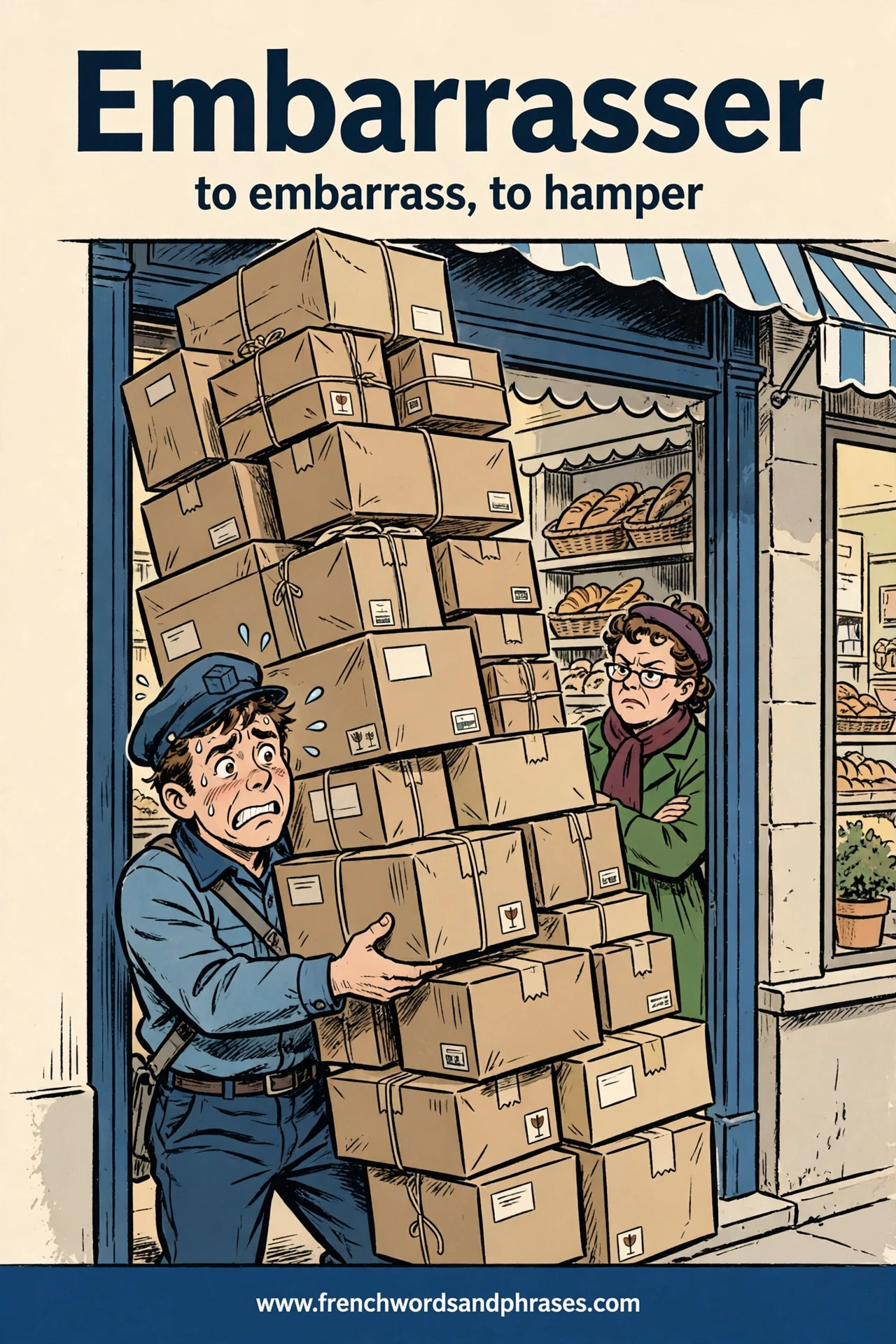
Embarrasser means to embarrass, to hamper — to put someone in an awkward position, or to get in the way and hold everything up.
A question nobody wants to answer in a silent meeting room, a fallen tree across a mountain road, suitcases piled in a narrow corridor — embarrasser is the verb of obstruction in both its worlds: it embarrasses people, and it hampers traffic, passages and plans.
In this guide, you’ll learn how to conjugate embarrasser in all the major French tenses and moods. Explore complete conjugation tables, French examples, English translations, and practice quizzes.
Understanding the French Verb Embarrasser
Embarrasser is a regular French verb belonging to the first group of verbs, those ending in-er.
It means to embarrass, to hamper. It is used of questions, silences and revelations that embarrass people, and of objects, crowds, snow and breakdowns that hamper movement and work — embarrasser le passage, embarrasser la circulation, embarrasser les secours. When someone says je suis embarrassé, they are awkward, put out or in difficulty, and the context decides which.
Verb classification: First group (-er)
Auxiliary verb: Avoir
Past participle: embarrassé
Present participle: embarrassant
English equivalents: To embarrass, to put in an awkward position; to hamper, to encumber, to clutter; embarrasser quelqu’un par une question — to embarrass someone with a question; embarrasser le passage — to block the passage; embarrasser la circulation — to hamper traffic; un embarras — an embarrassment, a difficulty, a traffic jam.
One important detail: embarrasser carries two senses that English splits apart — social (to embarrass: ta question m’embarrasse) and physical (to hamper, to clutter: ces cartons embarrassent le couloir). Both come from the image of a bar across the way. The spelling is steady — double r, double s — j’embarrasse, nous embarrassons, and the family is everywhere in daily French: un embarras (a difficulty, an embarrassment), embarrassant (embarrassing), and the famous false friend embarrassé, which never means pregnant, whatever Spanish suggests.
Experience the Word
Embarrasser is the verb of the bar across the path — sometimes the path is a corridor, sometimes it is a conversation.
Imagine a family dinner when an uncle asks, loudly, the one question everyone agreed not to ask. Forks stop. The silence embarrasses the whole table at once — nobody can move the conversation forward, exactly as if a wardrobe had been left across the stairs.
Nothing was broken or blocked. The room was simply embarrassed — embarrassée, hampered, stuck.
How to Conjugate Embarrasser: Complete French Conjugation Guide
Let’s explore every major conjugation of embarrasser, beginning with the indicative mood.
How to Conjugate Embarrasser in the Indicative Mood
The indicative mood is used to express facts, observations, actions, and events.
How to Conjugate Embarrasser in the Present Tense (Présent)
Used for actions happening now, habitual actions, and general truths.
| Subject | Conjugation |
|---|---|
| je | embarrasse |
| tu | embarrasses |
| il / elle | embarrasse |
| nous | embarrassons |
| vous | embarrassez |
| ils / elles | embarrassent |
Example
Tes questions embarrassent le ministre.
Your questions are embarrassing the minister.
Quick Quiz 1
Complete the sentence:
Ces cartons ______ le couloir.
Reveal the answer
embarrassent
Ces cartons embarrassent le couloir.
These boxes are cluttering the corridor.
How to Conjugate Embarrasser in the Passé Composé
Used for completed actions in the past. Embarrasser takes the auxiliary verb avoir.
| Subject | Conjugation |
|---|---|
| j’ | ai embarrassé |
| tu | as embarrassé |
| il / elle | a embarrassé |
| nous | avons embarrassé |
| vous | avez embarrassé |
| ils / elles | ont embarrassé |
Example
Son silence a embarrassé toute l’assistance.
His silence embarrassed the whole audience.
How to Conjugate Embarrasser in the Imparfait (Imperfect Tense)
Used for habitual past actions, descriptions, and ongoing situations in the past.
| Subject | Conjugation |
|---|---|
| je | embarrassais |
| tu | embarrassais |
| il / elle | embarrassait |
| nous | embarrassions |
| vous | embarrassiez |
| ils / elles | embarrassaient |
Example
Les cartons embarrassaient le couloir.
The boxes were cluttering the corridor.
Quick Quiz 2
Choose the correct form:
His silence embarrassed the whole audience.
Son silence ______ toute l’assistance. (a embarrassé / est embarrassé)
Reveal the answer
a embarrassé
Son silence a embarrassé toute l’assistance.
Embarrasser takes avoir.
How to Conjugate Embarrasser in the Plus-que-parfait
Used to describe an action that had already been completed before another past event.
| Subject | Conjugation |
|---|---|
| j’ | avais embarrassé |
| tu | avais embarrassé |
| il / elle | avait embarrassé |
| nous | avions embarrassé |
| vous | aviez embarrassé |
| ils / elles | avaient embarrassé |
Example
Elle avait embarrassé son ami avec une question directe.
She had embarrassed her friend with a direct question.
How to Conjugate Embarrasser in the Passé Simple
Primarily used in formal writing, literature, and historical narratives. It is rarely used in everyday conversation.
| Subject | Conjugation |
|---|---|
| je | embarrassai |
| tu | embarrassas |
| il / elle | embarrassa |
| nous | embarrassâmes |
| vous | embarrassâtes |
| ils / elles | embarrassèrent |
Example
Une panne embarrassa la circulation pendant des heures.
A breakdown hampered traffic for hours.
How to Conjugate Embarrasser in the Passé Antérieur
A literary tense used to express an action completed immediately before another past action, generally in the passé simple.
| Subject | Conjugation |
|---|---|
| j’ | eus embarrassé |
| tu | eus embarrassé |
| il / elle | eut embarrassé |
| nous | eûmes embarrassé |
| vous | eûtes embarrassé |
| ils / elles | eurent embarrassé |
Example
Quand la neige eut embarrassé les routes, les secours s’arrêtèrent.
When the snow had blocked the roads, the rescue services stopped.
How to Conjugate Embarrasser in the Future Tense (Futur Simple)
Used to describe actions that will take place in the future.
| Subject | Conjugation |
|---|---|
| je | embarrasserai |
| tu | embarrasseras |
| il / elle | embarrassera |
| nous | embarrasserons |
| vous | embarrasserez |
| ils / elles | embarrasseront |
Example
Cette valise embarrassera les voyageurs dans l’allée.
This suitcase will get in the travellers’ way in the aisle.
How to Conjugate Embarrasser in the Futur Antérieur (Future Perfect)
Used for an action that will have been completed before a particular point in the future.
| Subject | Conjugation |
|---|---|
| j’ | aurai embarrassé |
| tu | auras embarrassé |
| il / elle | aura embarrassé |
| nous | aurons embarrassé |
| vous | aurez embarrassé |
| ils / elles | auront embarrassé |
Example
À la fin de la journée, ce dossier aura embarrassé trois ministres.
By the end of the day, this file will have embarrassed three ministers.
How to Conjugate Embarrasser in the Near Future (Futur Proche)
Used to describe something that is going to happen soon. Formed with aller + infinitive.
| Subject | Conjugation |
|---|---|
| je | vais embarrasser |
| tu | vas embarrasser |
| il / elle | va embarrasser |
| nous | allons embarrasser |
| vous | allez embarrasser |
| ils / elles | vont embarrasser |
Example
Ta question va embarrasser le directeur.
Your question is going to embarrass the director.
How to Conjugate Embarrasser in the Conditional Mood
The conditional mood expresses what would happen under certain circumstances. It is also frequently used to make polite requests or express wishes.
How to Conjugate Embarrasser in the Present Conditional
| Subject | Conjugation |
|---|---|
| je | embarrasserais |
| tu | embarrasserais |
| il / elle | embarrasserait |
| nous | embarrasserions |
| vous | embarrasseriez |
| ils / elles | embarrasseraient |
Example
Un témoin pareil embarrasserait n’importe quel avocat.
Such a witness would embarrass any lawyer.
How to Conjugate Embarrasser in the Past Conditional
| Subject | Conjugation |
|---|---|
| j’ | aurais embarrassé |
| tu | aurais embarrassé |
| il / elle | aurait embarrassé |
| nous | aurions embarrassé |
| vous | auriez embarrassé |
| ils / elles | auraient embarrassé |
Example
Son erreur aurait embarrassé tout le service.
His mistake would have embarrassed the whole department.
Embarrasser in the Literary Past Conditional Form
This less common literary form uses the imperfect subjunctive of avoir.
| Subject | Conjugation |
|---|---|
| j’ | eusse embarrassé |
| tu | eusses embarrassé |
| il / elle | eût embarrassé |
| nous | eussions embarrassé |
| vous | eussiez embarrassé |
| ils / elles | eussent embarrassé |
Example
La neige eût embarrassé la marche de l’armée.
The snow would have hampered the army’s march.
How to Conjugate Embarrasser in the Subjunctive Mood
The subjunctive is used to express wishes, emotions, doubts, necessity, and uncertainty. It frequently follows expressions such as il faut que (it is necessary that) or bien que (although).
How to Conjugate Embarrasser in the Present Subjunctive
| Subject | Conjugation |
|---|---|
| que je | embarrasse |
| que tu | embarrasses |
| qu’il / qu’elle | embarrasse |
| que nous | embarrassions |
| que vous | embarrassiez |
| qu’ils / qu’elles | embarrassent |
Example
Il est gênant que ce sujet embarrasse encore la famille.
It is awkward that this subject still embarrasses the family.
Quick Quiz 3
Complete the sentence using the subjunctive:
Il est gênant que vous ______ le passage.
Reveal the answer
embarrassiez
Il est gênant que vous embarrassiez le passage.
It is awkward that you are blocking the passage.
How to Conjugate Embarrasser in the Imperfect Subjunctive
A literary tense, rarely encountered in modern spoken French.
| Subject | Conjugation |
|---|---|
| que je | embarrassasse |
| que tu | embarrassasses |
| qu’il / qu’elle | embarrassât |
| que nous | embarrassassions |
| que vous | embarrassassiez |
| qu’ils / qu’elles | embarrassassent |
Example
On craignait que la foule embarrassât la sortie.
People feared the crowd might block the exit.
How to Conjugate Embarrasser in the Pluperfect Subjunctive
A literary construction used to express an action completed before another past action.
| Subject | Conjugation |
|---|---|
| que j’ | eusse embarrassé |
| que tu | eusses embarrassé |
| qu’il / qu’elle | eût embarrassé |
| que nous | eussions embarrassé |
| que vous | eussiez embarrassé |
| qu’ils / qu’elles | eussent embarrassé |
Example
On disait que cette affaire eût embarrassé le gouvernement.
People said this affair had embarrassed the government.
How to Conjugate Embarrasser in the Past Subjunctive
| Subject | Conjugation |
|---|---|
| que j’ | aie embarrassé |
| que tu | aies embarrassé |
| qu’il / qu’elle | ait embarrassé |
| que nous | ayons embarrassé |
| que vous | ayez embarrassé |
| qu’ils / qu’elles | aient embarrassé |
Example
Je regrette que ma question ait embarrassé l’orateur.
I am sorry my question embarrassed the speaker.
How to Conjugate Embarrasser in the Imperative
The imperative is used to give commands, instructions, invitations, or suggestions. Subject pronouns are omitted.
How to Conjugate Embarrasser in the Present Imperative
| Person | Conjugation |
|---|---|
| (tu) | embarrasse |
| (nous) | embarrassons |
| (vous) | embarrassez |
Example
N’embarrassez pas le passage, s’il vous plaît.
Please do not block the passage.
Quick Quiz 4
How would you say Do not block the passage (tu form)?
Reveal the answer
N’embarrasse pas le passage !
French Participles of Embarrasser
Participles are verb forms that can be used in compound tenses and other grammatical constructions.
Present Participle of Embarrasser
embarrassant
En embarrassant le témoin, l’avocat a gagné le procès.
By embarrassing the witness, the lawyer won the case.
Past Participle of Embarrasser
embarrassé
Embarrassé par les caméras, le ministre a bredouillé.
Embarrassed by the cameras, the minister stammered.
Embarrasser in Everyday French: Real-Life Examples
Now that you know the conjugations, let’s see how embarrasser appears in everyday French.
Example 1 — Present
Tes questions embarrassent le ministre.
Your questions are embarrassing the minister.
Example 2 — Passé composé
Son silence a embarrassé toute l’assistance.
His silence embarrassed the whole audience.
Example 3 — Imparfait
Les cartons embarrassaient le couloir.
The boxes were cluttering the corridor.
Example 4 — Future
Ta question embarrassera le directeur.
Your question will embarrass the director.
Example 5 — Conditional
Un témoin pareil embarrasserait n’importe quel avocat.
Such a witness would embarrass any lawyer.
Example 6 — Imperative
N’embarrassez pas le passage, s’il vous plaît.
Please do not block the passage.
Beyond Translation: The Meaning of Embarrasser
English embarrass borrowed the social sense and left the furniture behind; French embarrasser still does both jobs, because both are the same picture — something bulky standing where you need to pass.
Every embarrassment is a blocked passage.
Its noun un embarras ranges from a blush to a traffic jam (les embarras de Paris was the old name for the city’s congestion), and the polite formula vous avez le choix, vous n’avez que l’embarras du choix — you are spoilt for choice — turns the obstacle into an abundance.
How to Remember the French Verb Embarrasser
Remember it this way: Embarrasser is about the wardrobe left across the stairs — and the question left across the dinner table.
- Two senses, one picture: to embarrass a person, to hamper a passage — a bar across the way.
- Double r, double s, never changing: j’embarrasse, nous embarrassons.
- Regular -er with avoir: j’embarrasse, nous embarrassons, past participle embarrassé; its noun is un embarras.
The key idea is the wardrobe left across the stairs — and the question left across the dinner table.
Test Your Knowledge of Embarrasser
Let’s see how much you’ve learned. Try answering these questions before revealing the answers.
Question 1
What are the two senses of embarrasser?
Reveal the answer
To embarrass (a person) and to hamper, to clutter (a passage, traffic) — both from the image of a bar across the way.
Question 2
How do you say Your questions are embarrassing the minister in French?
Reveal the answer
Tes questions embarrassent le ministre.
Question 3
Translate: The boxes were cluttering the corridor.
Reveal the answer
Les cartons embarrassaient le couloir.
Question 4
What is the past participle of embarrasser?
Reveal the answer
Embarrassé.
Question 5
Complete the sentence:
Il est gênant que ce sujet ______ encore la famille.
Reveal the answer
embarrasse
Il est gênant que ce sujet embarrasse encore la famille.
It is awkward that this subject still embarrasses the family.
Your Final Challenge
Can You Use It?
How would you say this in French?
A frank question sometimes embarrasses more than a long silence.
Reveal the answer
Une question franche embarrasse parfois plus qu’un long silence.
A frank question sometimes embarrasses more than a long silence.
A little French. A little curiosity. A richer everyday life.
LEARN FRENCH ONE WORD AT A TIME