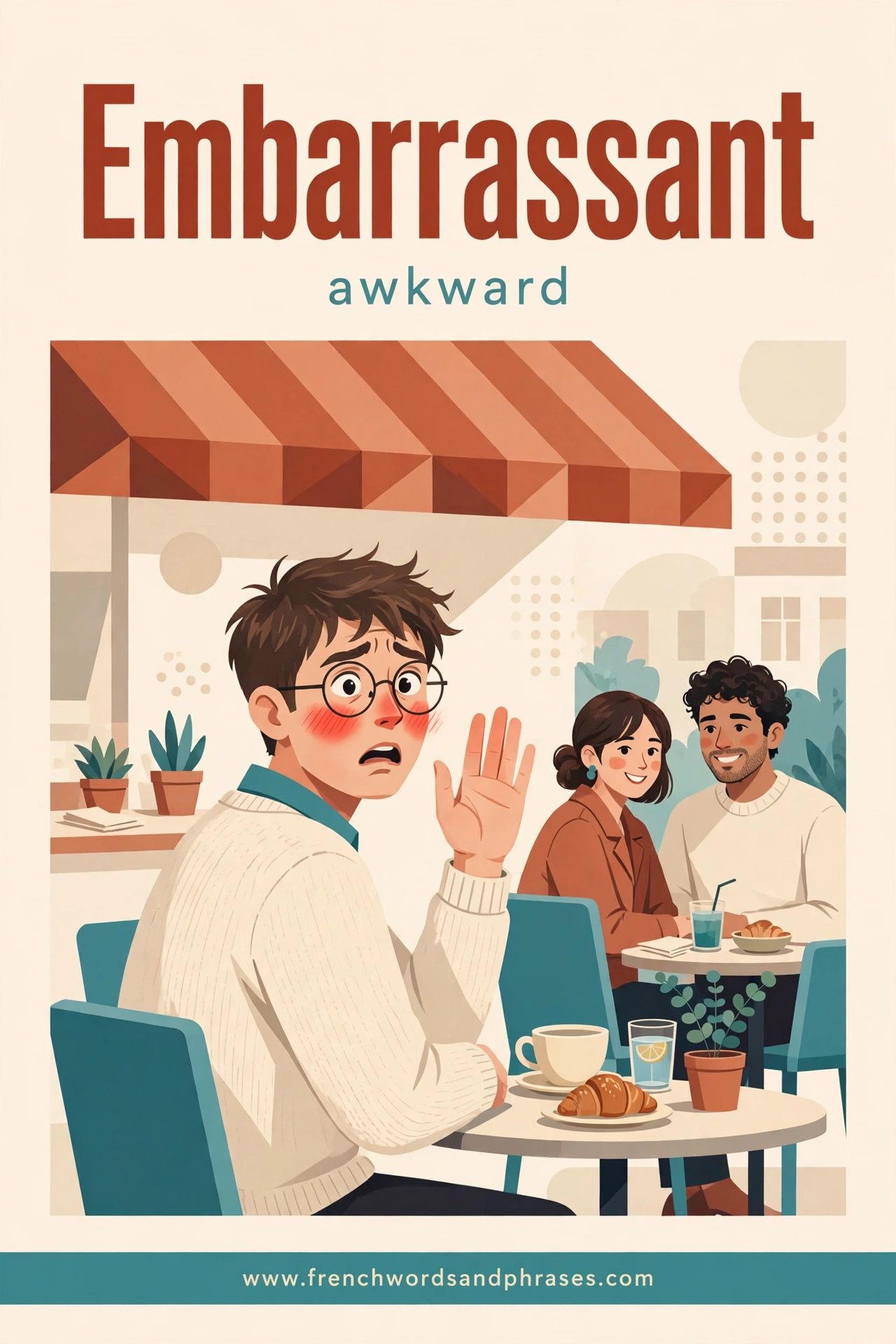
A French Word to Live By
Translate Embarrassant to English
/ɑ̃.ba.ʁa.sɑ̃/
Embarrassant means awkward, embarrassing.
A dinner party, eight people around the table. Someone asks the host, cheerfully and loudly, when the baby is due — and there is no baby. The question hangs in the air; forks slow down; somebody studies the tablecloth as if it were a map. That suspended, squirming moment has a name in French: un silence embarrassant.
In this guide, you’ll learn what embarrassant means in English, why it describes the situation and never the person who suffers it, how its feminine wakes up a sleeping t, and the phrases French uses for life’s most awkward moments. Explore French examples, English translations, and practice quizzes.
Understanding the French Adjective Embarrassant
Embarrassant is a French adjective of quality — the adjective of social discomfort. It agrees like the -ant family: embarrassant, embarrassante, embarrassants, embarrassantes. Its whole job is to describe the thing that makes people squirm: a silence, a question, a situation.
It means embarrassing and awkward — and, for questions and problems, tricky: un silence embarrassant, an awkward silence; une question embarrassante, an awkward (or tricky) question; une situation embarrassante, an embarrassing situation. Crucially, embarrassant describes the cause of the discomfort. The person who feels it is embarrassé — a different word, and the difference matters.
Type: Adjective of quality — social discomfort
Answers the question: What is it like? — awkward, embarrassing
Changes form: Yes — embarrassant, embarrassante, embarrassants, embarrassantes
English equivalents: Embarrassing; awkward; tricky (for questions).
One important usage detail: embarrassant stands AFTER the noun — un silence embarrassant. And never use it for yourself when you feel embarrassed: « je suis embarrassant » announces that you embarrass other people. For the feeling, French says je suis embarrassé or je suis gêné.
Experience the Word
Embarrassant is the adjective of the wrong name at the office party, the phone that rings during the minute of silence, the waiter arriving with the bill at exactly the wrong sentence.
Imagine calling your new teacher ‘Maman’ in front of the whole class — every French adult carries that memory, polished by thirty years of retelling, and every retelling ends with the same verdict: « C’était très embarrassant. »
You have not just described a bad moment. You have given the squirm a name — and naming it is how French politeness survives it.
How to Use Embarrassant in French: Complete Guide
Let’s explore how embarrassant works in French, beginning with the whole word on one card.
Embarrassant at a Glance
Before the details, here is the whole word on one card.
The Whole Word on One Card
Meaning, type, position and forms — embarrassant in four lines.
| Point | Embarrassant |
|---|---|
| Meaning | awkward, embarrassing |
| Type | adjective of quality — social discomfort |
| Usual position | after the noun — un silence embarrassant |
| Form | embarrassant / embarrassante / embarrassants / embarrassantes |
Example
Il y a eu un silence embarrassant.
There was an awkward silence.
The Four Forms of Embarrassant
Embarrassant agrees with the noun it describes — and the nouns it keeps company with are moments, silences, questions and situations.
| Form | Embarrassant | Example |
|---|---|---|
| Masculine singular | embarrassant | un moment embarrassant — an awkward moment |
| Feminine singular | embarrassante | une question embarrassante — an awkward question |
| Masculine plural | embarrassants | des silences embarrassants — awkward silences |
| Feminine plural | embarrassantes | des situations embarrassantes — embarrassing situations |
Example
Une question embarrassante a créé un silence embarrassant.
An awkward question created an awkward silence.
Quick Quiz 1
Which form of embarrassant goes with question (feminine)?
Reveal the answer
embarrassante
Une question embarrassante.
An awkward question.
Embarrassante: The Feminine Where the T Wakes Up
The -ant family builds its feminine in -ante: the final t, silent in embarrassant, is pronounced in embarrassante. Your ear can hear the feminine of this family — that is what makes it easy.
| Situation | Example |
|---|---|
| The rule | -ant becomes -ante — embarrassant → embarrassante |
| The sound | the t is silent in embarrassant, pronounced in embarrassante |
| Masculine plural | embarrassants — des moments embarrassants |
| Feminine plural | embarrassantes — des erreurs embarrassantes |
Example
C’était une erreur embarrassante, mais tout le monde a ri.
It was an embarrassing mistake, but everyone laughed.
Where Embarrassant Goes: After the Noun
Embarrassant follows the noun it describes, and it lives just as happily after être — c’est embarrassant is one of the most useful verdicts in French conversation.
| Pattern | Example |
|---|---|
| After the noun | un silence embarrassant — an awkward silence |
| After être | c’est embarrassant — that’s embarrassing |
| With an adverb | très embarrassant — very embarrassing |
| Before the noun | un embarrassant silence — not in everyday French |
Example
C’est très embarrassant, j’ai oublié son prénom.
It’s very embarrassing, I’ve forgotten her name.
Quick Quiz 2
In c’est embarrassant, what is being described — a person, or a situation?
Reveal the answer
A situation
Embarrassant describes the cause of the discomfort, never the person suffering it.
C’est embarrassant — that’s embarrassing.
More Embarrassing: Comparing with Embarrassant
Embarrassant compares the regular way, with plus, moins and aussi — and French storytellers compete for the superlative: le plus embarrassant is a title worth winning at dinner.
| Degree | Example |
|---|---|
| As embarrassing as | aussi embarrassant que — as embarrassing as |
| More embarrassing | plus embarrassant — more embarrassing |
| Less embarrassing | moins embarrassant — less embarrassing |
| The most embarrassing (masc.) | le plus embarrassant — le plus embarrassant des moments |
| The most embarrassing (fem.) | la plus embarrassante — la plus embarrassante des situations |
Example
Son histoire est plus embarrassante que la mienne.
His story is more embarrassing than mine.
Everyday Expressions with Embarrassant
Life supplies these phrases ready-made: the silence after the wrong remark, the question nobody wants to answer, the mistake everybody saw.
| Expression | In English |
|---|---|
| un silence embarrassant | an awkward silence |
| une question embarrassante | an awkward question — or a tricky one |
| une situation embarrassante | an embarrassing situation |
| une erreur embarrassante | an embarrassing mistake |
| un moment embarrassant | an awkward moment |
| c’est embarrassant | that’s embarrassing |
Example
Après sa remarque, il y a eu un long silence embarrassant.
After his remark, there was a long awkward silence.
Quick Quiz 3
What is un silence embarrassant in English?
Reveal the answer
An awkward silence
Personne ne parlait : un vrai silence embarrassant.
Nobody spoke: a real awkward silence.
Embarrassant and Its Neighbours
Gênant is the everyday twin of embarrassant; embarrassé is the feeling itself, worn by people. Learn the three together and the family is complete.
| French | In English |
|---|---|
| gênant | awkward, embarrassing — the everyday twin |
| embarrassé | embarrassed — the feeling, for people |
| gêné | embarrassed, ill at ease — for people |
| délicat | delicate, tricky — of subjects and questions |
| confus | confused, flustered |
| honteux | shameful, disgraceful — much stronger |
Example
Il était très embarrassé : la situation était vraiment gênante.
He was very embarrassed: the situation was really awkward.
Watch Out: The Traps Around Embarrassant
One trap here is famous enough to have its own anecdotes: the learner who announces, red-faced, « je suis très embarrassant » — I am very embarrassing.
| Trap | The truth |
|---|---|
| embarrassant vs embarrassé | embarrassant = the cause (the situation); embarrassé = the feeling (the person) |
| Saying ‘I am embarrassed’ | je suis embarrassé or je suis gêné — never je suis embarrassant |
| A tricky question | une question embarrassante can mean a difficult, delicate question — not a rude one |
| Spelling | the feminine is embarrassante with -ante, never ‘-ente’ |
Example
Ne sois pas embarrassé, la situation était embarrassante pour tout le monde.
Don’t be embarrassed, the situation was awkward for everyone.
Quick Quiz 4
How do you say ‘I am embarrassed’ — je suis embarrassant or je suis embarrassé?
Reveal the answer
je suis embarrassé
Je suis embarrassé, j’ai oublié ton anniversaire.
I’m embarrassed, I forgot your birthday.
Embarrassant in Everyday French: Real-Life Examples
Now that you know the word, let’s see how embarrassant appears in everyday French.
Example 1 — At a dinner
Après sa question, il y a eu un silence embarrassant.
After her question, there was an awkward silence.
Example 2 — At the office
J’ai appelé mon directeur par un autre prénom, c’était embarrassant.
I called my manager by the wrong name, it was embarrassing.
Example 3 — In class
Le professeur a posé une question embarrassante.
The teacher asked an awkward question.
Example 4 — At the cinema
Mon téléphone a sonné pendant le film, très embarrassant !
My phone rang during the film, very embarrassing!
Example 5 — A mistake
C’est une erreur embarrassante, je suis désolé.
It’s an embarrassing mistake, I’m sorry.
Example 6 — Two friends
Ne t’inquiète pas, ce moment embarrassant est déjà oublié.
Don’t worry, that awkward moment is already forgotten.
Beyond Translation: The Meaning of Embarrassant
English lets one word, embarrassing, cover both the crime and the blush — but French insists on separating them. Embarrassant belongs to the situation; embarrassé belongs to the person. The root tells the story: un embarras was first an obstacle, something blocking the road.
To say embarrassant in French is to point at the obstacle in the conversation — the thing everyone is politely stepping around.
That is why the word also serves for a tricky question: une question embarrassante is a question with an obstacle inside it.
How to Remember the French Adjective Embarrassant
Remember it this way: Embarrassant is the word for the moment, never for the person — the situation is embarrassant, the person is embarrassé.
- You point it at situations — un silence embarrassant, une question embarrassante.
- You never point it at yourself — je suis embarrassé, not embarrassant.
- You hear the t wake up in the feminine — embarrassante.
The key idea is embarrassant describes the awkward cause; embarrassé describes the person who feels it.
Test Your Knowledge of Embarrassant
Let’s see how much you’ve learned. Try answering these questions before revealing the answers.
Question 1
What does embarrassant mean?
Reveal the answer
Awkward, embarrassing — and tricky, for a question or a problem.
Question 2
What is the feminine of embarrassant?
Reveal the answer
embarrassante — the -ant becomes -ante, and the t is pronounced.
Question 3
Translate: an awkward silence.
Reveal the answer
Un silence embarrassant.
Question 4
Complete the sentence:
C’est très ______ , j’ai oublié son nom.
Reveal the answer
embarrassant
C’est très embarrassant, j’ai oublié son nom.
It’s very embarrassing, I’ve forgotten his name.
Question 5
How do you say ‘I am embarrassed’?
Reveal the answer
Je suis embarrassé — or je suis gêné. Embarrassant would mean you embarrass other people.
Your Final Challenge
Can You Use It?
How would you say this in French?
“There was an awkward silence after her question.”
Reveal the answer
Il y a eu un silence embarrassant après sa question.
There was an awkward silence after her question.
A little French. A little curiosity. A richer everyday life.
LEARN FRENCH ONE WORD AT A TIME