A French Word to Live By
How to Conjugate Emballotter in French
/ɑ̃.ba.lɔ.te/
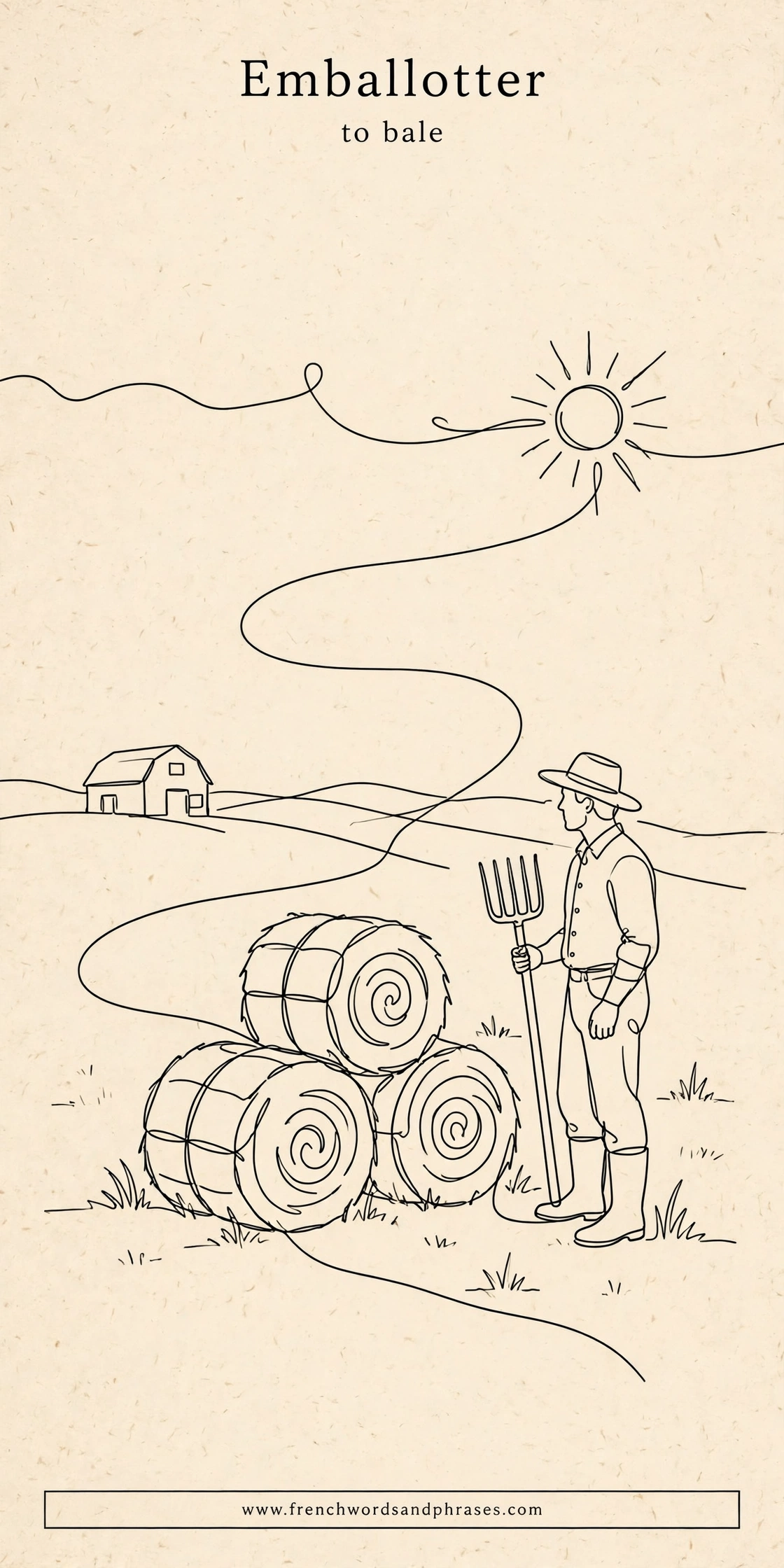
Emballotter means to bale — to gather loose material, above all hay and straw, and bind it into compact bundles, des ballots, that can be stacked, carried and stored.
A July field after the mower has passed, rows of straw waiting in the heat, a farmer’s pitchfork working in rhythm — emballotter is the verb of the harvest bundle: loose stalks in, a tight ballot out.
In this guide, you’ll learn how to conjugate emballotter in all the major French tenses and moods. Explore complete conjugation tables, French examples, English translations, and practice quizzes.
Understanding the French Verb Emballotter
Emballotter is a regular French verb belonging to the first group of verbs, those ending in-er.
It means to bale. It is used in agriculture for hay, straw and sometimes wool or rags gathered into ballots, and in older commercial French for bundling merchandise. Today a machine, la botteleuse or la presse, does most of the work, but the verb still names the job, machine or no machine.
Verb classification: First group (-er)
Auxiliary verb: Avoir
Past participle: emballotté
Present participle: emballottant
English equivalents: To bale, to bundle up; emballotter le foin — to bale the hay; emballotter la paille — to bundle up the straw; un ballot de foin — a bale of hay; emballotter des marchandises — to bundle up goods for transport.
One important detail: emballotter is the diminutive cousin of emballer — where emballer makes one big balle, emballotter makes ballots, the smaller bundles, one after another, which is exactly the rhythm of baling a field. Watch the double t and the o before it: j’emballotte, nous emballottons, past participle emballotté. It is farm vocabulary first, and only secondarily a word for bundling up goods.
Experience the Word
Emballotter is the verb of tidying a harvest — a whole field of loose straw, reduced to a row of identical bundles.
Imagine the last evening of the hay harvest. The light is going, the field is striped with cut straw, and the farmer walks his rows with a fork, emballottant ballot after ballot, each one tied, lifted, stacked — turning weather-risk into winter stock before the dew falls.
The straw has not changed. It has been baled — emballotté — loose no longer, ready for the barn.
How to Conjugate Emballotter: Complete French Conjugation Guide
Let’s explore every major conjugation of emballotter, beginning with the indicative mood.
How to Conjugate Emballotter in the Indicative Mood
The indicative mood is used to express facts, observations, actions, and events.
How to Conjugate Emballotter in the Present Tense (Présent)
Used for actions happening now, habitual actions, and general truths.
| Subject | Conjugation |
|---|---|
| je | emballotte |
| tu | emballottes |
| il / elle | emballotte |
| nous | emballottons |
| vous | emballottez |
| ils / elles | emballottent |
Example
Les fermiers emballottent le foin avant la pluie.
The farmers bale the hay before the rain.
Quick Quiz 1
Complete the sentence:
Nous ______ la paille avant l’orage.
Reveal the answer
emballottons
Nous emballottons la paille avant l’orage.
We are baling the straw before the storm.
How to Conjugate Emballotter in the Passé Composé
Used for completed actions in the past. Emballotter takes the auxiliary verb avoir.
| Subject | Conjugation |
|---|---|
| j’ | ai emballotté |
| tu | as emballotté |
| il / elle | a emballotté |
| nous | avons emballotté |
| vous | avez emballotté |
| ils / elles | ont emballotté |
Example
Nous avons emballotté toute la paille du champ.
We baled all the straw in the field.
How to Conjugate Emballotter in the Imparfait (Imperfect Tense)
Used for habitual past actions, descriptions, and ongoing situations in the past.
| Subject | Conjugation |
|---|---|
| je | emballottais |
| tu | emballottais |
| il / elle | emballottait |
| nous | emballottions |
| vous | emballottiez |
| ils / elles | emballottaient |
Example
Autrefois, on emballottait la paille à la main.
In the old days, straw used to be baled by hand.
Quick Quiz 2
Choose the correct form:
We baled the straw.
Nous ______ la paille. (avons emballotté / sommes emballottés)
Reveal the answer
avons emballotté
Nous avons emballotté la paille.
Emballotter takes avoir.
How to Conjugate Emballotter in the Plus-que-parfait
Used to describe an action that had already been completed before another past event.
| Subject | Conjugation |
|---|---|
| j’ | avais emballotté |
| tu | avais emballotté |
| il / elle | avait emballotté |
| nous | avions emballotté |
| vous | aviez emballotté |
| ils / elles | avaient emballotté |
Example
Il avait emballotté le foin avant la tombée de la nuit.
He had baled the hay before nightfall.
How to Conjugate Emballotter in the Passé Simple
Primarily used in formal writing, literature, and historical narratives. It is rarely used in everyday conversation.
| Subject | Conjugation |
|---|---|
| je | emballottai |
| tu | emballottas |
| il / elle | emballotta |
| nous | emballottâmes |
| vous | emballottâtes |
| ils / elles | emballottèrent |
Example
Le fermier emballotta la récolte en deux jours.
The farmer baled the harvest in two days.
How to Conjugate Emballotter in the Passé Antérieur
A literary tense used to express an action completed immediately before another past action, generally in the passé simple.
| Subject | Conjugation |
|---|---|
| j’ | eus emballotté |
| tu | eus emballotté |
| il / elle | eut emballotté |
| nous | eûmes emballotté |
| vous | eûtes emballotté |
| ils / elles | eurent emballotté |
Example
Quand ils eurent emballotté la paille, ils la rentrèrent à la grange.
When they had baled the straw, they brought it into the barn.
How to Conjugate Emballotter in the Future Tense (Futur Simple)
Used to describe actions that will take place in the future.
| Subject | Conjugation |
|---|---|
| je | emballotterai |
| tu | emballotteras |
| il / elle | emballottera |
| nous | emballotterons |
| vous | emballotterez |
| ils / elles | emballotteront |
Example
Demain, la machine emballottera le champ entier.
Tomorrow, the machine will bale the whole field.
How to Conjugate Emballotter in the Futur Antérieur (Future Perfect)
Used for an action that will have been completed before a particular point in the future.
| Subject | Conjugation |
|---|---|
| j’ | aurai emballotté |
| tu | auras emballotté |
| il / elle | aura emballotté |
| nous | aurons emballotté |
| vous | aurez emballotté |
| ils / elles | auront emballotté |
Example
À la fin de la semaine, nous aurons emballotté cent ballots.
By the end of the week, we will have baled a hundred bales.
How to Conjugate Emballotter in the Near Future (Futur Proche)
Used to describe something that is going to happen soon. Formed with aller + infinitive.
| Subject | Conjugation |
|---|---|
| je | vais emballotter |
| tu | vas emballotter |
| il / elle | va emballotter |
| nous | allons emballotter |
| vous | allez emballotter |
| ils / elles | vont emballotter |
Example
Vite, on va emballotter le foin avant l’orage.
Quick, we are going to bale the hay before the storm.
How to Conjugate Emballotter in the Conditional Mood
The conditional mood expresses what would happen under certain circumstances. It is also frequently used to make polite requests or express wishes.
How to Conjugate Emballotter in the Present Conditional
| Subject | Conjugation |
|---|---|
| je | emballotterais |
| tu | emballotterais |
| il / elle | emballotterait |
| nous | emballotterions |
| vous | emballotteriez |
| ils / elles | emballotteraient |
Example
Avec une presse moderne, on emballotterait deux fois plus vite.
With a modern press, we would bale twice as fast.
How to Conjugate Emballotter in the Past Conditional
| Subject | Conjugation |
|---|---|
| j’ | aurais emballotté |
| tu | aurais emballotté |
| il / elle | aurait emballotté |
| nous | aurions emballotté |
| vous | auriez emballotté |
| ils / elles | auraient emballotté |
Example
Il aurait emballotté la paille hier sans la panne du tracteur.
He would have baled the straw yesterday without the tractor breaking down.
Emballotter in the Literary Past Conditional Form
This less common literary form uses the imperfect subjunctive of avoir.
| Subject | Conjugation |
|---|---|
| j’ | eusse emballotté |
| tu | eusses emballotté |
| il / elle | eût emballotté |
| nous | eussions emballotté |
| vous | eussiez emballotté |
| ils / elles | eussent emballotté |
Example
Le fermier eût emballotté tout le champ sans la pluie du soir.
The farmer would have baled the whole field without the evening rain.
How to Conjugate Emballotter in the Subjunctive Mood
The subjunctive is used to express wishes, emotions, doubts, necessity, and uncertainty. It frequently follows expressions such as il faut que (it is necessary that) or bien que (although).
How to Conjugate Emballotter in the Present Subjunctive
| Subject | Conjugation |
|---|---|
| que je | emballotte |
| que tu | emballottes |
| qu’il / qu’elle | emballotte |
| que nous | emballottions |
| que vous | emballottiez |
| qu’ils / qu’elles | emballottent |
Example
Il faut que l’on emballotte le foin tant qu’il est sec.
The hay must be baled while it is dry.
Quick Quiz 3
Complete the sentence using the subjunctive:
Il faut que vous ______ le foin aujourd’hui.
Reveal the answer
emballottiez
Il faut que vous emballottiez le foin aujourd’hui.
You must bale the hay today.
How to Conjugate Emballotter in the Imperfect Subjunctive
A literary tense, rarely encountered in modern spoken French.
| Subject | Conjugation |
|---|---|
| que je | emballottasse |
| que tu | emballottasses |
| qu’il / qu’elle | emballottât |
| que nous | emballottassions |
| que vous | emballottassiez |
| qu’ils / qu’elles | emballottassent |
Example
Le fermier voulait que l’on emballottât la paille avant dimanche.
The farmer wanted the straw baled before Sunday.
How to Conjugate Emballotter in the Pluperfect Subjunctive
A literary construction used to express an action completed before another past action.
| Subject | Conjugation |
|---|---|
| que j’ | eusse emballotté |
| que tu | eusses emballotté |
| qu’il / qu’elle | eût emballotté |
| que nous | eussions emballotté |
| que vous | eussiez emballotté |
| qu’ils / qu’elles | eussent emballotté |
Example
On vérifia que les ouvriers eussent emballotté tous les ballots.
They checked that the workers had baled all the bales.
How to Conjugate Emballotter in the Past Subjunctive
| Subject | Conjugation |
|---|---|
| que j’ | aie emballotté |
| que tu | aies emballotté |
| qu’il / qu’elle | ait emballotté |
| que nous | ayons emballotté |
| que vous | ayez emballotté |
| qu’ils / qu’elles | aient emballotté |
Example
Je suis content que vous ayez emballotté le foin à temps.
I am glad you baled the hay in time.
How to Conjugate Emballotter in the Imperative
The imperative is used to give commands, instructions, invitations, or suggestions. Subject pronouns are omitted.
How to Conjugate Emballotter in the Present Imperative
| Person | Conjugation |
|---|---|
| (tu) | emballotte |
| (nous) | emballottons |
| (vous) | emballottez |
Example
Emballottez la paille pendant qu’elle est sèche !
Bale the straw while it is dry!
Quick Quiz 4
How would you say Bale the hay while it is dry (tu form)?
Reveal the answer
Emballotte le foin tant qu’il est sec !
French Participles of Emballotter
Participles are verb forms that can be used in compound tenses and other grammatical constructions.
Present Participle of Emballotter
emballottant
En emballottant le foin, il prépare l’hiver de ses bêtes.
By baling the hay, he prepares his animals’ winter.
Past Participle of Emballotter
emballotté
Emballottée dès juillet, la paille attend l’hiver dans la grange.
Baled as early as July, the straw waits for winter in the barn.
Emballotter in Everyday French: Real-Life Examples
Now that you know the conjugations, let’s see how emballotter appears in everyday French.
Example 1 — Present
Les fermiers emballottent le foin avant la pluie.
The farmers bale the hay before the rain.
Example 2 — Passé composé
Nous avons emballotté toute la paille.
We baled all the straw.
Example 3 — Imparfait
On emballottait la paille à la main autrefois.
Straw used to be baled by hand in the old days.
Example 4 — Future
La machine emballottera le champ entier.
The machine will bale the whole field.
Example 5 — Conditional
On emballotterait plus vite avec une presse moderne.
We would bale faster with a modern press.
Example 6 — Imperative
Emballotte le foin tant qu’il est sec !
Bale the hay while it is dry!
Beyond Translation: The Meaning of Emballotter
French emballotter is emballer with a smaller bundle and a busier hand — the suffix makes ballots where the parent verb makes one great balle.
It is the verb of the repeated bundle.
That is why it belongs to the harvest: nobody bales once. Ballot after ballot, row after row, the verb ticks along with the work until the field is empty and the barn is full.
How to Remember the French Verb Emballotter
Remember it this way: Emballotter is about the harvest evening — ballot after ballot stacked before the dew.
- Ballot, not balle: emballotter makes the smaller bundles, one after another — the rhythm of baling hay.
- Mind the spelling: emballotter with o and double t — j’emballotte, nous emballottons.
- Regular -er: past participle emballotté; its world is le foin, la paille, la grange.
The key idea is the harvest evening — ballot after ballot stacked before the dew.
Test Your Knowledge of Emballotter
Let’s see how much you’ve learned. Try answering these questions before revealing the answers.
Question 1
How does emballotter differ from emballer?
Reveal the answer
Size and rhythm — emballer makes one big bale or parcel; emballotter makes ballots, the smaller bundles, one after another.
Question 2
How do you say The farmers bale the hay before the rain in French?
Reveal the answer
Les fermiers emballottent le foin avant la pluie.
Question 3
Translate: We baled all the straw.
Reveal the answer
Nous avons emballotté toute la paille.
Question 4
What is the past participle of emballotter?
Reveal the answer
Emballotté.
Question 5
Complete the sentence:
Il faut que l’on ______ le foin tant qu’il est sec.
Reveal the answer
emballotte
Il faut que l’on emballotte le foin tant qu’il est sec.
The hay must be baled while it is dry.
Your Final Challenge
Can You Use It?
How would you say this in French?
Come evening, the field is empty and the barn is full: summer has been baled for winter.
Reveal the answer
Le soir venu, le champ est vide et la grange pleine : on a emballotté l’été pour l’hiver.
Come evening, the field is empty and the barn is full: summer has been baled for winter.
A little French. A little curiosity. A richer everyday life.
LEARN FRENCH ONE WORD AT A TIME