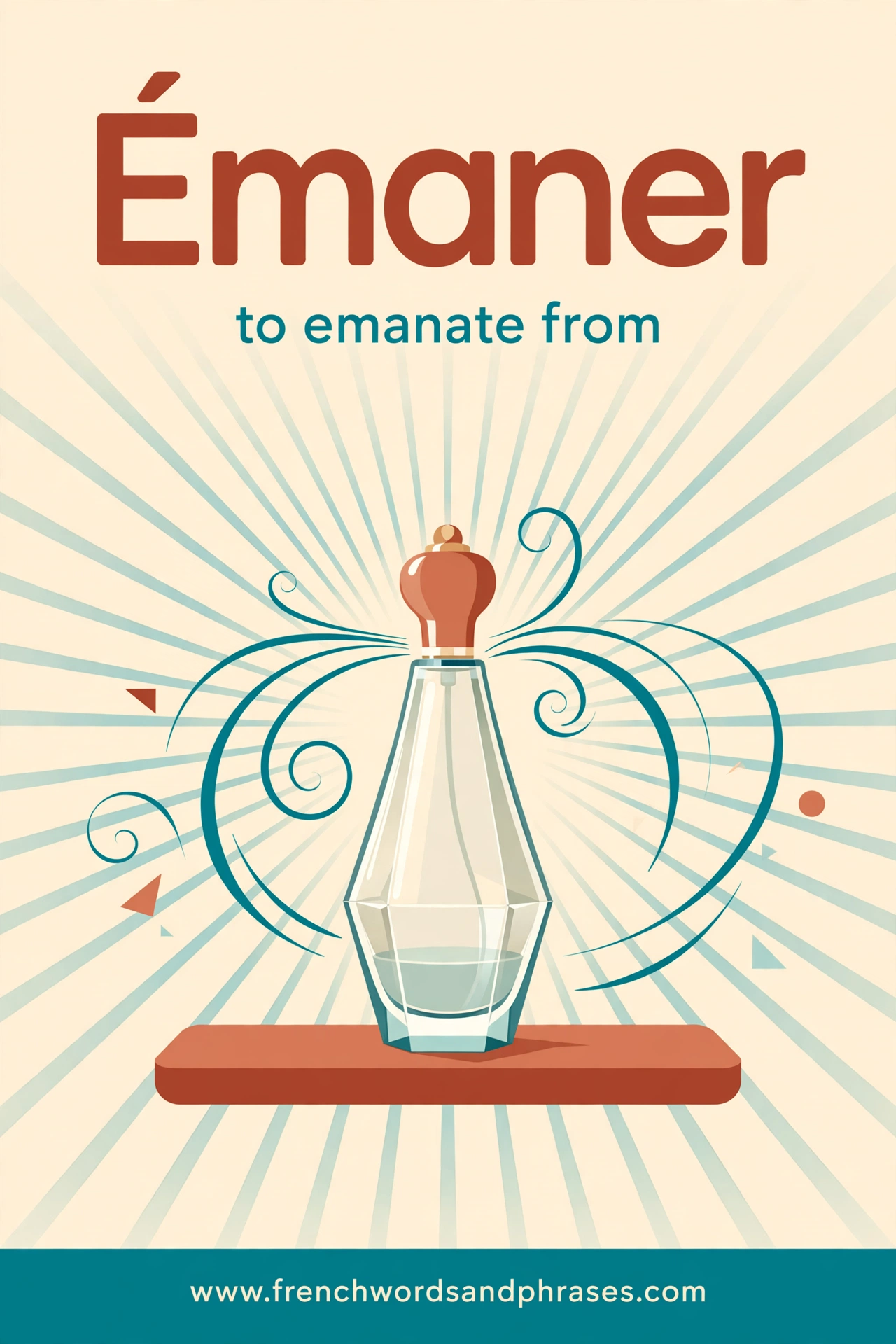
A French Word to Live By
How to Conjugate Émaner in French
/e.ma.ne/
Émaner means to emanate from — to come out of a source and spread, as scent comes from a flower, light from a lamp, or an order from a ministry.
Steam rising off a cup, the smell of rain on hot stone, a calm authority radiating from an old judge — émaner is the verb of the invisible outflow: something leaves its source and fills the air around it.
In this guide, you’ll learn how to conjugate émaner in all the major French tenses and moods. Explore complete conjugation tables, French examples, English translations, and practice quizzes.
Understanding the French Verb Émaner
Émaner is a regular French verb belonging to the first group of verbs, those ending in-er.
It means to emanate from. It is used for smells, light, heat and steam physically flowing from a source, and in formal French for anything issuing from an authority — orders, decrees, proposals — and for qualities radiating from a person: le calme qui émane d’elle, the calm that emanates from her.
Verb classification: First group (-er)
Auxiliary verb: Avoir
Past participle: émané
Present participle: émanant
English equivalents: To emanate from, to come from; émaner de — to emanate from; un parfum émane des fleurs — a scent emanates from the flowers; la lumière qui émane de la lampe — the light coming from the lamp; un ordre émanant du ministère — an order emanating from the ministry; l’autorité qui émane d’elle — the authority she radiates.
One important detail: émaner is never used without its source — the preposition de is part of the verb: le parfum émane des fleurs, la décision émane du directeur. And notice what becomes the subject: not the flower but the scent, not the ministry but the order — émaner describes the thing that flows out, travelling from its source. It lives mostly in the third person, and the verb is regular: il émane, ils émanent, past participle émané.
Experience the Word
Émaner is the verb of the source and its halo — you cannot see the flower’s scent leave, but the whole garden knows it has.
Imagine a bakery at dawn in a sleeping street. The shutters are still closed, yet un parfum de croissants chauds émane de la boutique and reaches the first passer-by twenty metres away — the bread announces itself long before the door opens.
The smell has travelled on its own. It has emanated — émané de la boutique, invisible and unmistakable.
How to Conjugate Émaner: Complete French Conjugation Guide
Let’s explore every major conjugation of émaner, beginning with the indicative mood.
How to Conjugate Émaner in the Indicative Mood
The indicative mood is used to express facts, observations, actions, and events.
How to Conjugate Émaner in the Present Tense (Présent)
Used for actions happening now, habitual actions, and general truths.
| Subject | Conjugation |
|---|---|
| je | émane |
| tu | émanes |
| il / elle | émane |
| nous | émanons |
| vous | émanez |
| ils / elles | émanent |
Example
Un doux parfum émane des roses du jardin.
A sweet scent emanates from the roses in the garden.
Quick Quiz 1
Complete the sentence:
Les ordres ______ de la nouvelle direction.
Reveal the answer
émanent
Les ordres émanent de la nouvelle direction.
The orders emanate from the new management.
How to Conjugate Émaner in the Passé Composé
Used for completed actions in the past. Émaner takes the auxiliary verb avoir.
| Subject | Conjugation |
|---|---|
| j’ | ai émané |
| tu | as émané |
| il / elle | a émané |
| nous | avons émané |
| vous | avez émané |
| ils / elles | ont émané |
Example
Une étrange lueur a émané de la vieille maison toute la nuit.
A strange glow emanated from the old house all night.
How to Conjugate Émaner in the Imparfait (Imperfect Tense)
Used for habitual past actions, descriptions, and ongoing situations in the past.
| Subject | Conjugation |
|---|---|
| je | émanais |
| tu | émanais |
| il / elle | émanait |
| nous | émanions |
| vous | émaniez |
| ils / elles | émanaient |
Example
De la cuisine émanait une odeur de soupe et de bois brûlé.
From the kitchen emanated a smell of soup and burnt wood.
Quick Quiz 2
Choose the correct form:
The instruction emanated from the ministry.
La consigne ______ du ministère. (a émané / est émanée)
Reveal the answer
a émané
La consigne a émané du ministère.
Émaner takes avoir.
How to Conjugate Émaner in the Plus-que-parfait
Used to describe an action that had already been completed before another past event.
| Subject | Conjugation |
|---|---|
| j’ | avais émané |
| tu | avais émané |
| il / elle | avait émané |
| nous | avions émané |
| vous | aviez émané |
| ils / elles | avaient émané |
Example
La consigne avait émané directement du ministère.
The instruction had emanated directly from the ministry.
How to Conjugate Émaner in the Passé Simple
Primarily used in formal writing, literature, and historical narratives. It is rarely used in everyday conversation.
| Subject | Conjugation |
|---|---|
| je | émanai |
| tu | émanas |
| il / elle | émana |
| nous | émanâmes |
| vous | émanâtes |
| ils / elles | émanèrent |
Example
De la vallée émana une brume épaisse au crépuscule.
From the valley emanated a thick mist at dusk.
How to Conjugate Émaner in the Passé Antérieur
A literary tense used to express an action completed immediately before another past action, generally in the passé simple.
| Subject | Conjugation |
|---|---|
| j’ | eus émané |
| tu | eus émané |
| il / elle | eut émané |
| nous | eûmes émané |
| vous | eûtes émané |
| ils / elles | eurent émané |
Example
Quand la fumée eut émané du toit, les voisins appelèrent les pompiers.
When smoke had begun emanating from the roof, the neighbours called the fire brigade.
How to Conjugate Émaner in the Future Tense (Futur Simple)
Used to describe actions that will take place in the future.
| Subject | Conjugation |
|---|---|
| je | émanerai |
| tu | émaneras |
| il / elle | émanera |
| nous | émanerons |
| vous | émanerez |
| ils / elles | émaneront |
Example
Demain, les ordres émaneront de la nouvelle direction.
Tomorrow, orders will emanate from the new management.
How to Conjugate Émaner in the Futur Antérieur (Future Perfect)
Used for an action that will have been completed before a particular point in the future.
| Subject | Conjugation |
|---|---|
| j’ | aurai émané |
| tu | auras émané |
| il / elle | aura émané |
| nous | aurons émané |
| vous | aurez émané |
| ils / elles | auront émané |
Example
À la fin de l’enquête, la vérité aura émané des témoignages.
By the end of the inquiry, the truth will have emanated from the testimonies.
How to Conjugate Émaner in the Near Future (Futur Proche)
Used to describe something that is going to happen soon. Formed with aller + infinitive.
| Subject | Conjugation |
|---|---|
| je | vais émaner |
| tu | vas émaner |
| il / elle | va émaner |
| nous | allons émaner |
| vous | allez émaner |
| ils / elles | vont émaner |
Example
Écoute : une belle musique va émaner de la chapelle.
Listen: beautiful music is going to emanate from the chapel.
How to Conjugate Émaner in the Conditional Mood
The conditional mood expresses what would happen under certain circumstances. It is also frequently used to make polite requests or express wishes.
How to Conjugate Émaner in the Present Conditional
| Subject | Conjugation |
|---|---|
| je | émanerais |
| tu | émanerais |
| il / elle | émanerait |
| nous | émanerions |
| vous | émaneriez |
| ils / elles | émaneraient |
Example
Sans cette lampe, aucune lumière n’émanerait de la grotte.
Without this lamp, no light would emanate from the cave.
How to Conjugate Émaner in the Past Conditional
| Subject | Conjugation |
|---|---|
| j’ | aurais émané |
| tu | aurais émané |
| il / elle | aurait émané |
| nous | aurions émané |
| vous | auriez émané |
| ils / elles | auraient émané |
Example
Le parfum aurait émané des fleurs sans la pluie qui les a fermées.
The scent would have emanated from the flowers without the rain that closed them.
Émaner in the Literary Past Conditional Form
This less common literary form uses the imperfect subjunctive of avoir.
| Subject | Conjugation |
|---|---|
| j’ | eusse émané |
| tu | eusses émané |
| il / elle | eût émané |
| nous | eussions émané |
| vous | eussiez émané |
| ils / elles | eussent émané |
Example
Nulle consigne n’eût émané du bureau sans la signature du préfet.
No instruction would have emanated from the office without the prefect’s signature.
How to Conjugate Émaner in the Subjunctive Mood
The subjunctive is used to express wishes, emotions, doubts, necessity, and uncertainty. It frequently follows expressions such as il faut que (it is necessary that) or bien que (although).
How to Conjugate Émaner in the Present Subjunctive
| Subject | Conjugation |
|---|---|
| que je | émane |
| que tu | émanes |
| qu’il / qu’elle | émane |
| que nous | émanions |
| que vous | émaniez |
| qu’ils / qu’elles | émanent |
Example
Il est rare qu’un tel calme émane d’un si jeune chef.
It is rare for such calm to emanate from so young a leader.
Quick Quiz 3
Complete the sentence using the subjunctive:
Il est rare que tant de chaleur ______ d’un si petit feu.
Reveal the answer
émane
Il est rare que tant de chaleur émane d’un si petit feu.
It is rare for so much heat to emanate from such a small fire.
How to Conjugate Émaner in the Imperfect Subjunctive
A literary tense, rarely encountered in modern spoken French.
| Subject | Conjugation |
|---|---|
| que je | émanasse |
| que tu | émanasses |
| qu’il / qu’elle | émanât |
| que nous | émanassions |
| que vous | émanassiez |
| qu’ils / qu’elles | émanassent |
Example
On s’étonnait que tant de bruit émanât d’une si petite salle.
People were surprised that so much noise emanated from such a small room.
How to Conjugate Émaner in the Pluperfect Subjunctive
A literary construction used to express an action completed before another past action.
| Subject | Conjugation |
|---|---|
| que j’ | eusse émané |
| que tu | eusses émané |
| qu’il / qu’elle | eût émané |
| que nous | eussions émané |
| que vous | eussiez émané |
| qu’ils / qu’elles | eussent émané |
Example
On racontait qu’une lumière eût émané de la tombe du saint.
It was told that a light had emanated from the saint’s tomb.
How to Conjugate Émaner in the Past Subjunctive
| Subject | Conjugation |
|---|---|
| que j’ | aie émané |
| que tu | aies émané |
| qu’il / qu’elle | ait émané |
| que nous | ayons émané |
| que vous | ayez émané |
| qu’ils / qu’elles | aient émané |
Example
Je suis frappé que cette idée ait émané d’un enfant.
I am struck that this idea emanated from a child.
How to Conjugate Émaner in the Imperative
The imperative is used to give commands, instructions, invitations, or suggestions. Subject pronouns are omitted.
How to Conjugate Émaner in the Present Imperative
| Person | Conjugation |
|---|---|
| (tu) | émane |
| (nous) | émanons |
| (vous) | émanez |
Example
Émanez de la source, parfums du soir, et emplissez le jardin !
Emanate from your source, evening scents, and fill the garden!
Quick Quiz 4
How would you say Emanate from the garden, scent of roses (tu form)?
Reveal the answer
Émane du jardin, parfum des roses !
French Participles of Émaner
Participles are verb forms that can be used in compound tenses and other grammatical constructions.
Present Participle of Émaner
émanant
Émanant des marais, la brume couvrit bientôt la route.
Emanating from the marshes, the mist soon covered the road.
Past Participle of Émaner
émané
Émanée d’une autorité lointaine, la consigne fut obéie sans discussion.
Having emanated from a distant authority, the instruction was obeyed without discussion.
Émaner in Everyday French: Real-Life Examples
Now that you know the conjugations, let’s see how émaner appears in everyday French.
Example 1 — Present
Un parfum émane des fleurs.
A scent emanates from the flowers.
Example 2 — Passé composé
La consigne a émané du ministère.
The instruction emanated from the ministry.
Example 3 — Imparfait
Une odeur de soupe émanait de la cuisine.
A smell of soup emanated from the kitchen.
Example 4 — Future
Les ordres émaneront de la direction.
Orders will emanate from the management.
Example 5 — Conditional
Aucune lumière n’émanerait de la grotte sans lampe.
No light would emanate from the cave without a lamp.
Example 6 — Imperative
Émane de ton jardin, parfum des roses !
Emanate from your garden, scent of roses!
Beyond Translation: The Meaning of Émaner
English emanate is the exact twin — Latin emanare, to flow out, drop by drop (manare, to flow).
What émanes spreads without moving.
French loves the verb for the space between the physical and the official: a smell émanes from a kitchen, a rumour émanes from an office, an authority émanes from a person — in each case the source stays still and its influence travels.
How to Remember the French Verb Émaner
Remember it this way: Émaner is about the bakery at dawn — the scent leaves the shop and fills the street.
- De is part of the verb: émaner de — always name the source, émaner des fleurs, du ministère.
- The subject is what flows out — the scent, the light, the order — never the source itself.
- Regular -er, mostly third person: il émane, ils émanent, past participle émané.
The key idea is the bakery at dawn — the scent leaves the shop and fills the street.
Test Your Knowledge of Émaner
Let’s see how much you’ve learned. Try answering these questions before revealing the answers.
Question 1
Which preposition is inseparable from émaner?
Reveal the answer
De — émaner de: le parfum émane des fleurs.
Question 2
How do you say A scent emanates from the flowers in French?
Reveal the answer
Un parfum émane des fleurs.
Question 3
Translate: The instruction emanated from the ministry.
Reveal the answer
La consigne a émané du ministère.
Question 4
What is the past participle of émaner?
Reveal the answer
Émané.
Question 5
Complete the sentence:
Il est rare qu’un tel calme ______ d’un si jeune chef.
Reveal the answer
émane
Il est rare qu’un tel calme émane d’un si jeune chef.
It is rare for such calm to emanate from so young a leader.
Your Final Challenge
Can You Use It?
How would you say this in French?
From the old house emanated a gentle light, and the whole village felt at home.
Reveal the answer
De la vieille maison émanait une lumière douce, et tout le village se sentait chez soi.
From the old house emanated a gentle light, and the whole village felt at home.
A little French. A little curiosity. A richer everyday life.
LEARN FRENCH ONE WORD AT A TIME