A French Word to Live By
How to Conjugate Élucider in French
/e.ly.si.de/
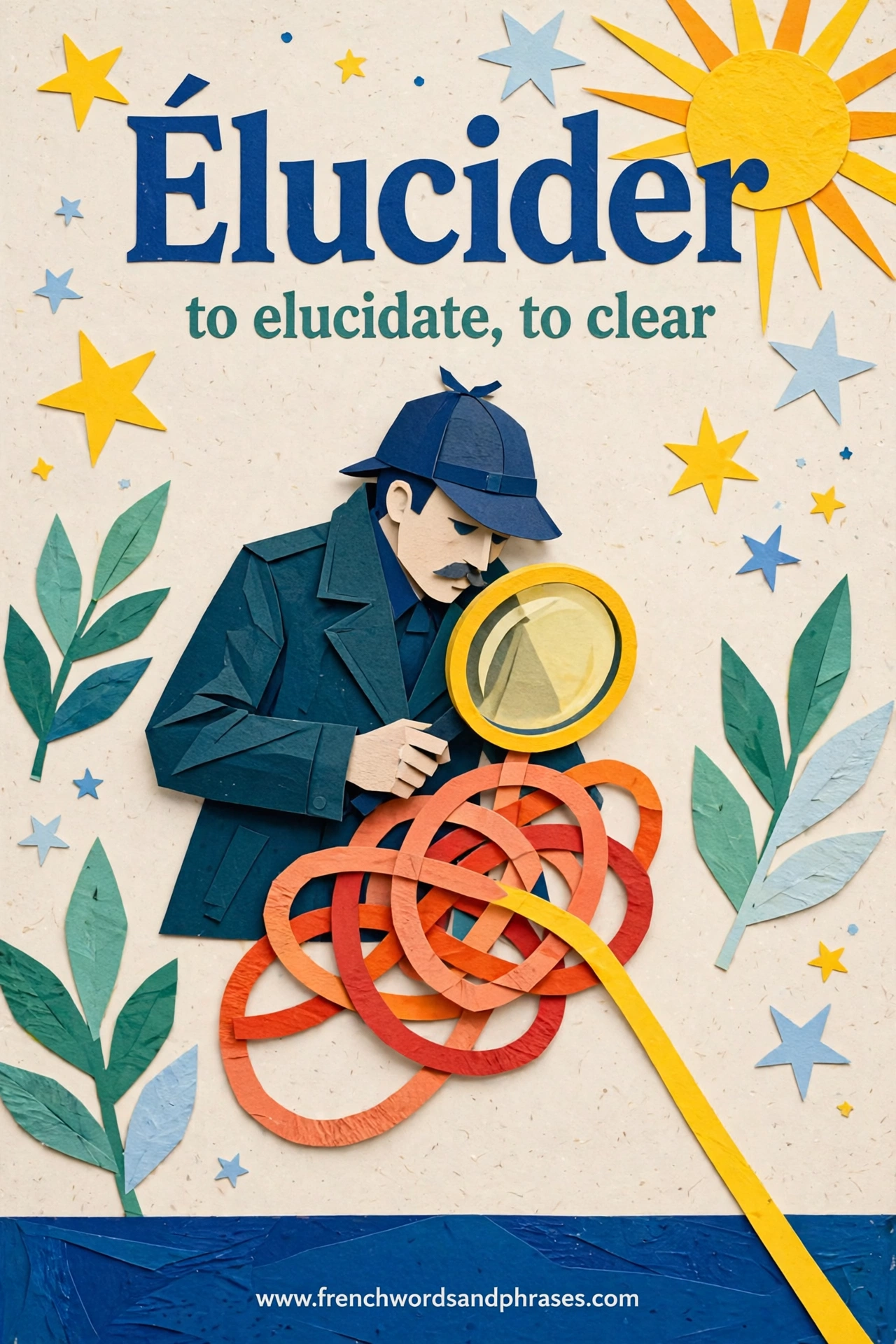
Élucider means to elucidate, to clear — to throw light on a mystery until it stops being one, as a detective clears up a case.
A detective with a wall of photographs and string, a scientist staring at results that suddenly make sense, a reader reaching the last page of a mystery novel — élucider is the verb of light arriving: a dark matter, examined patiently, becomes clear.
In this guide, you’ll learn how to conjugate élucider in all the major French tenses and moods. Explore complete conjugation tables, French examples, English translations, and practice quizzes.
Understanding the French Verb Élucider
Élucider is a regular French verb belonging to the first group of verbs, those ending in-er.
It means to elucidate, to clear. It is commonly used of police work and journalism — crimes, affairs and mysteries waiting to be solved — and in careful prose for any obscure point that patient work finally explains. An affaire non élucidée is an unsolved case.
Verb classification: First group (-er)
Auxiliary verb: Avoir
Past participle: élucidé
Present participle: élucidant
English equivalents: To elucidate, to clear up, to solve; élucider un mystère — to clear up a mystery; élucider une affaire — to solve a case; élucider un crime — to solve a crime; rester à élucider — to remain unexplained.
One important detail: élucider carries the Latin lux, light, inside it — é-lucider is literally to bring into the light — and its home ground is the investigation: élucider un mystère, élucider une affaire, élucider un crime. It is a transitive, fairly formal verb: the police, a report or an explanation élucide something. It is perfectly regular: j’élucide, nous élucidons. When the mystery itself clears, French turns it reflexive — l’affaire s’élucide, the case is clearing up.
Experience the Word
Élucider is the verb of the lamp switched on in a dark room — the facts were all there; now they can be seen.
Imagine a cold case in a provincial police station: thirty years of files, one grey box of evidence. A young inspector reads everything twice, notices a bus ticket nobody had questioned — and in a week, elle a élucidé what two generations had left in the dark.
The facts never changed. She has cleared them up — élucidés — and the dark is gone.
How to Conjugate Élucider: Complete French Conjugation Guide
Let’s explore every major conjugation of élucider, beginning with the indicative mood.
How to Conjugate Élucider in the Indicative Mood
The indicative mood is used to express facts, observations, actions, and events.
How to Conjugate Élucider in the Present Tense (Présent)
Used for actions happening now, habitual actions, and general truths.
| Subject | Conjugation |
|---|---|
| je | élucide |
| tu | élucides |
| il / elle | élucide |
| nous | élucidons |
| vous | élucidez |
| ils / elles | élucident |
Example
La police élucide l’affaire grâce à un témoin.
The police are clearing up the case thanks to a witness.
Quick Quiz 1
Complete the sentence:
Nous ______ les causes de l’accident.
Reveal the answer
élucidons
Nous élucidons les causes de l’accident.
We are clearing up the causes of the accident.
How to Conjugate Élucider in the Passé Composé
Used for completed actions in the past. Élucider takes the auxiliary verb avoir.
| Subject | Conjugation |
|---|---|
| j’ | ai élucidé |
| tu | as élucidé |
| il / elle | a élucidé |
| nous | avons élucidé |
| vous | avez élucidé |
| ils / elles | ont élucidé |
Example
Les enquêteurs ont élucidé le mystère en une semaine.
The investigators solved the mystery in a week.
How to Conjugate Élucider in the Imparfait (Imperfect Tense)
Used for habitual past actions, descriptions, and ongoing situations in the past.
| Subject | Conjugation |
|---|---|
| je | élucidais |
| tu | élucidais |
| il / elle | élucidait |
| nous | élucidions |
| vous | élucidiez |
| ils / elles | élucidaient |
Example
Ce détective élucidait toutes les affaires qu’on lui confiait.
This detective used to solve every case he was given.
Quick Quiz 2
Choose the correct form:
The investigators solved the mystery.
Les enquêteurs ______ le mystère. (ont élucidé / sont élucidés)
Reveal the answer
ont élucidé
Les enquêteurs ont élucidé le mystère.
Élucider takes avoir.
How to Conjugate Élucider in the Plus-que-parfait
Used to describe an action that had already been completed before another past event.
| Subject | Conjugation |
|---|---|
| j’ | avais élucidé |
| tu | avais élucidé |
| il / elle | avait élucidé |
| nous | avions élucidé |
| vous | aviez élucidé |
| ils / elles | avaient élucidé |
Example
Elle avait élucidé l’énigme avant tout le monde.
She had solved the riddle before anyone else.
How to Conjugate Élucider in the Passé Simple
Primarily used in formal writing, literature, and historical narratives. It is rarely used in everyday conversation.
| Subject | Conjugation |
|---|---|
| je | élucidai |
| tu | élucidas |
| il / elle | élucida |
| nous | élucidâmes |
| vous | élucidâtes |
| ils / elles | élucidèrent |
Example
Le rapport élucida enfin les causes de l’accident.
The report finally cleared up the causes of the accident.
How to Conjugate Élucider in the Passé Antérieur
A literary tense used to express an action completed immediately before another past action, generally in the passé simple.
| Subject | Conjugation |
|---|---|
| j’ | eus élucidé |
| tu | eus élucidé |
| il / elle | eut élucidé |
| nous | eûmes élucidé |
| vous | eûtes élucidé |
| ils / elles | eurent élucidé |
Example
Quand il eut élucidé ce point, le procès put commencer.
When he had cleared up this point, the trial could begin.
How to Conjugate Élucider in the Future Tense (Futur Simple)
Used to describe actions that will take place in the future.
| Subject | Conjugation |
|---|---|
| je | éluciderai |
| tu | élucideras |
| il / elle | élucidera |
| nous | éluciderons |
| vous | éluciderez |
| ils / elles | élucideront |
Example
Cette nouvelle preuve élucidera l’affaire.
This new piece of evidence will clear up the case.
How to Conjugate Élucider in the Futur Antérieur (Future Perfect)
Used for an action that will have been completed before a particular point in the future.
| Subject | Conjugation |
|---|---|
| j’ | aurai élucidé |
| tu | auras élucidé |
| il / elle | aura élucidé |
| nous | aurons élucidé |
| vous | aurez élucidé |
| ils / elles | auront élucidé |
Example
À la fin du mois, la police aura élucidé la moitié des dossiers.
By the end of the month, the police will have solved half the files.
How to Conjugate Élucider in the Near Future (Futur Proche)
Used to describe something that is going to happen soon. Formed with aller + infinitive.
| Subject | Conjugation |
|---|---|
| je | vais élucider |
| tu | vas élucider |
| il / elle | va élucider |
| nous | allons élucider |
| vous | allez élucider |
| ils / elles | vont élucider |
Example
Ce témoin va élucider le mystère, j’en suis sûr.
This witness is going to clear up the mystery, I am sure of it.
How to Conjugate Élucider in the Conditional Mood
The conditional mood expresses what would happen under certain circumstances. It is also frequently used to make polite requests or express wishes.
How to Conjugate Élucider in the Present Conditional
| Subject | Conjugation |
|---|---|
| je | éluciderais |
| tu | éluciderais |
| il / elle | éluciderait |
| nous | éluciderions |
| vous | élucideriez |
| ils / elles | élucideraient |
Example
Un bon expert éluciderait cette affaire en quelques jours.
A good expert would solve this case in a few days.
How to Conjugate Élucider in the Past Conditional
| Subject | Conjugation |
|---|---|
| j’ | aurais élucidé |
| tu | aurais élucidé |
| il / elle | aurait élucidé |
| nous | aurions élucidé |
| vous | auriez élucidé |
| ils / elles | auraient élucidé |
Example
Ils auraient élucidé le crime avec de meilleures preuves.
They would have solved the crime with better evidence.
Élucider in the Literary Past Conditional Form
This less common literary form uses the imperfect subjunctive of avoir.
| Subject | Conjugation |
|---|---|
| j’ | eusse élucidé |
| tu | eusses élucidé |
| il / elle | eût élucidé |
| nous | eussions élucidé |
| vous | eussiez élucidé |
| ils / elles | eussent élucidé |
Example
Elle eût élucidé l’énigme sans la disparition du dossier.
She would have solved the riddle without the disappearance of the file.
How to Conjugate Élucider in the Subjunctive Mood
The subjunctive is used to express wishes, emotions, doubts, necessity, and uncertainty. It frequently follows expressions such as il faut que (it is necessary that) or bien que (although).
How to Conjugate Élucider in the Present Subjunctive
| Subject | Conjugation |
|---|---|
| que je | élucide |
| que tu | élucides |
| qu’il / qu’elle | élucide |
| que nous | élucidions |
| que vous | élucidiez |
| qu’ils / qu’elles | élucident |
Example
Il faut que la police élucide cette affaire rapidement.
The police must solve this case quickly.
Quick Quiz 3
Complete the sentence using the subjunctive:
Il faut que vous ______ ce point obscur.
Reveal the answer
élucidiez
Il faut que vous élucidiez ce point obscur.
You must clear up that obscure point.
How to Conjugate Élucider in the Imperfect Subjunctive
A literary tense, rarely encountered in modern spoken French.
| Subject | Conjugation |
|---|---|
| que je | élucidasse |
| que tu | élucidasses |
| qu’il / qu’elle | élucidât |
| que nous | élucidassions |
| que vous | élucidassiez |
| qu’ils / qu’elles | élucidassent |
Example
On doutait qu’il élucidât un jour ce mystère.
People doubted he would ever clear up this mystery.
How to Conjugate Élucider in the Pluperfect Subjunctive
A literary construction used to express an action completed before another past action.
| Subject | Conjugation |
|---|---|
| que j’ | eusse élucidé |
| que tu | eusses élucidé |
| qu’il / qu’elle | eût élucidé |
| que nous | eussions élucidé |
| que vous | eussiez élucidé |
| qu’ils / qu’elles | eussent élucidé |
Example
On admirait qu’elle eût élucidé une affaire si ancienne.
People admired that she had solved such an old case.
How to Conjugate Élucider in the Past Subjunctive
| Subject | Conjugation |
|---|---|
| que j’ | aie élucidé |
| que tu | aies élucidé |
| qu’il / qu’elle | ait élucidé |
| que nous | ayons élucidé |
| que vous | ayez élucidé |
| qu’ils / qu’elles | aient élucidé |
Example
Je suis ravi que vous ayez élucidé ce point obscur.
I am delighted you cleared up that obscure point.
How to Conjugate Élucider in the Imperative
The imperative is used to give commands, instructions, invitations, or suggestions. Subject pronouns are omitted.
How to Conjugate Élucider in the Present Imperative
| Person | Conjugation |
|---|---|
| (tu) | élucide |
| (nous) | élucidons |
| (vous) | élucidez |
Example
Élucidez ce mystère avant vendredi !
Solve this mystery before Friday!
Quick Quiz 4
How would you say Clear up this point (tu form)?
Reveal the answer
Élucide ce point !
French Participles of Élucider
Participles are verb forms that can be used in compound tenses and other grammatical constructions.
Present Participle of Élucider
élucidant
En élucidant l’affaire, la police a rassuré tout le quartier.
By solving the case, the police reassured the whole neighbourhood.
Past Participle of Élucider
élucidé
Élucidée après trente ans, l’affaire a fait la une des journaux.
Solved after thirty years, the case made the front pages.
Élucider in Everyday French: Real-Life Examples
Now that you know the conjugations, let’s see how élucider appears in everyday French.
Example 1 — Present
La police élucide l’affaire grâce à un témoin.
The police are clearing up the case thanks to a witness.
Example 2 — Passé composé
Les enquêteurs ont élucidé le mystère.
The investigators solved the mystery.
Example 3 — Imparfait
Ce détective élucidait toutes ses affaires.
This detective used to solve all his cases.
Example 4 — Future
Cette preuve élucidera l’affaire.
This evidence will clear up the case.
Example 5 — Conditional
Un bon expert éluciderait cette affaire en quelques jours.
A good expert would solve this case in a few days.
Example 6 — Imperative
Élucide ce point avant la réunion !
Clear up this point before the meeting!
Beyond Translation: The Meaning of Élucider
English elucidate is the same word wearing a suit — formal, bookish, rarely spoken; French élucider kept the light but lost the stiffness, and went to work for the police.
Every cold case is waiting for its light.
The family of lux runs through French: lucide is clear-headed, une élucidation is a clearing-up, and élucider is the moment the lamp is carried into the dark room of facts.
How to Remember the French Verb Élucider
Remember it this way: Élucider is about the inspector carrying a lamp into the dark room of facts.
- Lux, light, is inside it: élucider is to bring a dark matter into the light.
- The detective’s verb: élucider un mystère, une affaire, un crime — transitive, with avoir.
- Regular -er: j’élucide, nous élucidons, past participle élucidé; une affaire non élucidée is an unsolved case.
The key idea is the inspector carrying a lamp into the dark room of facts.
Test Your Knowledge of Élucider
Let’s see how much you’ve learned. Try answering these questions before revealing the answers.
Question 1
What Latin word hides inside élucider, and what does it mean?
Reveal the answer
Lux — light: to elucidate is to bring a matter into the light.
Question 2
How do you say The investigators solved the mystery in French?
Reveal the answer
Les enquêteurs ont élucidé le mystère.
Question 3
Translate: This new evidence will clear up the case.
Reveal the answer
Cette nouvelle preuve élucidera l’affaire.
Question 4
What is the past participle of élucider?
Reveal the answer
Élucidé — une affaire non élucidée is an unsolved case.
Question 5
Complete the sentence:
Il faut que la police ______ cette affaire rapidement.
Reveal the answer
élucide
Il faut que la police élucide cette affaire rapidement.
The police must solve this case quickly.
Your Final Challenge
Can You Use It?
How would you say this in French?
After thirty years of silence, a young inspector solved the case in a week.
Reveal the answer
Après trente ans de silence, une jeune inspectrice a élucidé l’affaire en une semaine.
After thirty years of silence, a young inspector solved the case in a week.
A little French. A little curiosity. A richer everyday life.
LEARN FRENCH ONE WORD AT A TIME