A French Word to Live By
How to Conjugate Égaler in French
/e.ɡa.le/
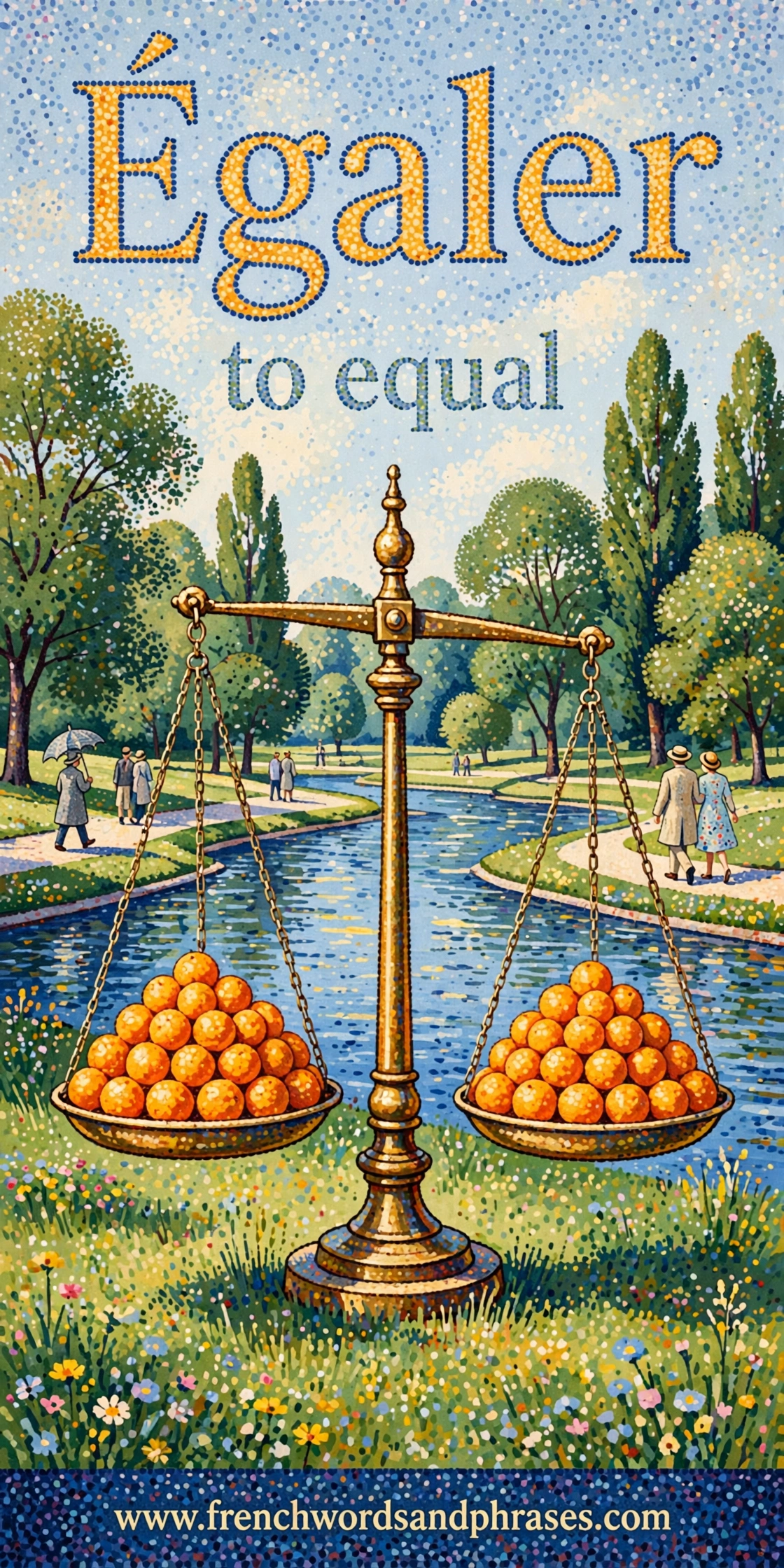
Égaler means to equal — to match someone or something in value, in quality or in achievement, and stand level beside them.
A pupil finally playing the piece as well as her teacher, a village wine standing up to the famous vintages, a daughter matching her mother’s record — égaler is the verb of drawing level: not passing, not beating, just arriving exactly alongside.
In this guide, you’ll learn how to conjugate égaler in all the major French tenses and moods. Explore complete conjugation tables, French examples, English translations, and practice quizzes.
Understanding the French Verb Égaler
Égaler is a regular French verb belonging to the first group of verbs, those ending in-er.
It means to equal. It is commonly used of records and performances in sport, of quality and flavour (rien n’égale ce fromage), and of people drawing level with a master, a parent or a rival — always with the quiet pride of a match achieved, never a defeat inflicted.
Verb classification: First group (-er)
Auxiliary verb: Avoir
Past participle: égalé
Present participle: égalant
English equivalents: To equal, to match, to be as good as; égaler un record — to equal a record; égaler son maître — to equal one’s master; rien n’égale — nothing equals, nothing matches; égaler quelqu’un en courage — to equal someone in courage.
One important detail: égaler is a statement of level, not of victory — elle a égalé le record means she matched the record, no more; to go one better you need battre or dépasser. Its favourite partner is the superlative boast rien n’égale… — nothing equals: rien n’égale un café du matin. The verb itself is a perfectly regular -er with fixed accents: j’égale, nous égalons, ils égalent. Do not confuse it with its cousin égaliser, which levels a surface or a score.
Experience the Word
Égaler is the verb of drawing level — the moment the pupil, the wine or the record-holder is no longer alone at the top.
Imagine a village baker whose grandfather was a legend. For thirty years the young man has risen at four, chasing a loaf he has only ever tasted in memory. This morning the mayor takes one bite, closes his eyes and says it: il égale son grand-père. Not better. Equal — and that is everything.
He has not beaten the old man. He has equalled him — égalé — and in this village there is no higher praise.
How to Conjugate Égaler: Complete French Conjugation Guide
Let’s explore every major conjugation of égaler, beginning with the indicative mood.
How to Conjugate Égaler in the Indicative Mood
The indicative mood is used to express facts, observations, actions, and events.
How to Conjugate Égaler in the Present Tense (Présent)
Used for actions happening now, habitual actions, and general truths.
| Subject | Conjugation |
|---|---|
| je | égale |
| tu | égales |
| il / elle | égale |
| nous | égalons |
| vous | égalez |
| ils / elles | égalent |
Example
Son courage égale sa bonté.
His courage equals his kindness.
Quick Quiz 1
Complete the sentence:
Nous ______ les champions en courage.
Reveal the answer
égalons
Nous égalons les champions en courage.
We equal the champions in courage.
How to Conjugate Égaler in the Passé Composé
Used for completed actions in the past. Égaler takes the auxiliary verb avoir.
| Subject | Conjugation |
|---|---|
| j’ | ai égalé |
| tu | as égalé |
| il / elle | a égalé |
| nous | avons égalé |
| vous | avez égalé |
| ils / elles | ont égalé |
Example
Elle a égalé le record du monde sur cent mètres.
She equalled the world record in the hundred metres.
How to Conjugate Égaler in the Imparfait (Imperfect Tense)
Used for habitual past actions, descriptions, and ongoing situations in the past.
| Subject | Conjugation |
|---|---|
| je | égalais |
| tu | égalais |
| il / elle | égalait |
| nous | égalions |
| vous | égaliez |
| ils / elles | égalaient |
Example
Aucun vin n’égalait celui de son grand-père.
No wine equalled his grandfather’s.
Quick Quiz 2
Choose the correct form:
She equalled the record.
Elle ______ le record. (a égalé / est égalée)
Reveal the answer
a égalé
Elle a égalé le record.
Égaler takes avoir.
How to Conjugate Égaler in the Plus-que-parfait
Used to describe an action that had already been completed before another past event.
| Subject | Conjugation |
|---|---|
| j’ | avais égalé |
| tu | avais égalé |
| il / elle | avait égalé |
| nous | avions égalé |
| vous | aviez égalé |
| ils / elles | avaient égalé |
Example
Il avait égalé son maître avant ses vingt ans.
He had equalled his master before he was twenty.
How to Conjugate Égaler in the Passé Simple
Primarily used in formal writing, literature, and historical narratives. It is rarely used in everyday conversation.
| Subject | Conjugation |
|---|---|
| je | égalai |
| tu | égalas |
| il / elle | égala |
| nous | égalâmes |
| vous | égalâtes |
| ils / elles | égalèrent |
Example
Le jeune violoniste égala bientôt les plus grands.
The young violinist soon equalled the greatest.
How to Conjugate Égaler in the Passé Antérieur
A literary tense used to express an action completed immediately before another past action, generally in the passé simple.
| Subject | Conjugation |
|---|---|
| j’ | eus égalé |
| tu | eus égalé |
| il / elle | eut égalé |
| nous | eûmes égalé |
| vous | eûtes égalé |
| ils / elles | eurent égalé |
Example
Quand elle eut égalé le record, le stade entier se leva.
When she had equalled the record, the whole stadium rose to its feet.
How to Conjugate Égaler in the Future Tense (Futur Simple)
Used to describe actions that will take place in the future.
| Subject | Conjugation |
|---|---|
| je | égalerai |
| tu | égaleras |
| il / elle | égalera |
| nous | égalerons |
| vous | égalerez |
| ils / elles | égaleront |
Example
Un jour, les élèves égaleront leurs professeurs.
One day, the pupils will equal their teachers.
How to Conjugate Égaler in the Futur Antérieur (Future Perfect)
Used for an action that will have been completed before a particular point in the future.
| Subject | Conjugation |
|---|---|
| j’ | aurai égalé |
| tu | auras égalé |
| il / elle | aura égalé |
| nous | aurons égalé |
| vous | aurez égalé |
| ils / elles | auront égalé |
Example
À ce rythme, elle aura égalé les meilleurs avant la fin de la saison.
At this rate, she will have equalled the best before the end of the season.
How to Conjugate Égaler in the Near Future (Futur Proche)
Used to describe something that is going to happen soon. Formed with aller + infinitive.
| Subject | Conjugation |
|---|---|
| je | vais égaler |
| tu | vas égaler |
| il / elle | va égaler |
| nous | allons égaler |
| vous | allez égaler |
| ils / elles | vont égaler |
Example
Ce nouveau modèle va égaler les performances des plus chers.
This new model is going to equal the performance of the most expensive ones.
How to Conjugate Égaler in the Conditional Mood
The conditional mood expresses what would happen under certain circumstances. It is also frequently used to make polite requests or express wishes.
How to Conjugate Égaler in the Present Conditional
| Subject | Conjugation |
|---|---|
| je | égalerais |
| tu | égalerais |
| il / elle | égalerait |
| nous | égalerions |
| vous | égaleriez |
| ils / elles | égaleraient |
Example
Avec plus d’entraînement, tu égalerais les champions.
With more training, you would equal the champions.
How to Conjugate Égaler in the Past Conditional
| Subject | Conjugation |
|---|---|
| j’ | aurais égalé |
| tu | aurais égalé |
| il / elle | aurait égalé |
| nous | aurions égalé |
| vous | auriez égalé |
| ils / elles | auraient égalé |
Example
Il aurait égalé son idole avec un peu plus de chance.
He would have equalled his idol with a little more luck.
Égaler in the Literary Past Conditional Form
This less common literary form uses the imperfect subjunctive of avoir.
| Subject | Conjugation |
|---|---|
| j’ | eusse égalé |
| tu | eusses égalé |
| il / elle | eût égalé |
| nous | eussions égalé |
| vous | eussiez égalé |
| ils / elles | eussent égalé |
Example
Nul n’eût égalé ce peintre dans l’art du portrait.
No one would have equalled this painter in the art of the portrait.
How to Conjugate Égaler in the Subjunctive Mood
The subjunctive is used to express wishes, emotions, doubts, necessity, and uncertainty. It frequently follows expressions such as il faut que (it is necessary that) or bien que (although).
How to Conjugate Égaler in the Present Subjunctive
| Subject | Conjugation |
|---|---|
| que je | égale |
| que tu | égales |
| qu’il / qu’elle | égale |
| que nous | égalions |
| que vous | égaliez |
| qu’ils / qu’elles | égalent |
Example
Je doute qu’un autre restaurant égale celui-ci.
I doubt that any other restaurant equals this one.
Quick Quiz 3
Complete the sentence using the subjunctive:
Je doute que tu ______ les champions un jour.
Reveal the answer
égales
Je doute que tu égales les champions un jour.
I doubt you will equal the champions one day.
How to Conjugate Égaler in the Imperfect Subjunctive
A literary tense, rarely encountered in modern spoken French.
| Subject | Conjugation |
|---|---|
| que je | égalasse |
| que tu | égalasses |
| qu’il / qu’elle | égalât |
| que nous | égalassions |
| que vous | égalassiez |
| qu’ils / qu’elles | égalassent |
Example
On ne pensait pas qu’un si jeune joueur égalât les champions.
No one thought such a young player would equal the champions.
How to Conjugate Égaler in the Pluperfect Subjunctive
A literary construction used to express an action completed before another past action.
| Subject | Conjugation |
|---|---|
| que j’ | eusse égalé |
| que tu | eusses égalé |
| qu’il / qu’elle | eût égalé |
| que nous | eussions égalé |
| que vous | eussiez égalé |
| qu’ils / qu’elles | eussent égalé |
Example
Les critiques affirmaient que ce tableau eût égalé les chefs-d’œuvre du maître.
The critics claimed this painting had equalled the master’s masterpieces.
How to Conjugate Égaler in the Past Subjunctive
| Subject | Conjugation |
|---|---|
| que j’ | aie égalé |
| que tu | aies égalé |
| qu’il / qu’elle | ait égalé |
| que nous | ayons égalé |
| que vous | ayez égalé |
| qu’ils / qu’elles | aient égalé |
Example
Je suis fier qu’elle ait égalé le record national.
I am proud that she equalled the national record.
How to Conjugate Égaler in the Imperative
The imperative is used to give commands, instructions, invitations, or suggestions. Subject pronouns are omitted.
How to Conjugate Égaler in the Present Imperative
| Person | Conjugation |
|---|---|
| (tu) | égale |
| (nous) | égalons |
| (vous) | égalez |
Example
Égalez les anciens dans l’effort, dépassez-les dans l’audace !
Equal your elders in effort, surpass them in daring!
Quick Quiz 4
How would you say Equal your master in patience (tu form)?
Reveal the answer
Égale ton maître en patience !
French Participles of Égaler
Participles are verb forms that can be used in compound tenses and other grammatical constructions.
Present Participle of Égaler
égalant
En égalant le record, elle est entrée dans l’histoire du club.
By equalling the record, she entered the history of the club.
Past Participle of Égaler
égalé
Égalée par sa fille, la championne a souri fièrement.
Equalled by her daughter, the champion smiled proudly.
Égaler in Everyday French: Real-Life Examples
Now that you know the conjugations, let’s see how égaler appears in everyday French.
Example 1 — Present
Son courage égale sa bonté.
His courage equals his kindness.
Example 2 — Passé composé
Elle a égalé le record du monde.
She equalled the world record.
Example 3 — Imparfait
Aucun vin n’égalait celui de son grand-père.
No wine equalled his grandfather’s.
Example 4 — Future
Les élèves égaleront leurs professeurs.
The pupils will equal their teachers.
Example 5 — Conditional
Tu égalerais les champions avec plus d’entraînement.
You would equal the champions with more training.
Example 6 — Imperative
Égale ton maître en patience !
Equal your master in patience!
Beyond Translation: The Meaning of Égaler
English equal and French égaler are the same word twice — both from Latin aequalis, level, even, like a flat field.
To equal is to stand on the same level ground.
That is why French reaches for égaler at its proudest moments: rien n’égale — nothing stands on the same ground as this. Its family is everywhere in French life: égal (equal), l’égalité — the second word of the Republic’s motto.
How to Remember the French Verb Égaler
Remember it this way: Égaler is about the pupil standing at last on the same level as the master.
- Égaler = to match, not to beat: elle a égalé le record — she equalled it; battre would mean she broke it.
- Learn the boast with it: rien n’égale… — nothing equals…
- Regular -er: j’égale, nous égalons, past participle égalé; its noun is l’égalité.
The key idea is the pupil standing at last on the same level as the master.
Test Your Knowledge of Égaler
Let’s see how much you’ve learned. Try answering these questions before revealing the answers.
Question 1
What is the difference between égaler un record and battre un record?
Reveal the answer
Égaler matches it; battre beats it — elle a égalé le record means she equalled it, no more.
Question 2
How do you say She equalled the world record in French?
Reveal the answer
Elle a égalé le record du monde.
Question 3
Translate: No wine equalled his grandfather’s.
Reveal the answer
Aucun vin n’égalait celui de son grand-père.
Question 4
What is the past participle of égaler?
Reveal the answer
Égalé.
Question 5
Complete the sentence:
Je doute qu’un autre restaurant ______ celui-ci.
Reveal the answer
égale
Je doute qu’un autre restaurant égale celui-ci.
I doubt that any other restaurant equals this one.
Your Final Challenge
Can You Use It?
How would you say this in French?
She equalled her mother’s record, and the whole stadium rose for both of them.
Reveal the answer
Elle a égalé le record de sa mère, et le stade entier s’est levé pour elles deux.
She equalled her mother’s record, and the whole stadium rose for both of them.
A little French. A little curiosity. A richer everyday life.
LEARN FRENCH ONE WORD AT A TIME