A French Word to Live By
How to Conjugate Effondrer in French
/e.fɔ̃.dʁe/
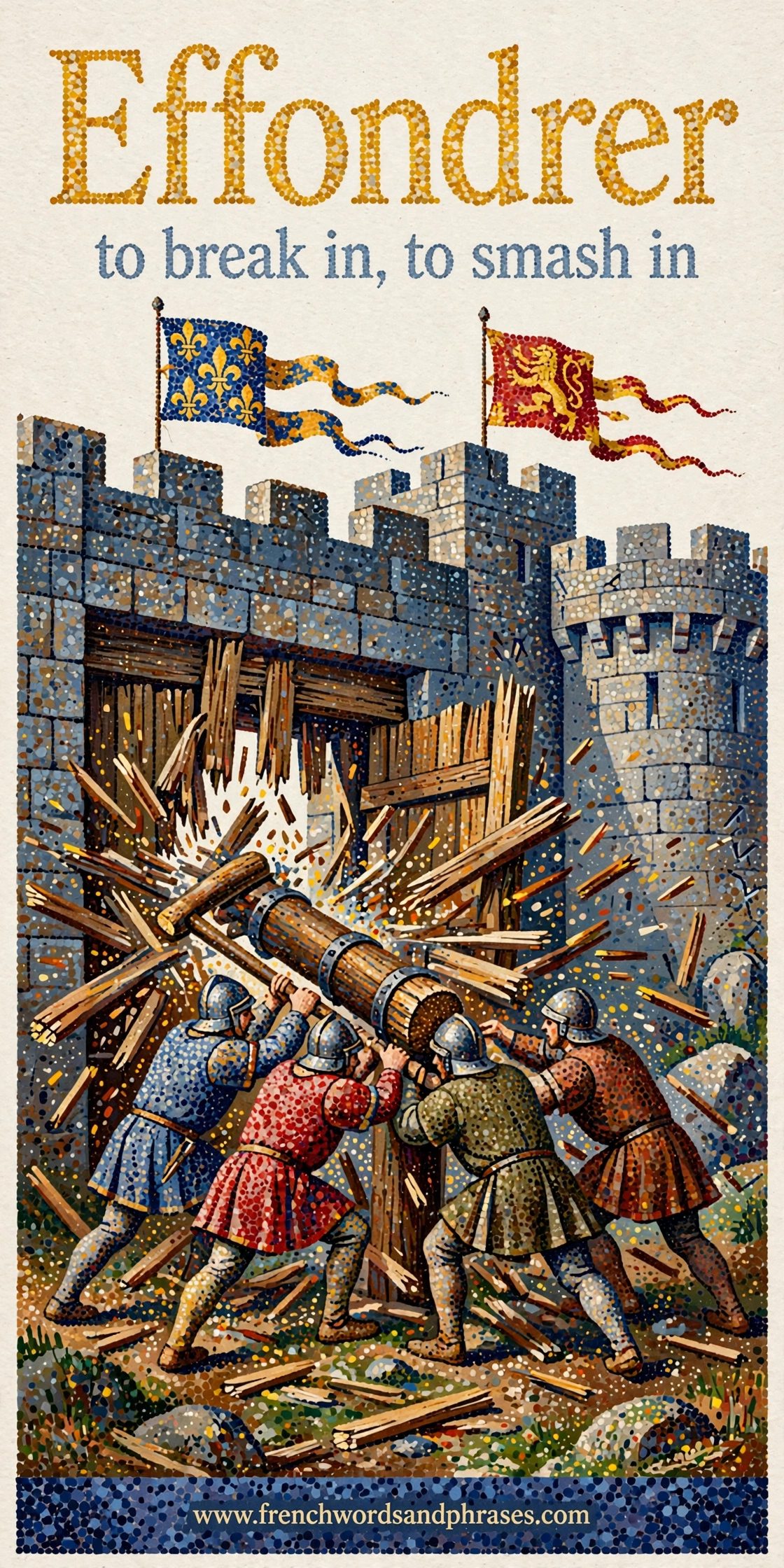
Effondrer means to break in, to smash in — to cave something inwards with force, the way a battering ram breaks in a door.
Firefighters swinging an axe at a locked door, rescuers smashing in the roof of a crushed car, a weight that caves in a fragile floor — effondrer is the verb of breaking something inwards: the surface gives way, and the inside is open.
In this guide, you’ll learn how to conjugate effondrer in all the major French tenses and moods. Explore complete conjugation tables, French examples, English translations, and practice quizzes.
Understanding the French Verb Effondrer
Effondrer is a regular French verb belonging to the first group of verbs, those ending in-er.
It means to break in, to smash in. It is the verb of rescue reports and accident accounts: doors, roofs, chests and skulls are effondrés by blows, weights and impacts — always with an agent doing the breaking, even when the agent is only the snow on the roof.
Verb classification: First group (-er)
Auxiliary verb: Avoir
Past participle: effondré
Present participle: effondrant
English equivalents: To break in, to smash in, to cave in (something); effondrer une porte — to smash in a door; effondrer un toit — to cave in a roof; effondrer le crâne — to smash in the skull; s’effondrer — to collapse (the separate reflexive page).
One important detail: effondrer is transitive — somebody or something breaks something in — and its famous partner is the reflexive s’effondrer, to collapse, which has its own page. Keep them apart: les pompiers ont effondré la porte (the firefighters smashed the door in), but le toit s’est effondré (the roof caved in by itself). The plain verb is a regular -er: je effondre, nous effondrons, past participle effondré, auxiliary avoir. Its heart is the word fond, the bottom: to effondrer is to send something down through its own bottom.
Experience the Word
Effondrer is the verb of the surface that gives way — one blow, and what was closed is broken inwards and open.
Imagine firefighters outside a burning flat at 3 a.m. No answer to their shouts. The captain nods, the axe swings twice, and ils effondrent la porte — the lock tears out of the frame and the door crashes inwards, letting out a breath of smoke and heat.
The door did not open or fall. It was smashed in — effondrée — by the men who needed to get through.
How to Conjugate Effondrer: Complete French Conjugation Guide
Let’s explore every major conjugation of effondrer, beginning with the indicative mood.
How to Conjugate Effondrer in the Indicative Mood
The indicative mood is used to express facts, observations, actions, and events.
How to Conjugate Effondrer in the Present Tense (Présent)
Used for actions happening now, habitual actions, and general truths.
| Subject | Conjugation |
|---|---|
| je | effondre |
| tu | effondres |
| il / elle | effondre |
| nous | effondrons |
| vous | effondrez |
| ils / elles | effondrent |
Example
Le poids de la neige effondre les vieux toits.
The weight of the snow caves in old roofs.
Quick Quiz 1
Complete the sentence:
Nous ______ la cloison pour agrandir la pièce.
Reveal the answer
effondrons
Nous effondrons la cloison pour agrandir la pièce.
We are breaking in the partition wall to enlarge the room.
How to Conjugate Effondrer in the Passé Composé
Used for completed actions in the past. Effondrer takes the auxiliary verb avoir.
| Subject | Conjugation |
|---|---|
| j’ | ai effondré |
| tu | as effondré |
| il / elle | a effondré |
| nous | avons effondré |
| vous | avez effondré |
| ils / elles | ont effondré |
Example
Les pompiers ont effondré la porte de l’appartement.
The firefighters smashed in the door of the flat.
How to Conjugate Effondrer in the Imparfait (Imperfect Tense)
Used for habitual past actions, descriptions, and ongoing situations in the past.
| Subject | Conjugation |
|---|---|
| je | effondrais |
| tu | effondrais |
| il / elle | effondrait |
| nous | effondrions |
| vous | effondriez |
| ils / elles | effondraient |
Example
Chaque hiver, la neige effondrait les granges abandonnées.
Every winter, the snow used to cave in the abandoned barns.
Quick Quiz 2
Choose the correct form:
The firefighters smashed in the door.
Les pompiers ______ la porte. (ont effondré / se sont effondrés)
Reveal the answer
ont effondré
Les pompiers ont effondré la porte.
Someone does the smashing: transitive effondrer takes avoir.
How to Conjugate Effondrer in the Plus-que-parfait
Used to describe an action that had already been completed before another past event.
| Subject | Conjugation |
|---|---|
| j’ | avais effondré |
| tu | avais effondré |
| il / elle | avait effondré |
| nous | avions effondré |
| vous | aviez effondré |
| ils / elles | avaient effondré |
Example
Le camion avait effondré le plancher de la grange.
The lorry had smashed in the floor of the barn.
How to Conjugate Effondrer in the Passé Simple
Primarily used in formal writing, literature, and historical narratives. It is rarely used in everyday conversation.
| Subject | Conjugation |
|---|---|
| je | effondrai |
| tu | effondras |
| il / elle | effondra |
| nous | effondrâmes |
| vous | effondrâtes |
| ils / elles | effondrèrent |
Example
D’un coup d’épaule, il effondra la porte vermoulue.
With one thrust of his shoulder, he smashed in the worm-eaten door.
How to Conjugate Effondrer in the Passé Antérieur
A literary tense used to express an action completed immediately before another past action, generally in the passé simple.
| Subject | Conjugation |
|---|---|
| j’ | eus effondré |
| tu | eus effondré |
| il / elle | eut effondré |
| nous | eûmes effondré |
| vous | eûtes effondré |
| ils / elles | eurent effondré |
Example
Quand ils eurent effondré la porte, la fumée sortit d’un coup.
When they had smashed in the door, the smoke rushed out all at once.
How to Conjugate Effondrer in the Future Tense (Futur Simple)
Used to describe actions that will take place in the future.
| Subject | Conjugation |
|---|---|
| je | effondrerai |
| tu | effondreras |
| il / elle | effondrera |
| nous | effondrerons |
| vous | effondrerez |
| ils / elles | effondreront |
Example
Si la neige continue, elle effondrera le toit de la cabane.
If the snow keeps up, it will cave in the roof of the hut.
How to Conjugate Effondrer in the Futur Antérieur (Future Perfect)
Used for an action that will have been completed before a particular point in the future.
| Subject | Conjugation |
|---|---|
| j’ | aurai effondré |
| tu | auras effondré |
| il / elle | aura effondré |
| nous | aurons effondré |
| vous | aurez effondré |
| ils / elles | auront effondré |
Example
À l’aube, les sauveteurs auront effondré trois cloisons.
By dawn, the rescuers will have broken in three partition walls.
How to Conjugate Effondrer in the Near Future (Futur Proche)
Used to describe something that is going to happen soon. Formed with aller + infinitive.
| Subject | Conjugation |
|---|---|
| je | vais effondrer |
| tu | vas effondrer |
| il / elle | va effondrer |
| nous | allons effondrer |
| vous | allez effondrer |
| ils / elles | vont effondrer |
Example
Attention, ce plancher va effondrer le plafond du dessous !
Careful, that floor is going to smash in the ceiling below!
How to Conjugate Effondrer in the Conditional Mood
The conditional mood expresses what would happen under certain circumstances. It is also frequently used to make polite requests or express wishes.
How to Conjugate Effondrer in the Present Conditional
| Subject | Conjugation |
|---|---|
| je | effondrerais |
| tu | effondrerais |
| il / elle | effondrerait |
| nous | effondrerions |
| vous | effondreriez |
| ils / elles | effondreraient |
Example
Un choc pareil effondrerait la paroi la plus solide.
Such an impact would cave in the strongest wall.
How to Conjugate Effondrer in the Past Conditional
| Subject | Conjugation |
|---|---|
| j’ | aurais effondré |
| tu | aurais effondré |
| il / elle | aurait effondré |
| nous | aurions effondré |
| vous | auriez effondré |
| ils / elles | auraient effondré |
Example
Sans les étais, le plafond aurait effondré la pièce entière.
Without the props, the ceiling would have smashed in the whole room.
Effondrer in the Literary Past Conditional Form
This less common literary form uses the imperfect subjunctive of avoir.
| Subject | Conjugation |
|---|---|
| j’ | eusse effondré |
| tu | eusses effondré |
| il / elle | eût effondré |
| nous | eussions effondré |
| vous | eussiez effondré |
| ils / elles | eussent effondré |
Example
La poutre eût effondré le plancher sans les étais d’acier.
The beam would have smashed in the floor without the steel props.
How to Conjugate Effondrer in the Subjunctive Mood
The subjunctive is used to express wishes, emotions, doubts, necessity, and uncertainty. It frequently follows expressions such as il faut que (it is necessary that) or bien que (although).
How to Conjugate Effondrer in the Present Subjunctive
| Subject | Conjugation |
|---|---|
| que je | effondre |
| que tu | effondres |
| qu’il / qu’elle | effondre |
| que nous | effondrions |
| que vous | effondriez |
| qu’ils / qu’elles | effondrent |
Example
Il faut que les pompiers effondrent cette porte, vite.
The firefighters must smash in this door, quickly.
Quick Quiz 3
Complete the sentence using the subjunctive:
Il faut que vous ______ le toit de la cabane avant l’hiver.
Reveal the answer
effondriez
Il faut que vous effondriez le toit de la cabane avant l’hiver.
You must cave in the roof of the hut before winter.
How to Conjugate Effondrer in the Imperfect Subjunctive
A literary tense, rarely encountered in modern spoken French.
| Subject | Conjugation |
|---|---|
| que je | effondrasse |
| que tu | effondrasses |
| qu’il / qu’elle | effondrât |
| que nous | effondrassions |
| que vous | effondrassiez |
| qu’ils / qu’elles | effondrassent |
Example
Le capitaine ordonna que l’on effondrât la cloison du fond.
The captain ordered the back partition wall to be broken in.
How to Conjugate Effondrer in the Pluperfect Subjunctive
A literary construction used to express an action completed before another past action.
| Subject | Conjugation |
|---|---|
| que j’ | eusse effondré |
| que tu | eusses effondré |
| qu’il / qu’elle | eût effondré |
| que nous | eussions effondré |
| que vous | eussiez effondré |
| qu’ils / qu’elles | eussent effondré |
Example
On raconta que la neige eût effondré le toit avant l’aube.
It was said that the snow had caved in the roof before dawn.
How to Conjugate Effondrer in the Past Subjunctive
| Subject | Conjugation |
|---|---|
| que j’ | aie effondré |
| que tu | aies effondré |
| qu’il / qu’elle | ait effondré |
| que nous | ayons effondré |
| que vous | ayez effondré |
| qu’ils / qu’elles | aient effondré |
Example
Je regrette qu’ils aient effondré cette belle porte ancienne.
I regret that they smashed in that beautiful old door.
How to Conjugate Effondrer in the Imperative
The imperative is used to give commands, instructions, invitations, or suggestions. Subject pronouns are omitted.
How to Conjugate Effondrer in the Present Imperative
| Person | Conjugation |
|---|---|
| (tu) | effondre |
| (nous) | effondrons |
| (vous) | effondrez |
Example
Effondrez la porte, il y a quelqu’un à l’intérieur !
Smash in the door, there is someone inside!
Quick Quiz 4
How would you say Smash in the door (tu form)?
Reveal the answer
Effondre la porte !
French Participles of Effondrer
Participles are verb forms that can be used in compound tenses and other grammatical constructions.
Present Participle of Effondrer
effondrant
En effondrant la cloison, ils ont découvert une pièce cachée.
By breaking in the partition wall, they discovered a hidden room.
Past Participle of Effondrer
effondré
Effondrée par les pompiers, la porte a laissé passer les sauveteurs.
Smashed in by the firefighters, the door let the rescuers through.
Effondrer in Everyday French: Real-Life Examples
Now that you know the conjugations, let’s see how effondrer appears in everyday French.
Example 1 — Present
La neige effondre les vieux toits.
The snow caves in old roofs.
Example 2 — Passé composé
Les pompiers ont effondré la porte.
The firefighters smashed in the door.
Example 3 — Imparfait
La neige effondrait les granges abandonnées.
The snow used to cave in the abandoned barns.
Example 4 — Future
La neige effondrera le toit de la cabane.
The snow will cave in the roof of the hut.
Example 5 — Conditional
Un tel choc effondrerait la paroi.
Such an impact would cave in the wall.
Example 6 — Imperative
Effondrez la porte, vite !
Smash in the door, quickly!
Beyond Translation: The Meaning of Effondrer
At the centre of effondrer sits fond, the bottom — the same word as in au fond, at the bottom, basically.
To effondrer is to send something through its own bottom.
That is why the blow always travels inwards and downwards: doors, roofs and floors are not knocked aside but caved in, bottomed out — and why the reflexive twin, s’effondrer, is French’s great verb of collapse, of buildings and of people.
How to Remember the French Verb Effondrer
Remember it this way: Effondrer is about the firefighters’ axe — the door caved inwards, through its bottom.
- Fond, the bottom, is inside the word: effondrer sends a door or a roof down through its bottom.
- Transitive with avoir: les pompiers ont effondré la porte — someone does the smashing-in.
- Regular -er: je effondre, nous effondrons, past participle effondré.
The key idea is the firefighters’ axe — the door caved inwards, through its bottom.
Test Your Knowledge of Effondrer
Let’s see how much you’ve learned. Try answering these questions before revealing the answers.
Question 1
What is the difference between effondrer and s’effondrer?
Reveal the answer
Effondrer is transitive — someone smashes something in (les pompiers ont effondré la porte); s’effondrer is the collapse itself (le toit s’est effondré).
Question 2
How do you say The firefighters smashed in the door in French?
Reveal the answer
Les pompiers ont effondré la porte.
Question 3
Translate: The weight of the snow caves in old roofs.
Reveal the answer
Le poids de la neige effondre les vieux toits.
Question 4
What is the past participle of effondrer?
Reveal the answer
Effondré.
Question 5
Complete the sentence:
Il faut que les pompiers ______ cette porte, vite.
Reveal the answer
effondrent
Il faut que les pompiers effondrent cette porte, vite.
The firefighters must smash in this door, quickly.
Your Final Challenge
Can You Use It?
How would you say this in French?
The firefighters smash in the door with two blows of the axe, and the smoke bursts out like a held breath.
Reveal the answer
Les pompiers effondrent la porte en deux coups de hache, et la fumée jaillit comme un souffle retenu.
The firefighters smash in the door with two blows of the axe, and the smoke bursts out like a held breath.
A little French. A little curiosity. A richer everyday life.
LEARN FRENCH ONE WORD AT A TIME