
A French Word to Live By
How to Conjugate Effacer in French
/e.fa.se/
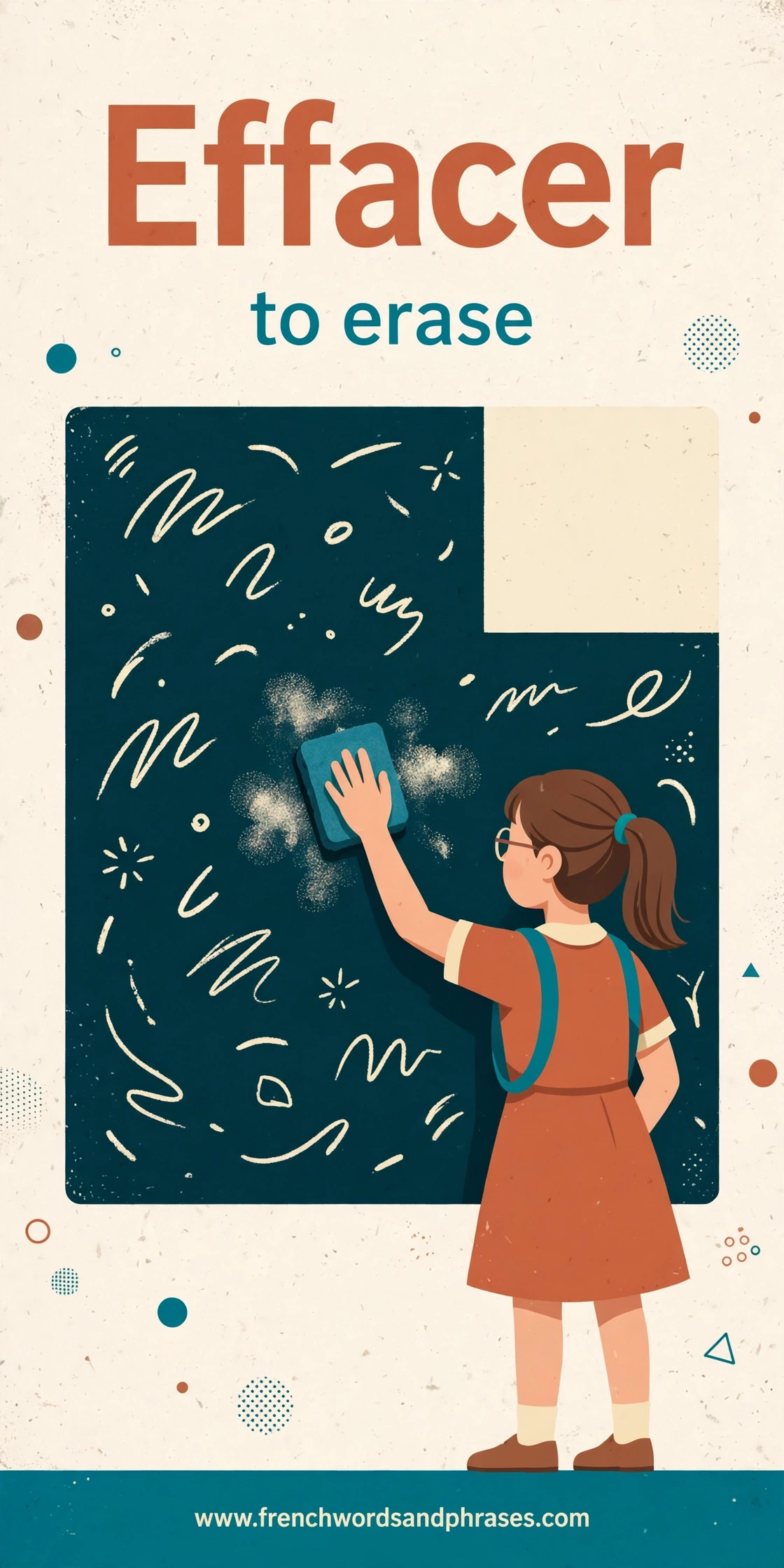
Effacer means to erase, to delete, or to wipe away.
A teacher wipes the blackboard clean, a thumb deletes a message, the sea erases footprints from the sand. Effacer is the verb of making things disappear — gently, completely, and sometimes mercifully.
In this guide, you’ll learn how to conjugate effacer in all the major French tenses and moods. Explore complete conjugation tables, French examples, English translations, and practice quizzes.
Understanding the French Verb Effacer
Effacer is a regular French verb belonging to the first group of verbs, those ending in -er.
It means to erase, to delete, to wipe. It is commonly used for blackboards and pencil marks, for deleting files, messages and photos on a phone (effacer un message), for wiping away tears, and for the memories and traces that time itself efface.
Verb classification: First group (-er)
Auxiliary verb: Avoir
Past participle: effacé
Present participle: effaçant
English equivalents: To erase, to rub out, to delete, to wipe away.
One spelling detail: effacer ends in -cer, so the c becomes ç before an a or an o to keep the soft s sound — nous effaçons, j’effaçais, il effaça. But before i there is no cedilla: nous effacions, vous effaciez, in the imperfect and the subjunctive. The ç appears exactly where the sound needs protecting.
Experience the Word
Effacer is the verb of the clean slate — the rubbed-out mistake, the deleted message, the footprint the tide takes back.
Imagine the end of a school day in a village classroom. The teacher picks up the felt duster, and in four slow strokes the whole day’s French vanishes from the blackboard — ready, tomorrow, to be written again.
Nothing has been destroyed. It has been erased — and the space is free again.
How to Conjugate Effacer: Complete French Conjugation Guide
Let’s explore every major conjugation of effacer, beginning with the indicative mood.
How to Conjugate Effacer in the Indicative Mood
The indicative mood is used to express facts, observations, actions, and events.
How to Conjugate Effacer in the Present Tense (Présent)
Used for actions happening now, habitual actions, and general truths.
| Subject | Conjugation |
|---|---|
| je | efface |
| tu | effaces |
| il / elle | efface |
| nous | effaçons |
| vous | effacez |
| ils / elles | effacent |
Example
Le professeur efface le tableau à la fin du cours.
The teacher wipes the board at the end of the lesson.
Quick Quiz 1
Complete the sentence:
Nous ______ le tableau après le cours.
Reveal the answer
effaçons
Nous effaçons le tableau après le cours.
We wipe the board after the lesson — with a cedilla, to keep the c soft before o.
How to Conjugate Effacer in the Passé Composé
Used for completed actions in the past. Effacer takes the auxiliary verb avoir.
| Subject | Conjugation |
|---|---|
| j’ | ai effacé |
| tu | as effacé |
| il / elle | a effacé |
| nous | avons effacé |
| vous | avez effacé |
| ils / elles | ont effacé |
Example
J’ai effacé le message par erreur.
I deleted the message by mistake.
How to Conjugate Effacer in the Imparfait (Imperfect Tense)
Used for habitual past actions, descriptions, and ongoing situations in the past.
| Subject | Conjugation |
|---|---|
| je | effaçais |
| tu | effaçais |
| il / elle | effaçait |
| nous | effacions |
| vous | effaciez |
| ils / elles | effaçaient |
Example
Elle effaçait chaque mot faux avec soin.
She used to erase every wrong word carefully.
Quick Quiz 2
Choose the correct form:
She erased every word.
Elle ______ chaque mot. (a effacé / est effacée)
Reveal the answer
a effacé
Elle a effacé chaque mot.
Effacer takes avoir.
How to Conjugate Effacer in the Plus-que-parfait
Used to describe an action that had already been completed before another past event.
| Subject | Conjugation |
|---|---|
| j’ | avais effacé |
| tu | avais effacé |
| il / elle | avait effacé |
| nous | avions effacé |
| vous | aviez effacé |
| ils / elles | avaient effacé |
Example
Nous avions effacé toutes les traces avant de partir.
We had wiped away all the traces before leaving.
How to Conjugate Effacer in the Passé Simple
Primarily used in formal writing, literature, and historical narratives. It is rarely used in everyday conversation.
| Subject | Conjugation |
|---|---|
| je | effaçai |
| tu | effaças |
| il / elle | effaça |
| nous | effaçâmes |
| vous | effaçâtes |
| ils / elles | effaçèrent |
Example
Il effaça le tableau d’un seul geste.
He wiped the board with a single gesture.
How to Conjugate Effacer in the Passé Antérieur
A literary tense used to express an action completed immediately before another past action, generally in the passé simple.
| Subject | Conjugation |
|---|---|
| j’ | eus effacé |
| tu | eus effacé |
| il / elle | eut effacé |
| nous | eûmes effacé |
| vous | eûtes effacé |
| ils / elles | eurent effacé |
Example
Quand elle eut effacé le fichier, il était déjà trop tard.
When she had deleted the file, it was already too late.
How to Conjugate Effacer in the Future Tense (Futur Simple)
Used to describe actions that will take place in the future.
| Subject | Conjugation |
|---|---|
| je | effacerai |
| tu | effaceras |
| il / elle | effacera |
| nous | effacerons |
| vous | effacerez |
| ils / elles | effaceront |
Example
Demain, j’effacerai ces vieilles photos.
Tomorrow, I will delete those old photos.
How to Conjugate Effacer in the Futur Antérieur (Future Perfect)
Used for an action that will have been completed before a particular point in the future.
| Subject | Conjugation |
|---|---|
| j’ | aurai effacé |
| tu | auras effacé |
| il / elle | aura effacé |
| nous | aurons effacé |
| vous | aurez effacé |
| ils / elles | auront effacé |
Example
À la fin du cours, il aura effacé le tableau trois fois.
By the end of the lesson, he will have wiped the board three times.
How to Conjugate Effacer in the Near Future (Futur Proche)
Used to describe something that is going to happen soon. Formed with aller + infinitive.
| Subject | Conjugation |
|---|---|
| je | vais effacer |
| tu | vas effacer |
| il / elle | va effacer |
| nous | allons effacer |
| vous | allez effacer |
| ils / elles | vont effacer |
Example
Attention, tu vas effacer la mauvaise ligne !
Careful, you are going to delete the wrong line!
How to Conjugate Effacer in the Conditional Mood
The conditional mood expresses what would happen under certain circumstances. It is also frequently used to make polite requests or express wishes.
How to Conjugate Effacer in the Present Conditional
| Subject | Conjugation |
|---|---|
| je | effacerais |
| tu | effacerais |
| il / elle | effacerait |
| nous | effacerions |
| vous | effaceriez |
| ils / elles | effaceraient |
Example
Sans gomme, je n’effacerais rien du tout.
Without an eraser, I would not rub out anything at all.
How to Conjugate Effacer in the Past Conditional
| Subject | Conjugation |
|---|---|
| j’ | aurais effacé |
| tu | aurais effacé |
| il / elle | aurait effacé |
| nous | aurions effacé |
| vous | auriez effacé |
| ils / elles | auraient effacé |
Example
Elle aurait effacé le message si elle l’avait relu.
She would have deleted the message if she had re-read it.
Effacer in the Literary Past Conditional Form
This less common literary form uses the imperfect subjunctive of avoir.
| Subject | Conjugation |
|---|---|
| j’ | eusse effacé |
| tu | eusses effacé |
| il / elle | eût effacé |
| nous | eussions effacé |
| vous | eussiez effacé |
| ils / elles | eussent effacé |
Example
Il eût effacé toute trace de son passage.
He would have wiped away every trace of his passing.
How to Conjugate Effacer in the Subjunctive Mood
The subjunctive is used to express wishes, emotions, doubts, necessity, and uncertainty. It frequently follows expressions such as il faut que (it is necessary that) or bien que (although).
How to Conjugate Effacer in the Present Subjunctive
| Subject | Conjugation |
|---|---|
| que je | efface |
| que tu | effaces |
| qu’il / qu’elle | efface |
| que nous | effacions |
| que vous | effaciez |
| qu’ils / qu’elles | effacent |
Example
Il faut que nous effacions les erreurs du brouillon.
We must erase the mistakes in the draft.
Quick Quiz 3
Complete the sentence using the subjunctive:
Il faut que nous ______ les erreurs.
Reveal the answer
effacions
Il faut que nous effacions les erreurs.
No cedilla before the i.
How to Conjugate Effacer in the Imperfect Subjunctive
A literary tense, rarely encountered in modern spoken French.
| Subject | Conjugation |
|---|---|
| que je | effacasse |
| que tu | effacasses |
| qu’il / qu’elle | effacât |
| que nous | effacassions |
| que vous | effacassiez |
| qu’ils / qu’elles | effacassent |
Example
Je voulais qu’il effaçât le tableau avant de partir.
I wanted him to wipe the board before leaving.
How to Conjugate Effacer in the Pluperfect Subjunctive
A literary construction used to express an action completed before another past action.
| Subject | Conjugation |
|---|---|
| que j’ | eusse effacé |
| que tu | eusses effacé |
| qu’il / qu’elle | eût effacé |
| que nous | eussions effacé |
| que vous | eussiez effacé |
| qu’ils / qu’elles | eussent effacé |
Example
Il regrettait que nous eussions effacé le premier brouillon.
He regretted that we had deleted the first draft.
How to Conjugate Effacer in the Past Subjunctive
| Subject | Conjugation |
|---|---|
| que j’ | aie effacé |
| que tu | aies effacé |
| qu’il / qu’elle | ait effacé |
| que nous | ayons effacé |
| que vous | ayez effacé |
| qu’ils / qu’elles | aient effacé |
Example
Je suis content que tu aies effacé ce mot.
I am glad you erased that word.
How to Conjugate Effacer in the Imperative
The imperative is used to give commands, instructions, invitations, or suggestions. Subject pronouns are omitted.
How to Conjugate Effacer in the Present Imperative
| Person | Conjugation |
|---|---|
| (tu) | efface |
| (nous) | effaçons |
| (vous) | effacez |
Example
Efface tout et recommence !
Erase everything and start again!
Quick Quiz 4
How would you say Erase everything (tu form)?
Reveal the answer
Efface tout !
French Participles of Effacer
Participles are verb forms that can be used in compound tenses and other grammatical constructions.
Present Participle of Effacer
effaçant
En effaçant le tableau, elle chantait doucement.
While wiping the board, she was singing softly.
Past Participle of Effacer
effacé
Le nom, effacé par le temps, ne se lisait presque plus.
The name, erased by time, could hardly be read any more.
Effacer in Everyday French: Real-Life Examples
Now that you know the conjugations, let’s see how effacer appears in everyday French.
Example 1 — Present
J’efface mes erreurs avec une gomme.
I erase my mistakes with an eraser.
Example 2 — Passé composé
Il a effacé le message sans le lire.
He deleted the message without reading it.
Example 3 — Imparfait
La mer effaçait nos pas sur le sable.
The sea used to wash away our footprints in the sand.
Example 4 — Future
Nous effacerons le tableau après le cours.
We will wipe the board after the lesson.
Example 5 — Conditional
J’effacerais tout et je recommencerais.
I would erase everything and start again.
Example 6 — Imperative
Effacez cette phrase, s’il vous plaît !
Erase that sentence, please!
Beyond Translation: The Meaning of Effacer
English splits the work between erase, rub out, delete and wipe; French lets effacer do all of it, from the blackboard to the smartphone.
And what time effaces, memory keeps.
The French say le temps efface tout — time erases everything — yet they also call some things ineffaçables, impossible to erase. Effacer carries both the comfort and the warning.
How to Remember the French Verb Effacer
Remember it this way: Effacer is about the clean slate — and the ç that guards the sound.
- The ç protects the soft sound before a and o — nous effaçons, j’effaçais.
- No cedilla before i — nous effacions, vous effaciez.
- One verb for the board, the pencil and the phone — effacer un message is to delete a message.
The key idea is the clean slate — and the ç that guards the sound.
Test Your Knowledge of Effacer
Let’s see how much you’ve learned. Try answering these questions before revealing the answers.
Question 1
Why does nous effaçons have a cedilla?
Reveal the answer
To keep the c soft (an s sound) before the o — without it, the c would sound like a k.
Question 2
How do you say I deleted the message by mistake in French?
Reveal the answer
J’ai effacé le message par erreur.
Question 3
Translate: We must erase the mistakes (with il faut que).
Reveal the answer
Il faut que nous effacions les erreurs.
Question 4
What is the past participle of effacer?
Reveal the answer
Effacé.
Question 5
Complete the sentence:
Le professeur ______ le tableau.
Reveal the answer
efface
Le professeur efface le tableau.
The teacher wipes the board.
Your Final Challenge
Can You Use It?
How would you say this in French?
The sea erases our footprints, but not our memories.
Reveal the answer
La mer efface nos pas, mais pas nos souvenirs.
The sea erases our footprints, but not our memories.
A little French. A little curiosity. A richer everyday life.
LEARN FRENCH ONE WORD AT A TIME




