A French Word to Live By
How to Conjugate Écœurer in French
/e.kœ.ʁe/
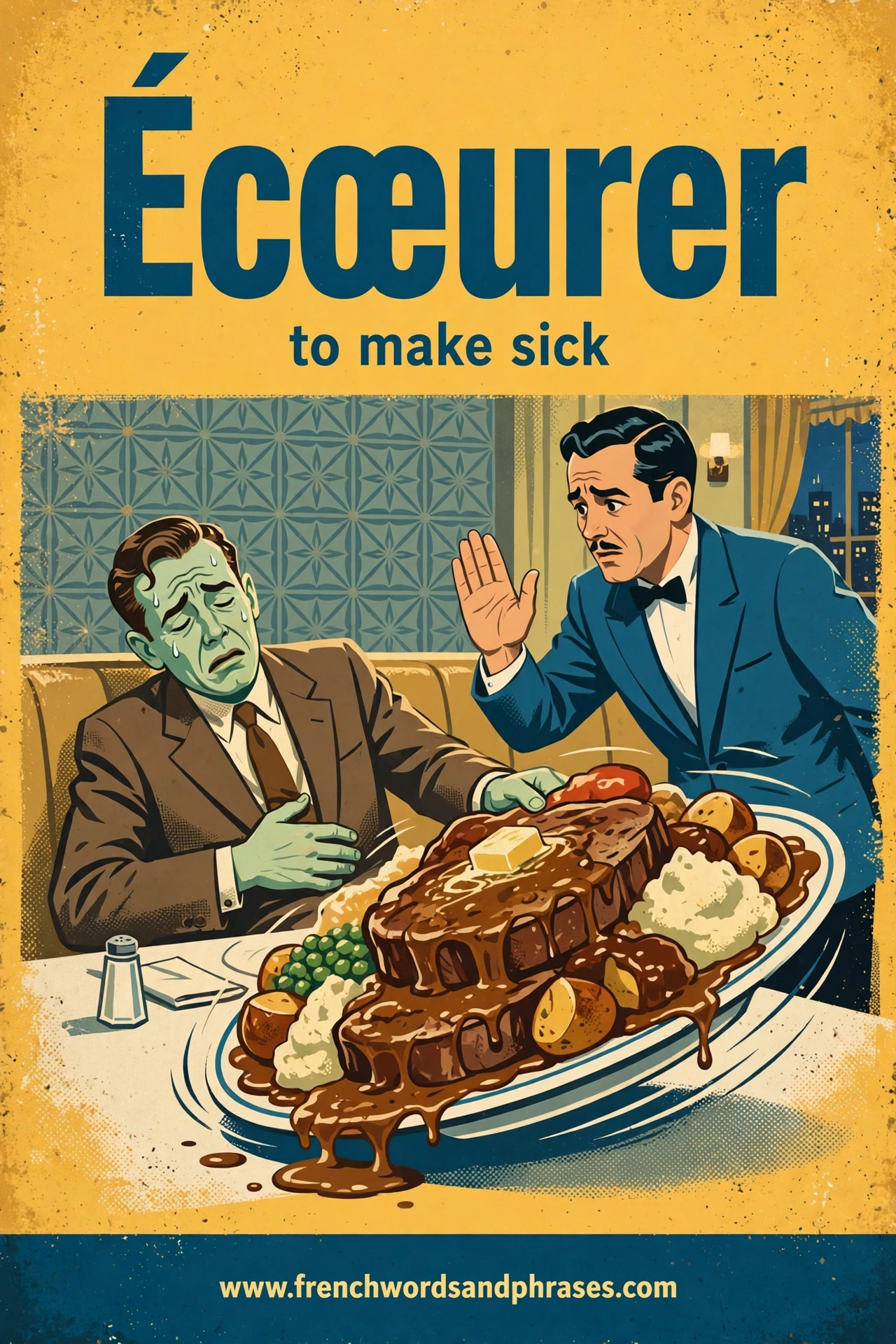
Écœurer means to make sick.
One oyster too many, a smell from the back of the fridge, an injustice you cannot swallow — écœurer is the verb of the stomach and the heart rising together in protest.
In this guide, you’ll learn how to conjugate écœurer in all the major French tenses and moods. Explore complete conjugation tables, French examples, English translations, and practice quizzes.
Understanding the French Verb Écœurer
Écœurer is a regular French verb belonging to the first group of verbs, those ending in -er.
It means to make sick. It is commonly used for food and smells that turn the stomach, for behaviour and injustice that disgust, for being sickened by an excess of anything sweet or rich, and in Quebec in its flipped slang sense for things so good they are almost sickening.
Verb classification: First group (-er)
Auxiliary verb: Avoir
Past participle: écœuré
Present participle: écœurant
English equivalents: To sicken, to disgust, to make sick; écœuré — sickened, disgusted; écœurant — sickening, disgusting (in Quebec slang, fantastic).
One important detail: écœurer keeps its œ — the little heart-ligature — through the whole conjugation: j’écœure, nous écœurons, past participle écœuré. The word is built on cœur, the heart: to be écœuré is to feel your heart rise against something — rich food, a foul smell, a disgusting act. And the famous Quebec twist: in Québec French, c’est écœurant in slang can mean the exact opposite — that something is absolutely fantastic. Context, and a smile, tell you which.
Experience the Word
Écœurer is the verb of too much — one spoonful, one smell, one outrage beyond what the heart can hold.
Imagine a wedding banquet in August: course after course of cream, butter and sugar, until the whole table slows down, forks hesitate, and the richest dessert in the world begins to écœurer the very guests who dreamed of it.
The food was delicious, every bite of it. It sickened them anyway — écœurés by plenty itself.
How to Conjugate Écœurer: Complete French Conjugation Guide
Let’s explore every major conjugation of écœurer, beginning with the indicative mood.
How to Conjugate Écœurer in the Indicative Mood
The indicative mood is used to express facts, observations, actions, and events.
How to Conjugate Écœurer in the Present Tense (Présent)
Used for actions happening now, habitual actions, and general truths.
| Subject | Conjugation |
|---|---|
| je | écœure |
| tu | écœures |
| il / elle | écœure |
| nous | écœurons |
| vous | écœurez |
| ils / elles | écœurent |
Example
Cette odeur écœure tout le monde dans la cuisine.
That smell makes everyone in the kitchen feel sick.
Quick Quiz 1
Complete the sentence:
Nous ______ les enfants avec trop de bonbons.
Reveal the answer
écœurons
Nous écœurons les enfants avec trop de bonbons.
We make the children sick with too many sweets.
How to Conjugate Écœurer in the Passé Composé
Used for completed actions in the past. Écœurer takes the auxiliary verb avoir.
| Subject | Conjugation |
|---|---|
| j’ | ai écœuré |
| tu | as écœuré |
| il / elle | a écœuré |
| nous | avons écœuré |
| vous | avez écœuré |
| ils / elles | ont écœuré |
Example
Le repas trop riche m’a écœuré.
The overly rich meal made me feel sick.
How to Conjugate Écœurer in the Imparfait (Imperfect Tense)
Used for habitual past actions, descriptions, and ongoing situations in the past.
| Subject | Conjugation |
|---|---|
| je | écœurais |
| tu | écœurais |
| il / elle | écœurait |
| nous | écœurions |
| vous | écœuriez |
| ils / elles | écœuraient |
Example
Autrefois, la fumée des usines écœurait le quartier entier.
In the old days, the factory smoke used to sicken the whole neighbourhood.
Quick Quiz 2
Choose the correct form:
The meal made him sick.
Le repas ______. (l’a écœuré / l’est écœuré)
Reveal the answer
l’a écœuré
Le repas l’a écœuré.
Écœurer takes avoir.
How to Conjugate Écœurer in the Plus-que-parfait
Used to describe an action that had already been completed before another past event.
| Subject | Conjugation |
|---|---|
| j’ | avais écœuré |
| tu | avais écœuré |
| il / elle | avait écœuré |
| nous | avions écœuré |
| vous | aviez écœuré |
| ils / elles | avaient écœuré |
Example
Elle avait écœuré ses invités avec un dessert trop sucré.
She had sickened her guests with an overly sweet dessert.
How to Conjugate Écœurer in the Passé Simple
Primarily used in formal writing, literature, and historical narratives. It is rarely used in everyday conversation.
| Subject | Conjugation |
|---|---|
| je | écœurai |
| tu | écœuras |
| il / elle | écœura |
| nous | écœurâmes |
| vous | écœurâtes |
| ils / elles | écœurèrent |
Example
Le spectacle de cette injustice écœura la foule.
The sight of this injustice sickened the crowd.
How to Conjugate Écœurer in the Passé Antérieur
A literary tense used to express an action completed immediately before another past action, generally in the passé simple.
| Subject | Conjugation |
|---|---|
| j’ | eus écœuré |
| tu | eus écœuré |
| il / elle | eut écœuré |
| nous | eûmes écœuré |
| vous | eûtes écœuré |
| ils / elles | eurent écœuré |
Example
Quand l’odeur eut écœuré les passants, on ferma la boutique.
When the smell had sickened the passers-by, they closed the shop.
How to Conjugate Écœurer in the Future Tense (Futur Simple)
Used to describe actions that will take place in the future.
| Subject | Conjugation |
|---|---|
| je | écœurerai |
| tu | écœureras |
| il / elle | écœurera |
| nous | écœurerons |
| vous | écœurerez |
| ils / elles | écœureront |
Example
Trop de chocolat écœurera les enfants avant le soir.
Too much chocolate will make the children sick before evening.
How to Conjugate Écœurer in the Futur Antérieur (Future Perfect)
Used for an action that will have been completed before a particular point in the future.
| Subject | Conjugation |
|---|---|
| j’ | aurai écœuré |
| tu | auras écœuré |
| il / elle | aura écœuré |
| nous | aurons écœuré |
| vous | aurez écœuré |
| ils / elles | auront écœuré |
Example
À la fin du banquet, la crème aura écœuré plus d’un invité.
By the end of the banquet, the cream will have sickened more than one guest.
How to Conjugate Écœurer in the Near Future (Futur Proche)
Used to describe something that is going to happen soon. Formed with aller + infinitive.
| Subject | Conjugation |
|---|---|
| je | vais écœurer |
| tu | vas écœurer |
| il / elle | va écœurer |
| nous | allons écœurer |
| vous | allez écœurer |
| ils / elles | vont écœurer |
Example
Ne mange pas ça, ça va t’écœurer.
Do not eat that, it is going to make you sick.
How to Conjugate Écœurer in the Conditional Mood
The conditional mood expresses what would happen under certain circumstances. It is also frequently used to make polite requests or express wishes.
How to Conjugate Écœurer in the Present Conditional
| Subject | Conjugation |
|---|---|
| je | écœurerais |
| tu | écœurerais |
| il / elle | écœurerait |
| nous | écœurerions |
| vous | écœureriez |
| ils / elles | écœureraient |
Example
Un tel gaspillage écœurerait n’importe qui.
Such waste would disgust anyone.
How to Conjugate Écœurer in the Past Conditional
| Subject | Conjugation |
|---|---|
| j’ | aurais écœuré |
| tu | aurais écœuré |
| il / elle | aurait écœuré |
| nous | aurions écœuré |
| vous | auriez écœuré |
| ils / elles | auraient écœuré |
Example
Ce plat m’aurait écœuré rien qu’à le regarder.
That dish would have made me sick just to look at it.
Écœurer in the Literary Past Conditional Form
This less common literary form uses the imperfect subjunctive of avoir.
| Subject | Conjugation |
|---|---|
| j’ | eusse écœuré |
| tu | eusses écœuré |
| il / elle | eût écœuré |
| nous | eussions écœuré |
| vous | eussiez écœuré |
| ils / elles | eussent écœuré |
Example
La richesse du festin eût écœuré les plus gourmands.
The richness of the feast would have sickened the greediest.
How to Conjugate Écœurer in the Subjunctive Mood
The subjunctive is used to express wishes, emotions, doubts, necessity, and uncertainty. It frequently follows expressions such as il faut que (it is necessary that) or bien que (although).
How to Conjugate Écœurer in the Present Subjunctive
| Subject | Conjugation |
|---|---|
| que je | écœure |
| que tu | écœures |
| qu’il / qu’elle | écœure |
| que nous | écœurions |
| que vous | écœuriez |
| qu’ils / qu’elles | écœurent |
Example
Je ne veux pas que ce fromage écœure les invités.
I do not want this cheese to make the guests sick.
Quick Quiz 3
Complete the sentence using the subjunctive:
Il ne faut pas que tu ______ tes frères avec tes histoires.
Reveal the answer
écœures
Il ne faut pas que tu écœures tes frères avec tes histoires.
You must not make your brothers sick with your stories.
How to Conjugate Écœurer in the Imperfect Subjunctive
A literary tense, rarely encountered in modern spoken French.
| Subject | Conjugation |
|---|---|
| que je | écœurasse |
| que tu | écœurasses |
| qu’il / qu’elle | écœurât |
| que nous | écœurassions |
| que vous | écœurassiez |
| qu’ils / qu’elles | écœurassent |
Example
On craignait que l’eau écœurât les enfants.
People feared the water might make the children sick.
How to Conjugate Écœurer in the Pluperfect Subjunctive
A literary construction used to express an action completed before another past action.
| Subject | Conjugation |
|---|---|
| que j’ | eusse écœuré |
| que tu | eusses écœuré |
| qu’il / qu’elle | eût écœuré |
| que nous | eussions écœuré |
| que vous | eussiez écœuré |
| qu’ils / qu’elles | eussent écœuré |
Example
Elle raconta que le voyage en mer l’eût écœurée toute la journée.
She said the sea journey had made her sick all day.
How to Conjugate Écœurer in the Past Subjunctive
| Subject | Conjugation |
|---|---|
| que j’ | aie écœuré |
| que tu | aies écœuré |
| qu’il / qu’elle | ait écœuré |
| que nous | ayons écœuré |
| que vous | ayez écœuré |
| qu’ils / qu’elles | aient écœuré |
Example
Je suis désolé que ce plat t’ait écœuré.
I am sorry that dish made you feel sick.
How to Conjugate Écœurer in the Imperative
The imperative is used to give commands, instructions, invitations, or suggestions. Subject pronouns are omitted.
How to Conjugate Écœurer in the Present Imperative
| Person | Conjugation |
|---|---|
| (tu) | écœure |
| (nous) | écœurons |
| (vous) | écœurez |
Example
N’écœure pas tes petits frères avec tes histoires !
Do not make your little brothers sick with your stories!
Quick Quiz 4
How would you say Do not make me sick (tu form)?
Reveal the answer
Ne m’écœure pas !
French Participles of Écœurer
Participles are verb forms that can be used in compound tenses and other grammatical constructions.
Present Participle of Écœurer
écœurant
En écœurant les lecteurs, ce roman dénonce la misère.
By sickening its readers, this novel denounces poverty.
Past Participle of Écœurer
écœuré
Écœuré par tant d’injustice, il a quitté la salle.
Sickened by so much injustice, he left the room.
Écœurer in Everyday French: Real-Life Examples
Now that you know the conjugations, let’s see how écœurer appears in everyday French.
Example 1 — Present
Le fromage fort écœure mon frère.
Strong cheese makes my brother feel sick.
Example 2 — Passé composé
Ce gâteau m’a écœuré, trop de crème.
That cake made me feel sick, too much cream.
Example 3 — Imparfait
L’odeur du port écœurait les touristes.
The smell of the harbour used to make tourists feel sick.
Example 4 — Future
Trop de bonbons écœurera les enfants.
Too many sweets will make the children sick.
Example 5 — Conditional
Cette injustice écœurerait tout le monde.
This injustice would disgust everyone.
Example 6 — Imperative
N’écœurez pas les invités avant le plat principal !
Do not make the guests sick before the main course!
Beyond Translation: The Meaning of Écœurer
English sicken and disgust live at two different addresses — stomach and morals; French écœurer lives in both houses at once, because its root is the heart.
And then Quebec flips the word.
In Québec slang, c’est écœurant can be the highest praise — so good it is sickening. Few verbs carry their own country, and a second country, in the same suitcase.
How to Remember the French Verb Écœurer
Remember it this way: Écœurer is about the heart rising — stomach and conscience together.
- Built on cœur, the heart: j’écœure, nous écœurons — the œ never leaves.
- Écœuré — sickened or disgusted; écœurant — sickening, but fantastic in Quebec slang.
- Regular -er: j’écœure, nous écœurons, past participle écœuré.
The key idea is the heart rising — stomach and conscience together.
Test Your Knowledge of Écœurer
Let’s see how much you’ve learned. Try answering these questions before revealing the answers.
Question 1
What word hides inside écœurer?
Reveal the answer
Cœur — the heart: to be écœuré is to feel your heart rise against something.
Question 2
How do you say That cake made me feel sick in French?
Reveal the answer
Ce gâteau m’a écœuré.
Question 3
Translate: This injustice would disgust everyone.
Reveal the answer
Cette injustice écœurerait tout le monde.
Question 4
What is the past participle of écœurer?
Reveal the answer
Écœuré.
Question 5
Complete the sentence:
Je ne veux pas que ce fromage ______ les invités.
Reveal the answer
écœure
Je ne veux pas que ce fromage écœure les invités.
I do not want this cheese to make the guests sick.
Your Final Challenge
Can You Use It?
How would you say this in French?
Too much cream makes the guests feel sick, but coffee sets them right again.
Reveal the answer
Trop de crème écœure les invités, mais le café les remet d’aplomb.
Too much cream makes the guests feel sick, but coffee sets them right again.
A little French. A little curiosity. A richer everyday life.
LEARN FRENCH ONE WORD AT A TIME