A French Word to Live By
How to Conjugate Détresser in French
/de.tʁe.se/
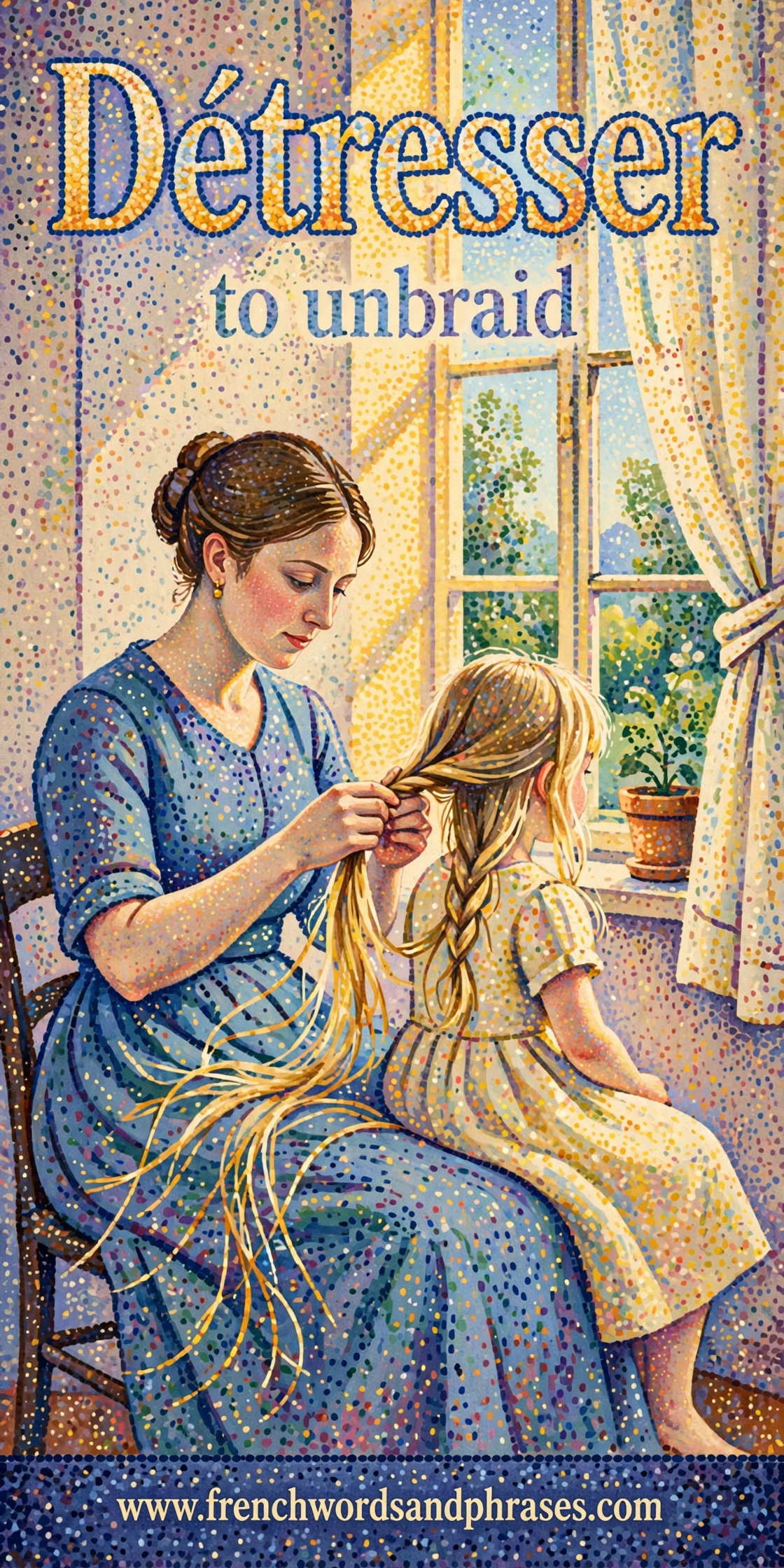
Détresser means to unbraid — to undo a braid or plait, in hair, in rope, in straw, and let the strands fall free.
A girl at bedtime undoing the day’s braid over her shoulders, a sailor unlaying a rope to splice it, a farmer taking apart a plait of garlic — détresser is the verb of the braid undone: three strands that were one thing becoming three again.
In this guide, you’ll learn how to conjugate détresser in all the major French tenses and moods. Explore complete conjugation tables, French examples, English translations, and practice quizzes.
Understanding the French Verb Détresser
Détresser is a regular French verb belonging to the first group of verbs, those ending in-er.
It means to unbraid. It is used at the dressing table for hair let down at night, in ropework for unlaying a line, and in the kitchen and market garden for plaits of garlic, onions and straw being taken apart strand by strand. Everywhere the gesture is the same: patience, and the braid’s brief unity politely dissolved.
Verb classification: First group (-er)
Auxiliary verb: Avoir
Past participle: détressé
Present participle: détressant
English equivalents: To unbraid, to unplait, to unlay; détresser les cheveux — to unbraid one’s hair; détresser une corde — to unlay a rope; détresser une natte — to undo a plait; tresser / détresser — to braid / to unbraid.
One important detail: détresser is tresser reversed — a tresse is a braid of three strands, in hair, rope, straw or dough, and dé- takes the plait apart. It is a regular -er verb: je détresse, nous détressons, with the double s of tresse kept in every form. Said of rope, it is the sailor’s and rigger’s word for unlaying the strands before a splice.
Experience the Word
Détresser is the verb of the evening undoing — what the morning braided tight, the night lets fall free.
Imagine a farmhouse bedroom a century ago, one candle lit. The eldest daughter sits at the edge of the bed and slowly détresse la longue natte that has held all day: over, under, over, under, in reverse, until her hair falls in waves to her waist and the day is officially over. Her little sister watches the way other children watch magic.
The hair has not been cut or washed. It has been unbraided — détressé, set free strand by strand.
How to Conjugate Détresser: Complete French Conjugation Guide
Let’s explore every major conjugation of détresser, beginning with the indicative mood.
How to Conjugate Détresser in the Indicative Mood
The indicative mood is used to express facts, observations, actions, and events.
How to Conjugate Détresser in the Present Tense (Présent)
Used for actions happening now, habitual actions, and general truths.
| Subject | Conjugation |
|---|---|
| je | détresse |
| tu | détresses |
| il / elle | détresse |
| nous | détressons |
| vous | détressez |
| ils / elles | détressent |
Example
Elle détresse ses cheveux avant de se coucher.
She unbraids her hair before going to bed.
Quick Quiz 1
Complete the sentence:
Nous ______ les cordages abîmés du bateau.
Reveal the answer
détressons
Nous détressons les cordages abîmés du bateau.
We are unlaying the boat’s damaged ropes.
How to Conjugate Détresser in the Passé Composé
Used for completed actions in the past. Détresser takes the auxiliary verb avoir.
| Subject | Conjugation |
|---|---|
| j’ | ai détressé |
| tu | as détressé |
| il / elle | a détressé |
| nous | avons détressé |
| vous | avez détressé |
| ils / elles | ont détressé |
Example
Le marin a détressé le cordage pour le réparer.
The sailor unlaid the rope to repair it.
How to Conjugate Détresser in the Imparfait (Imperfect Tense)
Used for habitual past actions, descriptions, and ongoing situations in the past.
| Subject | Conjugation |
|---|---|
| je | détressais |
| tu | détressais |
| il / elle | détressait |
| nous | détressions |
| vous | détressiez |
| ils / elles | détressaient |
Example
Chaque soir, elle détressait sa natte devant la glace.
Every evening, she used to unbraid her plait in front of the mirror.
Quick Quiz 2
Choose the correct form:
The sailor unlaid the rope.
Le marin ______ le cordage. (a détressé / est détressé)
Reveal the answer
a détressé
Le marin a détressé le cordage.
Détresser takes avoir.
How to Conjugate Détresser in the Plus-que-parfait
Used to describe an action that had already been completed before another past event.
| Subject | Conjugation |
|---|---|
| j’ | avais détressé |
| tu | avais détressé |
| il / elle | avait détressé |
| nous | avions détressé |
| vous | aviez détressé |
| ils / elles | avaient détressé |
Example
Nous avions détressé les cordes avant de les refaire.
We had unlaid the ropes before remaking them.
How to Conjugate Détresser in the Passé Simple
Primarily used in formal writing, literature, and historical narratives. It is rarely used in everyday conversation.
| Subject | Conjugation |
|---|---|
| je | détressai |
| tu | détressas |
| il / elle | détressa |
| nous | détressâmes |
| vous | détressâtes |
| ils / elles | détressèrent |
Example
Elle détressa sa longue natte et secoua la tête.
She unbraided her long plait and shook her head.
How to Conjugate Détresser in the Passé Antérieur
A literary tense used to express an action completed immediately before another past action, generally in the passé simple.
| Subject | Conjugation |
|---|---|
| j’ | eus détressé |
| tu | eus détressé |
| il / elle | eut détressé |
| nous | eûmes détressé |
| vous | eûtes détressé |
| ils / elles | eurent détressé |
Example
Quand il eut détressé le câble, il commença l’épissure.
When he had unlaid the cable, he began the splice.
How to Conjugate Détresser in the Future Tense (Futur Simple)
Used to describe actions that will take place in the future.
| Subject | Conjugation |
|---|---|
| je | détresserai |
| tu | détresseras |
| il / elle | détressera |
| nous | détresserons |
| vous | détresserez |
| ils / elles | détresseront |
Example
Ce soir, tu détresseras tes cheveux avant le bain.
This evening, you will unbraid your hair before your bath.
How to Conjugate Détresser in the Futur Antérieur (Future Perfect)
Used for an action that will have been completed before a particular point in the future.
| Subject | Conjugation |
|---|---|
| j’ | aurai détressé |
| tu | auras détressé |
| il / elle | aura détressé |
| nous | aurons détressé |
| vous | aurez détressé |
| ils / elles | auront détressé |
Example
À la fin de la journée, les marins auront détressé tous les cordages abîmés.
By the end of the day, the sailors will have unlaid all the damaged ropes.
How to Conjugate Détresser in the Near Future (Futur Proche)
Used to describe something that is going to happen soon. Formed with aller + infinitive.
| Subject | Conjugation |
|---|---|
| je | vais détresser |
| tu | vas détresser |
| il / elle | va détresser |
| nous | allons détresser |
| vous | allez détresser |
| ils / elles | vont détresser |
Example
Je vais détresser cette tresse d’ail pour la cuisine.
I am going to take apart this plait of garlic for the kitchen.
How to Conjugate Détresser in the Conditional Mood
The conditional mood expresses what would happen under certain circumstances. It is also frequently used to make polite requests or express wishes.
How to Conjugate Détresser in the Present Conditional
| Subject | Conjugation |
|---|---|
| je | détresserais |
| tu | détresserais |
| il / elle | détresserait |
| nous | détresserions |
| vous | détresseriez |
| ils / elles | détresseraient |
Example
Avec plus de temps, on détresserait la corde entière.
With more time, we would unlay the whole rope.
How to Conjugate Détresser in the Past Conditional
| Subject | Conjugation |
|---|---|
| j’ | aurais détressé |
| tu | aurais détressé |
| il / elle | aurait détressé |
| nous | aurions détressé |
| vous | auriez détressé |
| ils / elles | auraient détressé |
Example
Tu aurais détressé ta natte plus tôt si tu avais eu un miroir.
You would have unbraided your plait sooner if you had had a mirror.
Détresser in the Literary Past Conditional Form
This less common literary form uses the imperfect subjunctive of avoir.
| Subject | Conjugation |
|---|---|
| j’ | eusse détressé |
| tu | eusses détressé |
| il / elle | eût détressé |
| nous | eussions détressé |
| vous | eussiez détressé |
| ils / elles | eussent détressé |
Example
La jeune fille eût détressé ses cheveux sans la visite qui survint.
The girl would have unbraided her hair, if not for the visitor who arrived.
How to Conjugate Détresser in the Subjunctive Mood
The subjunctive is used to express wishes, emotions, doubts, necessity, and uncertainty. It frequently follows expressions such as il faut que (it is necessary that) or bien que (although).
How to Conjugate Détresser in the Present Subjunctive
| Subject | Conjugation |
|---|---|
| que je | détresse |
| que tu | détresses |
| qu’il / qu’elle | détresse |
| que nous | détressions |
| que vous | détressiez |
| qu’ils / qu’elles | détressent |
Example
Il faut que tu détresses tes cheveux avant de les laver.
You must unbraid your hair before washing it.
Quick Quiz 3
Complete the sentence using the subjunctive:
Il faut que vous ______ vos cheveux avant de les laver.
Reveal the answer
détressiez
Il faut que vous détressiez vos cheveux avant de les laver.
You must unbraid your hair before washing it.
How to Conjugate Détresser in the Imperfect Subjunctive
A literary tense, rarely encountered in modern spoken French.
| Subject | Conjugation |
|---|---|
| que je | détressasse |
| que tu | détressasses |
| qu’il / qu’elle | détressât |
| que nous | détressassions |
| que vous | détressassiez |
| qu’ils / qu’elles | détressassent |
Example
Sa mère voulait qu’elle détressât sa natte avant le dîner.
Her mother wanted her to unbraid her plait before dinner.
How to Conjugate Détresser in the Pluperfect Subjunctive
A literary construction used to express an action completed before another past action.
| Subject | Conjugation |
|---|---|
| que j’ | eusse détressé |
| que tu | eusses détressé |
| qu’il / qu’elle | eût détressé |
| que nous | eussions détressé |
| que vous | eussiez détressé |
| qu’ils / qu’elles | eussent détressé |
Example
On racontait que les sœurs eussent détressé des mètres de corde.
People said the sisters had unlaid metres of rope.
How to Conjugate Détresser in the Past Subjunctive
| Subject | Conjugation |
|---|---|
| que j’ | aie détressé |
| que tu | aies détressé |
| qu’il / qu’elle | ait détressé |
| que nous | ayons détressé |
| que vous | ayez détressé |
| qu’ils / qu’elles | aient détressé |
Example
Je suis content que vous ayez détressé le cordage à temps.
I am glad you unlaid the rope in time.
How to Conjugate Détresser in the Imperative
The imperative is used to give commands, instructions, invitations, or suggestions. Subject pronouns are omitted.
How to Conjugate Détresser in the Present Imperative
| Person | Conjugation |
|---|---|
| (tu) | détresse |
| (nous) | détressons |
| (vous) | détressez |
Example
Détresse tes cheveux, il est l’heure de dormir !
Unbraid your hair, it is time to sleep!
Quick Quiz 4
How would you say Unbraid your hair (tu form)?
Reveal the answer
Détresse tes cheveux !
French Participles of Détresser
Participles are verb forms that can be used in compound tenses and other grammatical constructions.
Present Participle of Détresser
détressant
En détressant la corde, il a trouvé le brin cassé.
By unlaying the rope, he found the broken strand.
Past Participle of Détresser
détressé
Détressée pour la nuit, sa chevelure tombe en vagues sur ses épaules.
Unbraided for the night, her hair falls in waves over her shoulders.
Détresser in Everyday French: Real-Life Examples
Now that you know the conjugations, let’s see how détresser appears in everyday French.
Example 1 — Present
Elle détresse ses cheveux avant de se coucher.
She unbraids her hair before going to bed.
Example 2 — Passé composé
Le marin a détressé le cordage pour le réparer.
The sailor unlaid the rope to repair it.
Example 3 — Imparfait
Elle détressait sa natte chaque soir devant la glace.
She used to unbraid her plait every evening in front of the mirror.
Example 4 — Future
Tu détresseras tes cheveux avant le bain.
You will unbraid your hair before your bath.
Example 5 — Conditional
On détresserait la corde entière avec plus de temps.
We would unlay the whole rope with more time.
Example 6 — Imperative
Détresse tes cheveux, il est l’heure de dormir !
Unbraid your hair, it is time to sleep!
Beyond Translation: The Meaning of Détresser
English unbraid is the plain twin; French détresser carries la tresse inside it — one of the oldest human gestures, three strands taught to behave as one.
Every braid is a promise to be undone.
Hair is braided for the day and détressée for the night; rope is laid for strength and détressée for repair. The verb marks the quiet moment when unity hands its strands back, each one remembering its own direction.
How to Remember the French Verb Détresser
Remember it this way: Détresser is about the eldest daughter at the candlelit bedside, undoing the day strand by strand.
- Dé- plus tresse: the braid comes apart — hair, rope, garlic, straw.
- The double s of tresse never leaves: je détresse, nous détressons, détressé.
- Regular -er: je détresse, nous détressons, past participle détressé.
The key idea is the eldest daughter at the candlelit bedside, undoing the day strand by strand.
Test Your Knowledge of Détresser
Let’s see how much you’ve learned. Try answering these questions before revealing the answers.
Question 1
What three things does détresser undo, besides hair?
Reveal the answer
Rope, and plaits of garlic, onions or straw — anything braided in three strands.
Question 2
How do you say She unbraids her hair before going to bed in French?
Reveal the answer
Elle détresse ses cheveux avant de se coucher.
Question 3
Translate: You must unbraid your hair before washing it.
Reveal the answer
Il faut que tu détresses tes cheveux avant de les laver.
Question 4
What is the past participle of détresser?
Reveal the answer
Détressé.
Question 5
Complete the sentence:
Ce soir, tu ______ tes cheveux avant le bain.
Reveal the answer
détresseras
Ce soir, tu détresseras tes cheveux avant le bain.
This evening, you will unbraid your hair before your bath.
Your Final Challenge
Can You Use It?
How would you say this in French?
She unbraids her plait by the lamplight, and the day gently comes undone.
Reveal the answer
Elle détresse sa natte à la lueur de la lampe, et la journée, doucement, se défait.
She unbraids her plait by the lamplight, and the day gently comes undone.
A little French. A little curiosity. A richer everyday life.
LEARN FRENCH ONE WORD AT A TIME