A French Word to Live By
How to Conjugate Détraquer in French
/de.tʁa.ke/
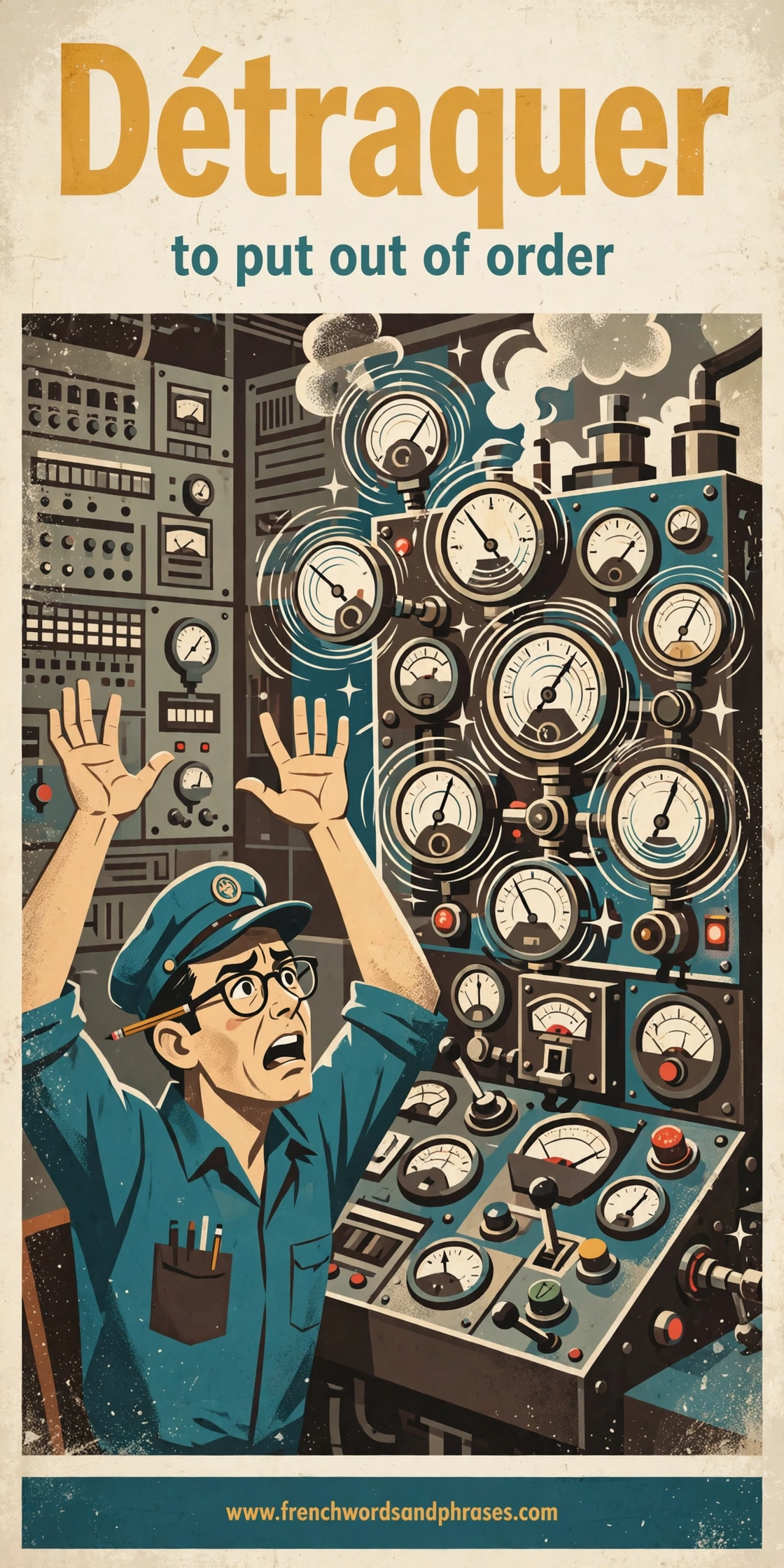
Détraquer means to put out of order — to upset a machine, a stomach, a mind or a schedule until nothing works as it should.
A clock whose hands have gone mad after a fall, a stomach ruined by one oyster too many, a whole week’s plans scattered by a single phone call — détraquer is the familiar verb of things knocked out of order: working yesterday, deranged today.
In this guide, you’ll learn how to conjugate détraquer in all the major French tenses and moods. Explore complete conjugation tables, French examples, English translations, and practice quizzes.
Understanding the French Verb Détraquer
Détraquer is a regular French verb belonging to the first group of verbs, those ending in-er.
It means to put out of order. It is used of anything thrown out of its proper working: watches and engines, digestion and sleep, weather and tempers. The adjective détraqué has wandered furthest — un détraqué is an unbalanced, unhinged person, and le temps est détraqué is the nation’s complaint every strange season.
Verb classification: First group (-er)
Auxiliary verb: Avoir
Past participle: détraqué
Present participle: détraquant
English equivalents: To put out of order, to upset, to derange; détraquer une machine — to put a machine out of order; détraquer l’estomac — to upset the stomach; détraquer la santé — to ruin someone’s health; un esprit détraqué — an unbalanced mind.
One important detail: détraquer is a lively, familiar-register verb — the word of kitchens and workshops rather than reports. Its favourite victims are mechanisms, stomachs and nerves: détraquer une horloge, se détraquer l’estomac, avoir les nerfs détraqués. The spelling holds one trap: the qu never simplifies — je détraque, nous détraquons, détraqué. And when the thing breaks down by itself, French turns reflexive: la machine se détraque.
Experience the Word
Détraquer is the verb of the derangement — the small internal disorder that turns a working thing into a puzzle.
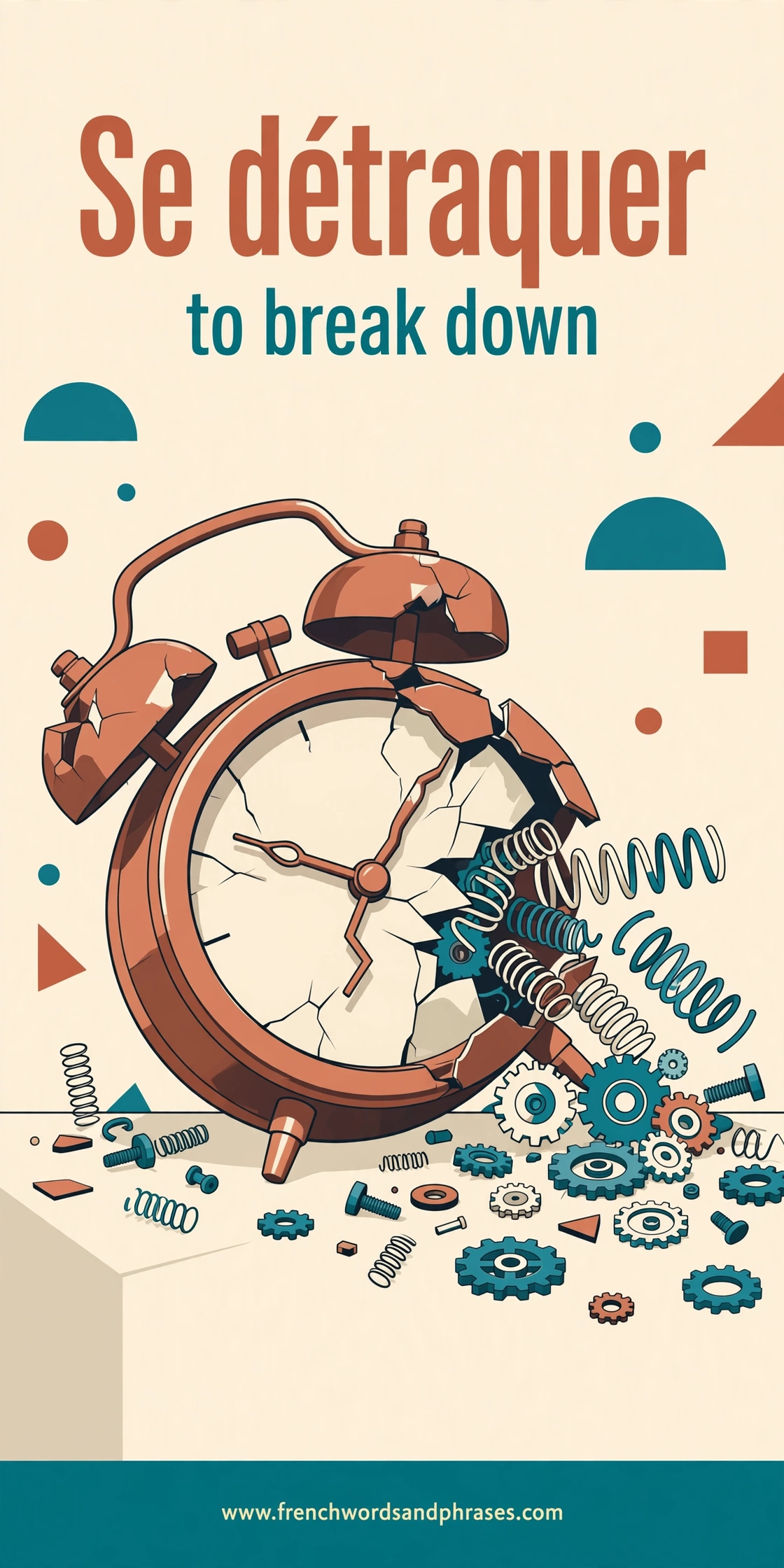
Imagine a great station clock that has kept the valley’s time for sixty years. One night of storm, one fallen wire, and by morning it détraque an entire railway: it strikes thirteen at dawn, runs backwards at noon, and sends every train in the province politely into chaos. Nothing is broken, exactly — everything is simply, thoroughly out of order.
The clock has not stopped or smashed. It has been put out of order — détraqué, and the whole valley’s day with it.
How to Conjugate Détraquer: Complete French Conjugation Guide
Let’s explore every major conjugation of détraquer, beginning with the indicative mood.
How to Conjugate Détraquer in the Indicative Mood
The indicative mood is used to express facts, observations, actions, and events.
How to Conjugate Détraquer in the Present Tense (Présent)
Used for actions happening now, habitual actions, and general truths.
| Subject | Conjugation |
|---|---|
| je | détraque |
| tu | détraques |
| il / elle | détraque |
| nous | détraquons |
| vous | détraquez |
| ils / elles | détraquent |
Example
Ce bruit constant détraque les nerfs de tout l’atelier.
This constant noise is upsetting everyone’s nerves in the workshop.
Quick Quiz 1
Complete the sentence:
Nous ______ les nerfs des voisins avec ce bruit.
Reveal the answer
détraquons
Nous détraquons les nerfs des voisins avec ce bruit.
We are upsetting the neighbours’ nerves with this noise.
How to Conjugate Détraquer in the Passé Composé
Used for completed actions in the past. Détraquer takes the auxiliary verb avoir.
| Subject | Conjugation |
|---|---|
| j’ | ai détraqué |
| tu | as détraqué |
| il / elle | a détraqué |
| nous | avons détraqué |
| vous | avez détraqué |
| ils / elles | ont détraqué |
Example
Le choc a détraqué la vieille horloge.
The shock put the old clock out of order.
How to Conjugate Détraquer in the Imparfait (Imperfect Tense)
Used for habitual past actions, descriptions, and ongoing situations in the past.
| Subject | Conjugation |
|---|---|
| je | détraquais |
| tu | détraquais |
| il / elle | détraquait |
| nous | détraquions |
| vous | détraquiez |
| ils / elles | détraquaient |
Example
L’humidité détraquait les montres des marins.
The damp used to put the sailors’ watches out of order.
Quick Quiz 2
Choose the correct form:
The shock put the clock out of order.
Le choc ______ l’horloge. (a détraqué / est détraqué)
Reveal the answer
a détraqué
Le choc a détraqué l’horloge.
Détraquer takes avoir.
How to Conjugate Détraquer in the Plus-que-parfait
Used to describe an action that had already been completed before another past event.
| Subject | Conjugation |
|---|---|
| j’ | avais détraqué |
| tu | avais détraqué |
| il / elle | avait détraqué |
| nous | avions détraqué |
| vous | aviez détraqué |
| ils / elles | avaient détraqué |
Example
Elle avait détraqué sa santé à force de travailler la nuit.
She had ruined her health by working nights for so long.
How to Conjugate Détraquer in the Passé Simple
Primarily used in formal writing, literature, and historical narratives. It is rarely used in everyday conversation.
| Subject | Conjugation |
|---|---|
| je | détraquai |
| tu | détraquas |
| il / elle | détraqua |
| nous | détraquâmes |
| vous | détraquâtes |
| ils / elles | détraquèrent |
Example
Un seul verre d’eau glacée lui détraqua l’estomac.
A single glass of iced water upset his stomach.
How to Conjugate Détraquer in the Passé Antérieur
A literary tense used to express an action completed immediately before another past action, generally in the passé simple.
| Subject | Conjugation |
|---|---|
| j’ | eus détraqué |
| tu | eus détraqué |
| il / elle | eut détraqué |
| nous | eûmes détraqué |
| vous | eûtes détraqué |
| ils / elles | eurent détraqué |
Example
Quand la machine eut détraqué tout l’atelier, on appela le réparateur.
When the machine had thrown the whole workshop into disorder, they called the repairman.
How to Conjugate Détraquer in the Future Tense (Futur Simple)
Used to describe actions that will take place in the future.
| Subject | Conjugation |
|---|---|
| je | détraquerai |
| tu | détraqueras |
| il / elle | détraquera |
| nous | détraquerons |
| vous | détraquerez |
| ils / elles | détraqueront |
Example
Ce voyage détraquera ton sommeil pour une semaine.
This trip will upset your sleep for a week.
How to Conjugate Détraquer in the Futur Antérieur (Future Perfect)
Used for an action that will have been completed before a particular point in the future.
| Subject | Conjugation |
|---|---|
| j’ | aurai détraqué |
| tu | auras détraqué |
| il / elle | aura détraqué |
| nous | aurons détraqué |
| vous | aurez détraqué |
| ils / elles | auront détraqué |
Example
À force de nuits blanches, il aura détraqué son horloge intérieure.
With all these sleepless nights, he will have put his body clock out of order.
How to Conjugate Détraquer in the Near Future (Futur Proche)
Used to describe something that is going to happen soon. Formed with aller + infinitive.
| Subject | Conjugation |
|---|---|
| je | vais détraquer |
| tu | vas détraquer |
| il / elle | va détraquer |
| nous | allons détraquer |
| vous | allez détraquer |
| ils / elles | vont détraquer |
Example
Attention, ce piment va te détraquer l’estomac !
Careful, that chilli is going to upset your stomach!
How to Conjugate Détraquer in the Conditional Mood
The conditional mood expresses what would happen under certain circumstances. It is also frequently used to make polite requests or express wishes.
How to Conjugate Détraquer in the Present Conditional
| Subject | Conjugation |
|---|---|
| je | détraquerais |
| tu | détraquerais |
| il / elle | détraquerait |
| nous | détraquerions |
| vous | détraqueriez |
| ils / elles | détraqueraient |
Example
Un peu de repos détraquerait moins ta santé que ce rythme.
A little rest would upset your health less than this pace.
How to Conjugate Détraquer in the Past Conditional
| Subject | Conjugation |
|---|---|
| j’ | aurais détraqué |
| tu | aurais détraqué |
| il / elle | aurait détraqué |
| nous | aurions détraqué |
| vous | auriez détraqué |
| ils / elles | auraient détraqué |
Example
Le froid aurait détraqué le mécanisme sans la housse.
The cold would have put the mechanism out of order without the cover.
Détraquer in the Literary Past Conditional Form
This less common literary form uses the imperfect subjunctive of avoir.
| Subject | Conjugation |
|---|---|
| j’ | eusse détraqué |
| tu | eusses détraqué |
| il / elle | eût détraqué |
| nous | eussions détraqué |
| vous | eussiez détraqué |
| ils / elles | eussent détraqué |
Example
La guerre eût détraqué les nerfs de la ville entière.
The war would have shattered the nerves of the whole town.
How to Conjugate Détraquer in the Subjunctive Mood
The subjunctive is used to express wishes, emotions, doubts, necessity, and uncertainty. It frequently follows expressions such as il faut que (it is necessary that) or bien que (although).
How to Conjugate Détraquer in the Present Subjunctive
| Subject | Conjugation |
|---|---|
| que je | détraque |
| que tu | détraques |
| qu’il / qu’elle | détraque |
| que nous | détraquions |
| que vous | détraquiez |
| qu’ils / qu’elles | détraquent |
Example
Je ne veux pas que ce bruit détraque les enfants.
I do not want this noise to upset the children.
Quick Quiz 3
Complete the sentence using the subjunctive:
Je ne veux pas que ce bruit ______ les enfants.
Reveal the answer
détraque
Je ne veux pas que ce bruit détraque les enfants.
I do not want this noise to upset the children.
How to Conjugate Détraquer in the Imperfect Subjunctive
A literary tense, rarely encountered in modern spoken French.
| Subject | Conjugation |
|---|---|
| que je | détraquasse |
| que tu | détraquasses |
| qu’il / qu’elle | détraquât |
| que nous | détraquassions |
| que vous | détraquassiez |
| qu’ils / qu’elles | détraquassent |
Example
On craignait que le voyage détraquât son sommeil fragile.
People feared the journey might upset his fragile sleep.
How to Conjugate Détraquer in the Pluperfect Subjunctive
A literary construction used to express an action completed before another past action.
| Subject | Conjugation |
|---|---|
| que j’ | eusse détraqué |
| que tu | eusses détraqué |
| qu’il / qu’elle | eût détraqué |
| que nous | eussions détraqué |
| que vous | eussiez détraqué |
| qu’ils / qu’elles | eussent détraqué |
Example
On disait que la fièvre eût détraqué le vieil homme.
People said the fever had unhinged the old man.
How to Conjugate Détraquer in the Past Subjunctive
| Subject | Conjugation |
|---|---|
| que j’ | aie détraqué |
| que tu | aies détraqué |
| qu’il / qu’elle | ait détraqué |
| que nous | ayons détraqué |
| que vous | ayez détraqué |
| qu’ils / qu’elles | aient détraqué |
Example
Je regrette que ce travail ait détraqué ta santé.
I regret that this work has ruined your health.
How to Conjugate Détraquer in the Imperative
The imperative is used to give commands, instructions, invitations, or suggestions. Subject pronouns are omitted.
How to Conjugate Détraquer in the Present Imperative
| Person | Conjugation |
|---|---|
| (tu) | détraque |
| (nous) | détraquons |
| (vous) | détraquez |
Example
Ne détraque pas cette horloge, elle marche encore très bien !
Do not put this clock out of order, it still works very well!
Quick Quiz 4
How would you say Do not put this clock out of order (tu form)?
Reveal the answer
Ne détraque pas cette horloge !
French Participles of Détraquer
Participles are verb forms that can be used in compound tenses and other grammatical constructions.
Present Participle of Détraquer
détraquant
En détraquant le mécanisme, il a perdu un ressort minuscule.
By putting the mechanism out of order, he lost a tiny spring.
Past Participle of Détraquer
détraqué
Détraquée par le choc, l’horloge sonne treize coups à minuit.
Put out of order by the shock, the clock strikes thirteen at midnight.
Détraquer in Everyday French: Real-Life Examples
Now that you know the conjugations, let’s see how détraquer appears in everyday French.
Example 1 — Present
Ce bruit détraque les nerfs de tout l’atelier.
This noise is upsetting everyone’s nerves in the workshop.
Example 2 — Passé composé
Le choc a détraqué la vieille horloge.
The shock put the old clock out of order.
Example 3 — Imparfait
L’humidité détraquait les montres des marins.
The damp used to put the sailors’ watches out of order.
Example 4 — Future
Ce voyage détraquera ton sommeil pour une semaine.
This trip will upset your sleep for a week.
Example 5 — Conditional
Le froid détraquerait le mécanisme sans la housse.
The cold would put the mechanism out of order without the cover.
Example 6 — Imperative
Ne détraque pas cette horloge !
Do not put this clock out of order!
Beyond Translation: The Meaning of Détraquer
English put out of order is the flat translation; French détraquer has grease on its hands — it comes from the world of tracks and mechanisms, of things knocked off their rails.
Its family runs from clocks to madmen.
Un esprit détraqué is an unbalanced mind, le temps se détraque is the weather gone wrong, and un détraqué, in crime pages, is a dangerous lunatic — one verb for every kind of derailment, mechanical or human.
How to Remember the French Verb Détraquer
Remember it this way: Détraquer is about the station clock striking thirteen at dawn — nothing broken, everything deranged.
- Familiar and vivid: clocks, stomachs, nerves and weather are its favourite victims.
- The qu never simplifies: je détraque, nous détraquons, détraqué.
- Regular -er: je détraque, nous détraquons, past participle détraqué.
The key idea is the station clock striking thirteen at dawn — nothing broken, everything deranged.
Test Your Knowledge of Détraquer
Let’s see how much you’ve learned. Try answering these questions before revealing the answers.
Question 1
Name three things détraquer loves to put out of order.
Reveal the answer
Machines, stomachs and nerves — détraquer une horloge, l’estomac, les nerfs.
Question 2
How do you say The shock put the old clock out of order in French?
Reveal the answer
Le choc a détraqué la vieille horloge.
Question 3
Translate: Careful, that chilli is going to upset your stomach!
Reveal the answer
Attention, ce piment va te détraquer l’estomac !
Question 4
What is the past participle of détraquer?
Reveal the answer
Détraqué.
Question 5
Complete the sentence:
Ce voyage ______ ton sommeil pour une semaine.
Reveal the answer
détraquera
Ce voyage détraquera ton sommeil pour une semaine.
This trip will upset your sleep for a week.
Your Final Challenge
Can You Use It?
How would you say this in French?
A single shock put the great clock out of order, and the whole village now lunches at fanciful hours.
Reveal the answer
Un seul choc a détraqué la grande horloge, et tout le village déjeune désormais à des heures de fantaisie.
A single shock put the great clock out of order, and the whole village now lunches at fanciful hours.
A little French. A little curiosity. A richer everyday life.
LEARN FRENCH ONE WORD AT A TIME