A French Word to Live By
How to Conjugate Détisser in French
/de.ti.se/
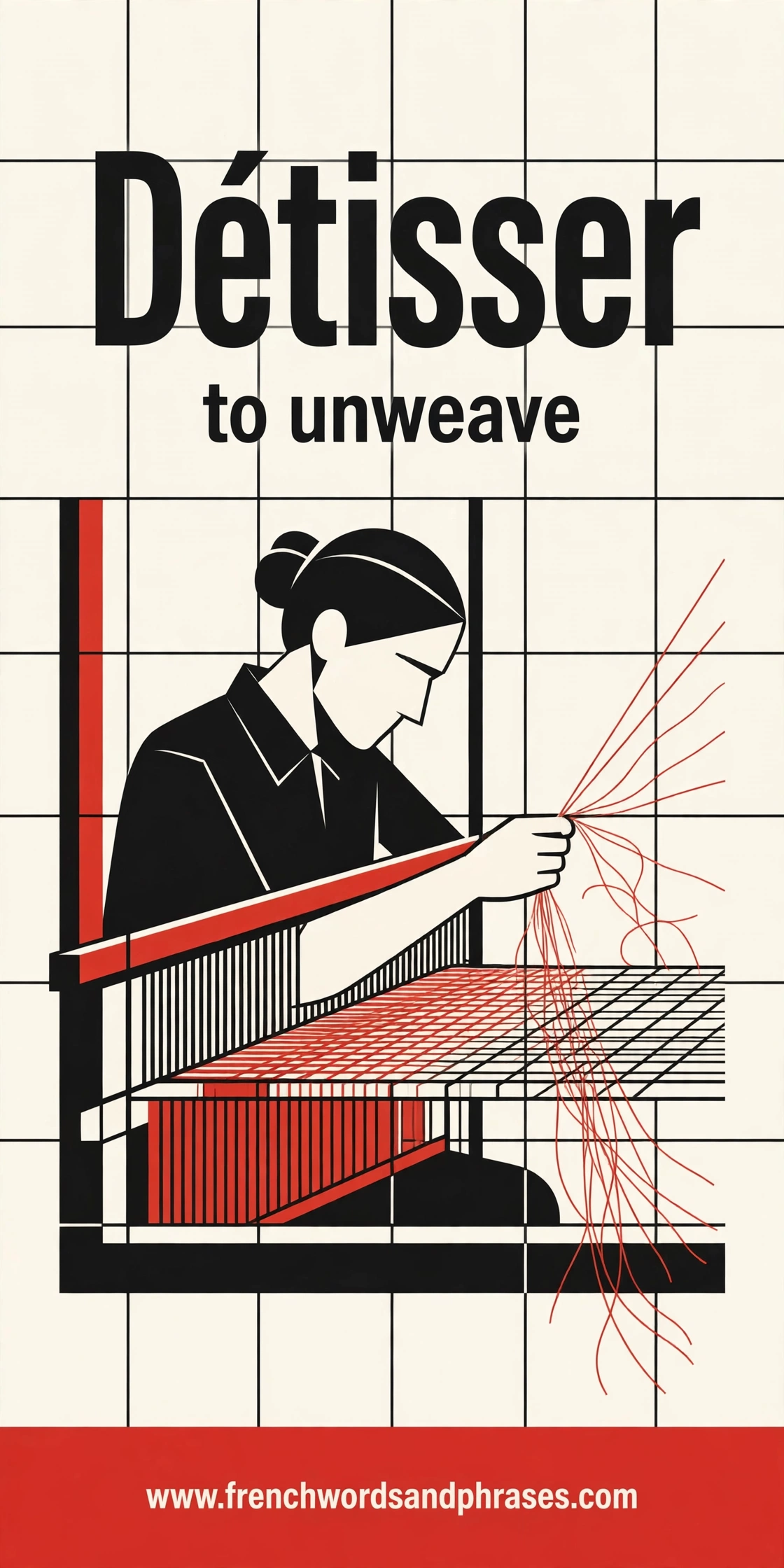
Détisser means to unweave — to take woven cloth back apart, thread by thread, undoing the loom’s work.
A weaver finding a flaw in the pattern and patiently drawing the threads back out, a wife in an old Greek story undoing by night what she wove by day — détisser is the verb of weaving in reverse: cloth returning to thread, work returning to nothing.
In this guide, you’ll learn how to conjugate détisser in all the major French tenses and moods. Explore complete conjugation tables, French examples, English translations, and practice quizzes.
Understanding the French Verb Détisser
Détisser is a regular French verb belonging to the first group of verbs, those ending in-er.
It means to unweave. It belongs to the workshop and the tapestry studio, where a mistake in the pattern means hours of careful unweaving, and it carries one of literature’s great images: Penelope, in the Odyssey, détissant by night the shroud she wove by day, to keep her suitors waiting for twenty years.
Verb classification: First group (-er)
Auxiliary verb: Avoir
Past participle: détissé
Present participle: détissant
English equivalents: To unweave, to unravel (woven work); détisser une tapisserie — to unweave a tapestry; détisser fil à fil — to unweave thread by thread; détisser un ouvrage — to undo a piece of weaving; tisser / détisser — to weave / to unweave.
One important detail: détisser is the exact reverse of tisser, to weave — the préfixe dé- undoes the loom. It is a regular -er verb: je détisse, nous détissons, with the double s of tisser kept everywhere. Do not confuse it with détricoter, which unpicks knitting, or défaire, which undoes anything at all: détisser is for woven work, thread crossing thread.
Experience the Word
Détisser is the verb of patience running backwards — every thread removed is an hour of work politely returned.
Imagine a tapestry workshop in Aubusson. The master weaver leans over a half-finished hunting scene and finds it: one stag’s leg, woven a shade too dark, three days ago. There is no eraser for cloth. All afternoon, with tweezers and sighs, the apprentice détisse — thread by thread, the leg, the shadow, the mistake — until the loom is innocent again.
Nothing has been destroyed in anger. It has been unwoven — détissé, taken back to the moment before the error.
How to Conjugate Détisser: Complete French Conjugation Guide
Let’s explore every major conjugation of détisser, beginning with the indicative mood.
How to Conjugate Détisser in the Indicative Mood
The indicative mood is used to express facts, observations, actions, and events.
How to Conjugate Détisser in the Present Tense (Présent)
Used for actions happening now, habitual actions, and general truths.
| Subject | Conjugation |
|---|---|
| je | détisse |
| tu | détisses |
| il / elle | détisse |
| nous | détissons |
| vous | détissez |
| ils / elles | détissent |
Example
L’apprentie détisse la partie ratée de la tapisserie.
The apprentice is unweaving the spoiled part of the tapestry.
Quick Quiz 1
Complete the sentence:
Nous ______ la partie abîmée de la toile.
Reveal the answer
détissons
Nous détissons la partie abîmée de la toile.
We are unweaving the damaged part of the cloth.
How to Conjugate Détisser in the Passé Composé
Used for completed actions in the past. Détisser takes the auxiliary verb avoir.
| Subject | Conjugation |
|---|---|
| j’ | ai détissé |
| tu | as détissé |
| il / elle | a détissé |
| nous | avons détissé |
| vous | avez détissé |
| ils / elles | ont détissé |
Example
Elle a détissé trois rangs pour corriger le motif.
She unwove three rows to correct the pattern.
How to Conjugate Détisser in the Imparfait (Imperfect Tense)
Used for habitual past actions, descriptions, and ongoing situations in the past.
| Subject | Conjugation |
|---|---|
| je | détissais |
| tu | détissais |
| il / elle | détissait |
| nous | détissions |
| vous | détissiez |
| ils / elles | détissaient |
Example
Chaque nuit, Pénélope détissait son ouvrage du jour.
Every night, Penelope used to unweave her day’s work.
Quick Quiz 2
Choose the correct form:
Penelope unwove her work every night.
Pénélope ______ son ouvrage chaque nuit. (a détissé / détissait)
Reveal the answer
détissait
Pénélope détissait son ouvrage chaque nuit.
A repeated habit in the past takes the imperfect.
How to Conjugate Détisser in the Plus-que-parfait
Used to describe an action that had already been completed before another past event.
| Subject | Conjugation |
|---|---|
| j’ | avais détissé |
| tu | avais détissé |
| il / elle | avait détissé |
| nous | avions détissé |
| vous | aviez détissé |
| ils / elles | avaient détissé |
Example
Le tisserand avait détissé la moitié de la pièce avant de voir l’erreur.
The weaver had unwoven half the piece before seeing the mistake.
How to Conjugate Détisser in the Passé Simple
Primarily used in formal writing, literature, and historical narratives. It is rarely used in everyday conversation.
| Subject | Conjugation |
|---|---|
| je | détissai |
| tu | détissas |
| il / elle | détissa |
| nous | détissâmes |
| vous | détissâtes |
| ils / elles | détissèrent |
Example
Elle détissa patiemment la tapisserie jusqu’au fil fautif.
She patiently unwove the tapestry back to the faulty thread.
How to Conjugate Détisser in the Passé Antérieur
A literary tense used to express an action completed immediately before another past action, generally in the passé simple.
| Subject | Conjugation |
|---|---|
| j’ | eus détissé |
| tu | eus détissé |
| il / elle | eut détissé |
| nous | eûmes détissé |
| vous | eûtes détissé |
| ils / elles | eurent détissé |
Example
Quand il eut détissé le rang entier, il recommença le motif.
When he had unwoven the whole row, he began the pattern again.
How to Conjugate Détisser in the Future Tense (Futur Simple)
Used to describe actions that will take place in the future.
| Subject | Conjugation |
|---|---|
| je | détisserai |
| tu | détisseras |
| il / elle | détissera |
| nous | détisserons |
| vous | détisserez |
| ils / elles | détisseront |
Example
Demain, nous détisserons cette bordure trop sombre.
Tomorrow, we will unweave this border that is too dark.
How to Conjugate Détisser in the Futur Antérieur (Future Perfect)
Used for an action that will have been completed before a particular point in the future.
| Subject | Conjugation |
|---|---|
| j’ | aurai détissé |
| tu | auras détissé |
| il / elle | aura détissé |
| nous | aurons détissé |
| vous | aurez détissé |
| ils / elles | auront détissé |
Example
À la fin de la semaine, elle aura détissé toute la partie abîmée.
By the end of the week, she will have unwoven the whole damaged part.
How to Conjugate Détisser in the Near Future (Futur Proche)
Used to describe something that is going to happen soon. Formed with aller + infinitive.
| Subject | Conjugation |
|---|---|
| je | vais détisser |
| tu | vas détisser |
| il / elle | va détisser |
| nous | allons détisser |
| vous | allez détisser |
| ils / elles | vont détisser |
Example
Je vais détisser ce coin, le fil est du mauvais bleu.
I am going to unweave this corner, the thread is the wrong blue.
How to Conjugate Détisser in the Conditional Mood
The conditional mood expresses what would happen under certain circumstances. It is also frequently used to make polite requests or express wishes.
How to Conjugate Détisser in the Present Conditional
| Subject | Conjugation |
|---|---|
| je | détisserais |
| tu | détisserais |
| il / elle | détisserait |
| nous | détisserions |
| vous | détisseriez |
| ils / elles | détisseraient |
Example
Avec plus de temps, on détisserait la pièce entière.
With more time, we would unweave the whole piece.
How to Conjugate Détisser in the Past Conditional
| Subject | Conjugation |
|---|---|
| j’ | aurais détissé |
| tu | aurais détissé |
| il / elle | aurait détissé |
| nous | aurions détissé |
| vous | auriez détissé |
| ils / elles | auraient détissé |
Example
Tu aurais détissé le motif si tu avais vu l’erreur plus tôt.
You would have unwoven the pattern if you had seen the mistake earlier.
Détisser in the Literary Past Conditional Form
This less common literary form uses the imperfect subjunctive of avoir.
| Subject | Conjugation |
|---|---|
| j’ | eusse détissé |
| tu | eusses détissé |
| il / elle | eût détissé |
| nous | eussions détissé |
| vous | eussiez détissé |
| ils / elles | eussent détissé |
Example
Pénélope eût détissé sa toile vingt ans sans le retour d’Ulysse.
Penelope would have unwoven her cloth for twenty years, had Ulysses not returned.
How to Conjugate Détisser in the Subjunctive Mood
The subjunctive is used to express wishes, emotions, doubts, necessity, and uncertainty. It frequently follows expressions such as il faut que (it is necessary that) or bien que (although).
How to Conjugate Détisser in the Present Subjunctive
| Subject | Conjugation |
|---|---|
| que je | détisse |
| que tu | détisses |
| qu’il / qu’elle | détisse |
| que nous | détissions |
| que vous | détissiez |
| qu’ils / qu’elles | détissent |
Example
Il faut que tu détisses ce rang avant de continuer.
You must unweave this row before continuing.
Quick Quiz 3
Complete the sentence using the subjunctive:
Il faut que vous ______ ce rang avant de continuer.
Reveal the answer
détissiez
Il faut que vous détissiez ce rang avant de continuer.
You must unweave this row before continuing.
How to Conjugate Détisser in the Imperfect Subjunctive
A literary tense, rarely encountered in modern spoken French.
| Subject | Conjugation |
|---|---|
| que je | détissasse |
| que tu | détissasses |
| qu’il / qu’elle | détissât |
| que nous | détissassions |
| que vous | détissassiez |
| qu’ils / qu’elles | détissassent |
Example
Le maître voulait qu’elle détissât la bordure sans abîmer les fils.
The master wanted her to unweave the border without damaging the threads.
How to Conjugate Détisser in the Pluperfect Subjunctive
A literary construction used to express an action completed before another past action.
| Subject | Conjugation |
|---|---|
| que j’ | eusse détissé |
| que tu | eusses détissé |
| qu’il / qu’elle | eût détissé |
| que nous | eussions détissé |
| que vous | eussiez détissé |
| qu’ils / qu’elles | eussent détissé |
Example
On admirait qu’elle eût détissé la tapisserie entière en une nuit.
People admired that she had unwoven the whole tapestry in one night.
How to Conjugate Détisser in the Past Subjunctive
| Subject | Conjugation |
|---|---|
| que j’ | aie détissé |
| que tu | aies détissé |
| qu’il / qu’elle | ait détissé |
| nous | ayons détissé |
| que vous | ayez détissé |
| qu’ils / qu’elles | aient détissé |
Example
Je suis étonné qu’il ait détissé un si bel ouvrage.
I am amazed he unwove such a fine piece of work.
How to Conjugate Détisser in the Imperative
The imperative is used to give commands, instructions, invitations, or suggestions. Subject pronouns are omitted.
How to Conjugate Détisser in the Present Imperative
| Person | Conjugation |
|---|---|
| (tu) | détisse |
| (nous) | détissons |
| (vous) | détissez |
Example
Détisse ce rang doucement, fil par fil !
Unweave this row gently, thread by thread!
Quick Quiz 4
How would you say Unweave this row gently (tu form)?
Reveal the answer
Détisse ce rang doucement !
French Participles of Détisser
Participles are verb forms that can be used in compound tenses and other grammatical constructions.
Present Participle of Détisser
détissant
En détissant la toile, elle a retrouvé le fil d’or perdu.
By unweaving the cloth, she found the lost gold thread again.
Past Participle of Détisser
détissé
Détissée avec soin, la tapisserie pourra être recommencée.
Unwoven with care, the tapestry can be started again.
Détisser in Everyday French: Real-Life Examples
Now that you know the conjugations, let’s see how détisser appears in everyday French.
Example 1 — Present
L’apprentie détisse la partie ratée de la tapisserie.
The apprentice is unweaving the spoiled part of the tapestry.
Example 2 — Passé composé
Elle a détissé trois rangs pour corriger le motif.
She unwove three rows to correct the pattern.
Example 3 — Imparfait
Pénélope détissait son ouvrage chaque nuit.
Penelope used to unweave her work every night.
Example 4 — Future
Nous détisserons cette bordure trop sombre.
We will unweave this border that is too dark.
Example 5 — Conditional
On détisserait la pièce entière avec plus de temps.
We would unweave the whole piece with more time.
Example 6 — Imperative
Détisse ce rang doucement, fil par fil !
Unweave this row gently, thread by thread!
Beyond Translation: The Meaning of Détisser
English unweave exists but sleeps in dictionaries; French détisser still works for a living wherever looms work.
Its patron saint is Penelope.
Twenty years of weaving by day and détissage by night made the verb a quiet emblem of faithful delay — undoing as a form of devotion. Every weaver who has ever pulled out a flawed row has repeated her gesture, if not her reasons.
How to Remember the French Verb Détisser
Remember it this way: Détisser is about Penelope at the loom by night — the day’s weaving quietly coming undone.
- Dé- plus tisser: weaving in reverse, thread by thread.
- The double s of tisser never leaves: je détisse, nous détissons.
- Knitting unpicks with détricoter; woven cloth unweaves with détisser.
The key idea is Penelope at the loom by night — the day’s weaving quietly coming undone.
Test Your Knowledge of Détisser
Let’s see how much you’ve learned. Try answering these questions before revealing the answers.
Question 1
What is the opposite of détisser?
Reveal the answer
Tisser — to weave. Détisser un-does the loom’s work.
Question 2
How do you say She unwove three rows in French?
Reveal the answer
Elle a détissé trois rangs.
Question 3
Translate: You must unweave this row before continuing.
Reveal the answer
Il faut que tu détisses ce rang avant de continuer.
Question 4
What is the past participle of détisser?
Reveal the answer
Détissé.
Question 5
Complete the sentence:
Nous ______ cette bordure trop sombre demain.
Reveal the answer
détisserons
Nous détisserons cette bordure trop sombre demain.
We will unweave this border that is too dark tomorrow.
Your Final Challenge
Can You Use It?
How would you say this in French?
She silently unweaves the faulty row, and the tapestry breathes again.
Reveal the answer
Elle détisse en silence le rang fautif, et la tapisserie respire à nouveau.
She silently unweaves the faulty row, and the tapestry breathes again.
A little French. A little curiosity. A richer everyday life.
LEARN FRENCH ONE WORD AT A TIME