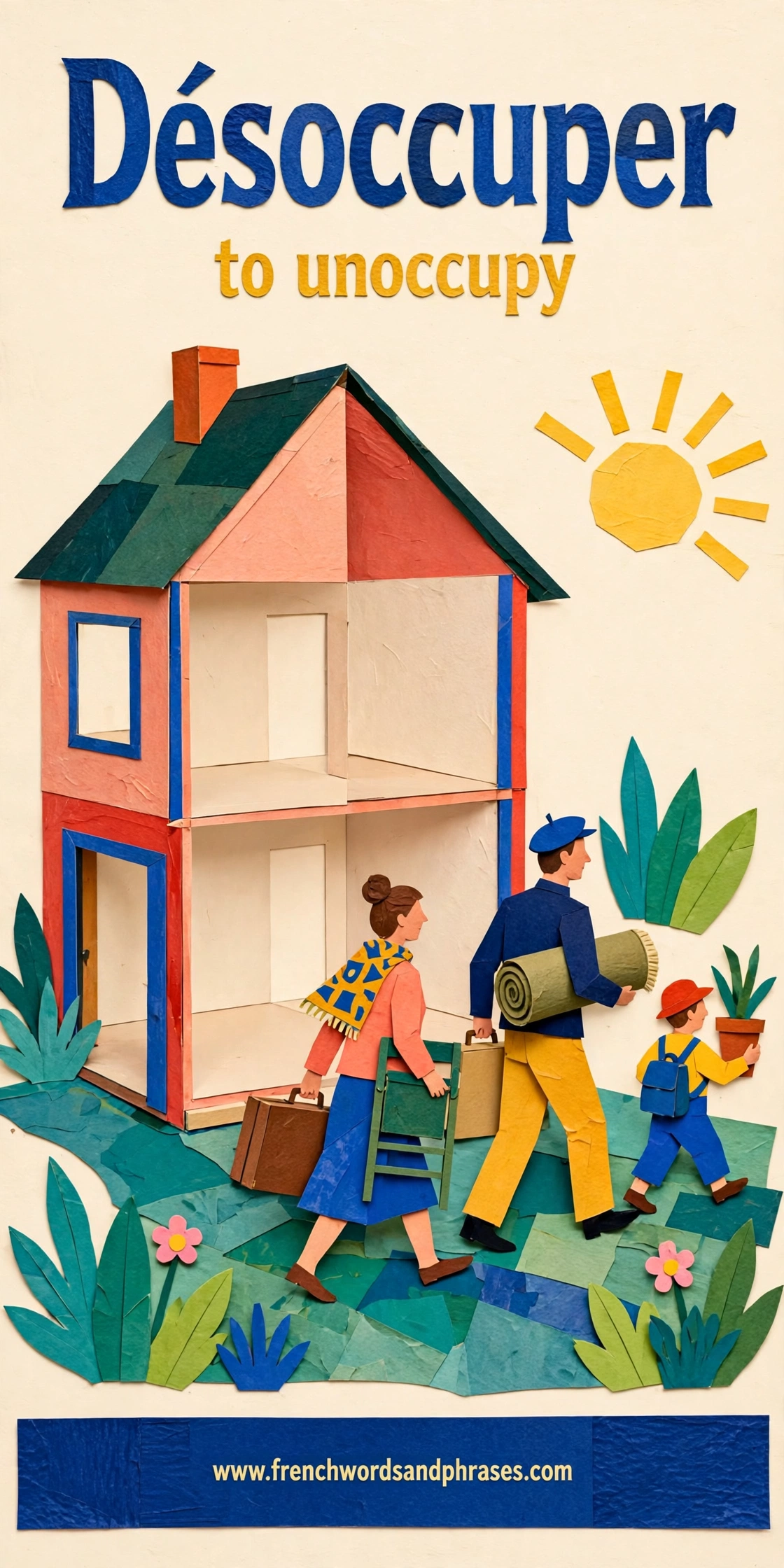
A French Word to Live By
How to Conjugate Désoccuper in French
/de.zɔ.ky.pe/
Désoccuper means to unoccupy — to leave a place empty, to free it of the people or the use that filled it.
Tenants handing back the keys, a hall emptied after the last meeting, premises returned to silence — désoccuper is the rare, sober verb for vacating: the moment a place stops being occupied and becomes simply a place again.
In this guide, you’ll learn how to conjugate désoccuper in all the major French tenses and moods. Explore complete conjugation tables, French examples, English translations, and practice quizzes.
Understanding the French Verb Désoccuper
Désoccuper is a regular French verb belonging to the first group of verbs, those ending in-er.
It means to unoccupy. It is used, sparingly, in property, administration and older written French for leaving premises, rooms or posts empty. For everyday ‘freeing up’ French prefers libérer — libérer une chambre, libérer une table — and désoccuper keeps the narrower sense of a place formally left vacant.
Verb classification: First group (-er)
Auxiliary verb: Avoir
Past participle: désoccupé
Present participle: désoccupant
English equivalents: To unoccupy, to vacate, to free up; désoccuper les lieux — to vacate the premises; désoccuper une chambre — to free up a room; désoccuper un local — to empty premises; un lieu désoccupé — an unoccupied, empty place.
One important detail: désoccuper is a rare verb, and honesty requires saying so — French almost always meets this family in the adjective désoccupé, unoccupied or idle: un appartement désoccupé, des mains désoccupées. The verb itself survives in formal and legal-flavoured French for vacating premises: désoccuper les lieux à la fin du bail. It conjugates as a perfectly regular -er verb: je désoccupe, nous désoccupons, past participle désoccupé — the same word as the adjective, which is exactly where the adjective comes from.
Experience the Word
Désoccuper is the verb of the emptied place — keys returned, rooms silent, occupation ended.
Imagine the last evening in a rented flat. The van has taken the furniture, the walls keep the pale rectangles where pictures hung, and the tenant sweeps the final room. Tomorrow the bail ends: ce soir, il désoccupe les lieux — and the flat belongs to its echoes again.
Nothing has been destroyed or sold. The flat has been vacated — désoccupé — returned to emptiness.
How to Conjugate Désoccuper: Complete French Conjugation Guide
Let’s explore every major conjugation of désoccuper, beginning with the indicative mood.
How to Conjugate Désoccuper in the Indicative Mood
The indicative mood is used to express facts, observations, actions, and events.
How to Conjugate Désoccuper in the Present Tense (Présent)
Used for actions happening now, habitual actions, and general truths.
| Subject | Conjugation |
|---|---|
| je | désoccupe |
| tu | désoccupes |
| il / elle | désoccupe |
| nous | désoccupons |
| vous | désoccupez |
| ils / elles | désoccupent |
Example
Le locataire désoccupe les lieux à la fin du mois.
The tenant vacates the premises at the end of the month.
Quick Quiz 1
Complete the sentence:
Nous ______ le local avant juin.
Reveal the answer
désoccuperons
Nous désoccuperons le local avant juin.
We will vacate the premises before June.
How to Conjugate Désoccuper in the Passé Composé
Used for completed actions in the past. Désoccuper takes the auxiliary verb avoir.
| Subject | Conjugation |
|---|---|
| j’ | ai désoccupé |
| tu | as désoccupé |
| il / elle | a désoccupé |
| nous | avons désoccupé |
| vous | avez désoccupé |
| ils / elles | ont désoccupé |
Example
Ils ont désoccupé la salle après la réunion.
They vacated the hall after the meeting.
How to Conjugate Désoccuper in the Imparfait (Imperfect Tense)
Used for habitual past actions, descriptions, and ongoing situations in the past.
| Subject | Conjugation |
|---|---|
| je | désoccupais |
| tu | désoccupais |
| il / elle | désoccupait |
| nous | désoccupions |
| vous | désoccupiez |
| ils / elles | désoccupaient |
Example
Autrefois, on désoccupait les granges pendant l’hiver.
In the past, barns were left empty during the winter.
Quick Quiz 2
Choose the correct form:
They vacated the hall.
Ils ______ la salle. (ont désoccupé / sont désoccupé)
Reveal the answer
ont désoccupé
Ils ont désoccupé la salle.
Désoccuper takes avoir.
How to Conjugate Désoccuper in the Plus-que-parfait
Used to describe an action that had already been completed before another past event.
| Subject | Conjugation |
|---|---|
| j’ | avais désoccupé |
| tu | avais désoccupé |
| il / elle | avait désoccupé |
| nous | avions désoccupé |
| vous | aviez désoccupé |
| ils / elles | avaient désoccupé |
Example
Elle avait désoccupé la chambre avant l’arrivée des invités.
She had freed up the room before the guests arrived.
How to Conjugate Désoccuper in the Passé Simple
Primarily used in formal writing, literature, and historical narratives. It is rarely used in everyday conversation.
| Subject | Conjugation |
|---|---|
| je | désoccupai |
| tu | désoccupas |
| il / elle | désoccupa |
| nous | désoccupâmes |
| vous | désoccupâtes |
| ils / elles | désoccupèrent |
Example
À la fin du bail, la famille désoccupa la maison.
At the end of the lease, the family vacated the house.
How to Conjugate Désoccuper in the Passé Antérieur
A literary tense used to express an action completed immediately before another past action, generally in the passé simple.
| Subject | Conjugation |
|---|---|
| j’ | eus désoccupé |
| tu | eus désoccupé |
| il / elle | eut désoccupé |
| nous | eûmes désoccupé |
| vous | eûtes désoccupé |
| ils / elles | eurent désoccupé |
Example
Quand il eut désoccupé le bureau, on repeignit les murs.
When he had vacated the office, they repainted the walls.
How to Conjugate Désoccuper in the Future Tense (Futur Simple)
Used to describe actions that will take place in the future.
| Subject | Conjugation |
|---|---|
| je | désoccuperai |
| tu | désoccuperas |
| il / elle | désoccupera |
| nous | désoccuperons |
| vous | désoccuperez |
| ils / elles | désoccuperont |
Example
Nous désoccuperons le local avant juin.
We will vacate the premises before June.
How to Conjugate Désoccuper in the Futur Antérieur (Future Perfect)
Used for an action that will have been completed before a particular point in the future.
| Subject | Conjugation |
|---|---|
| j’ | aurai désoccupé |
| tu | auras désoccupé |
| il / elle | aura désoccupé |
| nous | aurons désoccupé |
| vous | aurez désoccupé |
| ils / elles | auront désoccupé |
Example
À Noël, ils auront désoccupé tout l’étage.
By Christmas, they will have vacated the whole floor.
How to Conjugate Désoccuper in the Near Future (Futur Proche)
Used to describe something that is going to happen soon. Formed with aller + infinitive.
| Subject | Conjugation |
|---|---|
| je | vais désoccuper |
| tu | vas désoccuper |
| il / elle | va désoccuper |
| nous | allons désoccuper |
| vous | allez désoccuper |
| ils / elles | vont désoccuper |
Example
Le magasin va désoccuper le rez-de-chaussée cette semaine.
The shop is going to vacate the ground floor this week.
How to Conjugate Désoccuper in the Conditional Mood
The conditional mood expresses what would happen under certain circumstances. It is also frequently used to make polite requests or express wishes.
How to Conjugate Désoccuper in the Present Conditional
| Subject | Conjugation |
|---|---|
| je | désoccuperais |
| tu | désoccuperais |
| il / elle | désoccuperait |
| nous | désoccuperions |
| vous | désoccuperiez |
| ils / elles | désoccuperaient |
Example
Avec un préavis plus long, nous désoccuperions les lieux sans hâte.
With longer notice, we would vacate the premises without haste.
How to Conjugate Désoccuper in the Past Conditional
| Subject | Conjugation |
|---|---|
| j’ | aurais désoccupé |
| tu | aurais désoccupé |
| il / elle | aurait désoccupé |
| nous | aurions désoccupé |
| vous | auriez désoccupé |
| ils / elles | auraient désoccupé |
Example
Elle aurait désoccupé la chambre si on le lui avait demandé.
She would have freed up the room if she had been asked.
Désoccuper in the Literary Past Conditional Form
This less common literary form uses the imperfect subjunctive of avoir.
| Subject | Conjugation |
|---|---|
| j’ | eusse désoccupé |
| tu | eusses désoccupé |
| il / elle | eût désoccupé |
| nous | eussions désoccupé |
| vous | eussiez désoccupé |
| ils / elles | eussent désoccupé |
Example
Il eût désoccupé la place sans l’ordre du préfet.
He would have vacated the place without the prefect’s order.
How to Conjugate Désoccuper in the Subjunctive Mood
The subjunctive is used to express wishes, emotions, doubts, necessity, and uncertainty. It frequently follows expressions such as il faut que (it is necessary that) or bien que (although).
How to Conjugate Désoccuper in the Present Subjunctive
| Subject | Conjugation |
|---|---|
| que je | désoccupe |
| que tu | désoccupes |
| qu’il / qu’elle | désoccupe |
| que nous | désoccupions |
| que vous | désoccupiez |
| qu’ils / qu’elles | désoccupent |
Example
Le bail exige que le locataire désoccupe les lieux en mars.
The lease requires the tenant to vacate the premises in March.
Quick Quiz 3
Complete the sentence using the subjunctive:
Le bail exige que vous ______ les lieux en mars.
Reveal the answer
désoccupiez
Le bail exige que vous désoccupiez les lieux en mars.
The lease requires you to vacate the premises in March.
How to Conjugate Désoccuper in the Imperfect Subjunctive
A literary tense, rarely encountered in modern spoken French.
| Subject | Conjugation |
|---|---|
| que je | désoccupasse |
| que tu | désoccupasses |
| qu’il / qu’elle | désoccupât |
| que nous | désoccupassions |
| que vous | désoccupassiez |
| qu’ils / qu’elles | désoccupassent |
Example
Le propriétaire souhaitait que l’on désoccupât l’étage entier.
The owner wished the whole floor to be vacated.
How to Conjugate Désoccuper in the Pluperfect Subjunctive
A literary construction used to express an action completed before another past action.
| Subject | Conjugation |
|---|---|
| que j’ | eusse désoccupé |
| que tu | eusses désoccupé |
| qu’il / qu’elle | eût désoccupé |
| que nous | eussions désoccupé |
| que vous | eussiez désoccupé |
| qu’ils / qu’elles | eussent désoccupé |
Example
On nota qu’elle eût désoccupé le bureau dès le premier jour.
It was noted that she had vacated the office from the very first day.
How to Conjugate Désoccuper in the Past Subjunctive
| Subject | Conjugation |
|---|---|
| que j’ | aie désoccupé |
| que tu | aies désoccupé |
| qu’il / qu’elle | ait désoccupé |
| que nous | ayons désoccupé |
| que vous | ayez désoccupé |
| qu’ils / qu’elles | aient désoccupé |
Example
Je suis content qu’ils aient désoccupé la salle à temps.
I am glad they vacated the hall in time.
How to Conjugate Désoccuper in the Imperative
The imperative is used to give commands, instructions, invitations, or suggestions. Subject pronouns are omitted.
How to Conjugate Désoccuper in the Present Imperative
| Person | Conjugation |
|---|---|
| (tu) | désoccupe |
| (nous) | désoccupons |
| (vous) | désoccupez |
Example
Désoccupez les lieux avant vendredi, s’il vous plaît.
Please vacate the premises before Friday.
Quick Quiz 4
How would you say Free up this room (tu form)?
Reveal the answer
Désoccupe cette chambre !
French Participles of Désoccuper
Participles are verb forms that can be used in compound tenses and other grammatical constructions.
Present Participle of Désoccuper
désoccupant
En désoccupant l’étage, ils ont libéré trois bureaux.
By vacating the floor, they freed up three offices.
Past Participle of Désoccuper
désoccupé
Désoccupée depuis des mois, la maison semblait endormie.
Unoccupied for months, the house seemed asleep.
Désoccuper in Everyday French: Real-Life Examples
Now that you know the conjugations, let’s see how désoccuper appears in everyday French.
Example 1 — Present
Le locataire désoccupe les lieux à la fin du mois.
The tenant vacates the premises at the end of the month.
Example 2 — Passé composé
Ils ont désoccupé la salle après la réunion.
They vacated the hall after the meeting.
Example 3 — Imparfait
On désoccupait les granges pendant l’hiver.
Barns were left empty during the winter.
Example 4 — Future
Nous désoccuperons le local avant juin.
We will vacate the premises before June.
Example 5 — Conditional
Nous désoccuperions les lieux avec un préavis plus long.
We would vacate the premises with longer notice.
Example 6 — Imperative
Désoccupe cette chambre pour tes cousins !
Free up this room for your cousins!
Beyond Translation: The Meaning of Désoccuper
English unoccupy barely exists, and désoccuper is nearly as rare — both languages prefer to meet this idea in the adjective, unoccupied, désoccupé.
The verb is the adjective’s hidden engine.
Every lieu désoccupé was once désoccupé by someone: a tenant, a tenant’s van, and a set of keys changing hands. The formal phrase to keep is désoccuper les lieux — to vacate the premises.
How to Remember the French Verb Désoccuper
Remember it this way: Désoccuper is about the tenant’s last evening — keys back, rooms silent.
- A rare, formal verb: désoccuper les lieux — to vacate the premises — is its classic phrase.
- The family star is the adjective désoccupé: un appartement désoccupé, des mains désoccupées.
- Regular -er: je désoccupe, nous désoccupons, past participle désoccupé.
The key idea is the tenant’s last evening — keys back, rooms silent.
Test Your Knowledge of Désoccuper
Let’s see how much you’ve learned. Try answering these questions before revealing the answers.
Question 1
What is the classic phrase built on désoccuper, and what does it mean?
Reveal the answer
Désoccuper les lieux — to vacate the premises.
Question 2
How do you say The tenant vacates the premises at the end of the month in French?
Reveal the answer
Le locataire désoccupe les lieux à la fin du mois.
Question 3
Translate: They vacated the hall after the meeting.
Reveal the answer
Ils ont désoccupé la salle après la réunion.
Question 4
What is the past participle of désoccuper?
Reveal the answer
Désoccupé — also the everyday adjective: un lieu désoccupé, an unoccupied place.
Question 5
Complete the sentence:
Le bail exige que le locataire ______ les lieux en mars.
Reveal the answer
désoccupe
Le bail exige que le locataire désoccupe les lieux en mars.
The lease requires the tenant to vacate the premises in March.
Your Final Challenge
Can You Use It?
How would you say this in French?
To vacate the premises is to give a house back to its silence and its keys to the future.
Reveal the answer
Désoccuper les lieux, c’est rendre une maison à son silence et ses clés à l’avenir.
To vacate the premises is to give a house back to its silence and its keys to the future.
A little French. A little curiosity. A richer everyday life.
LEARN FRENCH ONE WORD AT A TIME