A French Word to Live By
How to Conjugate Désobéir in French
/de.zɔ.be.iʁ/
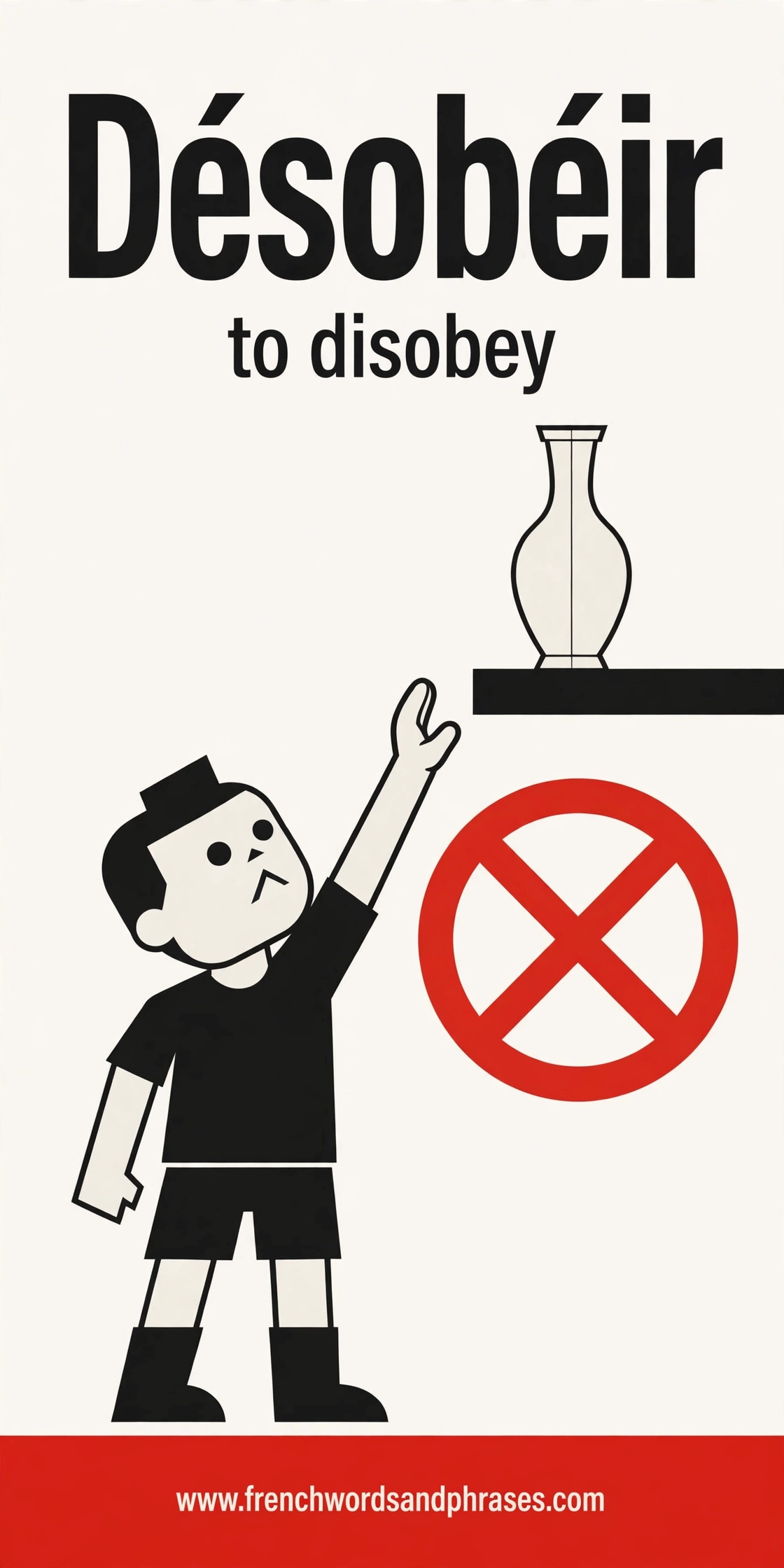
Désobéir means to disobey — to refuse, deliberately, to do what an order, a rule or a person in authority demands.
A child told to come inside who climbs higher up the tree, a soldier who lowers his rifle, a citizen who breaks an unjust law on purpose — désobéir is the verb of the refused order: authority has spoken, and the answer is no.
In this guide, you’ll learn how to conjugate désobéir in all the major French tenses and moods. Explore complete conjugation tables, French examples, English translations, and practice quizzes.
Understanding the French Verb Désobéir
Désobéir is a regular French verb belonging to the second group of verbs, those ending in -ir.
It means to disobey. It is commonly used of children and parents, soldiers and orders, citizens and laws. Its noun, la désobéissance, ranges from a toddler’s tantrum to la désobéissance civile — the deliberate, public breaking of an unjust law, where disobeying becomes a moral act rather than a fault.
Verb classification: Second group (-ir)
Auxiliary verb: Avoir
Past participle: désobéi
Present participle: désobéissant
English equivalents: To disobey; désobéir à quelqu’un — to disobey someone; désobéir à un ordre — to disobey an order; désobéir à la loi — to disobey the law; désobéir aux consignes — to ignore the instructions; la désobéissance civile — civil disobedience.
One important detail: désobéir is a regular second-group verb like finir — je désobéis, nous désobéissons, ils désobéissent, past participle désobéi — but it never takes its person or order directly. The construction is désobéir à: désobéir à ses parents, désobéir à un ordre, désobéir aux règles. With a pronoun, that à becomes lui or leur: l’enfant lui désobéit — the child disobeys him. Forgetting the à is the classic learner’s mistake: one never désobéit somebody in French.
Experience the Word
Désobéir is the verb of the spoken no — the moment an order lands, and someone, knowing the cost, refuses it anyway.
Imagine a boy of nine at the top of an apple tree. Below, his mother calls him down for the third time. He hears her perfectly. He chooses the topmost branch instead — il désobéit, calmly, completely, and with the deep satisfaction of a first taste of freedom.
The order was clear, and so was the refusal. He has disobeyed — désobéi à sa mère — and childhood will never be quite the same.
How to Conjugate Désobéir: Complete French Conjugation Guide
Let’s explore every major conjugation of désobéir, beginning with the indicative mood.
How to Conjugate Désobéir in the Indicative Mood
The indicative mood is used to express facts, observations, actions, and events.
How to Conjugate Désobéir in the Present Tense (Présent)
Used for actions happening now, habitual actions, and general truths.
| Subject | Conjugation |
|---|---|
| je | désobéis |
| tu | désobéis |
| il / elle | désobéit |
| nous | désobéissons |
| vous | désobéissez |
| ils / elles | désobéissent |
Example
Cet enfant désobéit à tous les adultes.
This child disobeys all the adults.
Quick Quiz 1
Complete the sentence:
Nous ne ______ jamais à nos parents.
Reveal the answer
désobéissons
Nous ne désobéissons jamais à nos parents.
We never disobey our parents.
How to Conjugate Désobéir in the Passé Composé
Used for completed actions in the past. Désobéir takes the auxiliary verb avoir.
| Subject | Conjugation |
|---|---|
| j’ | ai désobéi |
| tu | as désobéi |
| il / elle | a désobéi |
| nous | avons désobéi |
| vous | avez désobéi |
| ils / elles | ont désobéi |
Example
Le soldat a désobéi à un ordre injuste.
The soldier disobeyed an unjust order.
How to Conjugate Désobéir in the Imparfait (Imperfect Tense)
Used for habitual past actions, descriptions, and ongoing situations in the past.
| Subject | Conjugation |
|---|---|
| je | désobéissais |
| tu | désobéissais |
| il / elle | désobéissait |
| nous | désobéissions |
| vous | désobéissiez |
| ils / elles | désobéissaient |
Example
Petit, il désobéissait à la maîtresse chaque jour.
As a little boy, he disobeyed the teacher every day.
Quick Quiz 2
Choose the correct form:
The soldier disobeyed the order.
Le soldat ______ à l’ordre. (a désobéi / est désobéi)
Reveal the answer
a désobéi
Le soldat a désobéi à l’ordre.
Désobéir takes avoir.
How to Conjugate Désobéir in the Plus-que-parfait
Used to describe an action that had already been completed before another past event.
| Subject | Conjugation |
|---|---|
| j’ | avais désobéi |
| tu | avais désobéi |
| il / elle | avait désobéi |
| nous | avions désobéi |
| vous | aviez désobéi |
| ils / elles | avaient désobéi |
Example
Elle avait désobéi aux consignes avant l’accident.
She had ignored the instructions before the accident.
How to Conjugate Désobéir in the Passé Simple
Primarily used in formal writing, literature, and historical narratives. It is rarely used in everyday conversation.
| Subject | Conjugation |
|---|---|
| je | désobéis |
| tu | désobéis |
| il / elle | désobéit |
| nous | désobéîmes |
| vous | désobéîtes |
| ils / elles | désobéirent |
Example
Le marin désobéit au capitaine pendant la tempête.
The sailor disobeyed the captain during the storm.
How to Conjugate Désobéir in the Passé Antérieur
A literary tense used to express an action completed immediately before another past action, generally in the passé simple.
| Subject | Conjugation |
|---|---|
| j’ | eus désobéi |
| tu | eus désobéi |
| il / elle | eut désobéi |
| nous | eûmes désobéi |
| vous | eûtes désobéi |
| ils / elles | eurent désobéi |
Example
Quand il eut désobéi trois fois, on le punit sévèrement.
When he had disobeyed three times, he was severely punished.
How to Conjugate Désobéir in the Future Tense (Futur Simple)
Used to describe actions that will take place in the future.
| Subject | Conjugation |
|---|---|
| je | désobéirai |
| tu | désobéiras |
| il / elle | désobéira |
| nous | désobéirons |
| vous | désobéirez |
| ils / elles | désobéiront |
Example
Si tu désobéis à la loi, tu paieras l’amende.
If you disobey the law, you will pay the fine.
How to Conjugate Désobéir in the Futur Antérieur (Future Perfect)
Used for an action that will have been completed before a particular point in the future.
| Subject | Conjugation |
|---|---|
| j’ | aurai désobéi |
| tu | auras désobéi |
| il / elle | aura désobéi |
| nous | aurons désobéi |
| vous | aurez désobéi |
| ils / elles | auront désobéi |
Example
À la fin de la journée, les élèves auront désobéi dix fois.
By the end of the day, the pupils will have disobeyed ten times.
How to Conjugate Désobéir in the Near Future (Futur Proche)
Used to describe something that is going to happen soon. Formed with aller + infinitive.
| Subject | Conjugation |
|---|---|
| je | vais désobéir |
| tu | vas désobéir |
| il / elle | va désobéir |
| nous | allons désobéir |
| vous | allez désobéir |
| ils / elles | vont désobéir |
Example
Attention, ce chien va encore désobéir à son maître.
Careful, that dog is going to disobey its master again.
How to Conjugate Désobéir in the Conditional Mood
The conditional mood expresses what would happen under certain circumstances. It is also frequently used to make polite requests or express wishes.
How to Conjugate Désobéir in the Present Conditional
| Subject | Conjugation |
|---|---|
| je | désobéirais |
| tu | désobéirais |
| il / elle | désobéirait |
| nous | désobéirions |
| vous | désobéiriez |
| ils / elles | désobéiraient |
Example
Un bon soldat ne désobéirait jamais à un ordre légal.
A good soldier would never disobey a lawful order.
How to Conjugate Désobéir in the Past Conditional
| Subject | Conjugation |
|---|---|
| j’ | aurais désobéi |
| tu | aurais désobéi |
| il / elle | aurait désobéi |
| nous | aurions désobéi |
| vous | auriez désobéi |
| ils / elles | auraient désobéi |
Example
Elle aurait désobéi si l’ordre avait été injuste.
She would have disobeyed if the order had been unjust.
Désobéir in the Literary Past Conditional Form
This less common literary form uses the imperfect subjunctive of avoir.
| Subject | Conjugation |
|---|---|
| j’ | eusse désobéi |
| tu | eusses désobéi |
| il / elle | eût désobéi |
| nous | eussions désobéi |
| vous | eussiez désobéi |
| ils / elles | eussent désobéi |
Example
Il eût désobéi plutôt que de commettre cette injustice.
He would have disobeyed rather than commit that injustice.
How to Conjugate Désobéir in the Subjunctive Mood
The subjunctive is used to express wishes, emotions, doubts, necessity, and uncertainty. It frequently follows expressions such as il faut que (it is necessary that) or bien que (although).
How to Conjugate Désobéir in the Present Subjunctive
| Subject | Conjugation |
|---|---|
| que je | désobéisse |
| que tu | désobéisses |
| qu’il / qu’elle | désobéisse |
| que nous | désobéissions |
| que vous | désobéissiez |
| qu’ils / qu’elles | désobéissent |
Example
Je ne veux pas que les enfants désobéissent à leur grand-mère.
I do not want the children to disobey their grandmother.
Quick Quiz 3
Complete the sentence using the subjunctive:
Je ne veux pas que tu ______ à la maîtresse.
Reveal the answer
désobéisses
Je ne veux pas que tu désobéisses à la maîtresse.
I do not want you to disobey the teacher.
How to Conjugate Désobéir in the Imperfect Subjunctive
A literary tense, rarely encountered in modern spoken French.
| Subject | Conjugation |
|---|---|
| que je | désobéisse |
| que tu | désobéisses |
| qu’il / qu’elle | désobéît |
| que nous | désobéissions |
| que vous | désobéissiez |
| qu’ils / qu’elles | désobéissent |
Example
Le règlement exigeait que nul ne désobéît aux consignes.
The rules required that no one disobey the instructions.
How to Conjugate Désobéir in the Pluperfect Subjunctive
A literary construction used to express an action completed before another past action.
| Subject | Conjugation |
|---|---|
| que j’ | eusse désobéi |
| que tu | eusses désobéi |
| qu’il / qu’elle | eût désobéi |
| que nous | eussions désobéi |
| vous | eussiez désobéi |
| qu’ils / qu’elles | eussent désobéi |
Example
On racontait qu’il eût désobéi au général en pleine bataille.
People said he had disobeyed the general in the middle of the battle.
How to Conjugate Désobéir in the Past Subjunctive
| Subject | Conjugation |
|---|---|
| que j’ | aie désobéi |
| que tu | aies désobéi |
| qu’il / qu’elle | ait désobéi |
| que nous | ayons désobéi |
| que vous | ayez désobéi |
| qu’ils / qu’elles | aient désobéi |
Example
Je suis étonné qu’elle ait désobéi à un ordre si clair.
I am amazed she disobeyed such a clear order.
How to Conjugate Désobéir in the Imperative
The imperative is used to give commands, instructions, invitations, or suggestions. Subject pronouns are omitted.
How to Conjugate Désobéir in the Present Imperative
| Person | Conjugation |
|---|---|
| (tu) | désobéis |
| (nous) | désobéissons |
| (vous) | désobéissez |
Example
Ne désobéis pas à ta mère !
Do not disobey your mother!
Quick Quiz 4
How would you say Do not disobey your mother (tu form)?
Reveal the answer
Ne désobéis pas à ta mère !
French Participles of Désobéir
Participles are verb forms that can be used in compound tenses and other grammatical constructions.
Present Participle of Désobéir
désobéissant
En désobéissant à la loi, il a choisi la désobéissance civile.
By disobeying the law, he chose civil disobedience.
Past Participle of Désobéir
désobéi
Désobéi par ses propres troupes, le général démissionna.
Disobeyed by his own troops, the general resigned.
Désobéir in Everyday French: Real-Life Examples
Now that you know the conjugations, let’s see how désobéir appears in everyday French.
Example 1 — Present
Cet enfant désobéit à tous les adultes.
This child disobeys all the adults.
Example 2 — Passé composé
Le soldat a désobéi à un ordre injuste.
The soldier disobeyed an unjust order.
Example 3 — Imparfait
Il désobéissait à la maîtresse chaque jour.
He disobeyed the teacher every day.
Example 4 — Future
Si tu désobéis à la loi, tu paieras l’amende.
If you disobey the law, you will pay the fine.
Example 5 — Conditional
Elle désobéirait si l’ordre était injuste.
She would disobey if the order were unjust.
Example 6 — Imperative
Ne désobéis pas à ta mère !
Do not disobey your mother!
Beyond Translation: The Meaning of Désobéir
English disobey and French désobéir are the same invention in two languages — obéir with a negating prefix bolted on — but French grammar keeps a small fence around it: the à.
You disobey à someone, never someone tout court.
And the word has a noble career as well as a naughty one: la désobéissance civile is how French names the tradition of Thoreau and Gandhi — disobedience as a duty.
How to Remember the French Verb Désobéir
Remember it this way: Désobéir is about the boy at the top of the apple tree, not coming down.
- Never without à: désobéir à ses parents, à un ordre, à la loi — and lui/leur for pronouns: il lui désobéit.
- Second group, like finir: je désobéis, nous désobéissons, past participle désobéi.
- From the nursery to Gandhi: la désobéissance civile is civil disobedience.
The key idea is the boy at the top of the apple tree, not coming down.
Test Your Knowledge of Désobéir
Let’s see how much you’ve learned. Try answering these questions before revealing the answers.
Question 1
Which preposition must follow désobéir, and why does it matter?
Reveal the answer
À — désobéir à quelqu’un, à un ordre; French never disobeys a person directly.
Question 2
How do you say The soldier disobeyed an unjust order in French?
Reveal the answer
Le soldat a désobéi à un ordre injuste.
Question 3
Translate: This child disobeys all the adults.
Reveal the answer
Cet enfant désobéit à tous les adultes.
Question 4
What is the past participle of désobéir?
Reveal the answer
Désobéi.
Question 5
Complete the sentence:
Je ne veux pas que les enfants ______ à leur grand-mère.
Reveal the answer
désobéissent
Je ne veux pas que les enfants désobéissent à leur grand-mère.
I do not want the children to disobey their grandmother.
Your Final Challenge
Can You Use It?
How would you say this in French?
Disobeying an unjust order is not a whim: it is sometimes the first duty of a conscience.
Reveal the answer
Désobéir à un ordre injuste n’est pas un caprice : c’est parfois le premier devoir d’une conscience.
Disobeying an unjust order is not a whim: it is sometimes the first duty of a conscience.
A little French. A little curiosity. A richer everyday life.
LEARN FRENCH ONE WORD AT A TIME