A French Word to Live By
How to Conjugate Déserter in French
/de.zɛʁ.te/
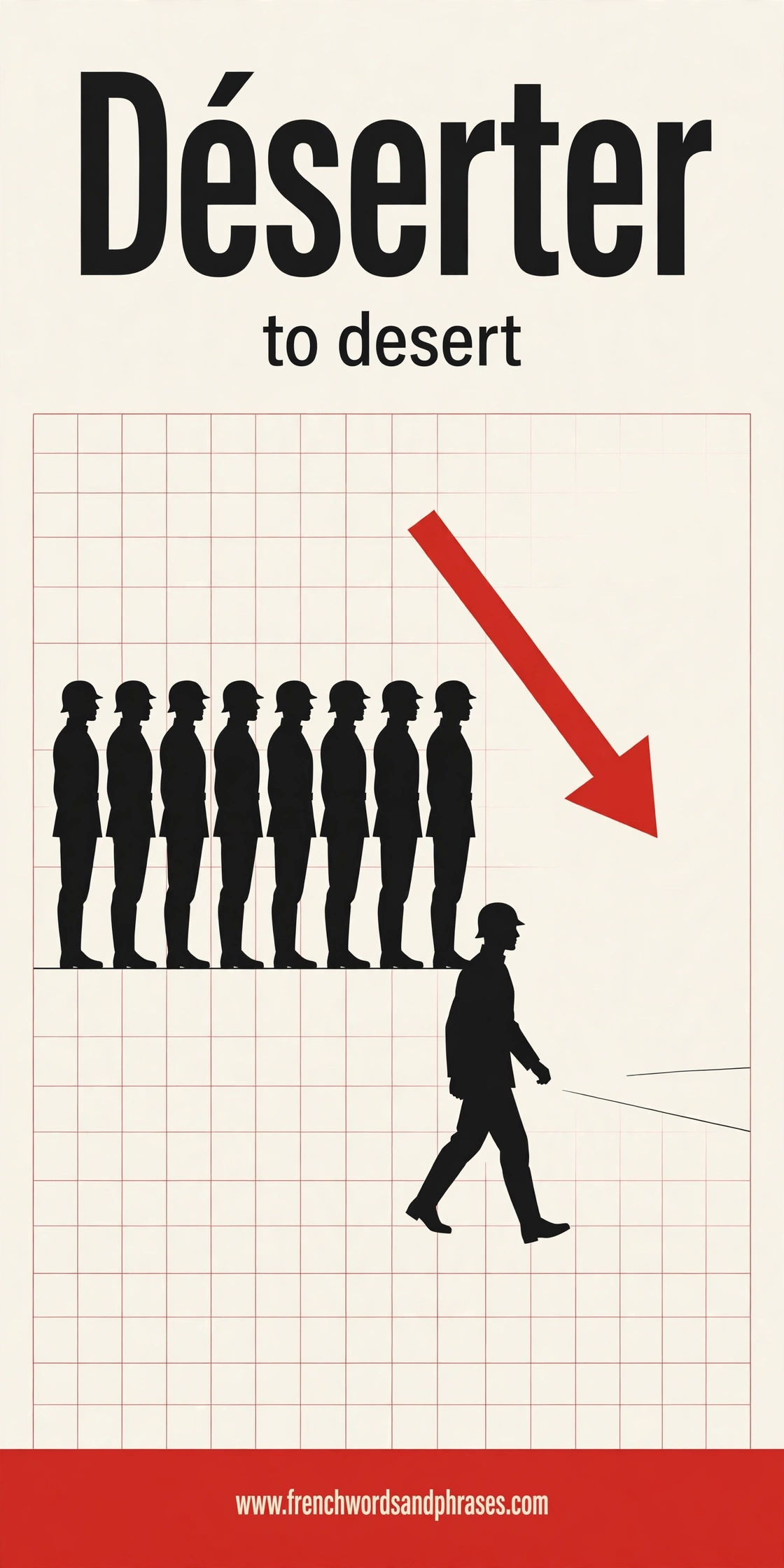
Déserter means to desert — to abandon a post, an army, a place or a person, and leave it empty behind you.
A sentry slipping away from his post in the night, tourists abandoning a rainy beach, a father walking out on his family — déserter is the verb of desertion: soldiers leave armies, crowds leave places, and the place itself is left empty, déserté, like the désert it is named after.
In this guide, you’ll learn how to conjugate déserter in all the major French tenses and moods. Explore complete conjugation tables, French examples, English translations, and practice quizzes.
Understanding the French Verb Déserter
Déserter is a regular French verb belonging to the first group of verbs, those ending in-er.
It means to desert. Beyond the army, modern French uses déserter constantly for places emptied of people — villages désertés by the young, shops désertés by customers, beaches désertées in winter — and for people who walk out on a duty, a party or a family. The one who does it is un déserteur.
Verb classification: First group (-er)
Auxiliary verb: Avoir
Past participle: déserté
Present participle: désertant
English equivalents: To desert, to abandon, to leave empty; déserter l’armée — to desert the army; déserter son poste — to desert one’s post; déserter les plages — to abandon the beaches; les rues désertées — the deserted streets.
One important detail: déserter has two constructions, and both are everyday French. Intransitive, it is the soldier’s crime: il a déserté, he deserted. Transitive, it means to leave a place empty: les touristes désertent les plages en septembre, il a déserté la maison familiale. The verb is regular — je déserte, nous désertons, past participle déserté — and it always takes avoir, even for the soldier: il a déserté, never with être.
Experience the Word
Déserter is the verb of the empty chair — a post, a place or a life abandoned without permission.
Imagine a seaside town in late September. The last train has taken the holidaymakers away; the shutters come down one by one, the cafés stack their chairs. In a week the tourists ont déserté les plages, and the town belongs again to the gulls and the winter wind.
Nothing was destroyed, only left. The beach is désertée — and the silence is total.
How to Conjugate Déserter: Complete French Conjugation Guide
Let’s explore every major conjugation of déserter, beginning with the indicative mood.
How to Conjugate Déserter in the Indicative Mood
The indicative mood is used to express facts, observations, actions, and events.
How to Conjugate Déserter in the Present Tense (Présent)
Used for actions happening now, habitual actions, and general truths.
| Subject | Conjugation |
|---|---|
| je | déserte |
| tu | désertes |
| il / elle | déserte |
| nous | désertons |
| vous | désertez |
| ils / elles | désertent |
Example
En septembre, les touristes désertent les plages.
In September, the tourists desert the beaches.
Quick Quiz 1
Complete the sentence:
Nous ne ______ jamais notre poste.
Reveal the answer
désertons
Nous ne désertons jamais notre poste.
We never desert our post.
How to Conjugate Déserter in the Passé Composé
Used for completed actions in the past. Déserter takes the auxiliary verb avoir.
| Subject | Conjugation |
|---|---|
| j’ | ai déserté |
| tu | as déserté |
| il / elle | a déserté |
| nous | avons déserté |
| vous | avez déserté |
| ils / elles | ont déserté |
Example
Le soldat a déserté pendant la nuit.
The soldier deserted during the night.
How to Conjugate Déserter in the Imparfait (Imperfect Tense)
Used for habitual past actions, descriptions, and ongoing situations in the past.
| Subject | Conjugation |
|---|---|
| je | désertais |
| tu | désertais |
| il / elle | désertait |
| nous | désertions |
| vous | désertiez |
| ils / elles | désertaient |
Example
Les jeunes désertaient le village pour la ville.
The young people used to leave the village for the city.
Quick Quiz 2
Choose the correct form:
The soldier deserted.
Le soldat ______. (a déserté / est déserté)
Reveal the answer
a déserté
Le soldat a déserté.
Déserter takes avoir, even for the soldier.
How to Conjugate Déserter in the Plus-que-parfait
Used to describe an action that had already been completed before another past event.
| Subject | Conjugation |
|---|---|
| j’ | avais déserté |
| tu | avais déserté |
| il / elle | avait déserté |
| nous | avions déserté |
| vous | aviez déserté |
| ils / elles | avaient déserté |
Example
Il avait déserté son poste avant l’aube.
He had deserted his post before dawn.
How to Conjugate Déserter in the Passé Simple
Primarily used in formal writing, literature, and historical narratives. It is rarely used in everyday conversation.
| Subject | Conjugation |
|---|---|
| je | désertai |
| tu | désertas |
| il / elle | déserta |
| nous | désertâmes |
| vous | désertâtes |
| ils / elles | désertèrent |
Example
Le régiment déserta en masse après la défaite.
The regiment deserted en masse after the defeat.
How to Conjugate Déserter in the Passé Antérieur
A literary tense used to express an action completed immediately before another past action, generally in the passé simple.
| Subject | Conjugation |
|---|---|
| j’ | eus déserté |
| tu | eus déserté |
| il / elle | eut déserté |
| nous | eûmes déserté |
| vous | eûtes déserté |
| ils / elles | eurent déserté |
Example
Quand les clients eurent déserté le magasin, il ferma ses portes.
When the customers had deserted the shop, it closed its doors.
How to Conjugate Déserter in the Future Tense (Futur Simple)
Used to describe actions that will take place in the future.
| Subject | Conjugation |
|---|---|
| je | déserterai |
| tu | déserteras |
| il / elle | désertera |
| nous | déserterons |
| vous | déserterez |
| ils / elles | déserteront |
Example
Si l’usine ferme, les habitants déserteront le village.
If the factory closes, the inhabitants will desert the village.
How to Conjugate Déserter in the Futur Antérieur (Future Perfect)
Used for an action that will have been completed before a particular point in the future.
| Subject | Conjugation |
|---|---|
| j’ | aurai déserté |
| tu | auras déserté |
| il / elle | aura déserté |
| nous | aurons déserté |
| vous | aurez déserté |
| ils / elles | auront déserté |
Example
À la fin de l’été, les vacanciers auront déserté la côte.
By the end of the summer, the holidaymakers will have deserted the coast.
How to Conjugate Déserter in the Near Future (Futur Proche)
Used to describe something that is going to happen soon. Formed with aller + infinitive.
| Subject | Conjugation |
|---|---|
| je | vais déserter |
| tu | vas déserter |
| il / elle | va déserter |
| nous | allons déserter |
| vous | allez déserter |
| ils / elles | vont déserter |
Example
Regarde les nuages : tout le monde va déserter la plage.
Look at the clouds: everyone is going to desert the beach.
How to Conjugate Déserter in the Conditional Mood
The conditional mood expresses what would happen under certain circumstances. It is also frequently used to make polite requests or express wishes.
How to Conjugate Déserter in the Present Conditional
| Subject | Conjugation |
|---|---|
| je | déserterais |
| tu | déserterais |
| il / elle | déserterait |
| nous | déserterions |
| vous | déserteriez |
| ils / elles | déserteraient |
Example
Sans travail, les jeunes déserteraient la région.
Without work, the young people would desert the region.
How to Conjugate Déserter in the Past Conditional
| Subject | Conjugation |
|---|---|
| j’ | aurais déserté |
| tu | aurais déserté |
| il / elle | aurait déserté |
| nous | aurions déserté |
| vous | auriez déserté |
| ils / elles | auraient déserté |
Example
Il aurait déserté s’il n’avait pas pensé à ses camarades.
He would have deserted if he had not thought of his comrades.
Déserter in the Literary Past Conditional Form
This less common literary form uses the imperfect subjunctive of avoir.
| Subject | Conjugation |
|---|---|
| j’ | eusse déserté |
| tu | eusses déserté |
| il / elle | eût déserté |
| nous | eussions déserté |
| vous | eussiez déserté |
| ils / elles | eussent déserté |
Example
Le soldat eût déserté cent fois plutôt que de trahir ses amis.
The soldier would have deserted a hundred times rather than betray his friends.
How to Conjugate Déserter in the Subjunctive Mood
The subjunctive is used to express wishes, emotions, doubts, necessity, and uncertainty. It frequently follows expressions such as il faut que (it is necessary that) or bien que (although).
How to Conjugate Déserter in the Present Subjunctive
| Subject | Conjugation |
|---|---|
| que je | déserte |
| que tu | désertes |
| qu’il / qu’elle | déserte |
| que nous | désertions |
| que vous | désertiez |
| qu’ils / qu’elles | désertent |
Example
Je ne crois pas qu’il déserte son poste.
I do not believe he would desert his post.
Quick Quiz 3
Complete the sentence using the subjunctive:
On craint que les habitants ne ______ le village.
Reveal the answer
désertent
On craint que les habitants ne désertent le village.
People fear the inhabitants may desert the village.
How to Conjugate Déserter in the Imperfect Subjunctive
A literary tense, rarely encountered in modern spoken French.
| Subject | Conjugation |
|---|---|
| que je | désertasse |
| que tu | désertasses |
| qu’il / qu’elle | désertât |
| que nous | désertassions |
| que vous | désertassiez |
| qu’ils / qu’elles | désertassent |
Example
On craignait que les habitants ne désertassent le village.
People feared the inhabitants might desert the village.
How to Conjugate Déserter in the Pluperfect Subjunctive
A literary construction used to express an action completed before another past action.
| Subject | Conjugation |
|---|---|
| que j’ | eusse déserté |
| que tu | eusses déserté |
| qu’il / qu’elle | eût déserté |
| que nous | eussions déserté |
| que vous | eussiez déserté |
| qu’ils / qu’elles | eussent déserté |
Example
On racontait que le gardien eût déserté le phare en pleine tempête.
People said the keeper had deserted the lighthouse in the middle of the storm.
How to Conjugate Déserter in the Past Subjunctive
| Subject | Conjugation |
|---|---|
| que j’ | aie déserté |
| que tu | aies déserté |
| qu’il / qu’elle | ait déserté |
| que nous | ayons déserté |
| que vous | ayez déserté |
| qu’ils / qu’elles | aient déserté |
Example
Il est honteux qu’il ait déserté ses camarades.
It is shameful that he deserted his comrades.
How to Conjugate Déserter in the Imperative
The imperative is used to give commands, instructions, invitations, or suggestions. Subject pronouns are omitted.
How to Conjugate Déserter in the Present Imperative
| Person | Conjugation |
|---|---|
| (tu) | déserte |
| (nous) | désertons |
| (vous) | désertez |
Example
Ne déserte pas ton poste !
Do not desert your post!
Quick Quiz 4
How would you say Do not desert your post (tu form)?
Reveal the answer
Ne déserte pas ton poste !
French Participles of Déserter
Participles are verb forms that can be used in compound tenses and other grammatical constructions.
Present Participle of Déserter
désertant
En désertant les campagnes, les jeunes changent le pays.
By deserting the countryside, young people are changing the country.
Past Participle of Déserter
déserté
Désertée par ses habitants, la maison tombe en ruine.
Deserted by its inhabitants, the house is falling into ruin.
Déserter in Everyday French: Real-Life Examples
Now that you know the conjugations, let’s see how déserter appears in everyday French.
Example 1 — Present
Les touristes désertent les plages en septembre.
The tourists desert the beaches in September.
Example 2 — Passé composé
Le soldat a déserté pendant la nuit.
The soldier deserted during the night.
Example 3 — Imparfait
Les jeunes désertaient le village.
The young people used to leave the village.
Example 4 — Future
Les vacanciers déserteront la côte à la fin de l’été.
The holidaymakers will desert the coast at the end of summer.
Example 5 — Conditional
Il déserterait sans ses camarades.
He would desert if not for his comrades.
Example 6 — Imperative
Ne déserte pas ton poste !
Do not desert your post!
Beyond Translation: The Meaning of Déserter
English desert the verb and desert the sand are cousins twice over in French: déserter makes a place into un désert — to desert a village is to turn it into a desert.
The adjective désert tells the same story.
Une rue déserte, une île déserte — a deserted street, a desert island — and the past participle déserté carries the human cause: places are déserts by nature, but désertés by people who left.
How to Remember the French Verb Déserter
Remember it this way: Déserter is about the empty beach in September — everyone has gone.
- Two constructions: il a déserté (the soldier) and déserter un lieu (to leave a place empty).
- Always avoir, even for the soldier: il a déserté — never with être.
- The family: un désert (a desert), désert (deserted), un déserteur (a deserter).
The key idea is the empty beach in September — everyone has gone.
Test Your Knowledge of Déserter
Let’s see how much you’ve learned. Try answering these questions before revealing the answers.
Question 1
Which auxiliary does déserter take, even for a soldier deserting?
Reveal the answer
Avoir — il a déserté. Déserter never uses être.
Question 2
How do you say The tourists desert the beaches in French?
Reveal the answer
Les touristes désertent les plages.
Question 3
Translate: The soldier deserted during the night.
Reveal the answer
Le soldat a déserté pendant la nuit.
Question 4
What is the past participle of déserter?
Reveal the answer
Déserté.
Question 5
Complete the sentence:
Je ne crois pas qu’il ______ son poste.
Reveal the answer
déserte
Je ne crois pas qu’il déserte son poste.
I do not believe he would desert his post.
Your Final Challenge
Can You Use It?
How would you say this in French?
In September, the tourists desert the beach, and the village finds its quiet again.
Reveal the answer
En septembre, les touristes désertent la plage, et le village retrouve son silence.
In September, the tourists desert the beach, and the village finds its quiet again.
A little French. A little curiosity. A richer everyday life.
LEARN FRENCH ONE WORD AT A TIME