A French Word to Live By
How to Conjugate Désembuer in French
/de.zɑ̃.bɥe/
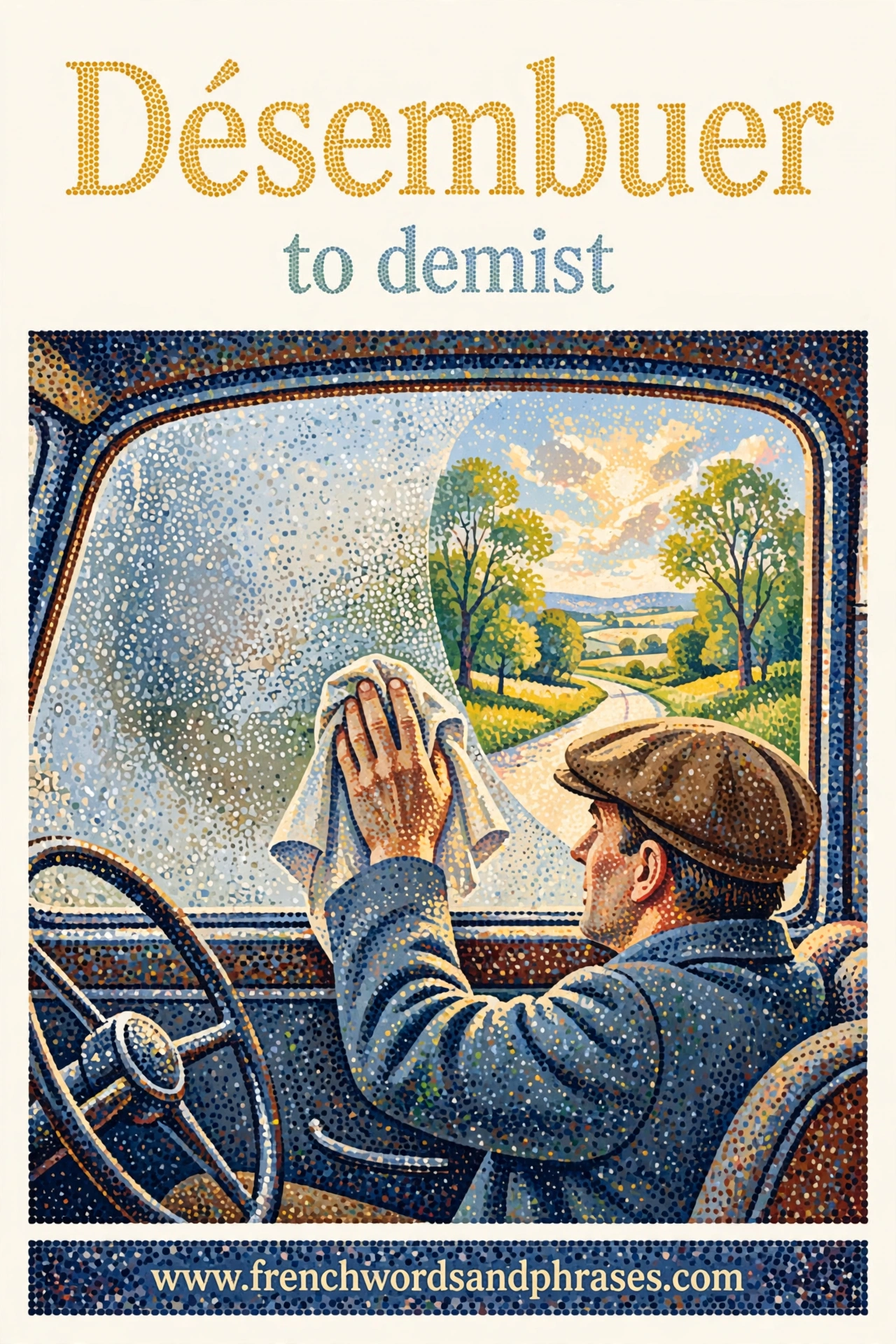
Désembuer means to demist — to clear the film of condensation from a windscreen, a mirror or a pair of glasses until the world is sharp again.
A cold morning, a windscreen white with mist, the fan roaring at full blast; a bathroom mirror fogged after the shower — désembuer is the small daily verb of wiping the fog away and seeing clearly.
In this guide, you’ll learn how to conjugate désembuer in all the major French tenses and moods. Explore complete conjugation tables, French examples, English translations, and practice quizzes.
Understanding the French Verb Désembuer
Désembuer is a regular French verb belonging to the first group of verbs, those ending in-er.
It means to demist. It is used every winter morning for windscreens and rear windows, after every shower for bathroom mirrors, and whenever glasses steam up on entering a warm room — the verb of condensation removed, by heat, air or a cloth.
Verb classification: First group (-er)
Auxiliary verb: Avoir
Past participle: désembué
Present participle: désembuant
English equivalents: To demist, to clear of condensation; désembuer le pare-brise — to demist the windscreen; désembuer ses lunettes — to clear one’s glasses; le désembuage — the demisting system in a car.
One important detail: désembuer is built on la buée, the mist that your breath and hot water leave on cold glass — the same buée that fogs a mirror. The verb is regular: je désembue, nous désembuons, ils désembuent. Its opposite is embuer (les yeux embués de larmes — eyes misted with tears), and in a car the button that does the work is le désembuage, a word every French driver knows by touch.
Experience the Word
Désembuer is the verb of the returning world — fog thinning at the edges, shapes sharpening, the road coming back.
Imagine a January morning in the mountains. The windscreen is a white wall. You turn the fan to full, the mist retreats in slow circles from the vents, and stripe by stripe the désembuage reveals the snowy road — le pare-brise est désembué, the day can begin.
Nothing has been cleaned or repaired. The glass has been demisted — désembué — and seeing is believing again.
How to Conjugate Désembuer: Complete French Conjugation Guide
Let’s explore every major conjugation of désembuer, beginning with the indicative mood.
How to Conjugate Désembuer in the Indicative Mood
The indicative mood is used to express facts, observations, actions, and events.
How to Conjugate Désembuer in the Present Tense (Présent)
Used for actions happening now, habitual actions, and general truths.
| Subject | Conjugation |
|---|---|
| je | désembue |
| tu | désembues |
| il / elle | désembue |
| nous | désembuons |
| vous | désembuez |
| ils / elles | désembuent |
Example
Le chauffage désembue le pare-brise en deux minutes.
The heater demists the windscreen in two minutes.
Quick Quiz 1
Complete the sentence:
Nous ______ le pare-brise avant de partir.
Reveal the answer
désembuons
Nous désembuons le pare-brise avant de partir.
We demist the windscreen before leaving.
How to Conjugate Désembuer in the Passé Composé
Used for completed actions in the past. Désembuer takes the auxiliary verb avoir.
| Subject | Conjugation |
|---|---|
| j’ | ai désembué |
| tu | as désembué |
| il / elle | a désembué |
| nous | avons désembué |
| vous | avez désembué |
| ils / elles | ont désembué |
Example
J’ai désembué mes lunettes en entrant dans la boulangerie.
I cleared my glasses as I came into the bakery.
How to Conjugate Désembuer in the Imparfait (Imperfect Tense)
Used for habitual past actions, descriptions, and ongoing situations in the past.
| Subject | Conjugation |
|---|---|
| je | désembuais |
| tu | désembuais |
| il / elle | désembuait |
| nous | désembuions |
| vous | désembuiez |
| ils / elles | désembuaient |
Example
Chaque matin, il désembuait la vitre avec un chiffon.
Every morning, he used to demist the window with a cloth.
Quick Quiz 2
Choose the correct form:
She had demisted the mirror.
Elle ______ le miroir. (avait désembué / était désembuée)
Reveal the answer
avait désembué
Elle avait désembué le miroir.
Désembuer takes avoir.
How to Conjugate Désembuer in the Plus-que-parfait
Used to describe an action that had already been completed before another past event.
| Subject | Conjugation |
|---|---|
| j’ | avais désembué |
| tu | avais désembué |
| il / elle | avait désembué |
| nous | avions désembué |
| vous | aviez désembué |
| ils / elles | avaient désembué |
Example
Elle avait désembué le miroir avant de se maquiller.
She had demisted the mirror before putting on her make-up.
How to Conjugate Désembuer in the Passé Simple
Primarily used in formal writing, literature, and historical narratives. It is rarely used in everyday conversation.
| Subject | Conjugation |
|---|---|
| je | désembuai |
| tu | désembuas |
| il / elle | désembua |
| nous | désembuâmes |
| vous | désembuâtes |
| ils / elles | désembuèrent |
Example
Un coup de chiffon désembua la vitre embuée.
One wipe of the cloth demisted the fogged window.
How to Conjugate Désembuer in the Passé Antérieur
A literary tense used to express an action completed immediately before another past action, generally in the passé simple.
| Subject | Conjugation |
|---|---|
| j’ | eus désembué |
| tu | eus désembué |
| il / elle | eut désembué |
| nous | eûmes désembué |
| vous | eûtes désembué |
| ils / elles | eurent désembué |
Example
Quand il eut désembué ses lunettes, il reconnut enfin la rue.
When he had cleared his glasses, he finally recognised the street.
How to Conjugate Désembuer in the Future Tense (Futur Simple)
Used to describe actions that will take place in the future.
| Subject | Conjugation |
|---|---|
| je | désembuerai |
| tu | désembueras |
| il / elle | désembuera |
| nous | désembuerons |
| vous | désembuerez |
| ils / elles | désembueront |
Example
La ventilation désembuera le pare-brise pendant que tu conduis.
The ventilation will demist the windscreen while you drive.
How to Conjugate Désembuer in the Futur Antérieur (Future Perfect)
Used for an action that will have been completed before a particular point in the future.
| Subject | Conjugation |
|---|---|
| j’ | aurai désembué |
| tu | auras désembué |
| il / elle | aura désembué |
| nous | aurons désembué |
| vous | aurez désembué |
| ils / elles | auront désembué |
Example
Dans cinq minutes, le système aura désembué toutes les vitres.
In five minutes, the system will have demisted all the windows.
How to Conjugate Désembuer in the Near Future (Futur Proche)
Used to describe something that is going to happen soon. Formed with aller + infinitive.
| Subject | Conjugation |
|---|---|
| je | vais désembuer |
| tu | vas désembuer |
| il / elle | va désembuer |
| nous | allons désembuer |
| vous | allez désembuer |
| ils / elles | vont désembuer |
Example
Attends, je vais désembuer le miroir.
Wait, I am going to demist the mirror.
How to Conjugate Désembuer in the Conditional Mood
The conditional mood expresses what would happen under certain circumstances. It is also frequently used to make polite requests or express wishes.
How to Conjugate Désembuer in the Present Conditional
| Subject | Conjugation |
|---|---|
| je | désembuerais |
| tu | désembuerais |
| il / elle | désembuerait |
| nous | désembuerions |
| vous | désembueriez |
| ils / elles | désembueraient |
Example
Un peu d’air chaud désembuerait la vitre en un instant.
A little warm air would demist the window in an instant.
How to Conjugate Désembuer in the Past Conditional
| Subject | Conjugation |
|---|---|
| j’ | aurais désembué |
| tu | aurais désembué |
| il / elle | aurait désembué |
| nous | aurions désembué |
| vous | auriez désembué |
| ils / elles | auraient désembué |
Example
J’aurais désembué mes lunettes si j’avais eu un mouchoir.
I would have cleared my glasses if I had had a handkerchief.
Désembuer in the Literary Past Conditional Form
This less common literary form uses the imperfect subjunctive of avoir.
| Subject | Conjugation |
|---|---|
| j’ | eusse désembué |
| tu | eusses désembué |
| il / elle | eût désembué |
| nous | eussions désembué |
| vous | eussiez désembué |
| ils / elles | eussent désembué |
Example
Le soleil eût désembué la vitre sans le brouillard.
The sun would have demisted the window without the fog.
How to Conjugate Désembuer in the Subjunctive Mood
The subjunctive is used to express wishes, emotions, doubts, necessity, and uncertainty. It frequently follows expressions such as il faut que (it is necessary that) or bien que (although).
How to Conjugate Désembuer in the Present Subjunctive
| Subject | Conjugation |
|---|---|
| que je | désembue |
| que tu | désembues |
| qu’il / qu’elle | désembue |
| que nous | désembuions |
| que vous | désembuiez |
| qu’ils / qu’elles | désembuent |
Example
Il faut que tu désembues le pare-brise avant de partir.
You must demist the windscreen before leaving.
Quick Quiz 3
Complete the sentence using the subjunctive:
Il faut que vous ______ les vitres de la voiture.
Reveal the answer
désembuiez
Il faut que vous désembuiez les vitres de la voiture.
You must demist the car windows.
How to Conjugate Désembuer in the Imperfect Subjunctive
A literary tense, rarely encountered in modern spoken French.
| Subject | Conjugation |
|---|---|
| que je | désembuasse |
| que tu | désembuasses |
| qu’il / qu’elle | désembuât |
| que nous | désembuassions |
| que vous | désembuassiez |
| qu’ils / qu’elles | désembuassent |
Example
Elle cherchait le bouton qui désembuât la lunette arrière.
She was looking for the button that demisted the rear window.
How to Conjugate Désembuer in the Pluperfect Subjunctive
A literary construction used to express an action completed before another past action.
| Subject | Conjugation |
|---|---|
| que j’ | eusse désembué |
| que tu | eusses désembué |
| qu’il / qu’elle | eût désembué |
| que nous | eussions désembué |
| que vous | eussiez désembué |
| qu’ils / qu’elles | eussent désembué |
Example
On attendait que la ventilation eût désembué la vitre.
They waited for the ventilation to have demisted the window.
How to Conjugate Désembuer in the Past Subjunctive
| Subject | Conjugation |
|---|---|
| que j’ | aie désembué |
| que tu | aies désembué |
| qu’il / qu’elle | ait désembué |
| que nous | ayons désembué |
| que vous | ayez désembué |
| qu’ils / qu’elles | aient désembué |
Example
C’est bien que le chauffage ait désembué le pare-brise.
It is good that the heater demisted the windscreen.
How to Conjugate Désembuer in the Imperative
The imperative is used to give commands, instructions, invitations, or suggestions. Subject pronouns are omitted.
How to Conjugate Désembuer in the Present Imperative
| Person | Conjugation |
|---|---|
| (tu) | désembue |
| (nous) | désembuons |
| (vous) | désembuez |
Example
Désembue le pare-brise avant de démarrer !
Demist the windscreen before setting off!
Quick Quiz 4
How would you say Demist the windscreen (tu form)?
Reveal the answer
Désembue le pare-brise !
French Participles of Désembuer
Participles are verb forms that can be used in compound tenses and other grammatical constructions.
Present Participle of Désembuer
désembuant
En désembuant le miroir de la salle de bain, elle s’est vue enfin nette.
By demisting the bathroom mirror, she finally saw herself clearly.
Past Participle of Désembuer
désembué
Désembué en une minute, le pare-brise laissait voir la route.
Demisted in a minute, the windscreen let the road be seen.
Désembuer in Everyday French: Real-Life Examples
Now that you know the conjugations, let’s see how désembuer appears in everyday French.
Example 1 — Present
Le chauffage désembue le pare-brise.
The heater demists the windscreen.
Example 2 — Passé composé
J’ai désembué mes lunettes.
I cleared my glasses.
Example 3 — Imparfait
Il désembuait la vitre avec un chiffon.
He used to demist the window with a cloth.
Example 4 — Future
La ventilation désembuera les vitres.
The ventilation will demist the windows.
Example 5 — Conditional
L’air chaud désembuerait le miroir.
Warm air would demist the mirror.
Example 6 — Imperative
Désembue le pare-brise !
Demist the windscreen!
Beyond Translation: The Meaning of Désembuer
The noun is la buée — the breath of warm air made visible on cold glass, the same word for the steam on a mirror and the mist on a window in winter.
French keeps the fog and its removal in one family.
Embuer fogs, désembuer clears, and le désembuage is the button your finger finds blind, every cold morning, before the road appears.
How to Remember the French Verb Désembuer
Remember it this way: Désembuer is about wiping the mist off the bathroom mirror.
- Buée is the mist itself — on mirrors, windscreens and glasses; désembuer wipes it away.
- The car’s demister button is le désembuage — the noun from this verb.
- Regular -er: je désembue, nous désembuons, past participle désembué.
The key idea is wiping the mist off the bathroom mirror.
Test Your Knowledge of Désembuer
Let’s see how much you’ve learned. Try answering these questions before revealing the answers.
Question 1
What is la buée?
Reveal the answer
The mist of condensation — the fog warm air leaves on cold glass; désembuer clears it.
Question 2
How do you say I cleared my glasses in French?
Reveal the answer
J’ai désembué mes lunettes.
Question 3
Translate: The heater demists the windscreen in two minutes.
Reveal the answer
Le chauffage désembue le pare-brise en deux minutes.
Question 4
What is the past participle of désembuer?
Reveal the answer
Désembué.
Question 5
Complete the sentence:
Il faut que tu ______ le pare-brise avant de partir.
Reveal the answer
désembues
Il faut que tu désembues le pare-brise avant de partir.
You must demist the windscreen before leaving.
Your Final Challenge
Can You Use It?
How would you say this in French?
She wipes the mist from the mirror with one gesture, and the day truly begins.
Reveal the answer
Elle désembue le miroir d’un geste, et la journée commence pour de bon.
She wipes the mist from the mirror with one gesture, and the day truly begins.
A little French. A little curiosity. A richer everyday life.
LEARN FRENCH ONE WORD AT A TIME