A French Word to Live By
How to Conjugate Désamarrer in French
/de.za.ma.ʁe/
Désamarrer means to unmoor — to cast off the ropes that hold a boat to the quay, so that the vessel floats free and the voyage can begin.
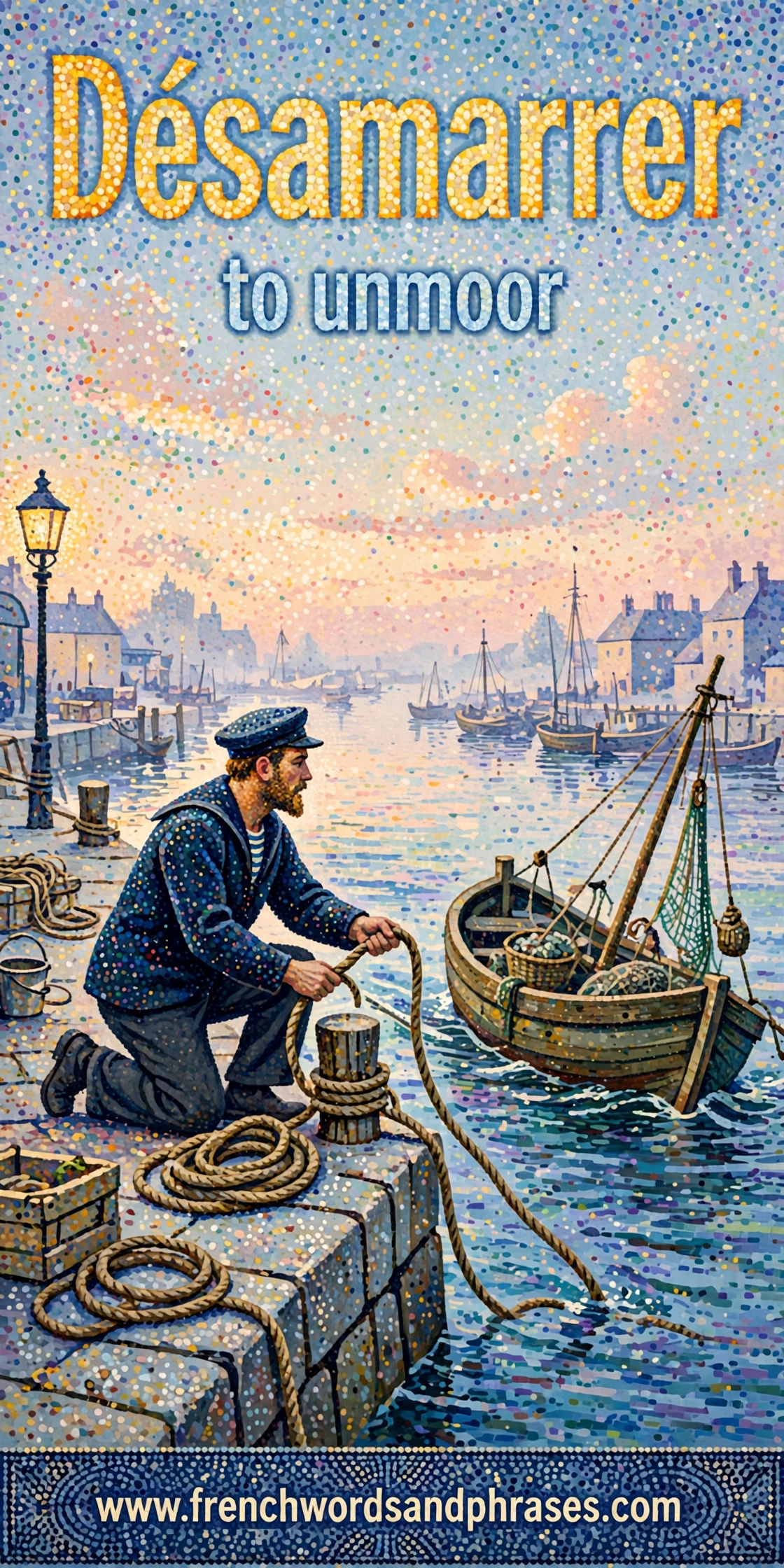
Ropes coiled on a wet quay, a captain watching the last line, the narrow strip of water widening between hull and harbour — désamarrer is the sailor’s verb of departure: untie the boat, and the land lets go.
In this guide, you’ll learn how to conjugate désamarrer in all the major French tenses and moods. Explore complete conjugation tables, French examples, English translations, and practice quizzes.
Understanding the French Verb Désamarrer
Désamarrer is a regular French verb belonging to the first group of verbs, those ending in-er.
It means to unmoor. It belongs to harbours, canals and rivers: sailors désamarrent ferries, barges and fishing boats at the start of every crossing. Figuratively it is rare, but a project or a person who leaves the shore of routine can be said, playfully, to désamarrer.
Verb classification: First group (-er)
Auxiliary verb: Avoir
Past participle: désamarré
Present participle: désamarrant
English equivalents: To unmoor, to cast off; désamarrer un bateau — to unmoor a boat; désamarrer un navire — to cast off a ship; les amarres — the mooring lines; larguer les amarres — to cast off the moorings.
One important detail: désamarrer is built on une amarre, a mooring line — to amarrer a boat is to tie it up, and désamarrer unties it. Watch the double r, inherited from amarre, through the whole conjugation: je désamarre, nous désamarrons, ils désamarrent, past participle désamarré. The verb is transitive — one désamarre a boat — and its great companion phrase is larguer les amarres, to cast off, the shout of every French departure.
Experience the Word
Désamarrer is the verb of the last rope — everything before it is preparation, everything after it is voyage.
Imagine a small ferry at first light. The cars are loaded, the coffee is poured, the deckhand unwinds the final line from its bollard et désamarre le bateau. The engine growls, the water widens, and the island on the other side becomes the whole of the world.
One rope was all that held it. The rope is off — désamarré, the ferry belongs to the sea again.
How to Conjugate Désamarrer: Complete French Conjugation Guide
Let’s explore every major conjugation of désamarrer, beginning with the indicative mood.
How to Conjugate Désamarrer in the Indicative Mood
The indicative mood is used to express facts, observations, actions, and events.
How to Conjugate Désamarrer in the Present Tense (Présent)
Used for actions happening now, habitual actions, and general truths.
| Subject | Conjugation |
|---|---|
| je | désamarre |
| tu | désamarres |
| il / elle | désamarre |
| nous | désamarrons |
| vous | désamarrez |
| ils / elles | désamarrent |
Example
Le marin désamarre le bateau dès l’aube.
The sailor unmoors the boat at dawn.
Quick Quiz 1
Complete the sentence:
Nous ______ le voilier dès que le vent tombe.
Reveal the answer
désamarrons
Nous désamarrons le voilier dès que le vent tombe.
We unmoor the sailing boat as soon as the wind drops.
How to Conjugate Désamarrer in the Passé Composé
Used for completed actions in the past. Désamarrer takes the auxiliary verb avoir.
| Subject | Conjugation |
|---|---|
| j’ | ai désamarré |
| tu | as désamarré |
| il / elle | a désamarré |
| nous | avons désamarré |
| vous | avez désamarré |
| ils / elles | ont désamarré |
Example
Ils ont désamarré le ferry à six heures précises.
They cast off the ferry at six o’clock sharp.
How to Conjugate Désamarrer in the Imparfait (Imperfect Tense)
Used for habitual past actions, descriptions, and ongoing situations in the past.
| Subject | Conjugation |
|---|---|
| je | désamarrais |
| tu | désamarrais |
| il / elle | désamarrait |
| nous | désamarrions |
| vous | désamarriez |
| ils / elles | désamarraient |
Example
Chaque matin, le passeur désamarrait sa barque sans un mot.
Every morning, the ferryman used to unmoor his boat without a word.
Quick Quiz 2
Choose the correct form:
They cast off the ferry at six.
Ils ______ le ferry à six heures. (ont désamarré / sont désamarrés)
Reveal the answer
ont désamarré
Ils ont désamarré le ferry à six heures.
Désamarrer takes avoir.
How to Conjugate Désamarrer in the Plus-que-parfait
Used to describe an action that had already been completed before another past event.
| Subject | Conjugation |
|---|---|
| j’ | avais désamarré |
| tu | avais désamarré |
| il / elle | avait désamarré |
| nous | avions désamarré |
| vous | aviez désamarré |
| ils / elles | avaient désamarré |
Example
Le capitaine avait désamarré le navire avant la tempête.
The captain had unmoored the ship before the storm.
How to Conjugate Désamarrer in the Passé Simple
Primarily used in formal writing, literature, and historical narratives. It is rarely used in everyday conversation.
| Subject | Conjugation |
|---|---|
| je | désamarrai |
| tu | désamarras |
| il / elle | désamarra |
| nous | désamarrâmes |
| vous | désamarrâtes |
| ils / elles | désamarrèrent |
Example
Au signal, l’équipage désamarra le voilier en silence.
At the signal, the crew cast off the sailing boat in silence.
How to Conjugate Désamarrer in the Passé Antérieur
A literary tense used to express an action completed immediately before another past action, generally in the passé simple.
| Subject | Conjugation |
|---|---|
| j’ | eus désamarré |
| tu | eus désamarré |
| il / elle | eut désamarré |
| nous | eûmes désamarré |
| vous | eûtes désamarré |
| ils / elles | eurent désamarré |
Example
Quand le matelot eut désamarré la péniche, le courant l’emporta doucement.
When the deckhand had unmoored the barge, the current carried it gently away.
How to Conjugate Désamarrer in the Future Tense (Futur Simple)
Used to describe actions that will take place in the future.
| Subject | Conjugation |
|---|---|
| je | désamarrerai |
| tu | désamarreras |
| il / elle | désamarrera |
| nous | désamarrerons |
| vous | désamarrerez |
| ils / elles | désamarreront |
Example
Demain, nous désamarrerons le bateau avant le lever du soleil.
Tomorrow, we will unmoor the boat before sunrise.
How to Conjugate Désamarrer in the Futur Antérieur (Future Perfect)
Used for an action that will have been completed before a particular point in the future.
| Subject | Conjugation |
|---|---|
| j’ | aurai désamarré |
| tu | auras désamarré |
| il / elle | aura désamarré |
| nous | aurons désamarré |
| vous | aurez désamarré |
| ils / elles | auront désamarré |
Example
À sept heures, ils auront désamarré tous les bateaux du port.
By seven o’clock, they will have unmoored all the boats in the harbour.
How to Conjugate Désamarrer in the Near Future (Futur Proche)
Used to describe something that is going to happen soon. Formed with aller + infinitive.
| Subject | Conjugation |
|---|---|
| je | vais désamarrer |
| tu | vas désamarrer |
| il / elle | va désamarrer |
| nous | allons désamarrer |
| vous | allez désamarrer |
| ils / elles | vont désamarrer |
Example
Attention, il va désamarrer la barque, tenez-vous bien !
Careful, he is going to unmoor the boat, hold on tight!
How to Conjugate Désamarrer in the Conditional Mood
The conditional mood expresses what would happen under certain circumstances. It is also frequently used to make polite requests or express wishes.
How to Conjugate Désamarrer in the Present Conditional
| Subject | Conjugation |
|---|---|
| je | désamarrerais |
| tu | désamarrerais |
| il / elle | désamarrerait |
| nous | désamarrerions |
| vous | désamarreriez |
| ils / elles | désamarreraient |
Example
Avec moins de vent, on désamarrerait le voilier sans risque.
With less wind, one could cast off the sailing boat safely.
How to Conjugate Désamarrer in the Past Conditional
| Subject | Conjugation |
|---|---|
| j’ | aurais désamarré |
| tu | aurais désamarré |
| il / elle | aurait désamarré |
| nous | aurions désamarré |
| vous | auriez désamarré |
| ils / elles | auraient désamarré |
Example
Sans la marée, ils n’auraient pas désamarré la péniche si tôt.
Without the tide, they would not have unmoored the barge so early.
Désamarrer in the Literary Past Conditional Form
This less common literary form uses the imperfect subjunctive of avoir.
| Subject | Conjugation |
|---|---|
| j’ | eusse désamarré |
| tu | eusses désamarré |
| il / elle | eût désamarré |
| nous | eussions désamarré |
| vous | eussiez désamarré |
| ils / elles | eussent désamarré |
Example
Le capitaine eût désamarré son navire avant l’aube.
The captain would have unmoored his ship before dawn.
How to Conjugate Désamarrer in the Subjunctive Mood
The subjunctive is used to express wishes, emotions, doubts, necessity, and uncertainty. It frequently follows expressions such as il faut que (it is necessary that) or bien que (although).
How to Conjugate Désamarrer in the Present Subjunctive
| Subject | Conjugation |
|---|---|
| que je | désamarre |
| que tu | désamarres |
| qu’il / qu’elle | désamarre |
| que nous | désamarrions |
| que vous | désamarriez |
| qu’ils / qu’elles | désamarrent |
Example
Il faut que l’équipage désamarre le ferry à l’heure.
The crew must cast off the ferry on time.
Quick Quiz 3
Complete the sentence using the subjunctive:
Il faut que vous ______ le bateau à l’heure.
Reveal the answer
désamarriez
Il faut que vous désamarriez le bateau à l’heure.
You must unmoor the boat on time.
How to Conjugate Désamarrer in the Imperfect Subjunctive
A literary tense, rarely encountered in modern spoken French.
| Subject | Conjugation |
|---|---|
| que je | désamarrasse |
| que tu | désamarrasses |
| qu’il / qu’elle | désamarrât |
| que nous | désamarrassions |
| que vous | désamarrassiez |
| qu’ils / qu’elles | désamarrassent |
Example
Le capitaine ordonna que le matelot désamarrât la barque sur-le-champ.
The captain ordered the deckhand to unmoor the boat at once.
How to Conjugate Désamarrer in the Pluperfect Subjunctive
A literary construction used to express an action completed before another past action.
| Subject | Conjugation |
|---|---|
| que j’ | eusse désamarré |
| que tu | eusses désamarré |
| qu’il / qu’elle | eût désamarré |
| que nous | eussions désamarré |
| que vous | eussiez désamarré |
| qu’ils / qu’elles | eussent désamarré |
Example
On racontait que le passeur eût désamarré sa barque en pleine nuit.
People said the ferryman had unmoored his boat in the middle of the night.
How to Conjugate Désamarrer in the Past Subjunctive
| Subject | Conjugation |
|---|---|
| que j’ | aie désamarré |
| que tu | aies désamarré |
| qu’il / qu’elle | ait désamarré |
| que nous | ayons désamarré |
| que vous | ayez désamarré |
| qu’ils / qu’elles | aient désamarré |
Example
Je suis content qu’ils aient désamarré le bateau avant la tempête.
I am glad they unmoored the boat before the storm.
How to Conjugate Désamarrer in the Imperative
The imperative is used to give commands, instructions, invitations, or suggestions. Subject pronouns are omitted.
How to Conjugate Désamarrer in the Present Imperative
| Person | Conjugation |
|---|---|
| (tu) | désamarre |
| (nous) | désamarrons |
| (vous) | désamarrez |
Example
Désamarre le bateau, nous partons !
Unmoor the boat, we’re leaving!
Quick Quiz 4
How would you say Unmoor the boat, we’re leaving (tu form)?
Reveal the answer
Désamarre le bateau, nous partons !
French Participles of Désamarrer
Participles are verb forms that can be used in compound tenses and other grammatical constructions.
Present Participle of Désamarrer
désamarrant
En désamarrant le ferry, le matelot salue le port une dernière fois.
Unmooring the ferry, the deckhand salutes the harbour one last time.
Past Participle of Désamarrer
désamarré
Désamarré à l’aube, le voilier glissait déjà vers le large.
Unmoored at dawn, the sailing boat was already gliding towards the open sea.
Désamarrer in Everyday French: Real-Life Examples
Now that you know the conjugations, let’s see how désamarrer appears in everyday French.
Example 1 — Present
Le marin désamarre le bateau dès l’aube.
The sailor unmoors the boat at dawn.
Example 2 — Passé composé
Ils ont désamarré le ferry à six heures.
They cast off the ferry at six o’clock.
Example 3 — Imparfait
Le passeur désamarrait sa barque chaque matin.
The ferryman used to unmoor his boat every morning.
Example 4 — Future
Nous désamarrerons le bateau avant le lever du soleil.
We will unmoor the boat before sunrise.
Example 5 — Conditional
On désamarrerait le voilier sans risque avec moins de vent.
One could cast off the sailing boat safely with less wind.
Example 6 — Imperative
Désamarre le bateau, nous partons !
Unmoor the boat, we’re leaving!
Beyond Translation: The Meaning of Désamarrer
Everything hangs on une amarre, the rope itself: amarrer ties the boat to the land, désamarrer unties it, and larguer les amarres — to cast off — is the cry of departure.
French departures begin with an untying.
Before the engine, before the sail, before the horizon, there is this small verb on the quay: the moment the land’s last hold on the boat is given up.
How to Remember the French Verb Désamarrer
Remember it this way: Désamarrer is about the deckhand unwinding the last rope at first light — then the widening water.
- Une amarre is a mooring line: amarrer ties the boat up, désamarrer sets it free.
- Double r everywhere: je désamarre, nous désamarrons, past participle désamarré.
- Its companion cry is larguer les amarres — cast off!
The key idea is the deckhand unwinding the last rope at first light — then the widening water.
Test Your Knowledge of Désamarrer
Let’s see how much you’ve learned. Try answering these questions before revealing the answers.
Question 1
What is une amarre, and why does it matter for this verb?
Reveal the answer
A mooring line — amarrer ties a boat with it, désamarrer unties it.
Question 2
How do you say They cast off the ferry at six o’clock sharp in French?
Reveal the answer
Ils ont désamarré le ferry à six heures précises.
Question 3
Translate: The crew must cast off the ferry on time.
Reveal the answer
Il faut que l’équipage désamarre le ferry à l’heure.
Question 4
What is the past participle of désamarrer?
Reveal the answer
Désamarré.
Question 5
Complete the sentence:
Demain, nous ______ le bateau avant le lever du soleil.
Reveal the answer
désamarrerons
Demain, nous désamarrerons le bateau avant le lever du soleil.
Tomorrow, we will unmoor the boat before sunrise.
Your Final Challenge
Can You Use It?
How would you say this in French?
To unmoor a boat at dawn is to entrust one’s day to water and wind.
Reveal the answer
Désamarrer un bateau à l’aube, c’est confier sa journée à l’eau et au vent.
To unmoor a boat at dawn is to entrust one’s day to water and wind.
A little French. A little curiosity. A richer everyday life.
LEARN FRENCH ONE WORD AT A TIME