A French Word to Live By
How to Conjugate Dédoubler in French
/de.du.ble/
Dédoubler means to unfold.
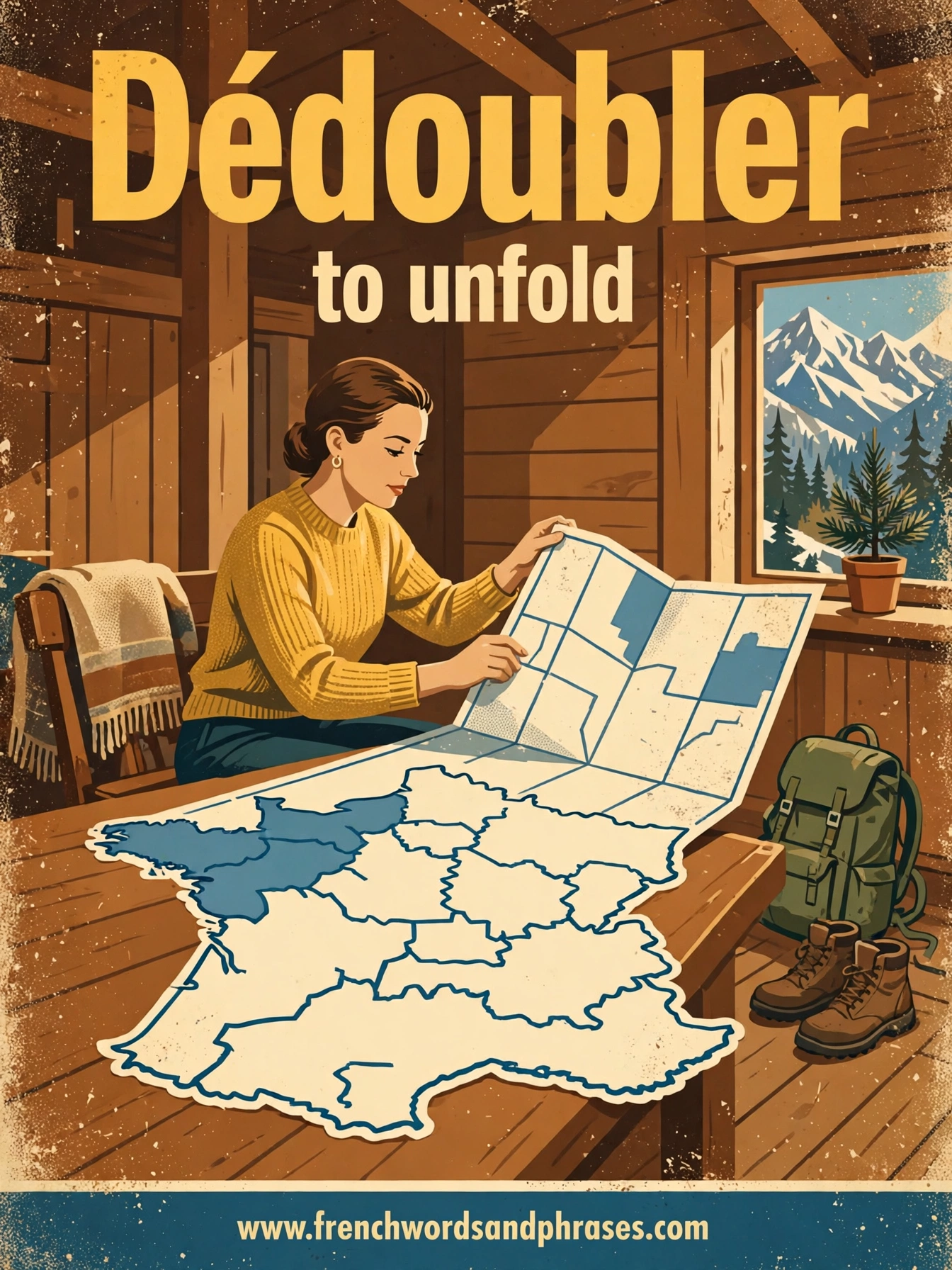
A road map spread across the bonnet of a car, a letter opened flat after years in a drawer, a single road becoming two at the edge of a village — dédoubler is the verb of unfolding and splitting: one thing, folded or single, becoming two.
In this guide, you’ll learn how to conjugate dédoubler in all the major French tenses and moods. Explore complete conjugation tables, French examples, English translations, and practice quizzes.
Understanding the French Verb Dédoubler
Dédoubler is a regular French verb belonging to the first group of verbs, those ending in -er.
It means to unfold. It is commonly used for unfolding paper, maps and linen, for splitting classes, trains and teams into two, and in the reflexive for roads that divide and for tireless people who appear to be in two places at once.
Verb classification: First group (-er)
Auxiliary verb: Avoir
Past participle: dédoublé
Present participle: dédoublant
English equivalents: To unfold, to split in two, to double up; se dédoubler — to split in two, or (of a person) to be in two places at once.
One important detail: dédoubler is doubler turned inside out — the prefix dé- undoes the doubling, so its first sense is to unfold what was folded double: dédoubler une carte, dédoubler une feuille. But the verb also splits: dédoubler une classe, to split a class into two groups, and the reflexive se dédoubler describes a road dividing — or a person who seems to be everywhere at once: elle se dédouble, she manages to do two jobs at the same time, said with admiration.
Experience the Word
Dédoubler is the verb of the fold opening — the crease flattening, the single sheet becoming a whole landscape.
Imagine a driver lost in the mountains in the days before phones. He stops the car, takes out the great paper map and dédouble it across the bonnet — and suddenly the whole region lies in front of him, every road and village in its place.
The map was always that big. It only needed unfolding — dédoublé, it shows everything.
How to Conjugate Dédoubler: Complete French Conjugation Guide
Let’s explore every major conjugation of dédoubler, beginning with the indicative mood.
How to Conjugate Dédoubler in the Indicative Mood
The indicative mood is used to express facts, observations, actions, and events.
How to Conjugate Dédoubler in the Present Tense (Présent)
Used for actions happening now, habitual actions, and general truths.
| Subject | Conjugation |
|---|---|
| je | dédouble |
| tu | dédoubles |
| il / elle | dédouble |
| nous | dédoublons |
| vous | dédoublez |
| ils / elles | dédoublent |
Example
Elle dédouble la nappe avant de la poser sur la table.
She unfolds the tablecloth before laying it on the table.
Quick Quiz 1
Complete the sentence:
Nous ______ la nappe avant le dîner.
Reveal the answer
dédoublons
Nous dédoublons la nappe avant le dîner.
We unfold the tablecloth before dinner.
How to Conjugate Dédoubler in the Passé Composé
Used for completed actions in the past. Dédoubler takes the auxiliary verb avoir.
| Subject | Conjugation |
|---|---|
| j’ | ai dédoublé |
| tu | as dédoublé |
| il / elle | a dédoublé |
| nous | avons dédoublé |
| vous | avez dédoublé |
| ils / elles | ont dédoublé |
Example
Il a dédoublé la lettre et l’a relue trois fois.
He unfolded the letter and read it three times.
How to Conjugate Dédoubler in the Imparfait (Imperfect Tense)
Used for habitual past actions, descriptions, and ongoing situations in the past.
| Subject | Conjugation |
|---|---|
| je | dédoublais |
| tu | dédoublais |
| il / elle | dédoublait |
| nous | dédoublions |
| vous | dédoubliez |
| ils / elles | dédoublaient |
Example
Le maître dédoublait la classe pour les cours de lecture.
The teacher used to split the class in two for reading lessons.
Quick Quiz 2
Choose the correct form:
She unfolded the letter.
Elle ______ la lettre. (a dédoublé / est dédoublée)
Reveal the answer
a dédoublé
Elle a dédoublé la lettre.
Dédoubler takes avoir.
How to Conjugate Dédoubler in the Plus-que-parfait
Used to describe an action that had already been completed before another past event.
| Subject | Conjugation |
|---|---|
| j’ | avais dédoublé |
| tu | avais dédoublé |
| il / elle | avait dédoublé |
| nous | avions dédoublé |
| vous | aviez dédoublé |
| ils / elles | avaient dédoublé |
Example
Nous avions dédoublé la carte quand le guide est arrivé.
We had unfolded the map when the guide arrived.
How to Conjugate Dédoubler in the Passé Simple
Primarily used in formal writing, literature, and historical narratives. It is rarely used in everyday conversation.
| Subject | Conjugation |
|---|---|
| je | dédoublai |
| tu | dédoublas |
| il / elle | dédoubla |
| nous | dédoublâmes |
| vous | dédoublâtes |
| ils / elles | dédoublèrent |
Example
Il dédoubla le parchemin avec précaution.
He unfolded the parchment carefully.
How to Conjugate Dédoubler in the Passé Antérieur
A literary tense used to express an action completed immediately before another past action, generally in the passé simple.
| Subject | Conjugation |
|---|---|
| j’ | eus dédoublé |
| tu | eus dédoublé |
| il / elle | eut dédoublé |
| nous | eûmes dédoublé |
| vous | eûtes dédoublé |
| ils / elles | eurent dédoublé |
Example
Quand elle eut dédoublé le journal, elle chercha la météo.
When she had unfolded the newspaper, she looked for the weather.
How to Conjugate Dédoubler in the Future Tense (Futur Simple)
Used to describe actions that will take place in the future.
| Subject | Conjugation |
|---|---|
| je | dédoublerai |
| tu | dédoubleras |
| il / elle | dédoublera |
| nous | dédoublerons |
| vous | dédoublerez |
| ils / elles | dédoubleront |
Example
Demain, on dédoublera les équipes pour finir plus vite.
Tomorrow, we will split the teams in two to finish faster.
How to Conjugate Dédoubler in the Futur Antérieur (Future Perfect)
Used for an action that will have been completed before a particular point in the future.
| Subject | Conjugation |
|---|---|
| j’ | aurai dédoublé |
| tu | auras dédoublé |
| il / elle | aura dédoublé |
| nous | aurons dédoublé |
| vous | aurez dédoublé |
| ils / elles | auront dédoublé |
Example
À midi, ils auront dédoublé toutes les serviettes de l’hôtel.
By noon, they will have unfolded all the hotel towels.
How to Conjugate Dédoubler in the Near Future (Futur Proche)
Used to describe something that is going to happen soon. Formed with aller + infinitive.
| Subject | Conjugation |
|---|---|
| je | vais dédoubler |
| tu | vas dédoubler |
| il / elle | va dédoubler |
| nous | allons dédoubler |
| vous | allez dédoubler |
| ils / elles | vont dédoubler |
Example
Je vais dédoubler ce plan sur la table.
I am going to unfold this plan on the table.
How to Conjugate Dédoubler in the Conditional Mood
The conditional mood expresses what would happen under certain circumstances. It is also frequently used to make polite requests or express wishes.
How to Conjugate Dédoubler in the Present Conditional
| Subject | Conjugation |
|---|---|
| je | dédoublerais |
| tu | dédoublerais |
| il / elle | dédoublerait |
| nous | dédoublerions |
| vous | dédoubleriez |
| ils / elles | dédoubleraient |
Example
Avec une classe plus petite, on ne dédoublerait pas le groupe.
With a smaller class, we would not split the group in two.
How to Conjugate Dédoubler in the Past Conditional
| Subject | Conjugation |
|---|---|
| j’ | aurais dédoublé |
| tu | aurais dédoublé |
| il / elle | aurait dédoublé |
| nous | aurions dédoublé |
| vous | auriez dédoublé |
| ils / elles | auraient dédoublé |
Example
Elle aurait dédoublé la couverture si le lit avait été plus grand.
She would have unfolded the blanket if the bed had been bigger.
Dédoubler in the Literary Past Conditional Form
This less common literary form uses the imperfect subjunctive of avoir.
| Subject | Conjugation |
|---|---|
| j’ | eusse dédoublé |
| tu | eusses dédoublé |
| il / elle | eût dédoublé |
| nous | eussions dédoublé |
| vous | eussiez dédoublé |
| ils / elles | eussent dédoublé |
Example
Il eût dédoublé la lettre sans un tremblement.
He would have unfolded the letter without a tremor.
How to Conjugate Dédoubler in the Subjunctive Mood
The subjunctive is used to express wishes, emotions, doubts, necessity, and uncertainty. It frequently follows expressions such as il faut que (it is necessary that) or bien que (although).
How to Conjugate Dédoubler in the Present Subjunctive
| Subject | Conjugation |
|---|---|
| que je | dédouble |
| que tu | dédoubles |
| qu’il / qu’elle | dédouble |
| que nous | dédoublions |
| que vous | dédoubliez |
| qu’ils / qu’elles | dédoublent |
Example
Il faut que tu dédoubles la carte pour voir le sud.
You must unfold the map to see the south.
Quick Quiz 3
Complete the sentence using the subjunctive:
Il faut que vous ______ le plan.
Reveal the answer
dédoubliez
Il faut que vous dédoubliez le plan.
You must unfold the plan.
How to Conjugate Dédoubler in the Imperfect Subjunctive
A literary tense, rarely encountered in modern spoken French.
| Subject | Conjugation |
|---|---|
| que je | dédoublasse |
| que tu | dédoublasses |
| qu’il / qu’elle | dédoublât |
| que nous | dédoublassions |
| que vous | dédoublassiez |
| qu’ils / qu’elles | dédoublassent |
Example
Je voulais qu’il dédoublât le plan devant tout le monde.
I wanted him to unfold the plan in front of everyone.
How to Conjugate Dédoubler in the Pluperfect Subjunctive
A literary construction used to express an action completed before another past action.
| Subject | Conjugation |
|---|---|
| que j’ | eusse dédoublé |
| que tu | eusses dédoublé |
| qu’il / qu’elle | eût dédoublé |
| que nous | eussions dédoublé |
| que vous | eussiez dédoublé |
| qu’ils / qu’elles | eussent dédoublé |
Example
On craignait que la route se fût dédoublée trop tard pour les voyageurs.
People feared the road had split in two too late for the travellers.
How to Conjugate Dédoubler in the Past Subjunctive
| Subject | Conjugation |
|---|---|
| que j’ | aie dédoublé |
| que tu | aies dédoublé |
| qu’il / qu’elle | ait dédoublé |
| que nous | ayons dédoublé |
| que vous | ayez dédoublé |
| qu’ils / qu’elles | aient dédoublé |
Example
Je suis content que vous ayez dédoublé le service pendant les fêtes.
I am glad you doubled the service during the holidays.
How to Conjugate Dédoubler in the Imperative
The imperative is used to give commands, instructions, invitations, or suggestions. Subject pronouns are omitted.
How to Conjugate Dédoubler in the Present Imperative
| Person | Conjugation |
|---|---|
| (tu) | dédouble |
| (nous) | dédoublons |
| (vous) | dédoublez |
Example
Dédouble la carte, on ne voit rien !
Unfold the map, we cannot see a thing!
Quick Quiz 4
How would you say Unfold the map (tu form)?
Reveal the answer
Dédouble la carte !
French Participles of Dédoubler
Participles are verb forms that can be used in compound tenses and other grammatical constructions.
Present Participle of Dédoubler
dédoublant
En dédoublant la feuille, il a trouvé un deuxième message.
While unfolding the sheet, he found a second message.
Past Participle of Dédoubler
dédoublé
Dédoublée sur la table, la carte couvrait tout le plateau.
Unfolded on the table, the map covered the whole top.
Dédoubler in Everyday French: Real-Life Examples
Now that you know the conjugations, let’s see how dédoubler appears in everyday French.
Example 1 — Present
La route se dédouble à la sortie du village.
The road splits in two at the edge of the village.
Example 2 — Passé composé
Elle a dédoublé la serviette et l’a posée sur ses genoux.
She unfolded the napkin and laid it on her knees.
Example 3 — Imparfait
On dédoublait les classes quand il y avait trop d’élèves.
Classes were split in two when there were too many pupils.
Example 4 — Future
Ils dédoubleront les bus sur cette ligne cet été.
They will run twice as many buses on this route this summer.
Example 5 — Conditional
Je me dédoublerais volontiers pour tout finir.
I would gladly be in two places at once to get everything done.
Example 6 — Imperative
Dédoublez le plan, s’il vous plaît !
Unfold the plan, please!
Beyond Translation: The Meaning of Dédoubler
English separates these ideas — unfold for paper, split for groups, double for numbers; French dédoubler holds them in one verb, because all three are the same gesture: one becomes two.
And the reflexive is pure admiration.
Elle se dédouble — she is in two places at once — is what French says of the colleague who runs two departments and never drops either.
How to Remember the French Verb Dédoubler
Remember it this way: Dédoubler is about one becomes two — the unfolded map, the split road.
- Dé- undoes doubler: dédoubler is to un-double — unfold what was folded in two.
- Dédoubler une classe, une équipe — to split a class, a team into two.
- Regular -er: je dédouble, nous dédoublons, past participle dédoublé.
The key idea is one becomes two — the unfolded map, the split road.
Test Your Knowledge of Dédoubler
Let’s see how much you’ve learned. Try answering these questions before revealing the answers.
Question 1
How do you say She unfolds the map in French?
Reveal the answer
Elle dédouble la carte.
Question 2
What does elle se dédouble suggest about a busy colleague?
Reveal the answer
That she seems to be in two places at once — doing two jobs at the same time.
Question 3
Translate: He unfolded the letter and read it again.
Reveal the answer
Il a dédoublé la lettre et l’a relue.
Question 4
What is the past participle of dédoubler?
Reveal the answer
Dédoublé.
Question 5
Complete the sentence:
Il faut que tu ______ la carte pour voir le sud.
Reveal the answer
dédoubles
Il faut que tu dédoubles la carte pour voir le sud.
You must unfold the map to see the south.
Your Final Challenge
Can You Use It?
How would you say this in French?
He unfolds the map on the bonnet, and the whole mountain appears.
Reveal the answer
Il dédouble la carte sur le capot, et toute la montagne apparaît.
He unfolds the map on the bonnet, and the whole mountain appears.
A little French. A little curiosity. A richer everyday life.
LEARN FRENCH ONE WORD AT A TIME