A French Word to Live By
How to Conjugate Décomposer in French
/de.kɔ̃.po.ze/
Décomposer means to decompose.
Autumn leaves dissolving into soil, a chemist splitting water into two gases, a gymnast breaking a leap into five small movements — décomposer is the verb of taking things apart into their elements, in nature, in the laboratory and in the mind.
In this guide, you’ll learn how to conjugate décomposer in all the major French tenses and moods. Explore complete conjugation tables, French examples, English translations, and practice quizzes.
Understanding the French Verb Décomposer
Décomposer is a regular French verb belonging to the first group of verbs, those ending in -er.
It means to decompose. It is commonly used in chemistry and biology for substances and bodies breaking down, in kitchens and gardens for food and leaves rotting, in teaching for breaking a problem, a movement or a number into steps, and in novels for a face that falls at sudden news.
Verb classification: First group (-er)
Auxiliary verb: Avoir
Past participle: décomposé
Present participle: décomposant
English equivalents: To decompose, to break down into parts; se décomposer — to rot, to break down; (of a face) to fall; la décomposition — decomposition, decay.
One important detail: décomposer is composer undone by dé-, and French uses the undoing everywhere. Nature does it without help — les feuilles se décomposent, the leaves rot away. The mind does it deliberately: décomposer un problème, décomposer un mouvement, décomposer un nombre en facteurs. And when bad news strikes, a face does it too: son visage s’est décomposé — his face fell.
Experience the Word
Décomposer is the verb of patient analysis — nothing vanishes, everything separates into what it was made of.
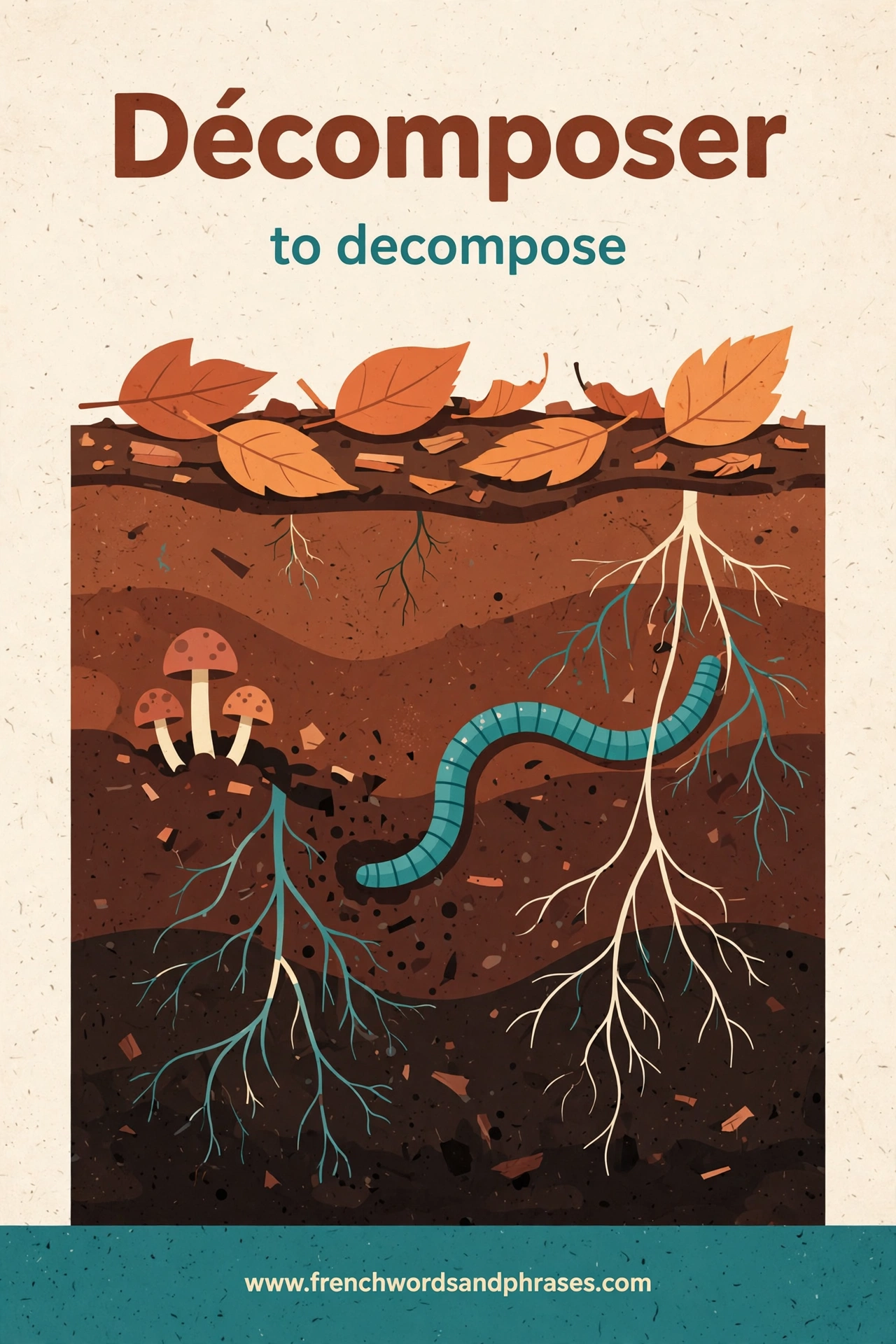
Imagine a forest floor in November. Last year’s leaves are half soil already, soft, dark and sweet-smelling: the forest décompose its own past and feeds its future with it.
The leaves have not disappeared. They have decomposed — broken down into earth, water and air.
How to Conjugate Décomposer: Complete French Conjugation Guide
Let’s explore every major conjugation of décomposer, beginning with the indicative mood.
How to Conjugate Décomposer in the Indicative Mood
The indicative mood is used to express facts, observations, actions, and events.
How to Conjugate Décomposer in the Present Tense (Présent)
Used for actions happening now, habitual actions, and general truths.
| Subject | Conjugation |
|---|---|
| je | décompose |
| tu | décomposes |
| il / elle | décompose |
| nous | décomposons |
| vous | décomposez |
| ils / elles | décomposent |
Example
Les bactéries décomposent les feuilles mortes en quelques mois.
Bacteria decompose dead leaves in a few months.
Quick Quiz 1
Complete the sentence:
Nous ______ le mouvement en cinq temps.
Reveal the answer
décomposons
Nous décomposons le mouvement en cinq temps.
We break the movement down into five beats.
How to Conjugate Décomposer in the Passé Composé
Used for completed actions in the past. Décomposer takes the auxiliary verb avoir.
| Subject | Conjugation |
|---|---|
| j’ | ai décomposé |
| tu | as décomposé |
| il / elle | a décomposé |
| nous | avons décomposé |
| vous | avez décomposé |
| ils / elles | ont décomposé |
Example
Le chimiste a décomposé l’eau en hydrogène et en oxygène.
The chemist decomposed water into hydrogen and oxygen.
How to Conjugate Décomposer in the Imparfait (Imperfect Tense)
Used for habitual past actions, descriptions, and ongoing situations in the past.
| Subject | Conjugation |
|---|---|
| je | décomposais |
| tu | décomposais |
| il / elle | décomposait |
| nous | décomposions |
| vous | décomposiez |
| ils / elles | décomposaient |
Example
Le professeur décomposait chaque mouvement au ralenti.
The teacher used to break down each movement in slow motion.
Quick Quiz 2
Choose the correct form:
The chemist decomposed the substance.
Le chimiste ______ la substance. (a décomposé / est décomposé)
Reveal the answer
a décomposé
Le chimiste a décomposé la substance.
Décomposer takes avoir.
How to Conjugate Décomposer in the Plus-que-parfait
Used to describe an action that had already been completed before another past event.
| Subject | Conjugation |
|---|---|
| j’ | avais décomposé |
| tu | avais décomposé |
| il / elle | avait décomposé |
| nous | avions décomposé |
| vous | aviez décomposé |
| ils / elles | avaient décomposé |
Example
Les feuilles s’étaient décomposées pendant l’hiver.
The leaves had decomposed during the winter.
How to Conjugate Décomposer in the Passé Simple
Primarily used in formal writing, literature, and historical narratives. It is rarely used in everyday conversation.
| Subject | Conjugation |
|---|---|
| je | décomposai |
| tu | décomposas |
| il / elle | décomposa |
| nous | décomposâmes |
| vous | décomposâtes |
| ils / elles | décomposèrent |
Example
À l’annonce du résultat, son visage se décomposa.
When the result was announced, his face fell.
How to Conjugate Décomposer in the Passé Antérieur
A literary tense used to express an action completed immediately before another past action, generally in the passé simple.
| Subject | Conjugation |
|---|---|
| j’ | eus décomposé |
| tu | eus décomposé |
| il / elle | eut décomposé |
| nous | eûmes décomposé |
| vous | eûtes décomposé |
| ils / elles | eurent décomposé |
Example
Quand la chaleur eut décomposé les restes, on ferma la cuisine.
When the heat had decomposed the leftovers, the kitchen was closed.
How to Conjugate Décomposer in the Future Tense (Futur Simple)
Used to describe actions that will take place in the future.
| Subject | Conjugation |
|---|---|
| je | décomposerai |
| tu | décomposeras |
| il / elle | décomposera |
| nous | décomposerons |
| vous | décomposerez |
| ils / elles | décomposeront |
Example
Ces déchets se décomposeront en moins d’un an.
This waste will decompose in less than a year.
How to Conjugate Décomposer in the Futur Antérieur (Future Perfect)
Used for an action that will have been completed before a particular point in the future.
| Subject | Conjugation |
|---|---|
| j’ | aurai décomposé |
| tu | auras décomposé |
| il / elle | aura décomposé |
| nous | aurons décomposé |
| vous | aurez décomposé |
| ils / elles | auront décomposé |
Example
Au printemps, les feuilles se seront décomposées entièrement.
By spring, the leaves will have decomposed completely.
How to Conjugate Décomposer in the Near Future (Futur Proche)
Used to describe something that is going to happen soon. Formed with aller + infinitive.
| Subject | Conjugation |
|---|---|
| je | vais décomposer |
| tu | vas décomposer |
| il / elle | va décomposer |
| nous | allons décomposer |
| vous | allez décomposer |
| ils / elles | vont décomposer |
Example
Je vais décomposer le problème en trois petites questions.
I am going to break the problem down into three small questions.
How to Conjugate Décomposer in the Conditional Mood
The conditional mood expresses what would happen under certain circumstances. It is also frequently used to make polite requests or express wishes.
How to Conjugate Décomposer in the Present Conditional
| Subject | Conjugation |
|---|---|
| je | décomposerais |
| tu | décomposerais |
| il / elle | décomposerait |
| nous | décomposerions |
| vous | décomposeriez |
| ils / elles | décomposeraient |
Example
Sans air, la matière se décomposerait beaucoup plus lentement.
Without air, matter would decompose much more slowly.
How to Conjugate Décomposer in the Past Conditional
| Subject | Conjugation |
|---|---|
| j’ | aurais décomposé |
| tu | aurais décomposé |
| il / elle | aurait décomposé |
| nous | aurions décomposé |
| vous | auriez décomposé |
| ils / elles | auraient décomposé |
Example
Le professeur aurait décomposé le mouvement en dix étapes.
The teacher would have broken the movement down into ten steps.
Décomposer in the Literary Past Conditional Form
This less common literary form uses the imperfect subjunctive of avoir.
| Subject | Conjugation |
|---|---|
| j’ | eusse décomposé |
| tu | eusses décomposé |
| il / elle | eût décomposé |
| nous | eussions décomposé |
| vous | eussiez décomposé |
| ils / elles | eussent décomposé |
Example
À cette nouvelle, son visage se fût décomposé sur-le-champ.
At that news, his face would have fallen on the spot.
How to Conjugate Décomposer in the Subjunctive Mood
The subjunctive is used to express wishes, emotions, doubts, necessity, and uncertainty. It frequently follows expressions such as il faut que (it is necessary that) or bien que (although).
How to Conjugate Décomposer in the Present Subjunctive
| Subject | Conjugation |
|---|---|
| que je | décompose |
| que tu | décomposes |
| qu’il / qu’elle | décompose |
| que nous | décomposions |
| que vous | décomposiez |
| qu’ils / qu’elles | décomposent |
Example
Il faut que tu décomposes la fraction avant de calculer.
You must break down the fraction before calculating.
Quick Quiz 3
Complete the sentence using the subjunctive:
Il faut que vous ______ le problème en étapes.
Reveal the answer
décomposiez
Il faut que vous décomposiez le problème en étapes.
You must break the problem down into steps.
How to Conjugate Décomposer in the Imperfect Subjunctive
A literary tense, rarely encountered in modern spoken French.
| Subject | Conjugation |
|---|---|
| que je | décomposasse |
| que tu | décomposasses |
| qu’il / qu’elle | décomposât |
| que nous | décomposassions |
| que vous | décomposassiez |
| qu’ils / qu’elles | décomposassent |
Example
Le maître exigeait que l’élève décomposât le saut en cinq temps.
The master required the pupil to break the jump down into five beats.
How to Conjugate Décomposer in the Pluperfect Subjunctive
A literary construction used to express an action completed before another past action.
| Subject | Conjugation |
|---|---|
| que j’ | eusse décomposé |
| que tu | eusses décomposé |
| qu’il / qu’elle | eût décomposé |
| que nous | eussions décomposé |
| que vous | eussiez décomposé |
| qu’ils / qu’elles | eussent décomposé |
Example
Il craignait que la chaleur n’eût décomposé les provisions.
He feared the heat had decomposed the provisions.
How to Conjugate Décomposer in the Past Subjunctive
| Subject | Conjugation |
|---|---|
| que j’ | aie décomposé |
| que tu | aies décomposé |
| qu’il / qu’elle | ait décomposé |
| que nous | ayons décomposé |
| que vous | ayez décomposé |
| qu’ils / qu’elles | aient décomposé |
Example
Je suis étonné que le bois ne se soit pas décomposé.
I am surprised the wood has not decomposed.
How to Conjugate Décomposer in the Imperative
The imperative is used to give commands, instructions, invitations, or suggestions. Subject pronouns are omitted.
How to Conjugate Décomposer in the Present Imperative
| Person | Conjugation |
|---|---|
| (tu) | décompose |
| (nous) | décomposons |
| (vous) | décomposez |
Example
Décompose le problème, étape par étape !
Break the problem down, step by step!
Quick Quiz 4
How would you say Break the problem down (tu form)?
Reveal the answer
Décompose le problème !
French Participles of Décomposer
Participles are verb forms that can be used in compound tenses and other grammatical constructions.
Present Participle of Décomposer
décomposant
En décomposant le mouvement, la gymnaste a compris son erreur.
By breaking down the movement, the gymnast understood her mistake.
Past Participle of Décomposer
décomposé
Décomposée par les bactéries, la feuille devient de l’humus.
Decomposed by bacteria, the leaf becomes humus.
Décomposer in Everyday French: Real-Life Examples
Now that you know the conjugations, let’s see how décomposer appears in everyday French.
Example 1 — Present
Les feuilles se décomposent sur le sol de la forêt.
The leaves decompose on the forest floor.
Example 2 — Passé composé
Nous avons décomposé le nombre en facteurs premiers.
We broke the number down into prime factors.
Example 3 — Imparfait
Le maître décomposait chaque phrase en mots.
The teacher used to break each sentence down into words.
Example 4 — Future
Je décomposerai le projet en petites tâches.
I will break the project down into small tasks.
Example 5 — Conditional
On décomposerait le problème plus facilement à deux.
We would break the problem down more easily with two of us.
Example 6 — Imperative
Décomposez la recette en étapes simples !
Break the recipe down into simple steps!
Beyond Translation: The Meaning of Décomposer
English decompose mostly rots in the garden; French décomposer works in the classroom and the gymnasium as happily as in the compost.
To decompose is to understand by unmaking.
A number into factors, a leap into beats, a sentence into words — and when the face of a minister se décompose on live television, French needs no further comment.
How to Remember the French Verb Décomposer
Remember it this way: Décomposer is about things taken back to their elements — leaves, numbers, movements, faces.
- Dé- + composer: to decompose is to un-compose — to take a thing back to its parts.
- Se décomposer — to rot, to break down; son visage se décompose — his face falls.
- Regular -er: je décompose, nous décomposons, past participle décomposé.
The key idea is things taken back to their elements — leaves, numbers, movements, faces.
Test Your Knowledge of Décomposer
Let’s see how much you’ve learned. Try answering these questions before revealing the answers.
Question 1
What happens to a face that se décompose?
Reveal the answer
It falls — shock or dismay spreads across it.
Question 2
How do you say The leaves decompose in French?
Reveal the answer
Les feuilles se décomposent.
Question 3
Translate: The chemist decomposed water into hydrogen and oxygen.
Reveal the answer
Le chimiste a décomposé l’eau en hydrogène et en oxygène.
Question 4
What is the past participle of décomposer?
Reveal the answer
Décomposé.
Question 5
Complete the sentence:
Il faut que tu ______ la fraction avant de calculer.
Reveal the answer
décomposes
Il faut que tu décomposes la fraction avant de calculer.
You must break down the fraction before calculating.
Your Final Challenge
Can You Use It?
How would you say this in French?
The leaves decompose in silence, and the forest feeds on its own past.
Reveal the answer
Les feuilles se décomposent en silence, et la forêt se nourrit de son passé.
The leaves decompose in silence, and the forest feeds on its own past.
A little French. A little curiosity. A richer everyday life.
LEARN FRENCH ONE WORD AT A TIME