A French Word to Live By
How to Conjugate Décoffrer in French
/de.kɔ.fʁe/
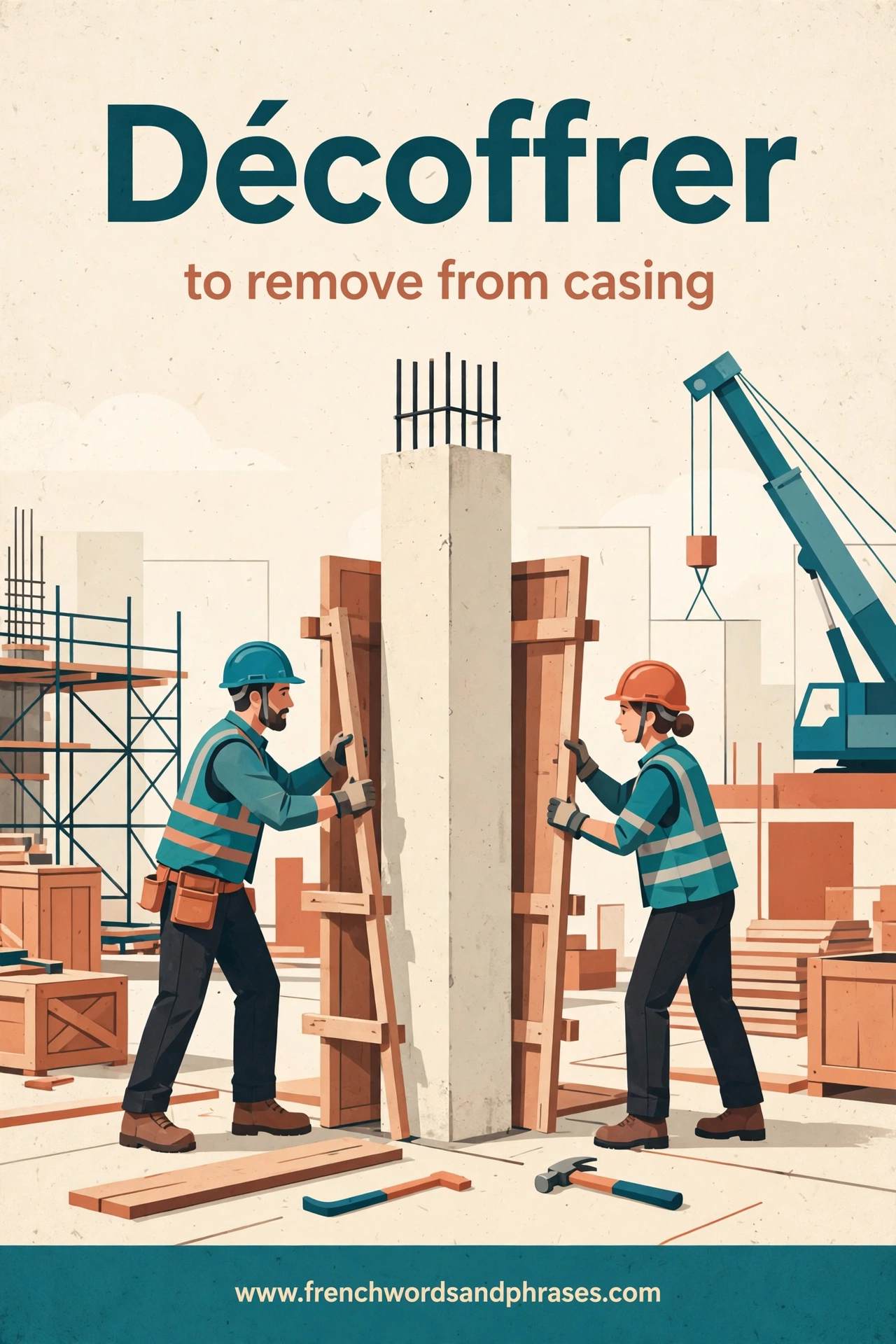
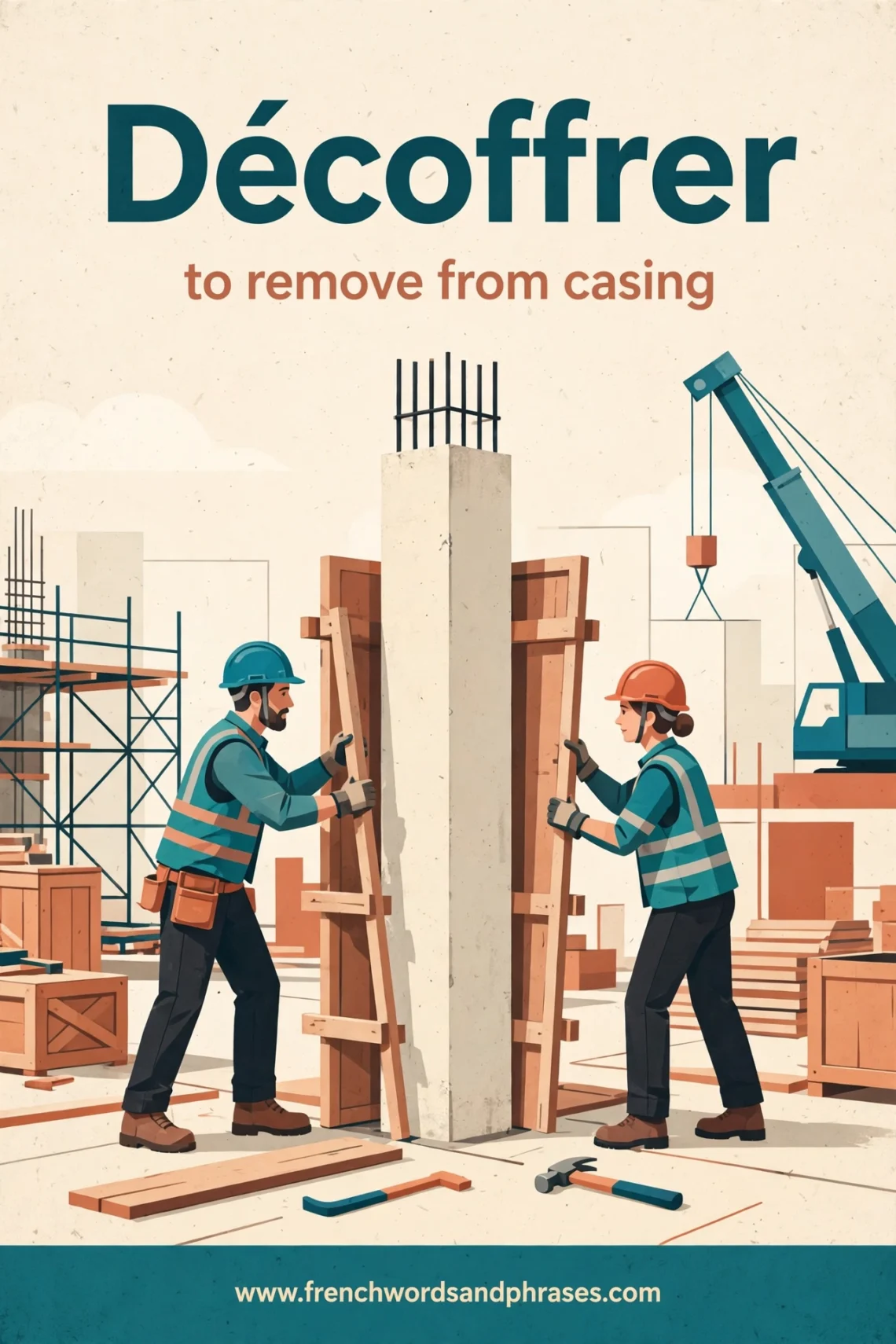
Décoffrer means to remove from casing — in building, to take the formwork off set concrete.
Timber panels coming away from a grey wall, and the concrete standing smooth and free underneath — décoffrer is the building verb of the great reveal, when the mould comes off and the shape stays.
In this guide, you’ll learn how to conjugate décoffrer in all the major French tenses and moods. Explore complete conjugation tables, French examples, English translations, and practice quizzes.
Understanding the French Verb Décoffrer
Décoffrer is a regular French verb belonging to the first group of verbs, those ending in -er.
It means to remove from casing. It is commonly used on building sites for walls, pillars, stairs and slabs once the concrete has hardened, and the noun le décoffrage names the whole operation — a milestone day on any construction schedule.
Verb classification: First group (-er)
Auxiliary verb: Avoir
Past participle: décoffré
Present participle: décoffrant
English equivalents: To remove from casing, to strike the formwork; le coffrage — the formwork, the casing; le décoffrage — the removal of the formwork.
One important detail: décoffrer is built on un coffre, a chest or casing. On a building site, le coffrage is the timber or metal casing into which concrete is poured, and décoffrer is taking that casing away once the concrete has set. Timing is everything: décoffrer trop tôt, and the wall slumps; wait the right number of days, and the concrete stands on its own, smooth as the mould that shaped it.
Experience the Word
Décoffrer is the verb of the reveal — the moment a building stops being a mould and becomes a wall.
Imagine a house going up in a village. For three days the new wall has hidden inside its timber casing while lorries come and go. This morning the builders décoffrent, panel by panel, and the grey wall stands in the sun for the first time.
The casing has done its work and comes away. The concrete has been set free — décoffré, and standing.
How to Conjugate Décoffrer: Complete French Conjugation Guide
Let’s explore every major conjugation of décoffrer, beginning with the indicative mood.
How to Conjugate Décoffrer in the Indicative Mood
The indicative mood is used to express facts, observations, actions, and events.
How to Conjugate Décoffrer in the Present Tense (Présent)
Used for actions happening now, habitual actions, and general truths.
| Subject | Conjugation |
|---|---|
| je | décoffre |
| tu | décoffres |
| il / elle | décoffre |
| nous | décoffrons |
| vous | décoffrez |
| ils / elles | décoffrent |
Example
Les maçons décoffrent le mur après trois jours.
The builders remove the formwork from the wall after three days.
Quick Quiz 1
Complete the sentence:
Nous ______ la dalle ce matin.
Reveal the answer
décoffrons
Nous décoffrons la dalle ce matin.
We strike the slab’s formwork this morning.
How to Conjugate Décoffrer in the Passé Composé
Used for completed actions in the past. Décoffrer takes the auxiliary verb avoir.
| Subject | Conjugation |
|---|---|
| j’ | ai décoffré |
| tu | as décoffré |
| il / elle | a décoffré |
| nous | avons décoffré |
| vous | avez décoffré |
| ils / elles | ont décoffré |
Example
Nous avons décoffré la dalle ce matin.
We struck the formwork from the slab this morning.
How to Conjugate Décoffrer in the Imparfait (Imperfect Tense)
Used for habitual past actions, descriptions, and ongoing situations in the past.
| Subject | Conjugation |
|---|---|
| je | décoffrais |
| tu | décoffrais |
| il / elle | décoffrait |
| nous | décoffrions |
| vous | décoffriez |
| ils / elles | décoffraient |
Example
Autrefois, on décoffrait les poutres après une semaine.
In the old days, people used to remove the casing from beams after a week.
Quick Quiz 2
Choose the correct form:
They removed the formwork too early.
Ils ______ le pilier trop tôt. (ont décoffré / sont décoffrés)
Reveal the answer
ont décoffré
Ils ont décoffré le pilier trop tôt.
Décoffrer takes avoir.
How to Conjugate Décoffrer in the Plus-que-parfait
Used to describe an action that had already been completed before another past event.
| Subject | Conjugation |
|---|---|
| j’ | avais décoffré |
| tu | avais décoffré |
| il / elle | avait décoffré |
| nous | avions décoffré |
| vous | aviez décoffré |
| ils / elles | avaient décoffré |
Example
Ils avaient décoffré le pilier trop tôt.
They had removed the formwork from the pillar too early.
How to Conjugate Décoffrer in the Passé Simple
Primarily used in formal writing, literature, and historical narratives. It is rarely used in everyday conversation.
| Subject | Conjugation |
|---|---|
| je | décoffrai |
| tu | décoffras |
| il / elle | décoffra |
| nous | décoffrâmes |
| vous | décoffrâtes |
| ils / elles | décoffrèrent |
Example
L’équipe décoffra le mur au lever du jour.
The team struck the formwork from the wall at daybreak.
How to Conjugate Décoffrer in the Passé Antérieur
A literary tense used to express an action completed immediately before another past action, generally in the passé simple.
| Subject | Conjugation |
|---|---|
| j’ | eus décoffré |
| tu | eus décoffré |
| il / elle | eut décoffré |
| nous | eûmes décoffré |
| vous | eûtes décoffré |
| ils / elles | eurent décoffré |
Example
Quand ils eurent décoffré la dalle, le béton apparut lisse et net.
When they had removed the casing from the slab, the concrete appeared smooth and clean.
How to Conjugate Décoffrer in the Future Tense (Futur Simple)
Used to describe actions that will take place in the future.
| Subject | Conjugation |
|---|---|
| je | décoffrerai |
| tu | décoffreras |
| il / elle | décoffrera |
| nous | décoffrerons |
| vous | décoffrerez |
| ils / elles | décoffreront |
Example
Demain, nous décoffrerons l’escalier.
Tomorrow, we will remove the formwork from the staircase.
How to Conjugate Décoffrer in the Futur Antérieur (Future Perfect)
Used for an action that will have been completed before a particular point in the future.
| Subject | Conjugation |
|---|---|
| j’ | aurai décoffré |
| tu | auras décoffré |
| il / elle | aura décoffré |
| nous | aurons décoffré |
| vous | aurez décoffré |
| ils / elles | auront décoffré |
Example
À la fin de la semaine, ils auront décoffré tout le rez-de-chaussée.
By the end of the week, they will have struck the formwork from the whole ground floor.
How to Conjugate Décoffrer in the Near Future (Futur Proche)
Used to describe something that is going to happen soon. Formed with aller + infinitive.
| Subject | Conjugation |
|---|---|
| je | vais décoffrer |
| tu | vas décoffrer |
| il / elle | va décoffrer |
| nous | allons décoffrer |
| vous | allez décoffrer |
| ils / elles | vont décoffrer |
Example
Je vais décoffrer la première marche.
I am going to remove the casing from the first step.
How to Conjugate Décoffrer in the Conditional Mood
The conditional mood expresses what would happen under certain circumstances. It is also frequently used to make polite requests or express wishes.
How to Conjugate Décoffrer in the Present Conditional
| Subject | Conjugation |
|---|---|
| je | décoffrerais |
| tu | décoffrerais |
| il / elle | décoffrerait |
| nous | décoffrerions |
| vous | décoffreriez |
| ils / elles | décoffreraient |
Example
Avec ce béton rapide, on décoffrerait dès demain.
With this quick concrete, we could remove the formwork as early as tomorrow.
How to Conjugate Décoffrer in the Past Conditional
| Subject | Conjugation |
|---|---|
| j’ | aurais décoffré |
| tu | aurais décoffré |
| il / elle | aurait décoffré |
| nous | aurions décoffré |
| vous | auriez décoffré |
| ils / elles | auraient décoffré |
Example
Il aurait décoffré plus tôt si le temps avait été sec.
He would have removed the formwork earlier if the weather had been dry.
Décoffrer in the Literary Past Conditional Form
This less common literary form uses the imperfect subjunctive of avoir.
| Subject | Conjugation |
|---|---|
| j’ | eusse décoffré |
| tu | eusses décoffré |
| il / elle | eût décoffré |
| nous | eussions décoffré |
| vous | eussiez décoffré |
| ils / elles | eussent décoffré |
Example
Les maçons eussent décoffré le mur avant la pluie.
The builders would have struck the formwork before the rain.
How to Conjugate Décoffrer in the Subjunctive Mood
The subjunctive is used to express wishes, emotions, doubts, necessity, and uncertainty. It frequently follows expressions such as il faut que (it is necessary that) or bien que (although).
How to Conjugate Décoffrer in the Present Subjunctive
| Subject | Conjugation |
|---|---|
| que je | décoffre |
| que tu | décoffres |
| qu’il / qu’elle | décoffre |
| que nous | décoffrions |
| que vous | décoffriez |
| qu’ils / qu’elles | décoffrent |
Example
Il faut que vous décoffriez le mur sans l’abîmer.
You must remove the formwork from the wall without damaging it.
Quick Quiz 3
Complete the sentence using the subjunctive:
Il faut que vous ______ le mur doucement.
Reveal the answer
décoffriez
Il faut que vous décoffriez le mur doucement.
You must remove the formwork from the wall gently.
How to Conjugate Décoffrer in the Imperfect Subjunctive
A literary tense, rarely encountered in modern spoken French.
| Subject | Conjugation |
|---|---|
| que je | décoffrasse |
| que tu | décoffrasses |
| qu’il / qu’elle | décoffrât |
| que nous | décoffrassions |
| que vous | décoffrassiez |
| qu’ils / qu’elles | décoffrassent |
Example
Le chef voulait que l’équipe décoffrât les piliers lundi.
The foreman wanted the team to strike the pillars’ formwork on Monday.
How to Conjugate Décoffrer in the Pluperfect Subjunctive
A literary construction used to express an action completed before another past action.
| Subject | Conjugation |
|---|---|
| que j’ | eusse décoffré |
| que tu | eusses décoffré |
| qu’il / qu’elle | eût décoffré |
| que nous | eussions décoffré |
| que vous | eussiez décoffré |
| qu’ils / qu’elles | eussent décoffré |
Example
On craignait qu’ils eussent décoffré la dalle trop tôt.
People feared they had removed the casing from the slab too early.
How to Conjugate Décoffrer in the Past Subjunctive
| Subject | Conjugation |
|---|---|
| que j’ | aie décoffré |
| que tu | aies décoffré |
| qu’il / qu’elle | ait décoffré |
| que nous | ayons décoffré |
| que vous | ayez décoffré |
| qu’ils / qu’elles | aient décoffré |
Example
Je suis content que vous ayez décoffré le mur à temps.
I am glad you removed the formwork from the wall in time.
How to Conjugate Décoffrer in the Imperative
The imperative is used to give commands, instructions, invitations, or suggestions. Subject pronouns are omitted.
How to Conjugate Décoffrer in the Present Imperative
| Person | Conjugation |
|---|---|
| (tu) | décoffre |
| (nous) | décoffrons |
| (vous) | décoffrez |
Example
Décoffrez la dalle demain matin !
Strike the formwork from the slab tomorrow morning!
Quick Quiz 4
How would you say Remove the casing from the step (tu form)?
Reveal the answer
Décoffre la marche !
French Participles of Décoffrer
Participles are verb forms that can be used in compound tenses and other grammatical constructions.
Present Participle of Décoffrer
décoffrant
En décoffrant le pilier, il a découvert une fissure.
While removing the formwork from the pillar, he discovered a crack.
Past Participle of Décoffrer
décoffré
Décoffré après trois jours, le mur tenait parfaitement.
With its casing removed after three days, the wall stood perfectly.
Décoffrer in Everyday French: Real-Life Examples
Now that you know the conjugations, let’s see how décoffrer appears in everyday French.
Example 1 — Present
Les maçons décoffrent le mur après trois jours.
The builders strike the wall’s formwork after three days.
Example 2 — Passé composé
Nous avons décoffré la dalle ce matin.
We removed the casing from the slab this morning.
Example 3 — Imparfait
On décoffrait les poutres après une semaine.
People used to remove the casing from beams after a week.
Example 4 — Future
Nous décoffrerons l’escalier demain.
We will strike the staircase formwork tomorrow.
Example 5 — Conditional
On décoffrerait dès demain avec ce béton.
We could remove the formwork tomorrow with this concrete.
Example 6 — Imperative
Décoffrez les piliers lundi matin !
Strike the pillars’ formwork on Monday morning!
Beyond Translation: The Meaning of Décoffrer
English building sites say strike the formwork or strip the shuttering — phrases, not a verb; French décoffrer packs the whole operation into one word.
Every French building has its décoffrage day.
It is the day the casing comes off and everyone sees, for the first time, whether the concrete is beautiful — the builder’s moment of truth.
How to Remember the French Verb Décoffrer
Remember it this way: Décoffrer is about the casing coming off, and the concrete standing free.
- Un coffre is a casing; le coffrage is the formwork — décoffrer takes it off.
- Le décoffrage — the day the casing comes off set concrete.
- Regular -er: je décoffre, nous décoffrons, past participle décoffré.
The key idea is the casing coming off, and the concrete standing free.
Test Your Knowledge of Décoffrer
Let’s see how much you’ve learned. Try answering these questions before revealing the answers.
Question 1
What is le coffrage?
Reveal the answer
The formwork — the casing into which concrete is poured.
Question 2
How do you say We removed the casing from the slab in French?
Reveal the answer
Nous avons décoffré la dalle.
Question 3
Translate: The builders strike the formwork after three days.
Reveal the answer
Les maçons décoffrent après trois jours.
Question 4
What is the past participle of décoffrer?
Reveal the answer
Décoffré.
Question 5
Complete the sentence:
Il faut que vous ______ le mur sans l’abîmer.
Reveal the answer
décoffriez
Il faut que vous décoffriez le mur sans l’abîmer.
You must remove the formwork from the wall without damaging it.
Your Final Challenge
Can You Use It?
How would you say this in French?
The builders remove the casing from the last wall, and the house finally shows its true face.
Reveal the answer
Les maçons décoffrent le dernier mur, et la maison montre enfin son vrai visage.
The builders remove the casing from the last wall, and the house finally shows its true face.
A little French. A little curiosity. A richer everyday life.
LEARN FRENCH ONE WORD AT A TIME