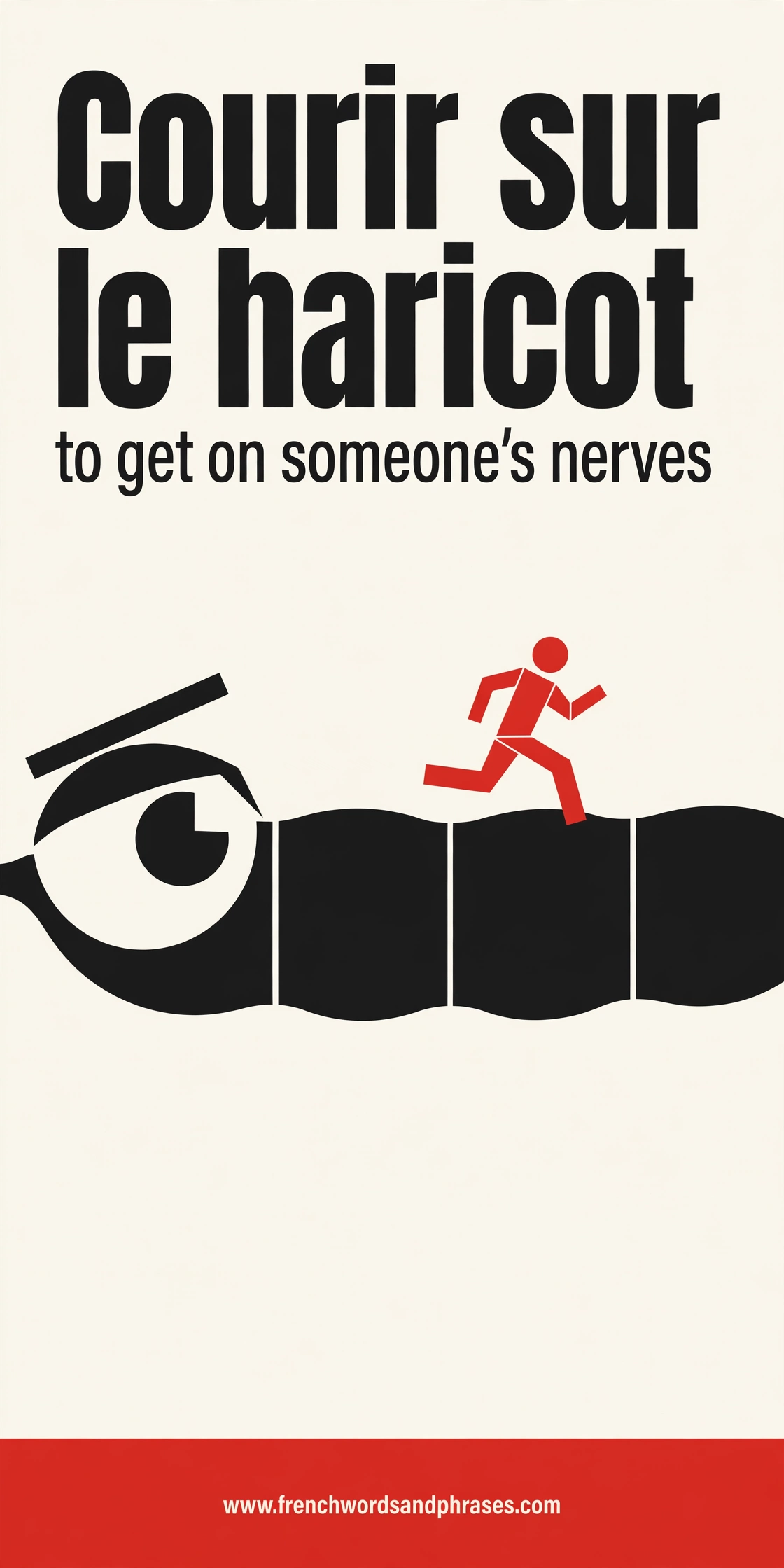
A French Word to Live By
Translate Courir sur le haricot to English
/ku.ʁiʁ syʁ lə a.ʁi.ko/
Courir sur le haricot means to get on someone’s nerves — to annoy them again and again until patience runs out.
All morning, the intern has been drumming his pen on the desk, humming the same three notes, and asking questions that were answered in the meeting. At the fourth round of drumming, the whole open-plan office hears the sentence escape from the corner desk: « Tu me cours sur le haricot, toi ! »
Let’s explore how courir sur le haricot works in French, beginning with the whole phrase on one card.
Understanding the French Phrase Courir sur le haricot
Courir sur le haricot is a French idiomatic expression built from courir (to run) and le haricot (the bean). It belongs to a small family of courir phrases where running on something small and precious — a bean, a system — means wearing it down. In living French it almost always arrives with its victim attached: tu me cours sur le haricot, you’re getting on my nerves.
It means to get on someone’s nerves — to irritate them persistently, in small repeated doses, until the patience snaps. Nobody is running and no beans are harmed: the picture is of someone trampling back and forth over the last small green thing that was keeping you calm. It is exasperated, familiar, and usually said straight to the person doing the trampling.
Type: Idiomatic expression — annoyance (verb + sur + noun)
Answers the need: Telling someone their little habits are driving you mad
Register: Familiar and humorous — spoken, direct, for people you know well
Strength: Exasperated but comic — a warning shot, not a declaration of war
One important usage detail: the victim travels inside the phrase as a little pronoun before cours — tu me cours sur le haricot, il lui court sur le haricot, ils nous courent sur le haricot. Said without the pronoun, courir sur le haricot sounds like a dictionary entry; said with it, it is the living sentence, aimed at the drummer, the hummer, the question-asker.
Experience the Word
Courir sur le haricot is annoyance measured in footsteps — nobody has done one terrible thing; they have done one small thing four hundred times.
Imagine the long train journey: the passenger opposite taps his foot, cracks his knuckles, unwraps sweets at geological speed, and sighs like a small accordion. No single act justifies a scene. Together, they are a marathon run across your very last bean. That is exactly the phrase’s territory.
French anger has artillery for enemies. For the pen-drummers of the world, it keeps a bean — and the comedy is the mercy in it.
How to Use Courir sur le haricot in French: Complete Guide
Let’s explore how courir sur le haricot works in French, beginning with the whole phrase on one card.
Courir sur le haricot at a Glance
The Whole Phrase on One Card
Real meaning, literal picture, English twin and register — courir sur le haricot in five lines.
| Point | Courir sur le haricot |
|---|---|
| What it really means | to get on someone’s nerves, persistently |
| Word for word | to run on the bean |
| English equivalent | to get on someone’s nerves / to drive someone up the wall |
| Register | familiar and humorous — direct speech, people you know |
| Use it for | pen-drumming, humming, repeated questions, small habits repeated forever |
Example
Arrête de siffler, tu me cours sur le haricot.
Stop whistling, you’re getting on my nerves.
Word by Word: Building the Trampled Bean
Three small pieces — take them one by one and the patience is already wearing thin.
| Word | Literal meaning | Its job in the phrase |
|---|---|---|
| courir | to run | the endless back-and-forth — the annoyance never sits still |
| sur | on, on top of | the trampling preposition: the running happens on something of yours |
| le haricot | the bean | the small green victim — old slang pictures your patience as one last bean |
Example
Ce bruit de fond me court sur le haricot depuis ce matin.
That background noise has been getting on my nerves since this morning.
Quick Quiz 1
Where does the victim of the annoyance appear in tu me cours sur le haricot?
Reveal the answer
In the little word me, tucked before cours — the phrase carries its victim inside it.
Il lui court sur le haricot avec ses questions.
He gets on her nerves with his questions.
When You Say It: The Nerve-Grating Moments
Courir sur le haricot fires at moments like these — small acts, repeated past all patience.
| Situation | Example |
|---|---|
| The pen-drummer | tu me cours sur le haricot avec ton stylo — you’re getting on my nerves with that pen |
| The hummer | il me court sur le haricot à force de chanter faux — he gets on my nerves, singing out of tune non-stop |
| Repeated questions | les enfants lui courent sur le haricot depuis une heure — the children have been getting on her nerves for an hour |
| A dripping tap | ce robinet qui goutte me court sur le haricot — that dripping tap is getting on my nerves |
| The final warning | tu commences à me courir sur le haricot — you’re starting to get on my nerves |
Example
Tu commences sérieusement à me courir sur le haricot.
You’re seriously starting to get on my nerves.
Make It Yours: The Bean for Every Victim
Courir conjugates, the pronoun names the victim — the bean survives them all, barely.
| Form | French | In English |
|---|---|---|
| You’re getting on my nerves | tu me cours sur le haricot | you’re getting on my nerves |
| He gets on her nerves | il lui court sur le haricot | he gets on her nerves |
| They got on our nerves | ils nous ont couru sur le haricot | they got on our nerves |
| Starting to | tu commences à me courir sur le haricot | you’re starting to get on my nerves |
| With the cause | tu me cours sur le haricot avec cette musique | you’re getting on my nerves with that music |
| Question | je te cours sur le haricot, moi ? | am I getting on your nerves? |
Example
Je te cours sur le haricot, moi ? Pardon, je me tais.
Am I getting on your nerves? Sorry, I’ll be quiet.
Quick Quiz 2
Complete the sentence: « Elle ______ court sur le haricot avec ses histoires. » (She gets on his nerves.)
Reveal the answer
lui — the victim pronoun goes before court: elle lui court sur le haricot.
Elle lui court sur le haricot avec ses histoires.
She gets on his nerves with her stories.
Everyday Expressions: Building on the Bean
Courir sur le haricot slots into these everyday frames — each one ready to use as it stands.
| Frame | In English |
|---|---|
| courir sur le haricot à quelqu’un | to get on someone’s nerves |
| tu me cours sur le haricot | you’re getting on my nerves |
| commencer à courir sur le haricot | to start getting on someone’s nerves |
| courir sur le haricot avec quelque chose | to get on someone’s nerves with something |
| à force, ça court sur le haricot | in the end, it gets on your nerves |
Example
À force d’entendre cette sonnerie, ça me court sur le haricot.
Hearing that ringtone over and over gets on my nerves.
Close Cousins: The Other Nerve-Grinders
French has a whole shelf of annoyance phrases — the bean is the comic one; its cousins strike the nerves directly or break the feet.
| Expression | The difference |
|---|---|
| courir sur le haricot | to get on someone’s nerves — familiar, comic, the trampled bean |
| taper sur les nerfs | to get on someone’s nerves — the standard version, nerves named outright |
| porter sur les nerfs | to weigh on someone’s nerves — a close twin of taper, slightly softer |
| casser les pieds à quelqu’un | to annoy or bore someone stiff — the feet break instead of the bean |
| courir sur le système | the same running, on ‘the system’ — a known variant, equally familiar |
| énerver | to annoy, to get on someone’s nerves — the plain verb, any register |
Example
Sa musique me tape sur les nerfs, son chant me court sur le haricot.
His music gets on my nerves, his singing drives me up the wall.
Quick Quiz 3
Which cousin names the nerves directly and works in almost any company?
Reveal the answer
Taper sur les nerfs — ‘to hit on the nerves’; the bean is the familiar, comic version of the same complaint.
Ce bruit me tape sur les nerfs depuis ce matin.
That noise has been getting on my nerves since this morning.
Courir sur le haricot and Its Neighbours
The annoyance shelf around the phrase — the grating, the patience, and the calm at the end of both.
| French | In English |
|---|---|
| les nerfs | the nerves — the true battlefield |
| la patience | patience — what the running wears away |
| agaçant | annoying, irritating |
| supporter | to put up with, to bear |
| un haricot vert | a green bean — the innocent vegetable |
| se calmer | to calm down — the peace treaty |
Example
Ma patience a des limites, et ce tambourinement les atteint.
My patience has limits, and this drumming is reaching them.
Watch Out: The Traps Around Courir sur le haricot
The traps: a real vegetable, a victim who must be named, and a bean that is not for eating here.
| Trap | The truth |
|---|---|
| the garden trap | des haricots verts is a side dish; the haricot of the phrase is trampled patience, not dinner |
| the victim is grammatical | without me, lui or nous inside the sentence, you have a dictionary entry, not the living complaint |
| courir’s other lives | courir also means to run races, to chase (courir après) and to be rife (un bruit court, a rumour is going round) — only sur le haricot grates the nerves |
| familiar, not formal | to a boss or in writing, say cela m’agace or cela m’irrite — the bean stays among friends and family |
Example
Au menu : des haricots verts. Dans le bureau : un collègue qui me court sur le haricot.
On the menu: green beans. In the office: a colleague who gets on my nerves.
Quick Quiz 4
True or false: courir sur le haricot is the polite, formal way to complain about a colleague.
Reveal the answer
False — it is familiar and comic. In formal settings, French says cela m’agace or cela m’irrite.
Entre collègues proches, le haricot passe ; dans un rapport, jamais.
Between close colleagues the bean is fine; in a report, never.
Courir sur le haricot in Everyday French: Real-Life Examples
Now that you know the word, let’s see how courir sur le haricot appears in everyday French.
Example 1 — The pen-drummer
Tu me cours sur le haricot avec ton stylo depuis ce matin.
You’ve been getting on my nerves with that pen since this morning.
Example 2 — The dripping tap
Ce robinet qui goutte me court sur le haricot.
That dripping tap is getting on my nerves.
Example 3 — The children
Les enfants courent sur le haricot de leur grand-mère.
The children are getting on their grandmother’s nerves.
Example 4 — The warning
Attention, tu commences à me courir sur le haricot.
Careful, you’re starting to get on my nerves.
Example 5 — The ringtone
Sa sonnerie me court sur le haricot à chaque appel.
His ringtone gets on my nerves with every call.
Example 6 — The apology
Pardon si je te cours sur le haricot, je suis stressé.
Sorry if I’m getting on your nerves, I’m stressed.
Beyond Translation: The Meaning of Courir sur le haricot
English grinds its annoyance into the nerves themselves — to get on someone’s nerves, raw anatomy. French, characteristically, goes to the kitchen garden: your patience is a bean, small, green and defenceless, and the irritating person is running laps on it. The absurdity is the point — it is very hard to stay furious inside a picture that silly.
Courir sur le haricot is exasperation with its boots on and its sense of humour intact.
Say it, and half the anger leaves with the laugh. The bean is trampled, but the friendship usually survives.
How to Remember the French Phrase Courir sur le haricot
Remember it this way: Courir sur le haricot is your patience pictured as one small bean — and the annoying person running laps across it in boots.
- You picture the bean — small, green, trampled: that is your patience after the four hundredth pen-tap.
- You carry the victim inside — tu me cours, il lui court: the pronoun before the verb names whose nerves.
- You keep the standard cousin ready — taper sur les nerfs for company where a bean would raise eyebrows.
The key idea is courir sur le haricot means to get on someone’s nerves — patience trampled like a bean.
Test Your Knowledge of Courir sur le haricot
Let’s see how much you’ve learned. Try answering these questions before revealing the answers.
Question 1
What does courir sur le haricot mean?
Reveal the answer
To get on someone’s nerves — to annoy them persistently, in small repeated doses.
Question 2
What is the literal picture?
Reveal the answer
Running on a bean — your patience is the bean, and the irritating person tramples it back and forth.
Question 3
How do you say ‘you’re getting on my nerves’?
Reveal the answer
Tu me cours sur le haricot — the victim, me, sits inside the phrase before cours.
Question 4
What is the standard cousin that names the nerves directly?
Reveal the answer
Taper sur les nerfs — to get on someone’s nerves, usable in almost any company.
Question 5
Complete the sentence:
Tu me cours sur le ______. (You’re getting on my nerves.)
Reveal the answer
haricot
Tu me cours sur le haricot.
You’re getting on my nerves.
Your Final Challenge
Can You Use It?
How would you say this in French?
“You’re really getting on my nerves.”
Reveal the answer
Tu me cours vraiment sur le haricot.
You’re really getting on my nerves.
A little French. A little curiosity. A richer everyday life.
LEARN FRENCH ONE WORD AT A TIME