A French Word to Live By
Translate Copine to English
/kɔ.pin/
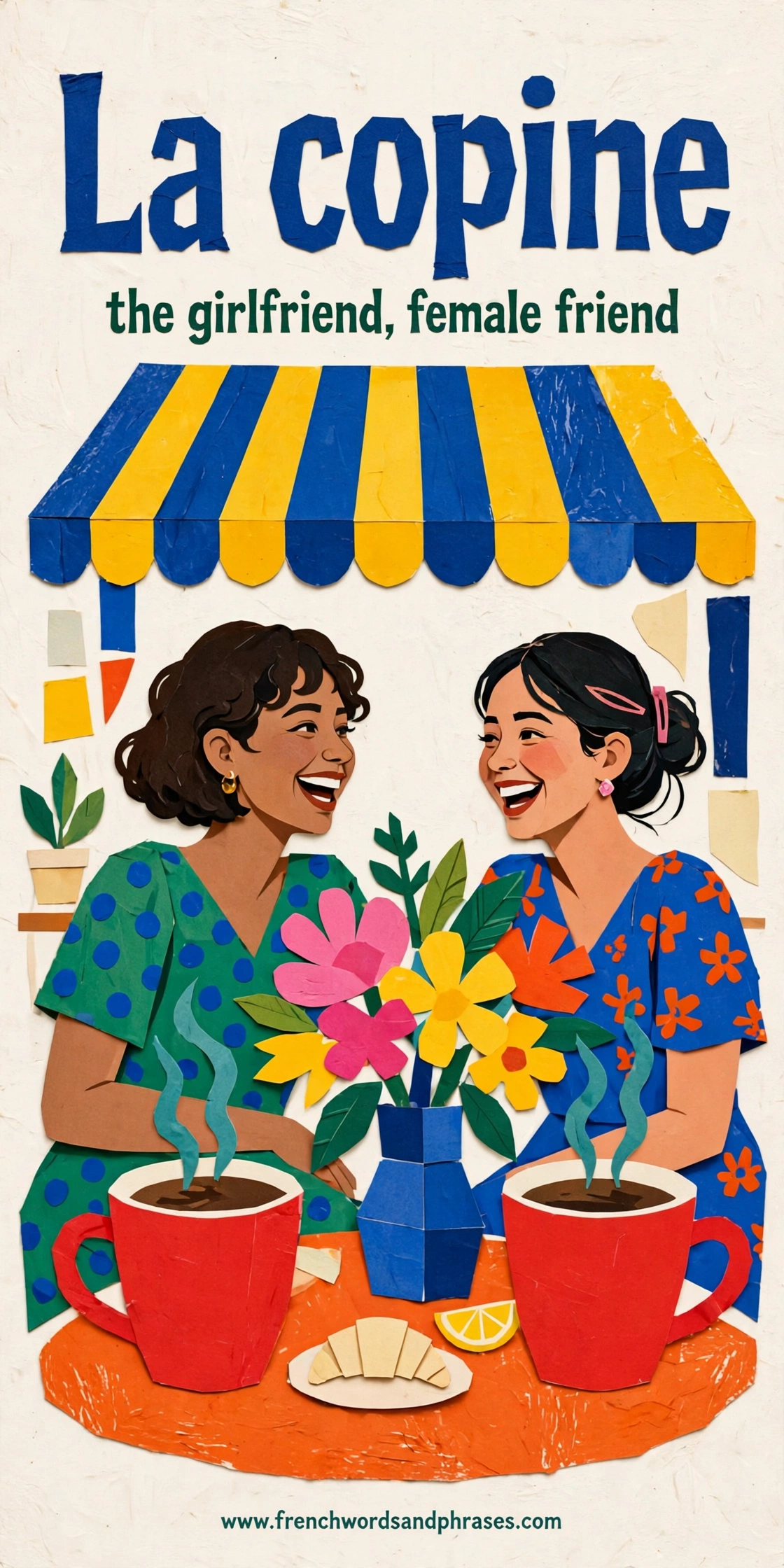
La copine means the girlfriend, female friend.
She is the one who gets the first text, the spare key, the truth before anyone else — and, depending on the sentence, she may also be the one holding his hand: la copine is both the girlfriend and the female friend, the mate, the pal. French lets one warm word do both jobs, and lets the smile decide which.
In this guide, you’ll learn what copine means in English, how to use it with its articles, how to form its plural, and how it appears in everyday French. Explore French examples, English translations, and practice quizzes.
Understanding the French Noun Copine
Copine is a feminine French noun, learned with its article: la copine, une copine. It is the feminine of copain, itself from the old French compain — the one you share bread with (Latin com-, with, + panis, bread; the same root as compagnon and company). Plural: les copines. Register: friendly, everyday, young at heart — the office says collègue, the heart says copine.
It means, first, a girlfriend — the female partner in a couple: je te présente ma copine, let me introduce my girlfriend. And second, a female friend, a mate: une copine de classe, a classmate friend; les copines, the girls, the gang of friends. The possessive usually decides: ma copine, said by a man, is his girlfriend; une copine, said by anyone, is a friend. When it matters, French adds a word: une copine à moi, a friend of mine — no romance.
Gender: Feminine — la copine
Definite article: la — la copine (the girlfriend, the friend)
Indefinite article: une — une copine (a girlfriend, a friend)
Plural: les copines — regular, with a simple -s
Two senses: girlfriend (ma copine) and female friend, mate (une copine)
Masculine: le copain — the boyfriend; the mate
English equivalents: The girlfriend; the (female) friend.
The golden rule: ma copine from a boyfriend’s mouth = his girlfriend; une copine from anyone = a friend. Women speaking of their own friends say mes copines without any romantic shadow. At school, une copine de classe is simply a classmate you like. And the bread root is real: copine and copain are the people you break bread with — which is why the word never sounds cold.
Experience the Word
Copine is friendship with the crust still on — the bread shared, the secrets shared, and sometimes the heart shared too.
Imagine the café table at five o’clock: three copines, one pot of tea, and the week’s whole news unpacked in an hour — who is hired, who is loved, who is forgiven. Les copines repartent légères : tout a été dit, tout est gardé.
You have not just named a girl. You have named the friend of the bread and the heart — la copine.
How to Use Copine in French: Complete Guide
Let’s explore how copine works in French, beginning with its articles — la copine, une copine, ma copine.
Copine with the Definite Article (La, Les)
Used for the specific copine — his girlfriend, her best friend, the gang’s heart.
| Form | French |
|---|---|
| Feminine singular | la copine |
| Plural | les copines |
Example
La copine de Max arrive ce soir.
Max’s girlfriend is arriving this evening.
Copine with the Indefinite Article (Une, Des)
Used for a copine in general — a friend being made, a girlfriend being mentioned.
| Form | French |
|---|---|
| Feminine singular | une copine |
| Plural | des copines |
Example
Elle s’est fait une copine à la piscine.
She made a friend at the pool.
Copine with Quantities (Une, Deux, Assez de…)
Copines are counted in gangs and group chats — the more, the louder the laughter.
| Quantity | French |
|---|---|
| one friend | une copine |
| two friends | deux copines |
| several friends | plusieurs copines |
| many friends | beaucoup de copines |
| all the girls (friends) | toutes les copines |
Example
Elle part en vacances avec trois copines.
She is going on holiday with three friends.
Quick Quiz 1
Complete the sentence:
______ copine de Hugo s’appelle Zoé. (the)
Reveal the answer
La
La copine de Hugo s’appelle Zoé.
Hugo’s girlfriend is called Zoé — copine is feminine, so la.
The Plural of Copine
Copine takes a regular plural in -s — the gang assembles easily.
| Number | French |
|---|---|
| Singular | la copine |
| Plural | les copines |
Example
Les copines se retrouvent au café à cinq heures.
The friends meet at the café at five.
Copine with Possessive Adjectives (Ma, Ta, Sa…)
Possessives agree with the noun: copine is feminine, so ma, ta, sa — and ma copine, from a partner, means girlfriend.
| Owner | French |
|---|---|
| my | ma copine |
| your (tu) | ta copine |
| his / her | sa copine |
| our | notre copine |
| your (vous) | votre copine |
| their | leur copine |
Example
Ma copine arrive par le train de six heures.
My girlfriend is arriving on the six o’clock train.
Quick Quiz 2
Complete the sentence:
Il présente ______ copine à ses parents. (his)
Reveal the answer
sa
Il présente sa copine à ses parents.
He introduces his girlfriend to his parents — sa, because copine is feminine.
Copine with Demonstrative Adjectives (Cette, Ces)
Used to point: cette copine, this friend — the one from school, the one from work.
| Form | French |
|---|---|
| Feminine singular | cette copine |
| Plural | ces copines |
Example
Cette copine-là connaît tous mes secrets.
That friend knows all my secrets.
Copine with Adjectives
Adjectives agree with copine — feminine singular, feminine plural for the gang.
| Adjective | With Copine |
|---|---|
| meilleure (best) | ma meilleure copine |
| nouvelle (new) | une nouvelle copine |
| ancienne (old, long-standing) | une ancienne copine |
| proche (close) | une copine proche |
| fidèles (loyal, plural) | des copines fidèles |
Example
Ma meilleure copine s’appelle Sarah.
My best friend is called Sarah.
Quick Quiz 3
Max says: « Je te présente ma copine. » Is she his friend or his girlfriend?
Reveal the answer
His girlfriend — ma copine, presented by a partner, is the girlfriend; une copine is a friend.
Une copine à moi arrive aussi. — A friend of mine is coming too.
Everyday Expressions with Copine
Schoolyards, group chats and presentations — the copine phrases of daily life.
| Expression | In English |
|---|---|
| ma copine | my girlfriend (from a partner); my friend (between women) |
| une copine de classe | a classmate friend |
| les copines | the girls, the gang of friends |
| se faire une copine | to make a (female) friend |
| une copine à moi | a friend of mine (no romance) |
Example
Les copines organisent une surprise pour son anniversaire.
The friends are organising a surprise for her birthday.
Words from the Same Family as Copine
The bread-sharing shelf — copine’s family of French words.
| French | In English |
|---|---|
| le copain | the boyfriend; the mate, pal |
| le compagnon | the companion, partner (the serious cousin) |
| l’amie | the (female) friend — the neutral word |
| le pain | bread — the root inside copain and copine |
| la bande de copines | the gang of friends |
Example
Le copain et la copine partagent le pain et les secrets.
The boyfriend and girlfriend share bread and secrets.
Quick Quiz 4
What food hides inside the word copine?
Reveal the answer
Bread — copain and copine come from sharing pain (bread): the companion is the bread-sharer.
Copine, copain : ceux avec qui on partage le pain. — Those with whom you share bread.
Copine in Everyday French: Real-Life Examples
Now that you know the word, let’s see how copine appears in everyday French.
Example 1 — Introductions
Je te présente ma copine, Zoé.
Let me introduce my girlfriend, Zoé.
Example 2 — School
Ma copine de classe m’aide en maths.
My classmate friend helps me with maths.
Example 3 — The gang
Les copines se retrouvent samedi pour un pique-nique.
The girls are meeting on Saturday for a picnic.
Example 4 — New friend
Elle s’est fait une copine à la danse.
She made a friend at dance class.
Example 5 — Best friend
Ma meilleure copine connaît toute ma vie.
My best friend knows my whole life.
Example 6 — No romance
C’est une copine à moi, rien de plus.
She’s a friend of mine, nothing more.
Beyond Translation: The Meaning of Copine
Copine carries bread in her name: com-panis, the with-bread person. Latin made companion from it, French made copain, and the feminine copine followed — the friend you eat with, which in France is the friend you trust. The double sense, girlfriend and mate, is not carelessness: French lets affection grade itself, and context — a hand held, a possessive used — does the fine work.
To say copine is to name the girl of the shared table — friend of the bread, and maybe of the heart.
LanGeek’s source printed « la copin », a typo; the word is copine, with its feminine e intact.
How to Remember the French Noun Copine
Remember it this way: Copine is the girlfriend and the female friend in one warm word — ma copine decides for romance, une copine for friendship.
- Always feminine — la copine, une copine, ma copine.
- The possessive decides — ma copine (d’un amoureux) = petite amie ; une copine = une amie.
- Bread inside — copine, copain : on partage le pain et les secrets.
The key idea is la copine — the girlfriend, the female friend; masculine le copain; root: sharing bread (pain).
Test Your Knowledge of Copine
Let’s see how much you’ve learned. Try answering these questions before revealing the answers.
Question 1
Is copine masculine or feminine?
Reveal the answer
Feminine — la copine, une copine.
Question 2
How do you say my best friend (female)?
Reveal the answer
Ma meilleure copine.
Question 3
Translate: He introduces his girlfriend to his parents.
Reveal the answer
Il présente sa copine à ses parents.
Question 4
What are the two senses of copine?
Reveal the answer
Girlfriend (ma copine, from a partner) and female friend, mate (une copine).
Question 5
Complete the sentence:
______ copines se retrouvent au café. (the)
Reveal the answer
Les
Les copines se retrouvent au café.
The friends meet at the café.
Your Final Challenge
Can You Use It?
How would you say this in French?
“Let me introduce my girlfriend, Zoé.”
Reveal the answer
Je te présente ma copine, Zoé.
Let me introduce my girlfriend, Zoé.
A little French. A little curiosity. A richer everyday life.
LEARN FRENCH ONE WORD AT A TIME