A French Word to Live By
Translate Coloré to English
/kɔ.lɔ.ʁe/
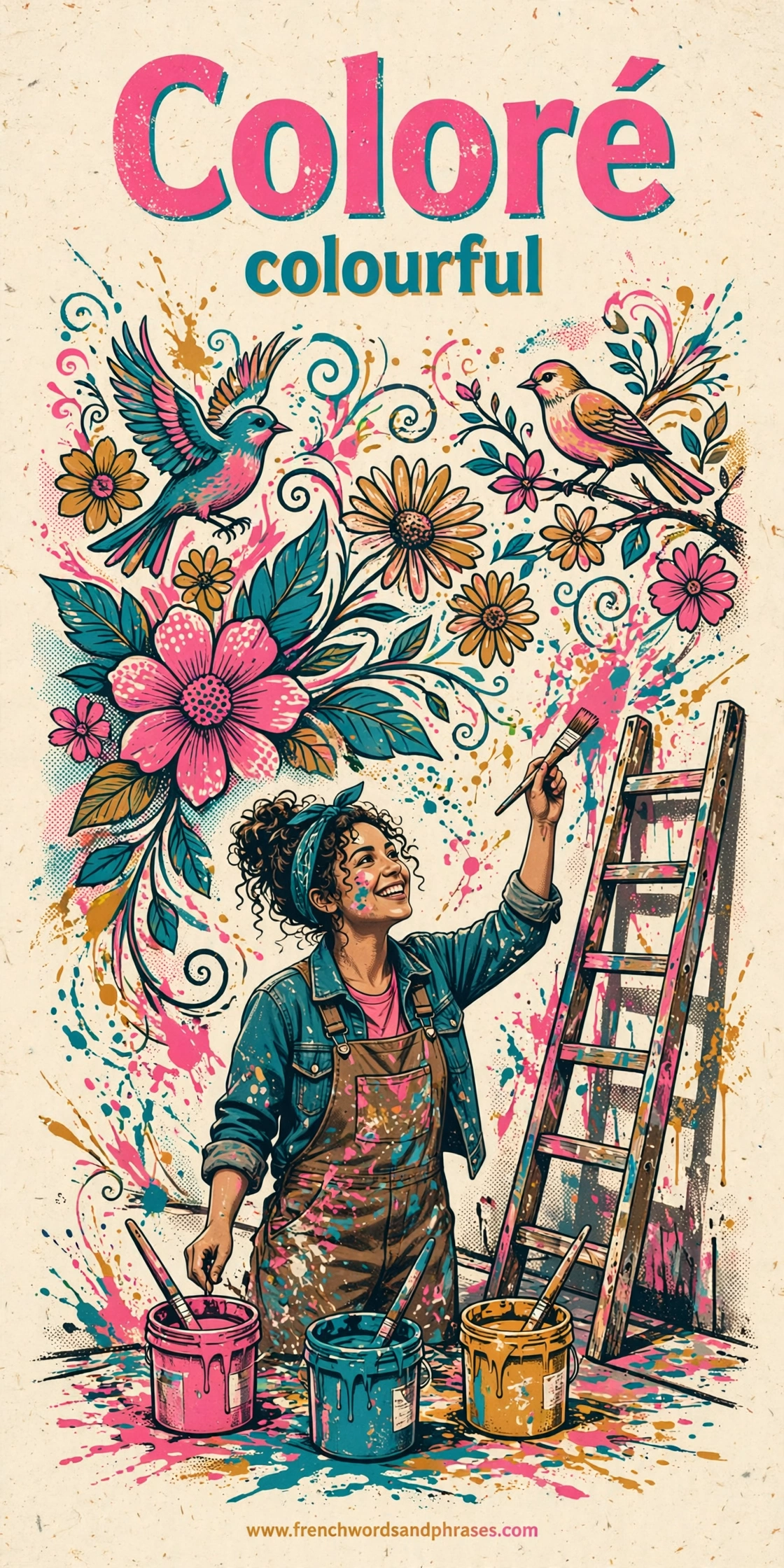
Coloré means colourful.
Red shutters, yellow awnings, blue doors, a market of peppers in five shades of fire: coloré, colourful — the adjective of everything that refuses to be beige, grey or plain.
In this guide, you’ll learn what coloré means in English, how its feminine colorée is formed, where it stands in the sentence, and how French uses it for lively speech and vivid stories as well as for bright cloth. Explore French examples, English translations, and practice quizzes.
Understanding the French Adjective Coloré
Coloré is a French adjective of colour and vividness. It is the past participle of colorer, to colour, and it agrees like one: coloré, colorée, colorés, colorées — un tissu coloré, une rue colorée. Beyond literal colour it describes anything vivid and lively: un récit coloré, a colourful account; un langage coloré, colourful — sometimes frankly fruity — language.
It means colourful — rich in colours, bright and varied: une robe colorée, a colourful dress; des maisons colorées, colourful houses; un marché coloré, a colourful market. In its figurative life it praises vividness: une description colorée, a vivid description — or warns of it: un langage coloré, strong, colourful language not meant for polite company. The opposite shelf holds terne, dull, and uni, plain solid colour.
Type: Adjective of colour and vividness — bright, varied, lively
Answers the question: What is it like? — rich in colour, or vivid in expression
Changes form: Feminine colorée — coloré / colorée; plurals colorés / colorées
English equivalents: Colourful; brightly coloured; vivid.
One important usage detail: coloré follows the noun or stands after être — une affiche colorée, le tissu est coloré. For a single strong colour French often prefers the colour’s own name (une robe rouge); coloré announces a mixture, a pattern, a whole palette. And handle the figurative sense with care: un langage coloré can mean vivid storytelling — or swearing, depending on the room.
Experience the Word
Coloré is the adjective of the market in full sun — the moment the greys of winter lose and the stalls win.
Imagine the old port street repainted house by house: ochre, rose, turquoise, lime, each door a different decision. La rue colorée devient la carte postale du village, and nobody photographs the grey street behind it any more.
You have not just called something bright. You have praised its whole palette — coloré, colour as a form of joy.
How to Use Coloré in French: Complete Guide
Let’s explore how coloré works in French, beginning with the whole word on one card.
Coloré at a Glance
Before the details, here is the whole word on one card.
The Whole Word on One Card
Meaning, type, position and forms — coloré in four lines.
| Point | Coloré |
|---|---|
| Meaning | colourful — rich in colours; vivid, lively in expression |
| Type | adjective of colour and vividness |
| Usual position | after the noun — une robe colorée |
| Form | coloré / colorée — colorés / colorées in the plural |
Example
Une robe colorée attire tous les regards.
A colourful dress catches every eye.
The Four Forms of Coloré
Coloré is the past participle of colorer, and it agrees like one: -é for him, -ée for her, -s in the plural.
| Form | Coloré | Example |
|---|---|---|
| Masculine singular | coloré | un tissu coloré — a colourful fabric |
| Feminine singular | colorée | une affiche colorée — a colourful poster |
| Masculine plural | colorés | des dessins colorés — colourful drawings |
| Feminine plural | colorées | des maisons colorées — colourful houses |
Example
Des maisons colorées bordent le vieux port.
Colourful houses line the old port.
Quick Quiz 1
What is the feminine of coloré?
Reveal the answer
colorée
Une rue colorée — the -é becomes -ée in the feminine.
A colourful street.
The Feminine of Coloré: Colorée
Colorée is not a separate word to learn later — it is half of this word’s life, formed exactly like the feminine of habillé or décontracté.
| Situation | Example |
|---|---|
| Masculine | un marché coloré — a colourful market |
| Feminine | une écharpe colorée — a colourful scarf |
| Why | adjectives in -é form their feminine in -ée |
| The plural | add s — des écharpes colorées, colourful scarves |
Example
Une écharpe colorée égaye son manteau noir.
A colourful scarf brightens her black coat.
Where Coloré Goes: After the Noun
Coloré follows the noun it describes, like most French adjectives, and it sits naturally after être.
| Pattern | Example |
|---|---|
| After the noun | un jardin coloré — a colourful garden |
| After être | ce tissu est coloré — this fabric is colourful |
| Figurative | un récit coloré — a vivid, colourful account |
| Before the noun | un coloré jardin — not in everyday French |
Example
Le quartier est coloré et vivant.
The district is colourful and lively.
Quick Quiz 2
How do you say ‘a colourful dress’ — une colorée robe or une robe colorée?
Reveal the answer
une robe colorée
Coloré stands after the noun, in its feminine form colorée.
A colourful dress.
More Coloré: Comparing with Coloré
Coloré compares the regular way, with plus, moins and aussi — a scale of brightness.
| Degree | Example |
|---|---|
| As colourful as | aussi coloré que — as colourful as |
| More colourful | plus coloré — more colourful |
| Less colourful | moins coloré — less colourful |
| The most colourful (masc.) | le plus coloré — le plus coloré des marchés |
| The most colourful (fem.) | la plus colorée — la plus colorée des rues |
Example
Ce marché est plus coloré que celui du village.
This market is more colourful than the village one.
Everyday Expressions with Coloré
Coloré paints streets and markets — and, figuratively, stories and language.
| Expression | In English |
|---|---|
| une robe colorée | a colourful dress |
| des maisons colorées | colourful houses |
| un marché coloré | a colourful market |
| un récit coloré | a vivid, colourful account |
| un langage coloré | colourful language — vivid, or frankly strong |
| un dessin coloré | a colourful drawing |
Example
Son récit coloré a fait rire toute la table.
His colourful account made the whole table laugh.
Quick Quiz 3
What can un langage coloré mean?
Reveal the answer
Colourful language
Un langage coloré — vivid, expressive speech, sometimes strong language, depending on the room.
Colourful language.
Coloré and Its Neighbours
Coloré keeps company with the other words of brightness — and faces the dull and the plain.
| French | In English |
|---|---|
| multicolore | multicoloured — many colours at once |
| vif | bright, vivid — une couleur vive |
| éclatant | dazzling, brilliant |
| terne | dull, drab — the opposite |
| uni | plain, solid-coloured — one colour only |
| gris | grey — the colour coloré defeats |
Example
Contre le ciel gris, le marché coloré gagne toujours.
Against the grey sky, the colourful market always wins.
Watch Out: The Traps Around Coloré
The traps here are the participle’s agreement and the difference between a palette and a single colour.
| Trap | The truth |
|---|---|
| The feminine | une affiche colorée — -é becomes -ée, and -s in the plural |
| Palette, not one colour | coloré means a mixture of colours; for one colour, name it — une robe rouge |
| The figurative sense | un langage coloré may be vivid praise or a warning about swearing — read the room |
| Not coloré for skin | French does not use coloré of people; it describes things, scenes and speech |
Example
Une robe colorée n’est pas une robe rouge : c’est toutes les couleurs à la fois.
A colourful dress is not a red dress: it is every colour at once.
Quick Quiz 4
How do you say ‘colourful houses’?
Reveal the answer
des maisons colorées
Coloré follows the noun and agrees with it: feminine plural colorées.
Colourful houses.
Coloré in Everyday French: Real-Life Examples
Now that you know the word, let’s see how coloré appears in everyday French.
Example 1 — A dress
Elle porte une robe colorée pour la fête.
She’s wearing a colourful dress for the party.
Example 2 — Houses
Les maisons colorées du port attirent les photographes.
The colourful houses of the port attract photographers.
Example 3 — A market
Le marché du samedi est bruyant et coloré.
The Saturday market is noisy and colourful.
Example 4 — A drawing
Les enfants font des dessins colorés pour la classe.
The children make colourful drawings for the class.
Example 5 — A story
Il raconte ses voyages d’une manière colorée.
He tells of his travels in a colourful way.
Example 6 — A scarf
Une écharpe colorée sur un manteau noir, parfait.
A colourful scarf on a black coat, perfect.
Beyond Translation: The Meaning of Coloré
Coloré is colorer grown into an adjective — the participle of the colouring hand. French art loved the word’s family: le coloris is a painter’s palette of tones, un coloriste a master of colour, and the Fauves — Matisse at their head — made coloré a manifesto in 1905, when their canvases were called wild precisely for their colour. The figurative sense followed the paint: a story told in bright strokes became un récit coloré.
Coloré is colour let off the leash — the adjective of the palette applied to cloth, streets and stories alike.
Learn it beside multicolore and vif, and against terne and uni: the whole argument between joy and beige is in those five words.
How to Remember the French Adjective Coloré
Remember it this way: Coloré is colourful — coloré for him, colorée for her, a whole palette in one word, for things and for vivid stories.
- You learn the pair together — un tissu coloré, une robe colorée.
- You keep the palette — coloré means many colours ; une seule couleur se nomme : rouge, bleu, vert.
- You keep the vivid sense — un récit coloré, un langage coloré, pleins de vie.
The key idea is coloré / colorée means colourful — of fabrics, streets, markets; figuratively vivid (un récit coloré).
Test Your Knowledge of Coloré
Let’s see how much you’ve learned. Try answering these questions before revealing the answers.
Question 1
What does coloré mean?
Reveal the answer
Colourful — rich in colours; figuratively, vivid and lively.
Question 2
What is the feminine of coloré?
Reveal the answer
colorée — the -é becomes -ée.
Question 3
Translate: a colourful dress.
Reveal the answer
Une robe colorée.
Question 4
Complete the sentence:
Des maisons ______ bordent le port.
Reveal the answer
colorées
Des maisons colorées bordent le port.
Colourful houses line the port.
Question 5
What is the opposite of coloré, for a dull scene?
Reveal the answer
terne — dull, drab; and uni for a single plain colour.
Your Final Challenge
Can You Use It?
How would you say this in French?
“Colourful houses line the old port.”
Reveal the answer
Des maisons colorées bordent le vieux port.
Colourful houses line the old port.
A little French. A little curiosity. A richer everyday life.
LEARN FRENCH ONE WORD AT A TIME