A French Word to Live By
Translate Cheveu to English
/ʃə.vø/
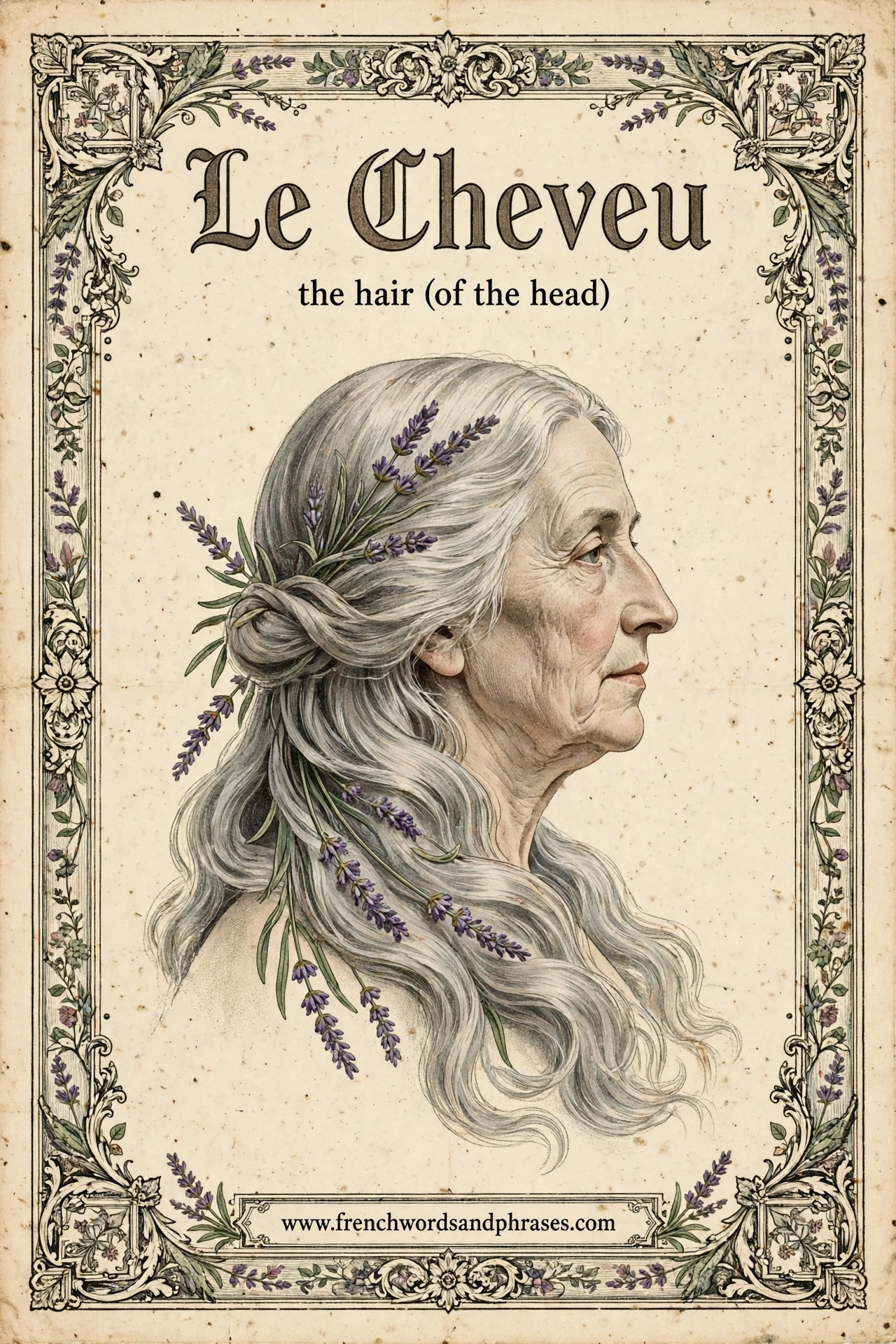
Le Cheveu means the hair (of the head).
At the hairdresser’s, the brush comes away with its usual harvest, and the coiffeuse laughs: « Ne vous inquiétez pas, on perd cent cheveux par jour ! » We lose a hundred hairs a day. Each single one of them is un cheveu — and together, they are your hair.
In this guide, you’ll learn what cheveu means in English, how to use it with its articles, how to form its plural, and how it appears in everyday French. Explore French examples, English translations, and practice quizzes.
Understanding the French Noun Cheveu
Cheveu is a masculine French noun, learned with its article: le cheveu, un cheveu. It is the hair of the human head — and it behaves the opposite way to English: un cheveu is ONE single hair, while your hair as a whole is always plural, les cheveux. For body hair and animal hair, French uses a different word: le poil.
It means a hair — one strand growing on the head. From that single strand, French builds the collective plural les cheveux, your hair: se faire couper les cheveux (to have your hair cut), avoir les cheveux longs (to have long hair). The word also stars in vivid idioms: couper les cheveux en quatre (to split hairs), arriver comme un cheveu sur la soupe (to turn up at the worst possible moment), avoir un cheveu sur la langue (to lisp).
Gender: Masculine — le cheveu, un cheveu
Definite article: le — le cheveu (the hair, one hair)
Indefinite article: un — un cheveu (a single hair)
Plural: les cheveux — your hair as a whole
Not the same word: le poil = body hair, animal hair, a bristle
English equivalents: The hair (of the head); a single hair
One important usage detail: never translate English « hair » word for word. One strand is un cheveu, but « my hair is wet » is mes cheveux sont mouillés — plural, always, for the whole head. And keep cheveu for the head only: the cat’s hair and the hair on your arms are des poils.
Experience the Word
Cheveu is a word of the mirror and the salon. France takes hair seriously — the coiffeur is a confidant, the coupe a small event — and les cheveux carry identity: longs, courts, bouclés, blancs. A first white hair, un cheveu blanc, is a tiny ceremony of time passing.
It is also a word of precision and embarrassment: the single hair found in the soup — un cheveu sur la soupe — became the image of the thing that arrives exactly where and when it is not wanted.
You have not just learned a strand. You have learned how French counts what English refuses to count — one hair at a time.
How to Use Cheveu in French: Complete Guide
Let’s explore how cheveu works in French, beginning with its articles — and with the great rule: one strand singular, the whole head plural.
Cheveu with the Definite Article (Le, Les)
Le cheveu is one hair; les cheveux is your hair, all of it.
| Form | French |
|---|---|
| Singular | le cheveu |
| Plural | les cheveux |
Example
Les cheveux de ma sœur sont longs et bouclés.
My sister’s hair is long and curly.
Cheveu with the Indefinite Article (Un, Des)
Un cheveu is a single strand — the one you find where it should not be.
| Form | French |
|---|---|
| Singular | un cheveu |
| Plural | des cheveux |
Example
Il y a un cheveu dans ma soupe !
There is a hair in my soup!
Cheveu: One Hair, a Whole Head — Quantities
How French measures hair: strand by strand, lock by lock.
| French | In English |
|---|---|
| un cheveu | a single hair |
| une mèche de cheveux | a lock of hair |
| une poignée de cheveux | a handful of hair |
| des cheveux blancs | white (grey) hairs |
| un cheveu sur la langue | a lisp (lit. a hair on the tongue) |
| à un cheveu de | within a hair’s breadth of |
Example
Elle garde une mèche de cheveux de son enfance.
She keeps a lock of hair from her childhood.
Quick Quiz 1
Translate: My hair is wet.
Reveal the answer
Mes cheveux sont mouillés.
Your hair as a whole is always plural in French: les cheveux, mes cheveux — never a singular mass noun.
The Plural of Cheveu
Cheveu makes its plural in -x, not -s: des cheveux.
| Number | French |
|---|---|
| Singular | le cheveu |
| Plural | les cheveux |
Example
Il se brosse les cheveux devant la glace.
He brushes his hair in front of the mirror.
Cheveu with Possessive Adjectives (Mon, Ton, Son…)
In real life you will use the plural forms — mes, tes, ses cheveux — almost every time.
| Owner | French |
|---|---|
| my | mon cheveu / mes cheveux |
| your (tu) | ton cheveu / tes cheveux |
| his / her | son cheveu / ses cheveux |
| our | notre cheveu / nos cheveux |
| your (vous) | votre cheveu / vos cheveux |
| their | leur cheveu / leurs cheveux |
Example
Tes cheveux ont poussé très vite cet été.
Your hair grew very fast this summer.
Quick Quiz 2
What is the plural of cheveu?
Reveal the answer
Cheveux — with an -x.
Un cheveu, des cheveux: cheveu belongs to the small family of nouns whose plural ends in -x.
Cheveu with Demonstrative Adjectives (Ce, Ces)
Ce cheveu for the single strand, ces cheveux for the whole head.
| Form | French |
|---|---|
| Masculine singular | ce cheveu |
| Plural | ces cheveux |
Example
Ces cheveux blancs te vont très bien.
That white hair suits you very well.
Cheveu with Adjectives
Hair adjectives describe the plural les cheveux — length, curl and colour.
| Adjective | With Cheveu |
|---|---|
| long (long) | les cheveux longs |
| bouclé (curly) | les cheveux bouclés |
| blanc (white, grey) | les cheveux blancs |
| fin (fine, thin) | un cheveu fin |
Example
Elle a les cheveux longs jusqu’aux épaules.
She has long hair down to her shoulders.
Quick Quiz 3
A colleague argues for twenty minutes about a comma. In French, what is he doing?
Reveal the answer
Il coupe les cheveux en quatre.
Couper les cheveux en quatre — to cut hairs into four — is the French way to say splitting hairs.
Everyday Expressions with Cheveu
Hair in trouble, hair in soup, hair by a whisker: the idioms are unforgettable.
| Expression | In English |
|---|---|
| se faire couper les cheveux | to have one’s hair cut |
| couper les cheveux en quatre | to split hairs |
| arriver comme un cheveu sur la soupe | to turn up at the worst possible moment |
| avoir un cheveu sur la langue | to lisp, to speak with a lisp |
| à un cheveu de | within a hair’s breadth of |
| s’arracher les cheveux | to tear one’s hair out |
Example
Il est arrivé comme un cheveu sur la soupe, en pleine dispute.
He turned up at the worst possible moment, in the middle of the argument.
Words from the Same Family as Cheveu
Hair and everything that grows, covers and styles it.
| French | In English |
|---|---|
| la chevelure | a head of hair, a mane of hair |
| chevelu | long-haired, hairy (of the head) |
| le cuir chevelu | the scalp |
| capillaire | hair- (produits capillaires, hair products) |
| le poil | body hair, animal hair — the cousin, not the same word |
Example
Sa chevelure rousse attire tous les regards.
Her red head of hair draws every eye.
Quick Quiz 4
How do you say « I am having my hair cut tomorrow »?
Reveal the answer
Je me fais couper les cheveux demain.
Se faire couper les cheveux is the set phrase — with les cheveux in the plural, as always for the whole head.
Cheveu in Everyday French: Real-Life Examples
Now that you know the word, let’s see how cheveu appears in everyday French.
Example 1 — At the hairdresser’s
Je me fais couper les cheveux samedi matin.
I am having my hair cut on Saturday morning.
Example 2 — In the soup
Excusez-moi, il y a un cheveu dans ma soupe.
Excuse me, there is a hair in my soup.
Example 3 — A compliment
Tes cheveux sont magnifiques aujourd’hui.
Your hair looks magnificent today.
Example 4 — Splitting hairs
Arrête de couper les cheveux en quatre, la décision est prise.
Stop splitting hairs, the decision is made.
Example 5 — A near miss
Il a évité l’accident à un cheveu près.
He avoided the accident by a hair’s breadth.
Example 6 — Going grey
Mon père a son premier cheveu blanc à trente ans.
My father got his first white hair at thirty.
Beyond Translation: The Meaning of Cheveu
Cheveu teaches a deep difference between the two languages. English treats hair as an uncountable mass, like water; French counts it, strand by strand — un cheveu, deux cheveux — and then, with the plural, gathers the strands back into the whole head. The idioms grow from the same closeness to the physical thing: a hair in the soup, a hair on the tongue, a hair’s breadth from disaster.
In French, hair is never abstract — it is always one cheveu away from a story.
Remember the division of labour too: cheveu for the head, poil for everything else, and the cat will thank you for the distinction.
How to Remember the French Noun Cheveu
Remember it this way: Cheveu counts what English will not: one strand is un cheveu, and your whole head of hair is the plural, les cheveux — with an -x, like a kiss at the end.
- You find one in the soup — un cheveu, a single hair, singular and unwelcome.
- You book the salon — se faire couper les cheveux, plural for the whole head.
- You spot the cousin — le poil is for the cat; le cheveu is for you.
The key idea is le cheveu, les cheveux — one strand, one head, always counted.
Test Your Knowledge of Cheveu
Let’s see how much you’ve learned. Try answering these questions before revealing the answers.
Question 1
What does cheveu mean?
Reveal the answer
A hair of the head — one single strand. The plural, les cheveux, is your hair as a whole.
Question 2
Is cheveu masculine or feminine?
Reveal the answer
Masculine — le cheveu, un cheveu.
Question 3
What is the plural of cheveu?
Reveal the answer
Cheveux, with an -x: un cheveu, des cheveux.
Question 4
What is the difference between cheveu and poil?
Reveal the answer
Cheveu is the hair of the human head; poil is body hair and animal hair.
Question 5
Translate: She is having her hair cut.
Reveal the answer
Elle se fait couper les cheveux.
Your Final Challenge
Can You Use It?
How would you say this in French?
“She is having her hair cut.”
Reveal the answer
Elle se fait couper les cheveux.
She is having her hair cut.
A little French. A little curiosity. A richer everyday life.
LEARN FRENCH ONE WORD AT A TIME