A French Word to Live By
Translate Chaud to English
/ʃo/
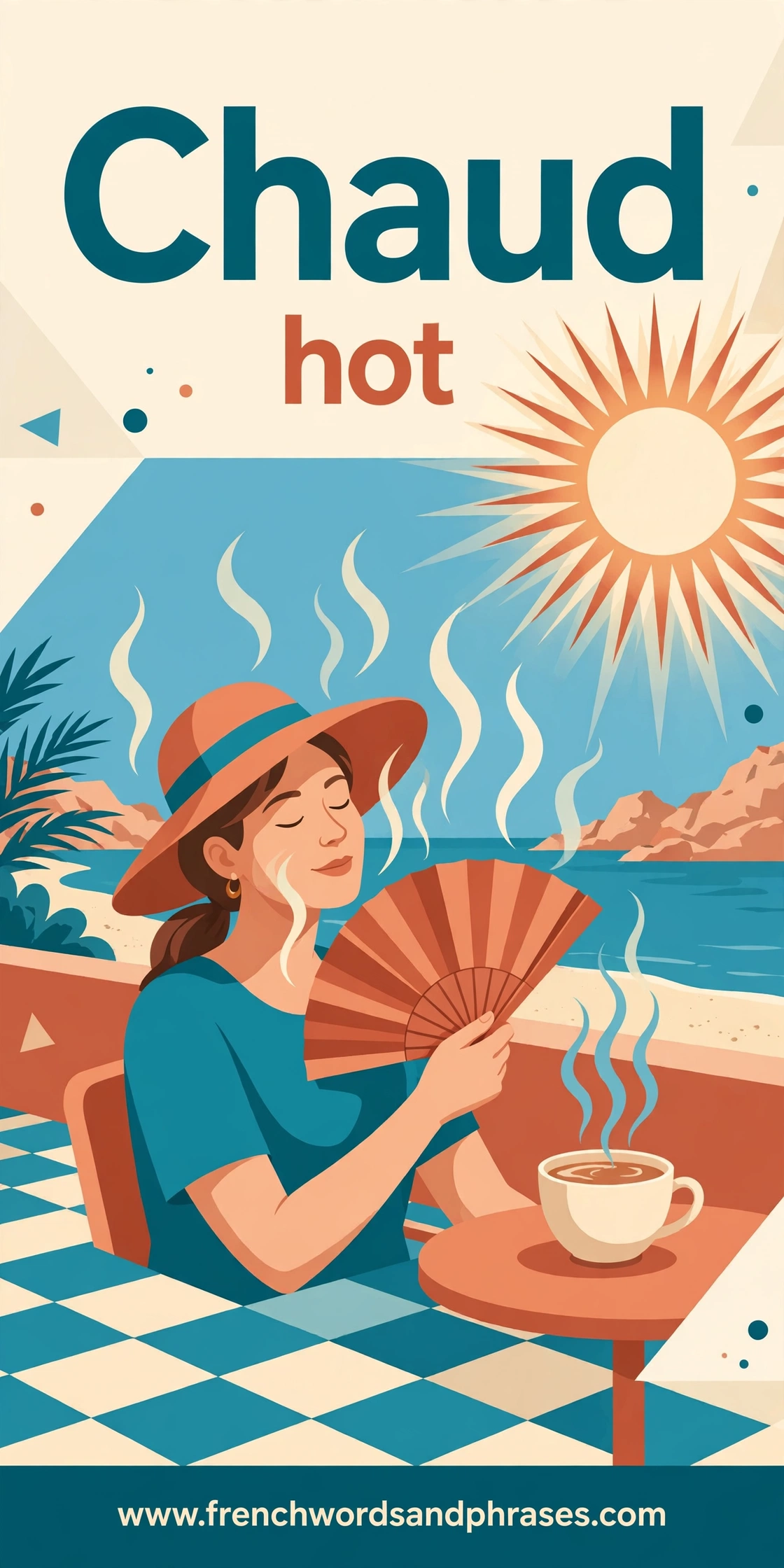
Chaud means hot.
A bowl of soup steaming on a winter table, a beach in August, a cup of tea you must blow on before the first sip. « Attention, c’est chaud ! » — careful, it’s hot! Chaud is the adjective of heat you can feel: weather, food, water and hands all take it.
In this guide, you’ll learn what chaud means in English, how its feminine chaude is formed, where it stands in the sentence, and how it differs from its cold opposite froid. Explore French examples, English translations, and practice quizzes.
Understanding the French Adjective Chaud
Chaud is a French adjective of temperature. It describes anything that gives off heat or feels warm to the touch: un plat chaud, a hot dish; un pays chaud, a hot country; des mains chaudes, warm hands. Its feminine adds a final -e and sounds the d: chaude. Its noun partner is la chaleur, the heat itself.
It means hot — and, for people and welcomes, warm: un accueil chaud, a warm welcome; une voix chaude, a warm voice. For weather French often lets the verb faire carry it: il fait chaud, it is hot (weather). For things you touch, être is the carrier: le café est chaud, the coffee is hot. Its opposite is froid, cold, and between the two sits tiède, lukewarm.
Type: Adjective — temperature and warmth
Answers the question: Comment est-ce ? — How is it? (Answer: hot to the touch or the air)
Changes form: chaud → chaude in the feminine; chauds / chaudes in the plural
English equivalents: Hot; warm (of a welcome, a voice, hands).
One important usage detail: for the weather, French says il fait chaud — never ‘il est chaud’ for the day itself. Save être chaud for things and people: la soupe est chaude, the soup is hot; and be careful with people — il est chaud can sound eager or keen in slang, while avoir chaud is how a person feels hot: j’ai chaud, I am (feeling) hot.
Experience the Word
Chaud is the adjective of the stove and the summer — heat that reaches the skin.
Imagine the first morning of a heatwave in Provence: the shutters are already closed at nine, the stones of the terrace burn through sandals, and the old men at the café say only one thing: « Il fait chaud. »
You have not just taken a temperature. You have felt the day on your skin.
How to Use Chaud in French: Complete Guide
Let’s explore how chaud works in French, beginning with the whole word on one card.
Chaud at a Glance
Before the details, here is the whole word on one card.
The Whole Word on One Card
Meaning, type, position and forms — chaud in four lines.
| Point | Chaud |
|---|---|
| Meaning | hot — of things, weather, and warm welcomes |
| Type | adjective of temperature |
| Usual position | after the noun — un café chaud |
| Form | chaud / chaude; plural chauds / chaudes |
Example
Un café chaud, s’il vous plaît.
A hot coffee, please.
The Four Forms of Chaud
The feminine adds -e and wakes the silent d: chaud is said ‘sho’, chaude is said ‘shod’.
| Form | Chaud | Example |
|---|---|---|
| Masculine singular | chaud | un thé chaud — a hot tea |
| Feminine singular | chaude | une soupe chaude — a hot soup |
| Masculine plural | chauds | des plats chauds — hot dishes |
| Feminine plural | chaudes | des journées chaudes — hot days |
Example
Des boissons chaudes sont servies à bord.
Hot drinks are served on board.
Quick Quiz 1
What is the feminine of chaud?
Reveal the answer
chaude
Une soupe chaude — the added -e makes the d sound.
A hot soup.
The Feminine of Chaud: Chaude
Chaud belongs to the family of adjectives whose final consonant sleeps in the masculine and wakes in the feminine.
| Situation | Example |
|---|---|
| Masculine | un four chaud — a hot oven |
| Feminine | une poêle chaude — a hot pan |
| Why | the written d is silent in chaud, sounded in chaude |
| The plural | des fours chauds, des poêles chaudes |
Example
Attention, la poêle est encore chaude.
Careful, the pan is still hot.
Where Chaud Goes: After the Noun
Chaud follows the noun it describes, and for weather it travels with the verb faire.
| Pattern | Example |
|---|---|
| After the noun | un bain chaud — a hot bath |
| After être | l’eau est chaude — the water is hot |
| Weather with faire | il fait chaud — it is hot (weather) |
| A person feeling hot | j’ai chaud — I feel hot (avoir, not être) |
Example
Aujourd’hui, il fait très chaud.
Today it is very hot.
Quick Quiz 2
How do you say ‘it is hot today’ (weather) — il est chaud or il fait chaud?
Reveal the answer
il fait chaud
Weather in French is made with faire: il fait chaud, il fait froid.
It is hot.
More Chaud: Comparing with Chaud
Chaud compares the regular way, with plus, moins and aussi.
| Degree | Example |
|---|---|
| As hot as | aussi chaud que — aussi chaud qu’hier |
| Hotter | plus chaud — plus chaud que prévu |
| Less hot | moins chaud — moins chaud que le café |
| The hottest (masc.) | le plus chaud — le jour le plus chaud de l’année |
| The hottest (fem.) | la plus chaude — la soupe la plus chaude |
Example
C’est le mois le plus chaud de l’année.
It is the hottest month of the year.
Everyday Expressions with Chaud
Chaud warms the kitchen, the weather report and the welcome.
| Expression | In English |
|---|---|
| il fait chaud | it is hot (weather) |
| avoir chaud | to feel hot (a person) |
| un plat chaud | a hot dish |
| un accueil chaud | a warm welcome |
| chaud devant ! | hot stuff coming through! (a waiter’s warning) |
| tenir chaud | to keep (someone) warm |
Example
Ce pull me tient chaud tout l’hiver.
This sweater keeps me warm all winter.
Quick Quiz 3
What does j’ai chaud mean?
Reveal the answer
I feel hot — a person’s heat is carried by avoir.
J’ai chaud, ouvre la fenêtre.
I’m hot, open the window.
Chaud and Its Neighbours
The temperature shelf, from the stove to the freezer.
| French | In English |
|---|---|
| chaud | hot |
| tiède | lukewarm, tepid |
| frais | cool, fresh |
| froid | cold — the opposite |
| brûlant | burning hot, scalding |
| la chaleur | the heat — the noun |
Example
Ni chaud ni froid : le café est tiède.
Neither hot nor cold: the coffee is lukewarm.
Watch Out: The Traps Around Chaud
The traps: weather with être, people with être, and the silent d.
| Trap | The truth |
|---|---|
| saying ‘il est chaud’ for the weather | weather takes faire: il fait chaud |
| saying ‘je suis chaud’ for feeling hot | a person feels hot with avoir: j’ai chaud — je suis chaud sounds keen or eager |
| dropping the d in the feminine | the feminine is chaude, and the d is sounded |
| confusing chaud and chaleur | chaud is the adjective; la chaleur is the noun, the heat |
Example
Avec cette chaleur, tout le monde a chaud.
In this heat, everyone feels hot.
Quick Quiz 4
How do you say ‘a warm welcome’?
Reveal the answer
un accueil chaud
Ils nous ont fait un accueil chaud.
They gave us a warm welcome.
Chaud in Everyday French: Real-Life Examples
Now that you know the word, let’s see how chaud appears in everyday French.
Example 1 — Weather
Il fait chaud aujourd’hui, mets un chapeau.
It is hot today, wear a hat.
Example 2 — In the kitchen
La soupe est chaude, on peut manger.
The soup is hot, we can eat.
Example 3 — At the café
Je voudrais un chocolat chaud.
I would like a hot chocolate.
Example 4 — Feeling hot
Tu as chaud ? Ouvre la fenêtre.
Are you hot? Open the window.
Example 5 — A warning
Attention, le plat est très chaud !
Careful, the dish is very hot!
Example 6 — A welcome
Merci pour votre accueil chaud et généreux.
Thank you for your warm and generous welcome.
Beyond Translation: The Meaning of Chaud
Chaud is one of the first adjectives a learner meets and one of the last they fully master, because French distributes heat among three verbs: faire for the sky, être for the thing, avoir for the body. Il fait chaud, le thé est chaud, j’ai chaud — one heat, three carriers.
Heat in French is always somebody’s heat.
And when the word leaves the thermometer it turns generous: une voix chaude, un accueil chaud, des couleurs chaudes — warmth as kindness, in sound and in paint.
How to Remember the French Adjective Chaud
Remember it this way: Chaud is hot — feminine chaude with the d sounded, weather with faire, and a person’s heat with avoir.
- You touch it with être — la soupe est chaude, the soup is hot.
- You weather it with faire — il fait chaud, it is hot today.
- You feel it with avoir — j’ai chaud, I feel hot.
The key idea is chaud means hot; feminine chaude; il fait chaud for weather, j’ai chaud for people.
Test Your Knowledge of Chaud
Let’s see how much you’ve learned. Try answering these questions before revealing the answers.
Question 1
What does chaud mean?
Reveal the answer
Hot — and warm, of welcomes and voices.
Question 2
What is the feminine of chaud?
Reveal the answer
Chaude — une soupe chaude, with the d sounded.
Question 3
Translate: It is hot today.
Reveal the answer
Il fait chaud aujourd’hui.
Question 4
What is the opposite of chaud?
Reveal the answer
Froid — cold; between them sits tiède, lukewarm.
Question 5
Complete the sentence:
Les journées sont ______ en août. (hot, feminine plural)
Reveal the answer
chaudes
Les journées sont chaudes en août.
The days are hot in August.
Your Final Challenge
Can You Use It?
How would you say this in French?
“It is hot today, wear a hat.”
Reveal the answer
Il fait chaud aujourd’hui, mets un chapeau.
It is hot today, wear a hat.
A little French. A little curiosity. A richer everyday life.
LEARN FRENCH ONE WORD AT A TIME